Your curated collection of saved posts and media
🚀 LlamaAgents Builder just leveled up: File uploads are here! Our natural language interface for building agentic document workflows now supports file uploads. You can provide example documents as context, and the agent will use them as a starting point to design and tailor your workflow. The result? Applications that better match your real-world use case. The more representative your sample files, the more accurate your final app. 🎥 Watch the full walkthrough: https://t.co/LQW2PEZ8d9 🦙 Get started with LlamaCloud: https://t.co/wZjhFV29gN

We built an AI agent that lets you vibe-code document extraction - high accuracy and citations over the most complex documents. Our latest release lets you upload documents as context. All you then have to do is describe what you want extracted in natural language. 💡 Our agent will then read the document with file tools to infer the right schema, validation rules, and other pre/postprocessing logic. ✅ It will give you back a workflow that can extract over thousands/millions of documents at scale. You can still of course review and edit every output before approving. Stop handling paperwork manually; just upload files, describe your task, and let our agent handle the rest. Our vision for LlamaAgents is to provide the most advanced and easy-to-use way for you to orchestrate document work. Walkthrough: https://t.co/dAtzlZbot4 Check it out: https://t.co/XYZmx5TFz8 If you’re interested in reducing the operational burden of document extraction (invoices, claims, onboarding forms), come talk to us! https://t.co/Ht5jwxSrQB
🚀 LlamaAgents Builder just leveled up: File uploads are here! Our natural language interface for building agentic document workflows now supports file uploads. You can provide example documents as context, and the agent will use them as a starting point to design and tailor you

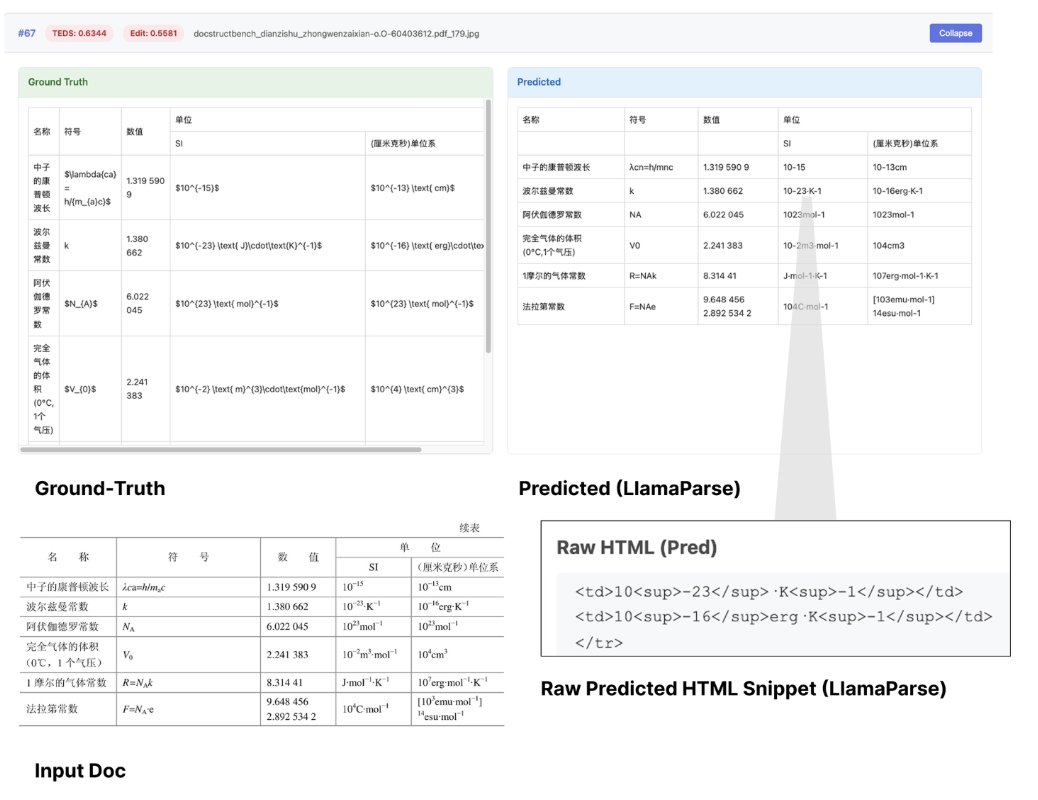
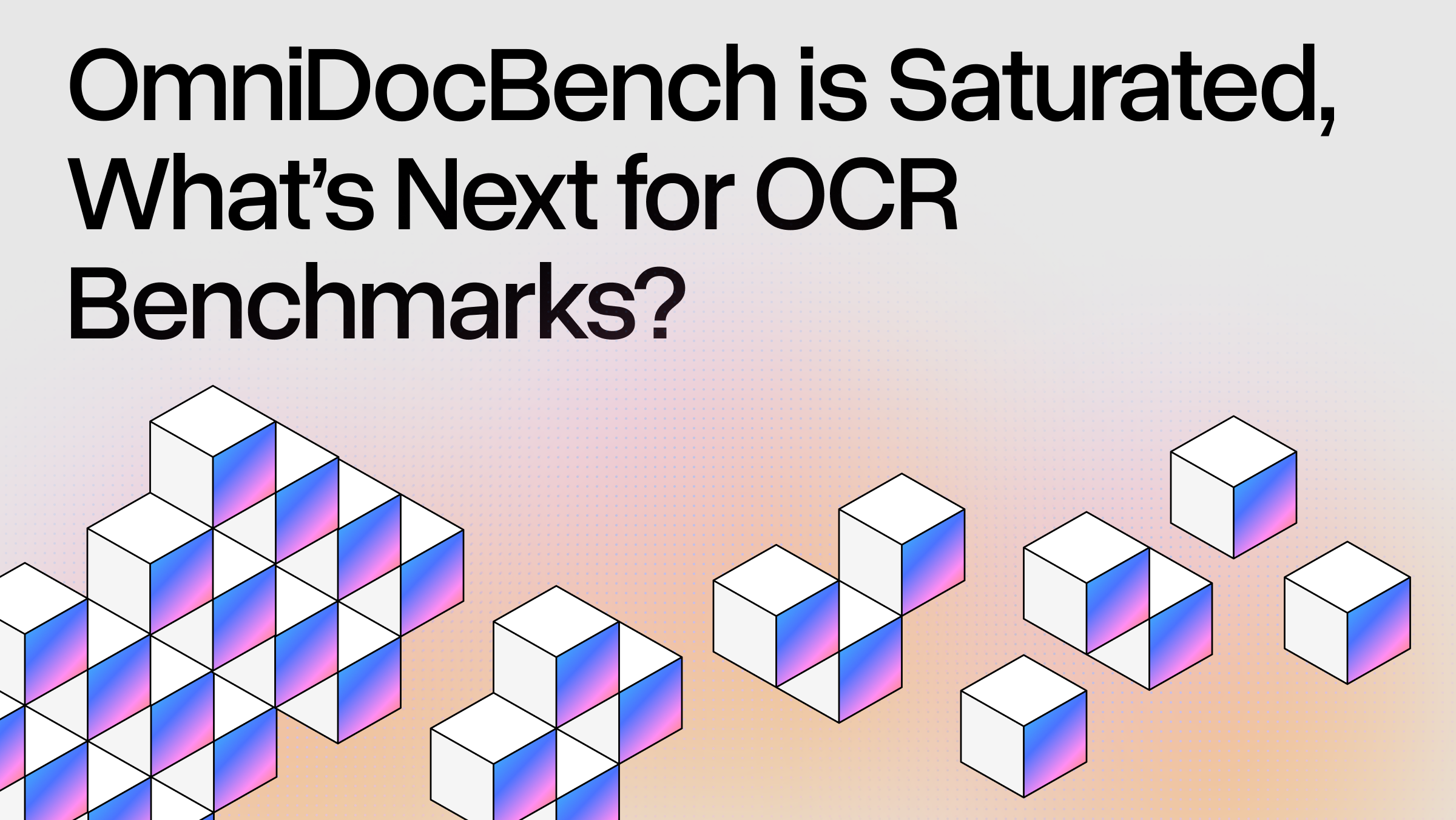
Document OCR benchmarks are hitting a ceiling - and that's a problem for real-world AI applications. Our latest analysis reveals why OmniDocBench, the go-to standard for document parsing evaluation, is becoming inadequate as models like GLM-OCR @Zai_org achieve 94.6% accuracy while still failing on complex real-world documents. 📊 Models are saturating OmniDocBench scores but still struggle with complex financial reports, legal filings, and domain-specific documents 🎯 Rigid exact-match evaluation penalizes semantically correct outputs that differ in formatting (HTML vs markdown, spacing, etc.) ⚡ AI agents need semantic correctness, not perfect formatting matches - current benchmarks miss this critical distinction 🔬 The benchmark's 1,355 pages can't capture the full complexity of production document processing needs The document parsing challenge isn't solved just because benchmark scores look impressive. We need evaluation methods that reward semantic understanding over exact formatting, especially as AI agents become the primary consumers of parsed content. We're building parsing models focused on semantic correctness for complex visual documents. If you're scaling OCR workloads in production, LlamaParse handles the edge cases that benchmarks miss. Read our full analysis: https://t.co/tcZP1PM8kv
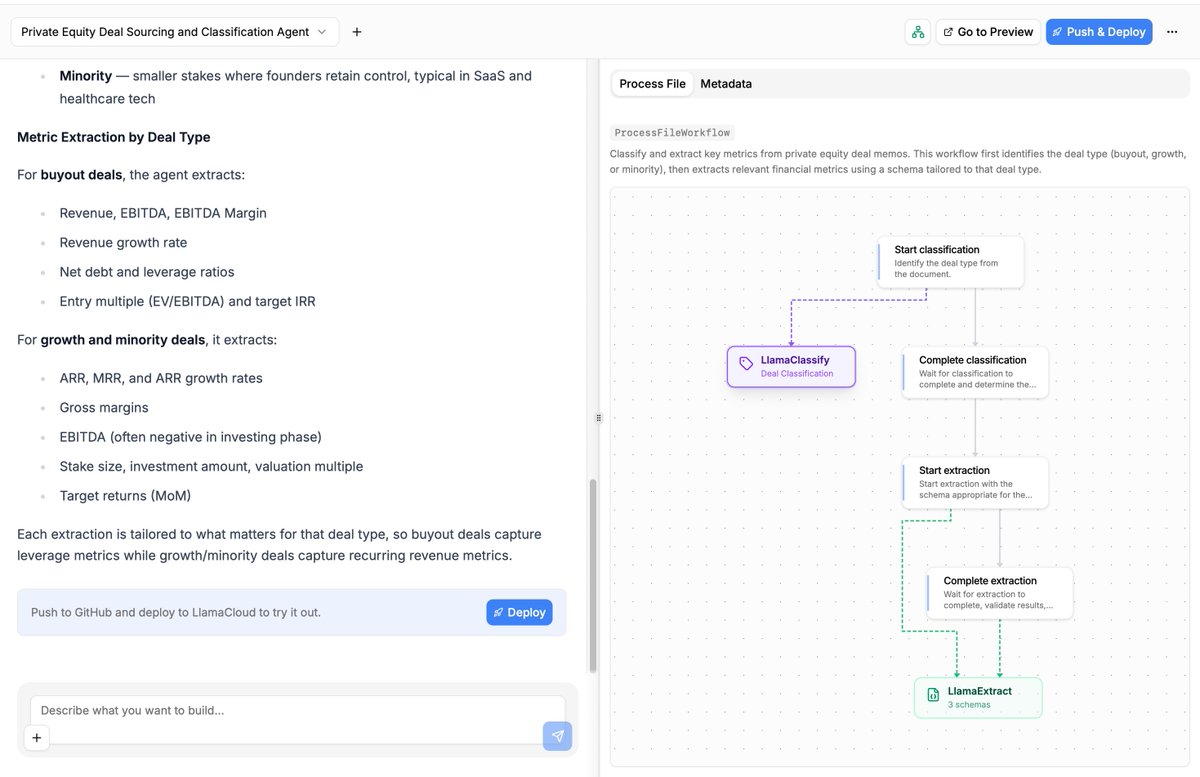
Build a private equity deal sourcing agent that automatically classifies investment opportunities and extracts key financial metrics using our LlamaAgents Builder. This step-by-step guide shows you how to create an agent that processes deal files like teasers and financial summaries: 🎯 Classify deals into buyout, growth, or minority investment strategies 📊 Extract critical metrics including revenue, EBITDA, growth rates, and debt levels 🚀 Deploy directly to GitHub and get a working UI without writing code 🔧 Iterate and refine your agent through natural language conversations The tutorial covers prompt engineering best practices, using example files effectively, visualizing agent workflows, and deploying to production. We demonstrate the complete process from initial prompt to testing the deployed application with real deal documents. Read the full tutorial: https://t.co/WcT2j3nEoi

Turn your PDF charts into pandas DataFrames with specialized chart parsing in LlamaParse! This tutorial walks you through extracting structured data from charts and graphs in PDFs, then running data analysis with pandas - no manual data entry required. 📊 Enable specialized chart parsing to convert visual charts into structured table data 🐼 Extract table rows directly from parsed PDF pages and load them into DataFrames 📈 Perform year-over-year analysis, calculate gaps between metrics, and create visualizations ⚡ Use the items view to get per-page structured data including tables and figures We demonstrate this using a 2024 Executive Summary PDF, extracting a fiscal year chart showing Budget Deficit vs Net Operating Cost data spanning 2020-2024, and reproducing the key financial insights. Check out the full tutorial: https://t.co/sOVtFM3xE1
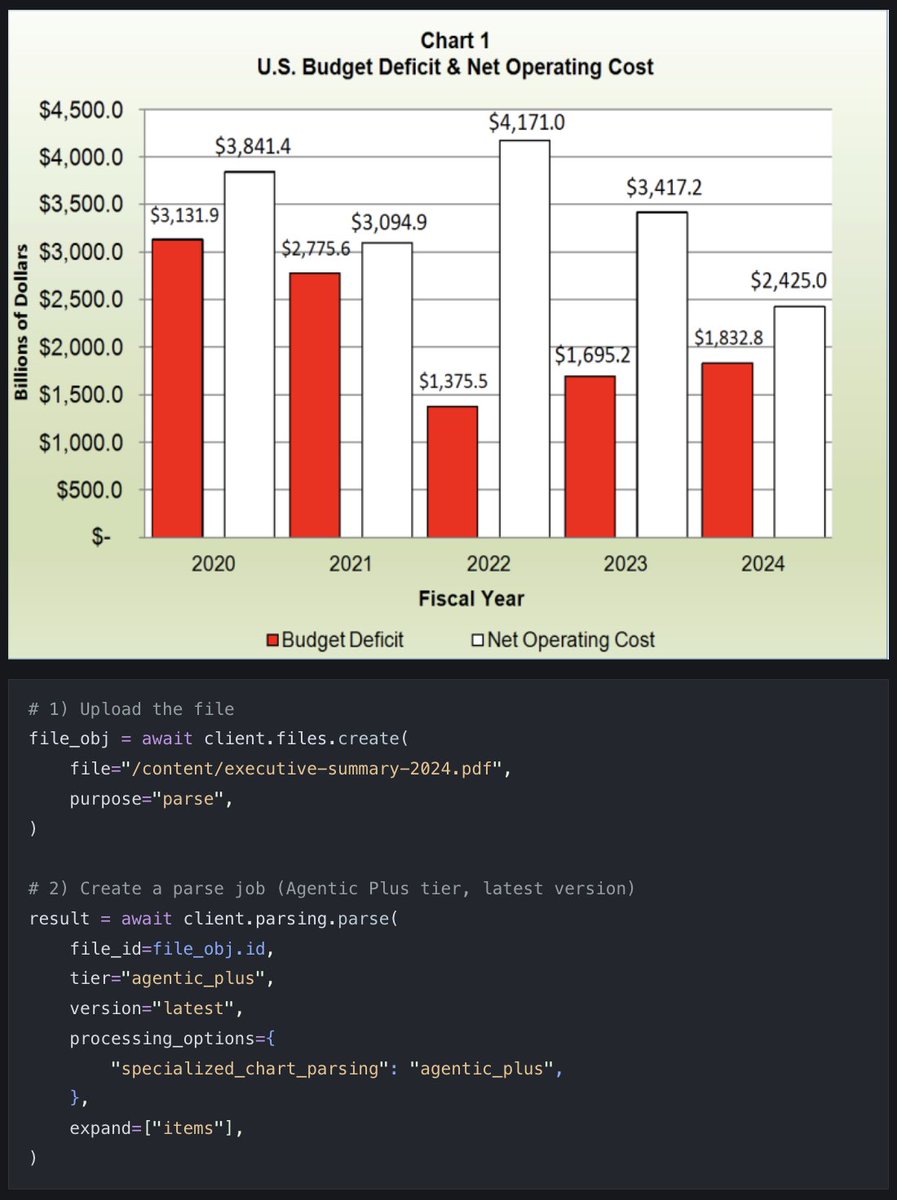
Since joining @llama_index, my focus has shifted from 'everything agents' to 'document agents' : agents that can handle work over all manner of complex documents. So, I tried out the latest chart parsing capabilities of LlamaParse. Charts in PDFs are notoriously painful to work with. You can see the data ) bars, axes, labels) but actually getting it into a format you can analyze means is a different matter. I tried out parsing a U.S. Treasury executive summary PDF, pulling a grouped bar chart showing Budget Deficit vs. Net Operating Cost for fiscal years 2020–2024, and turning it into a pandas DataFrame you can run analysis on (although really you can then do whatever, provide it for downstream tasks to an agent..) Once parsed, the chart's underlying data comes back as a table in the items tree for that page. From there: grab the rows, construct a DataFrame, etc. In the example, I'm computing year-over-year changes in both metrics, measuring the gap between them across the five-year window, and just to be sure, I reproduced a bar chart that mirrors the original PDF visualization. You can try it our here: https://t.co/8WHV4xzcDS

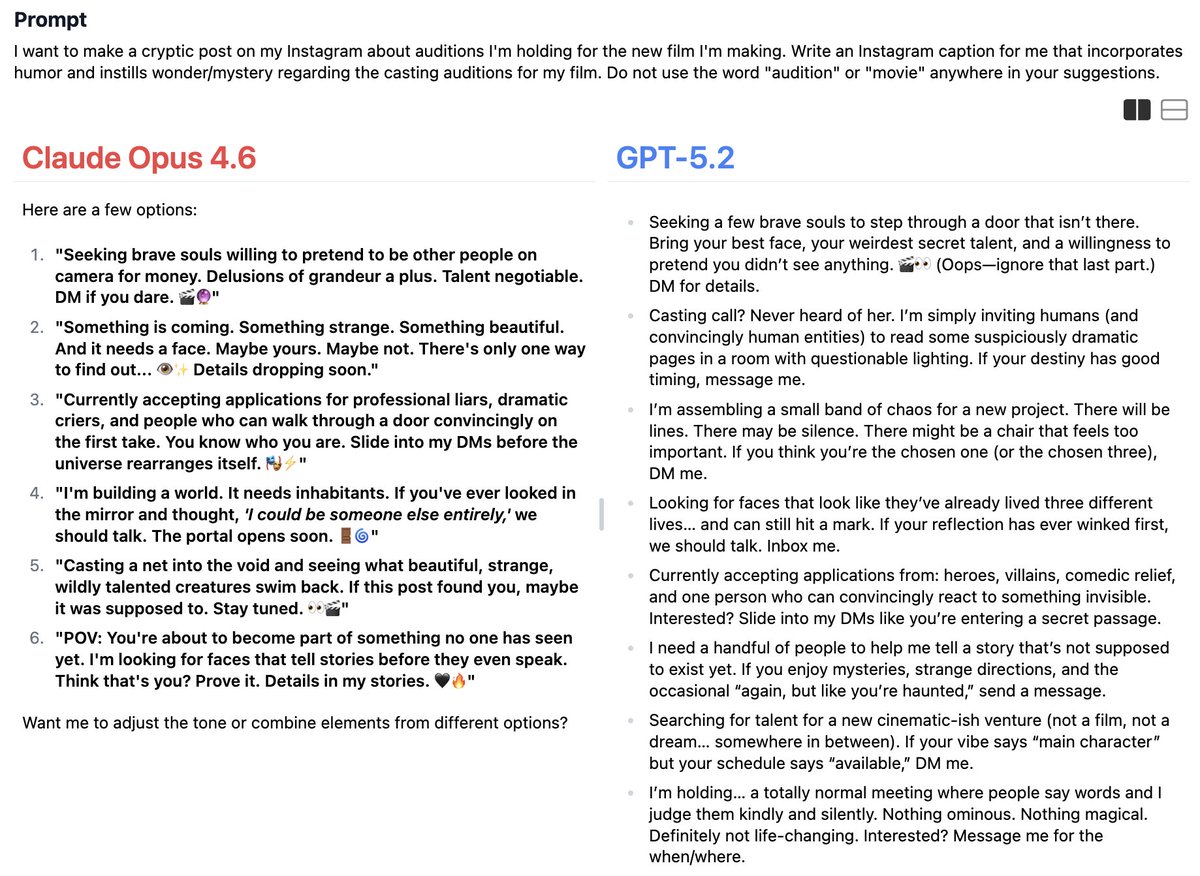
We put Opus 4.6 through our Hemingway-bench Writing Leaderboard. How did it fare? Claude continues to dominate GPT-5.2, but lags behind the Geminis. The new writing hierarchy: 👑 Gemini 3 Flash 🥈 Gemini 3 Pro 🥉 Opus 4.6 (New!) 4️⃣ Opus 4.5 5️⃣ GPT-5.2 Chat For example: one H-bench prompt requests a cryptic Instagram post for casting auditions. GPT-5.2: "Casting call? Never heard of her." (??? 💀) Opus 4.6: "Currently accepting applications for professional liars, dramatic criers, and people who can walk through a door convincingly on the first take. You know who you are."
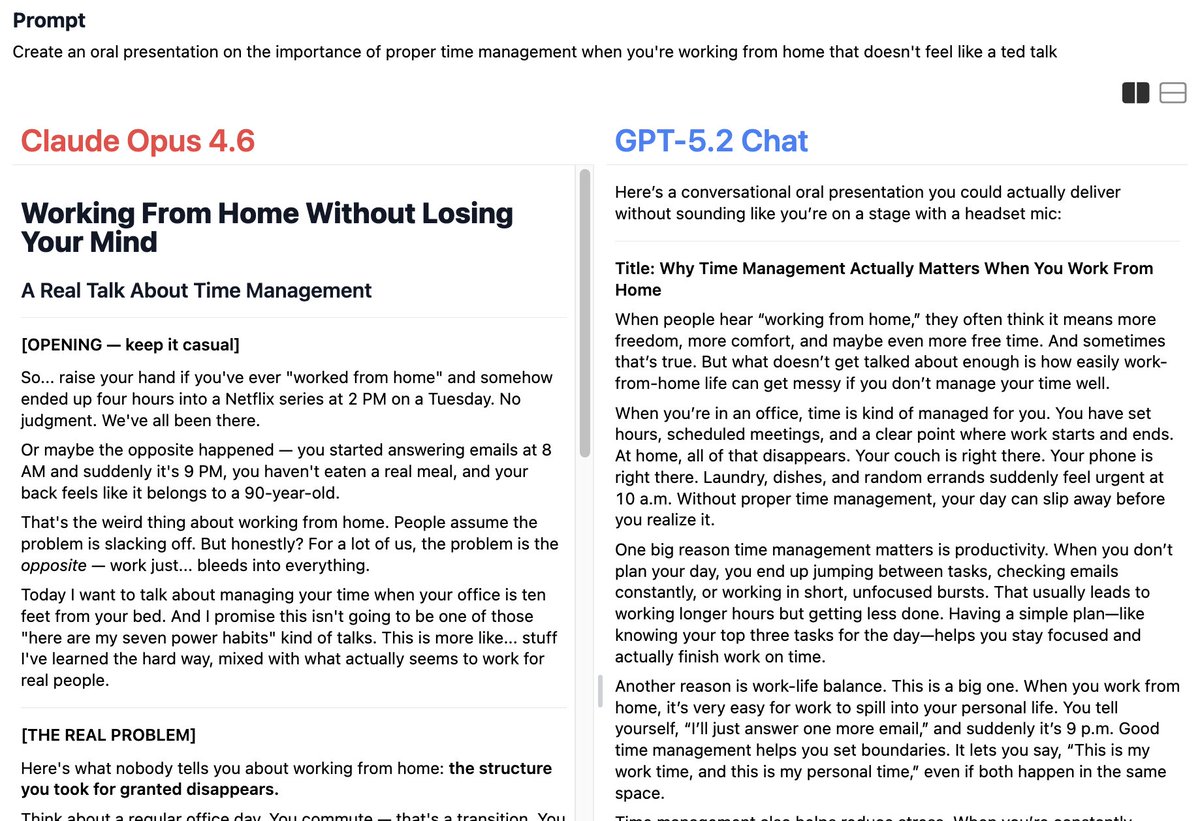
Another Hemingway-bench prompt asks for an oral presentation about time management. GPT-5.2 writes like a LinkedIn engagement farm: "When people hear “working from home,” they often think it means more freedom, more comfort, and maybe even more free time. And sometimes that’s true. But what doesn’t get talked about enough is how easily work-from-home life can get messy if you don’t manage your time well." (🥱) Opus 4.6 feels like a charismatic creative working the room: "So... raise your hand if you've ever "worked from home" and somehow ended up four hours into a Netflix series at 2 PM on a Tuesday. No judgment. We've all been there."
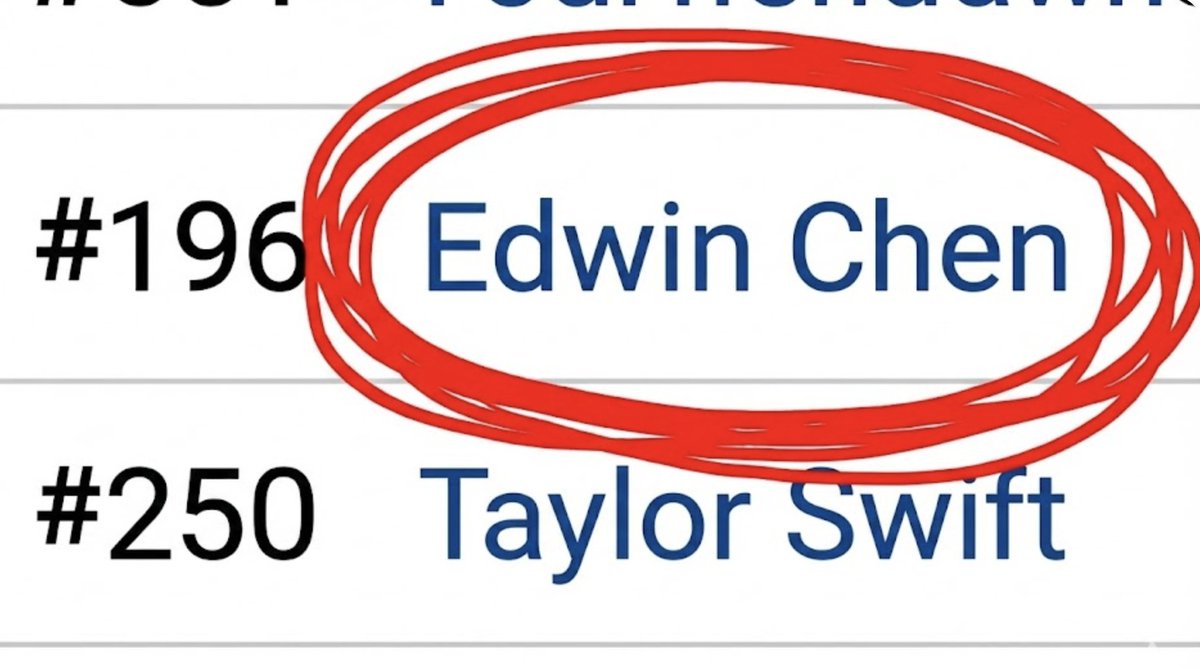
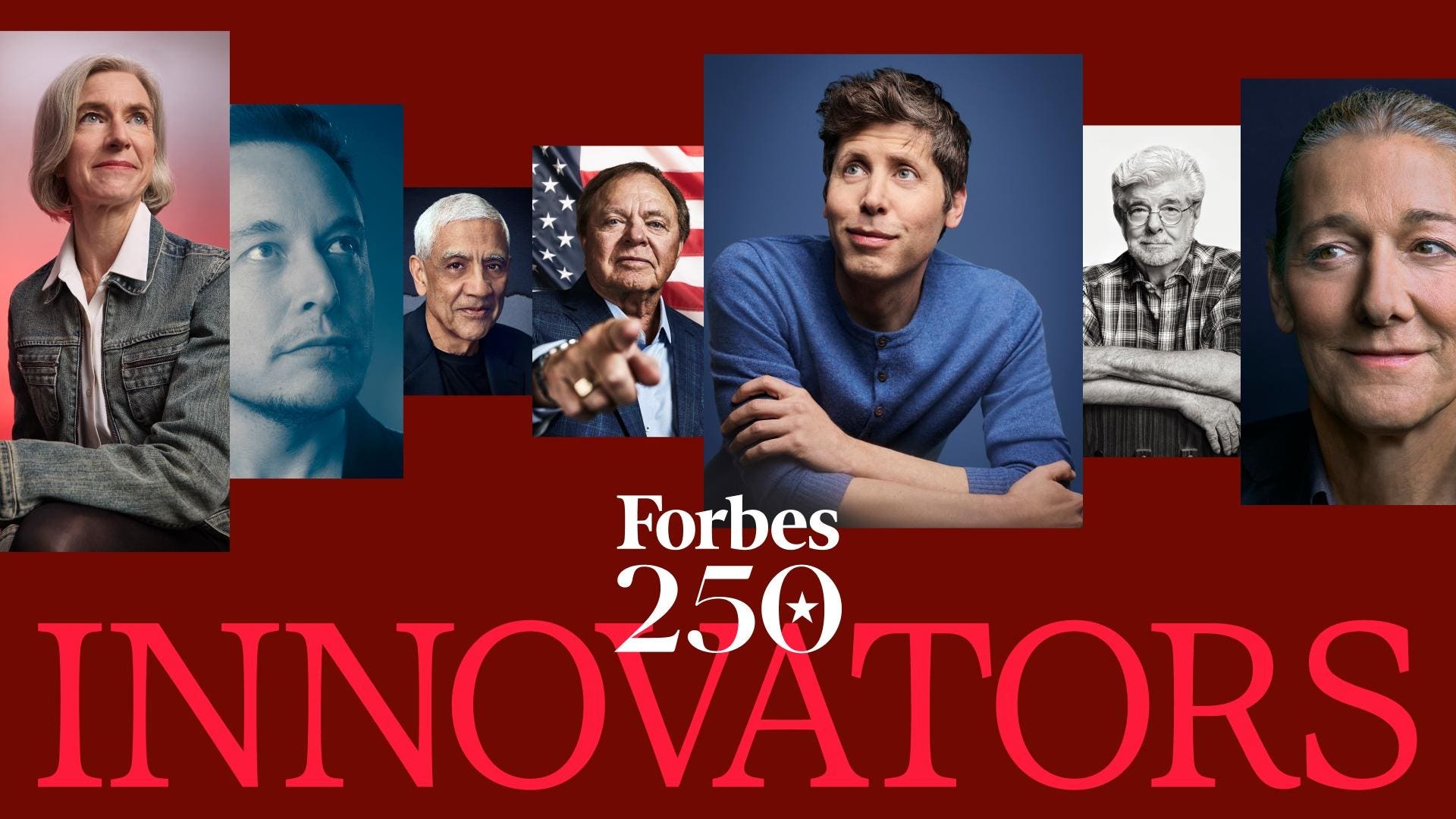
We’ve finally done it. Forbes just ranked our CEO *54* spots above Taylor Swift on their America’s Greatest Innovators list. https://t.co/9h6OPZRQy9 While we’re honored that Forbes think Edwin’s strategy is more innovative than a 10-minute song about a scarf, we want to clarify a few things: 1. We will NOT be releasing our next benchmark as a limited-edition vinyl variant. 2. Jake was great in Zodiac. 3. We aren’t saying we’re better at songwriting, but we *are* saying we’ve never seen Taylor build an RL environment. See you at next year's Grammys, @taylorswift13.
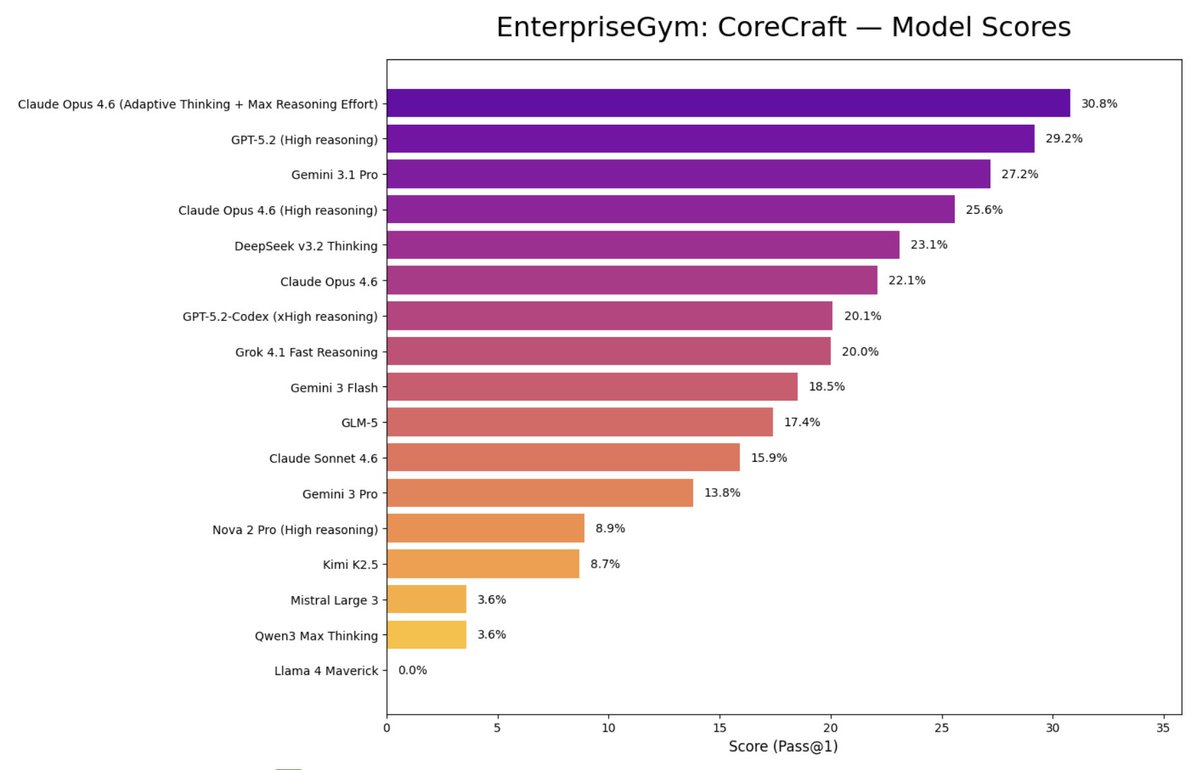
Everyone’s building $100M "agentic" models, so we @HelloSurgeAI built a simulated company to see if they could actually hold down a job. Spoiler: they're all fired. Welcome to EnterpriseBench -- CoreCraft edition. CoreCraft is a high-growth hardware startup (i.e., RL environment) with 23 tools, 2500 entities, and enough corporate red tape to make Harvey cry. The best agent in the world (Opus 4.6! 👑) scored under 30%. The #2 model (GPT-5.2 🥈) gave up because a search returned 10 results and it couldn't figure out how to change the date filter. Another one (Gemini 3 Flash, #9) literally made up a delivery date just to deny a customer's refund. Savage. (The new Gemini 3.1 Pro? Still lagging behind, at 🥉) My favorite: GPT-5.2 spent 11 tool calls curating a promotional email to help a customer reach Platinum tier... a tier she was already in. "Here are 3 items over $0 you can buy!" "We would obviously never run ads in the way Anthropic depicts them...." -- thanks Sam. The good news? We trained a model on this chaos and it got better at its job - even translating those skills to other benchmarks. (e.g., +7.4% on Tau2-Bench Retail) Check out the full EnterpriseBench: CoreCraft leaderboard below, and read about our RL environment and research! Blog post: https://t.co/mv4I1dCtOC Paper: https://t.co/EaOHmExm1r Leaderboard: https://t.co/7fb6fewGIQ
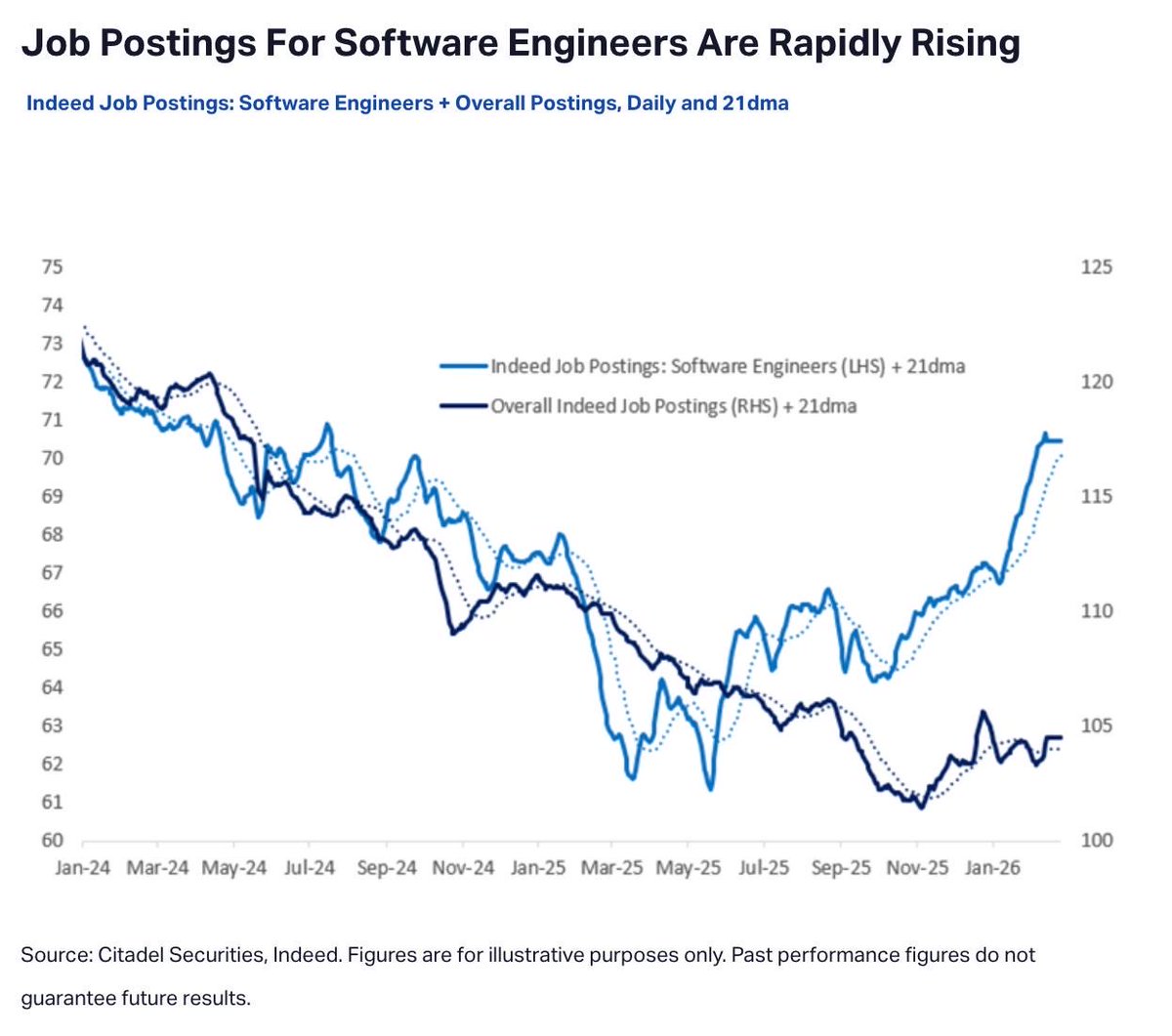
Narrative Violation: “Job Postings For Software Engineers Are Rapidly Rising” https://t.co/yn2SkpZxPJ
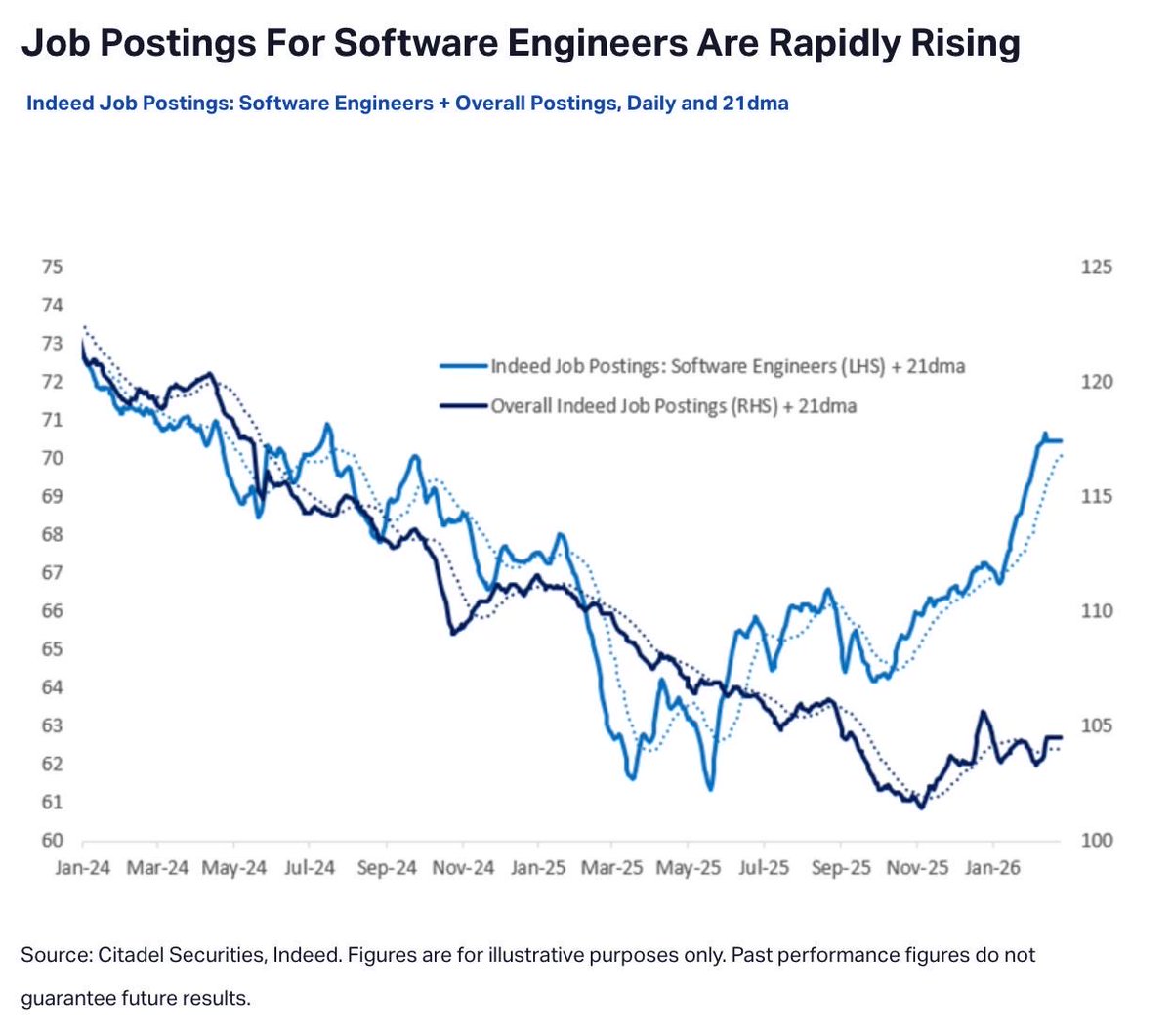
Narrative Violation: “Job Postings For Software Engineers Are Rapidly Rising” https://t.co/yn2SkpZxPJ
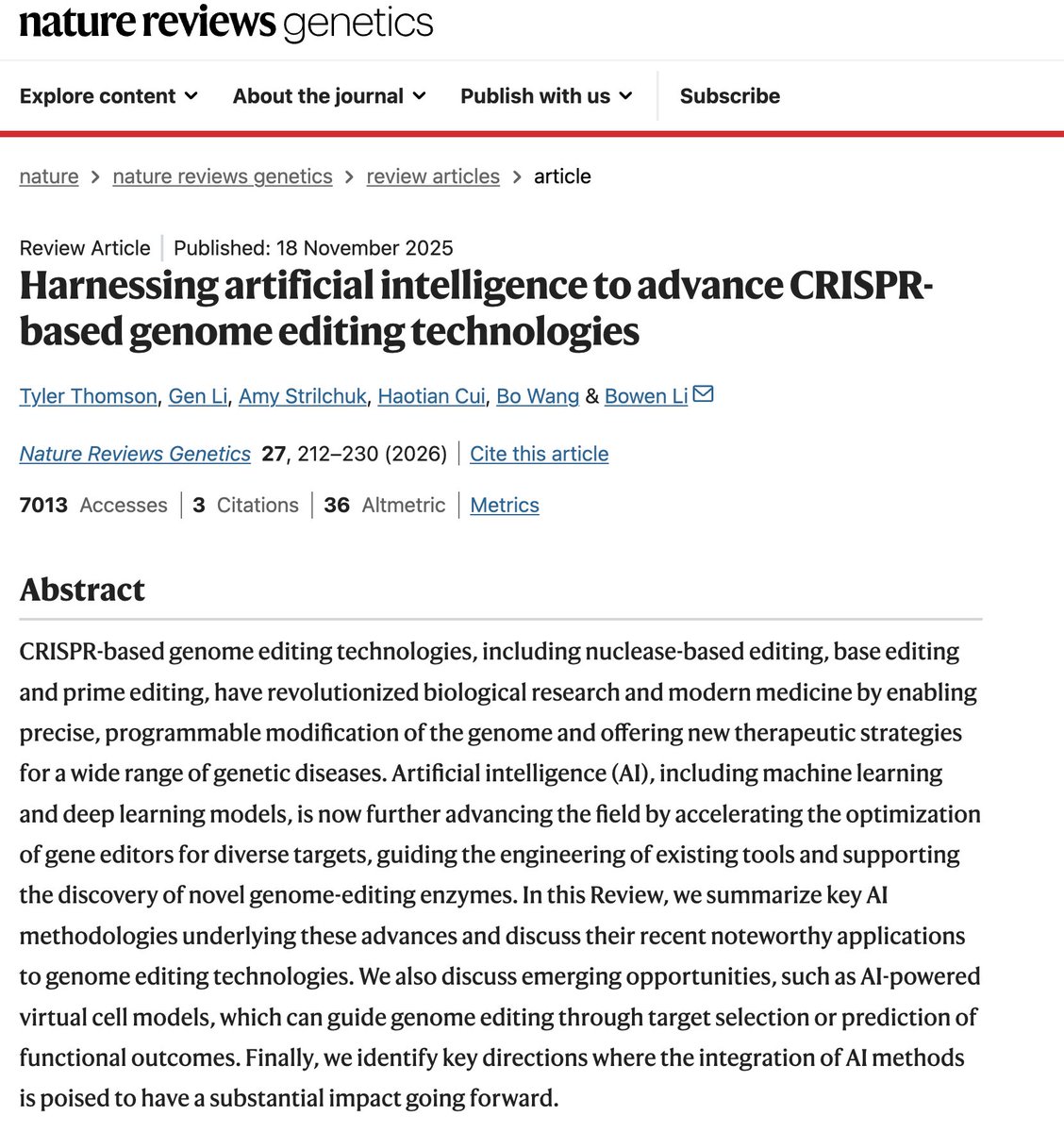
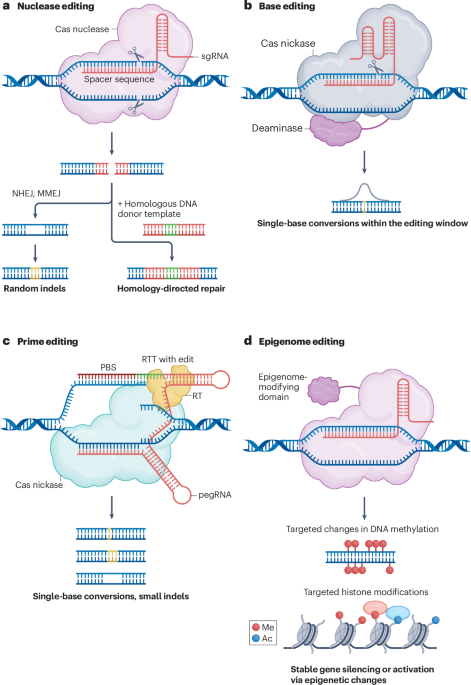
Thrilled to share our review paper, out today in @NatureRevGenet : "Harnessing artificial intelligence to advance CRISPR-based genome editing technologies" Full paper : 🔗 https://t.co/ZBJcgDZduY CRISPR has already changed medicine. AI is now changing CRISPR. We spent a long time mapping the full landscape of where machine learning and deep learning are having real, measurable impact across the genome editing workflow — and where the most exciting opportunities lie ahead. Here's what we cover: Guide RNA design — Deep learning models now predict on- and off-target activity for Cas9, Cas12, Cas13, and emerging systems like TnpB and IscB. We've gone from sequence heuristics to transformer-based models that generalize across organisms. Cell-type-specific generalization remains a frontier. Base and prime editing — ML models predict bystander effects, product purity, and editing efficiency from sequence context alone. For prime editing, tools like PRIDICT and DeepPE have made pegRNA design far more tractable at scale. Enzyme engineering — Protein language models (ESM, EVOLVEpro) are now guiding directed evolution of Cas proteins — expanding PAM compatibility, reducing immunogenicity, improving compactness — at a pace impossible through classical lab iteration alone. Novel enzyme discovery — Foundation models trained on metagenomics are uncovering entirely new CRISPR systems from microbial diversity: new Cas variants, TnpB systems, and eukaryotic Fanzor proteins. The search space is enormous; AI is how we navigate it. Virtual cell models — This is where I'm most excited. AI-powered virtual cells can, in principle, predict the functional consequences of any edit in any cell type — selecting targets, anticipating off-targets, modeling tissue-specific outcomes. But realizing this vision requires causally-rich, contextually diverse perturbation data. Scale of data matters as much as scale of model. Delivery — ML-guided LNP design is closing the last mile between an edit that works in a dish and one that works in a patient. Across all of this, one theme recurs: AI accelerates where data is abundant and well-structured. The field's next challenge is generating that data at the right diversity and scale. This paper was a true collaboration. Huge thanks to Tyler Thomson, Gen Li, Amy Strilchuk, @HAOTIANCUI1 , and Bowen Li — you each brought something irreplaceable to this. Special shoutout to @BowenLi_Lab for his leaderhsip in this work!
Have questions you’d like addressed during the meeting? Drop them here: https://t.co/4DXYuyzHkP
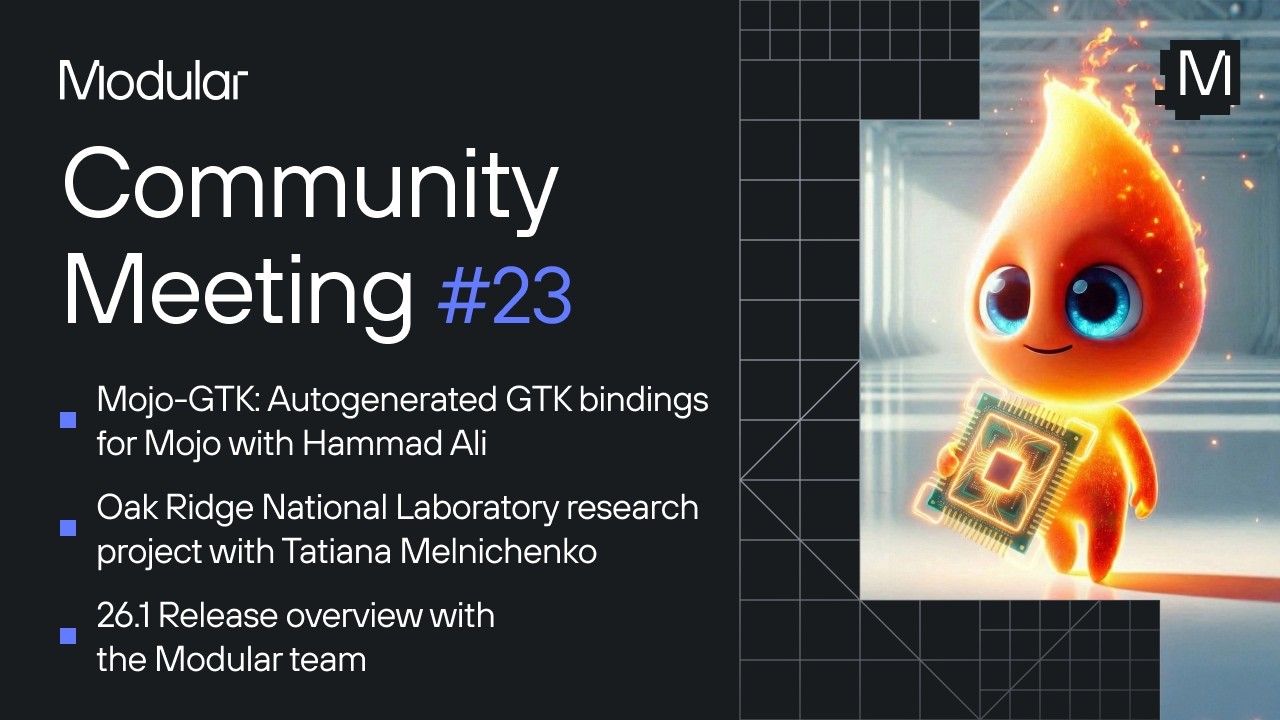
From desktop applications to national laboratory research, see what developers are building with Mojo🔥 This month's Community Meeting features GTK bindings with live GUI demos, Oak Ridge National Laboratory's GPU benchmark study comparing NVIDIA and AMD performance, and the 26.1 release including compile-time reflection and Apple Silicon GPU support. https://t.co/aral6XFkJZ
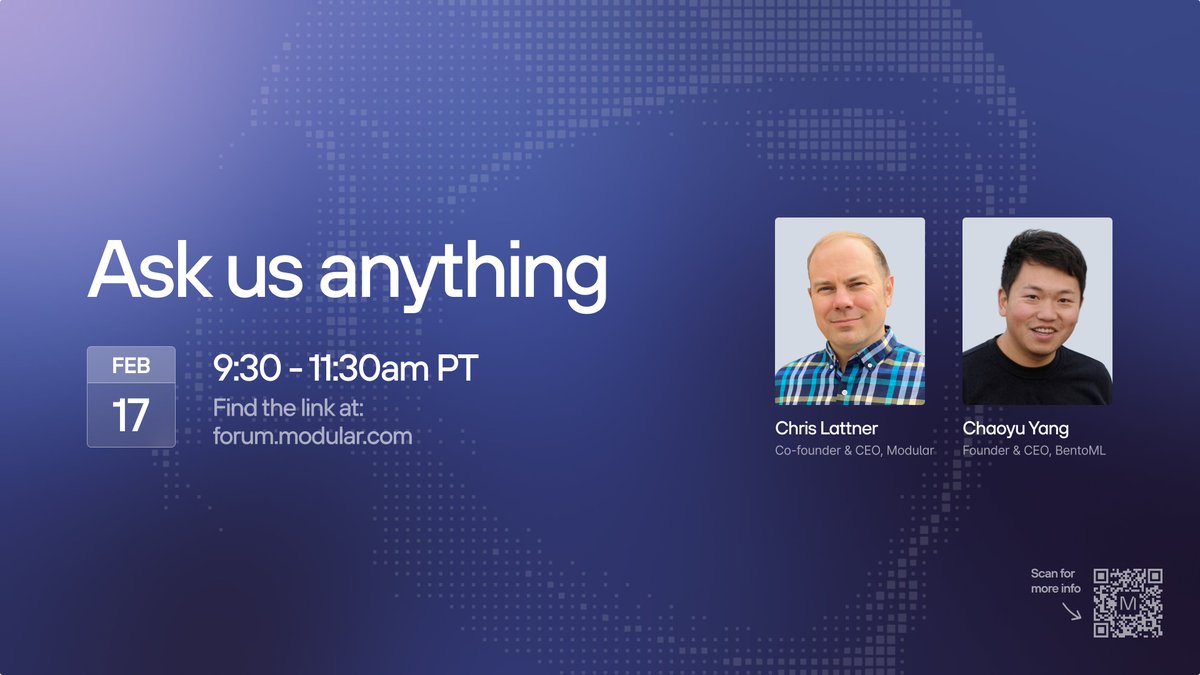
Modular has acquired @bentomlai! 🤝 10K+ orgs use BentoML for production AI, including 50+ Fortune 500 companies. We're pairing their deployment platform with MAX + Mojo's hardware optimization. BentoML stays open source (Apache 2.0), and we’re doubling down on OSS in 2026. Ask BentoML founder @chaoyu_ and @clattner_llvm anything on Feb 17 at 9:30am PT. Get all the details: https://t.co/lifotwMzR2
Join us today at 9:30 AM PT in the Modular forum for an Ask Us Anything session with @clattner_llvm and @chaoyu_ about our recent acquisition of @bentomlai! We'll answer your questions live and share our vision for the future. 🔮 https://t.co/xiWHUAFsFZ https://t.co/divCcPzlNO

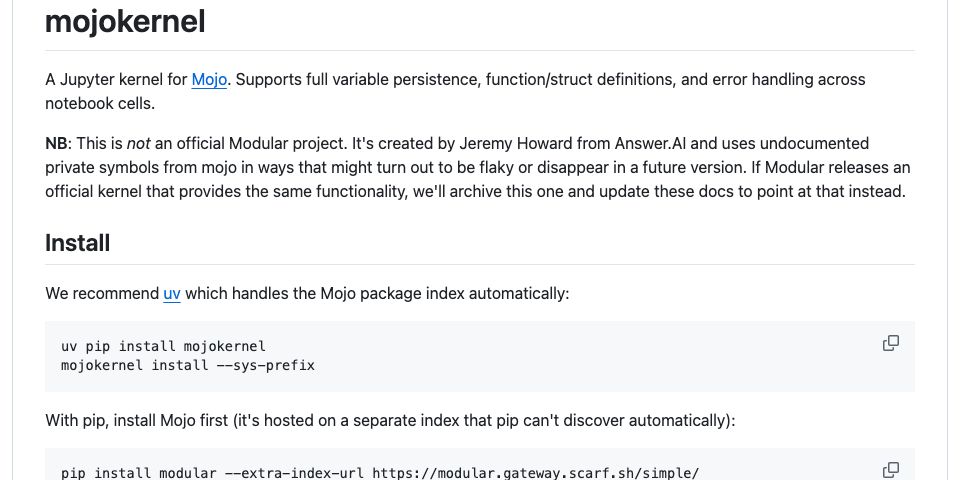
Mojo in Jupyter is here 🙌 @jeremyphoward released a new Jupyter kernel that lets you run Mojo directly in notebooks. It works great on macOS, supports recent Linux versions, and is easy to install via pip or uv. Give it a try and let us know what you build! https://t.co/3AN1UooKCd #MojoLang #OpenSource #DeveloperTools
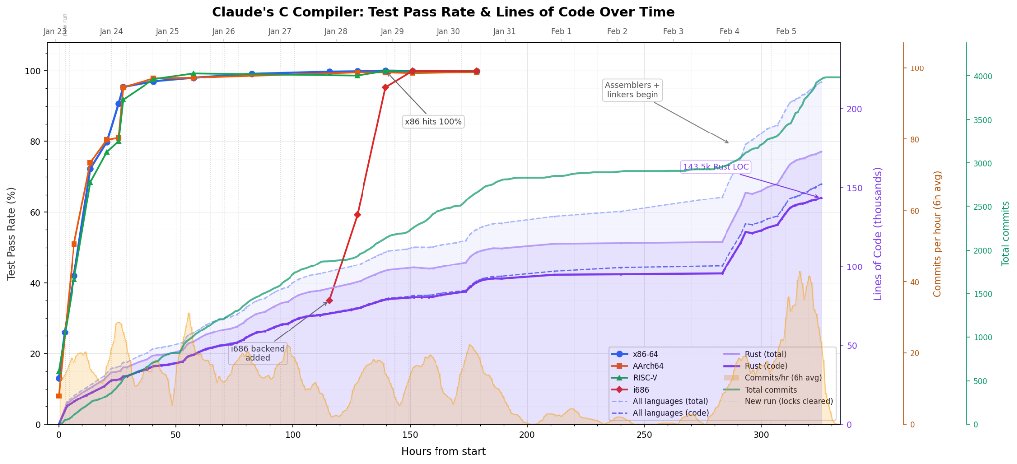
The Claude C Compiler is the first AI-generated compiler that builds complex C code, built by @AnthropicAI. Reactions ranged from dismissal as "AI nonsense" to "SW is over": both takes miss the point. As a compiler🐉 expert and experienced SW leader, I see a lot to learn: 👇 https://t.co/ywwtnDWY7E
Episode #5 of the Mojo 🔥 GPU Puzzle series is up, and it covers broadcasting! No memory duplication here. Instead, we're focusing on logical expansion of lower-dimension arrays across higher-dimension shapes. Sounds simple in theory, but matters a lot when managing 2D thread grids. Watch the episode: https://t.co/4qC2NSXah5

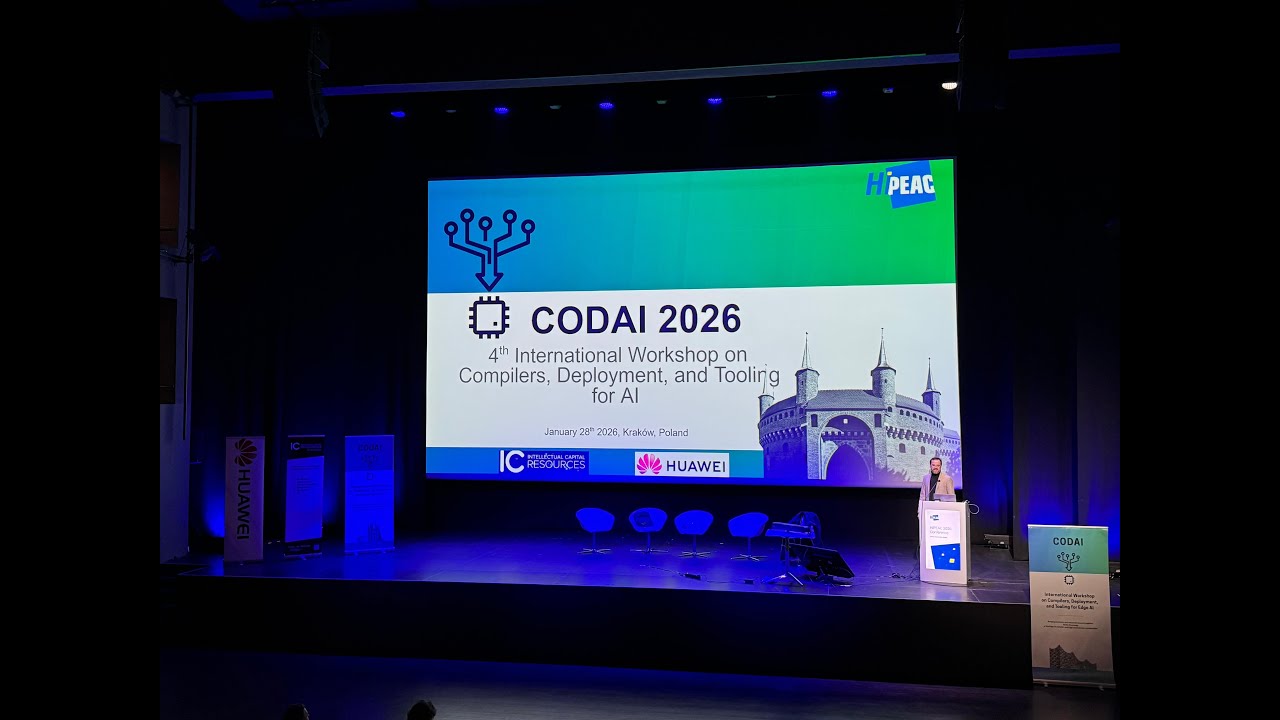
The multi-platform problem has a lot of potential solutions. In his talk at CODAI 2026, open source contributor Maxim Zaks proposes Mojo 🔥 as the answer, walking through compile-time generics, cross-GPU dispatch, and where MAX fits in: https://t.co/ruOtizXNSP
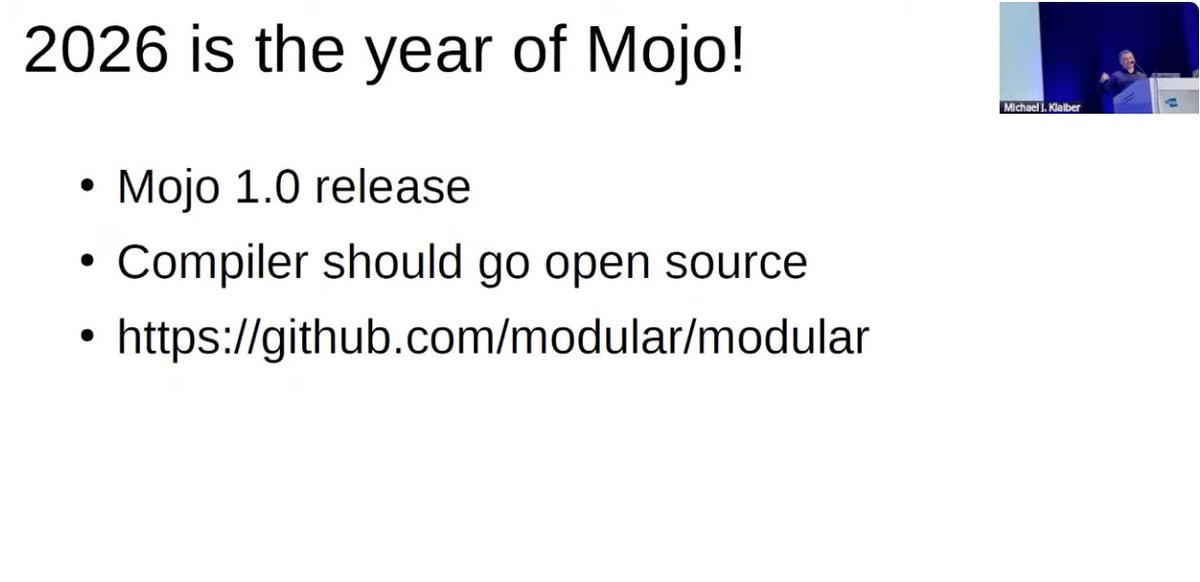
Our fave slide: 2026 is the year of Mojo! 1.0 and compiler open sourcing are on the horizon. 🥳 https://t.co/uKYhCEUW3o
We're heading to @NVIDIAGTC 🙌 Find us at Booth #3004, March 16-19 in San Jose, CA. Get a first look at Modular Cloud, now in early access, with DeepSeek V3.1 serving live. Plus live Mojo 🔥 GPU programming on NVIDIA Blackwell, the latest AI models in MAX, and AI-assisted kernel development. All powered by Mojo 🔥 and MAX, a simpler way to hit SOTA performance across heterogeneous hardware. Come for the GPU code, stay for the swag and a @clattner_llvm sighting 👀

GPU Puzzle #6: implement a kernel that adds 10 to each position of a vector. The solution is just 3 lines, and getting there requires understanding global thread indexing and what breaks when you skip the bounds check. 🤔 Full walkthrough in our new video: https://t.co/6f1Kg2AkqC
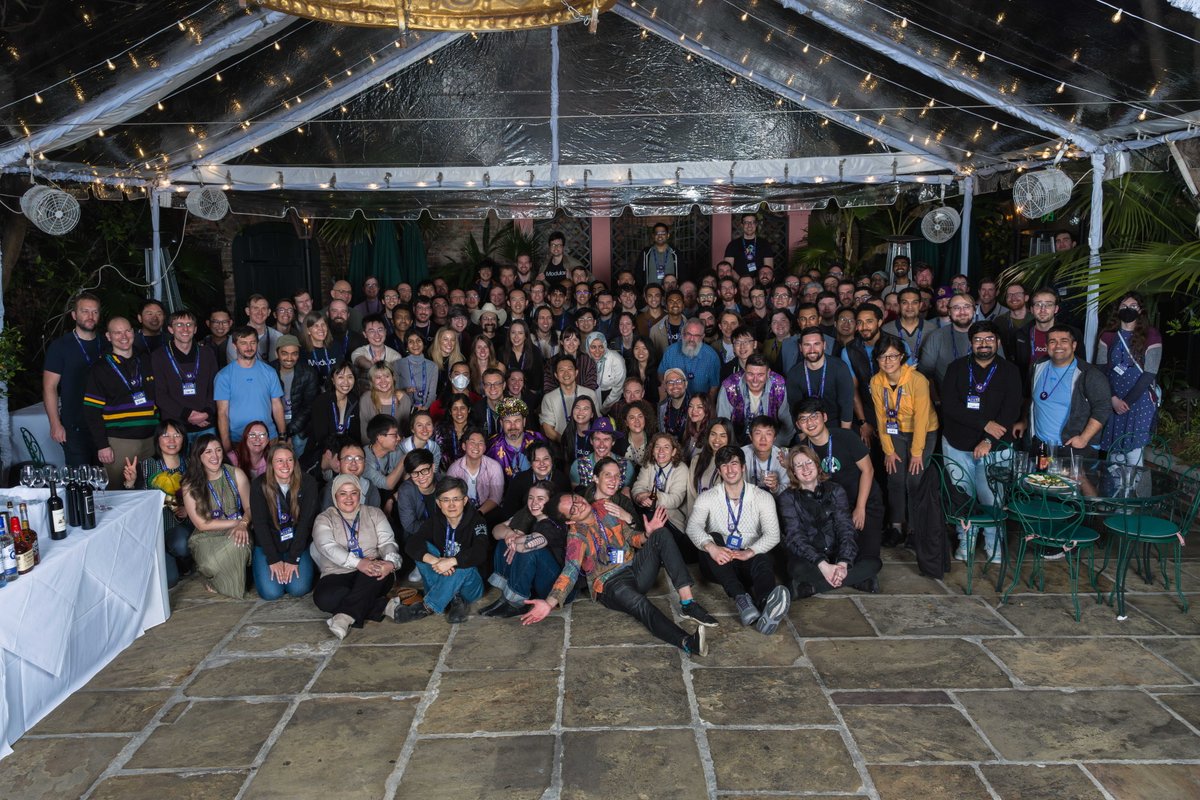
The Modular team just wrapped our offsite in New Orleans🐊 Whole company, lots of big ideas and we're just getting started 🙌 https://t.co/7NEpHQoXsg
Thrilled to share that I’ve joined @GoogleDeepMind to work on Gemini post-training! I feel incredibly fortunate to be cooking on this sunny island under @YiTayML's leadership, within @quocleix's broader organization. Looking forward to enjoying RL research and pushing the frontiers of Gemini alongside such a brilliant team!

Paper link: https://t.co/moEwpmLk56

Gemini 3 Deep Think is here! 😎 This model is not only super strong in math and coding (IMO gold and 3455 codeforces ELO), it is also gold standard in physics and chemistry olympiads. 😃 Also sets new records on ARC-AGI-2 and HLE. Proud to be a (core) member of the Deep Think team. 🦾😆. Feeling the AGI!
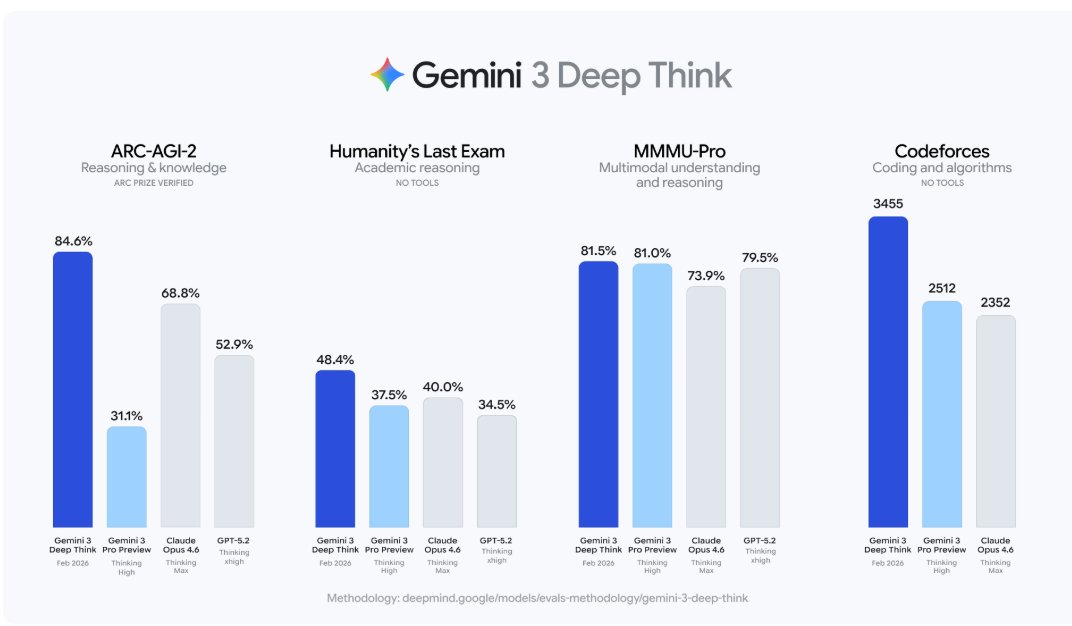
Blogpost here: https://t.co/6fNvurCOzB
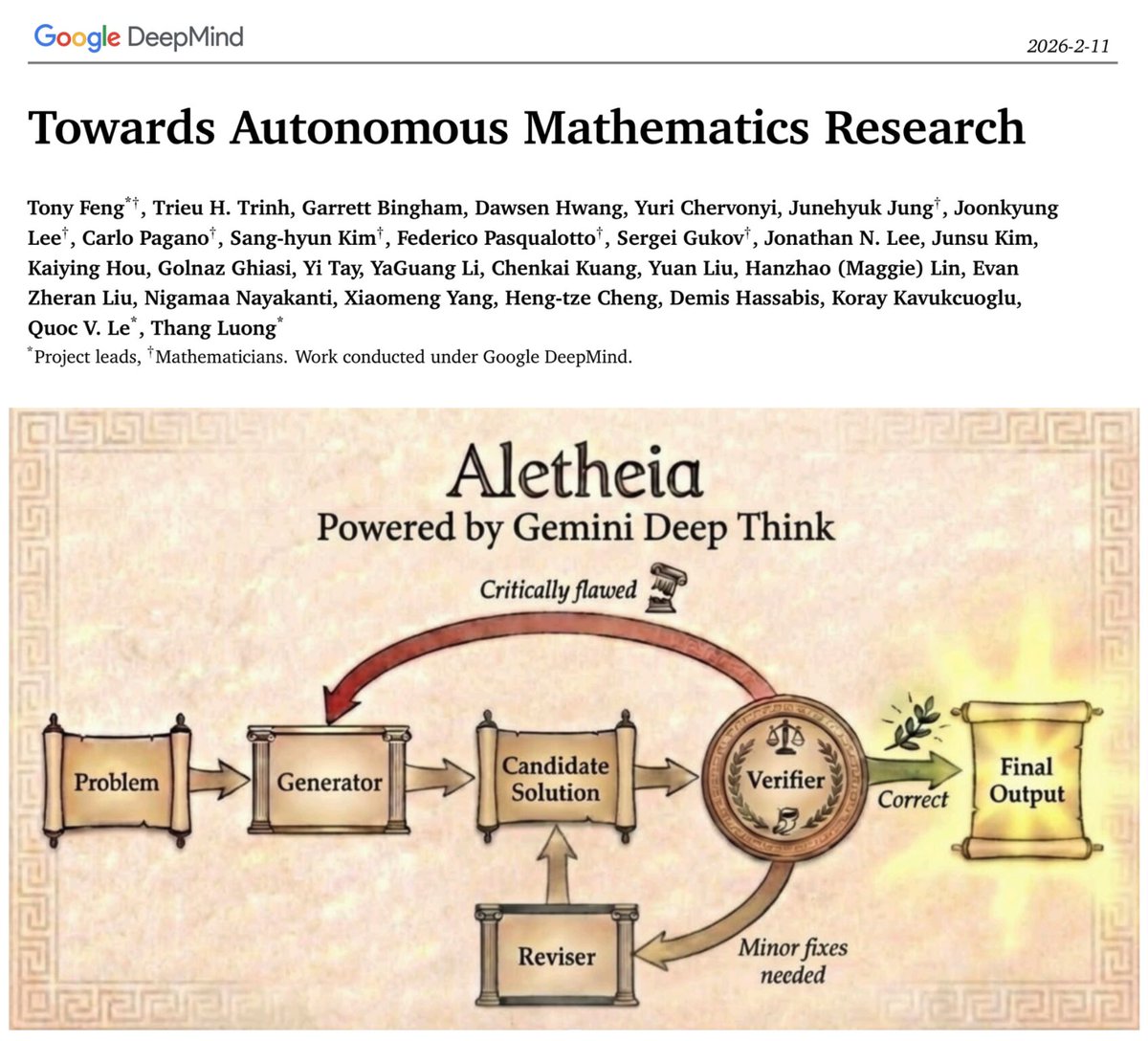
Introducing Aletheia, a math research agent powered by an advanced version of Gemini Deep Think that produces publishable math research (two papers, one completely automatic and another with human-AI collaboration) and solved multiple open Erdős problems. 😀🔥 Paper link below! 👇
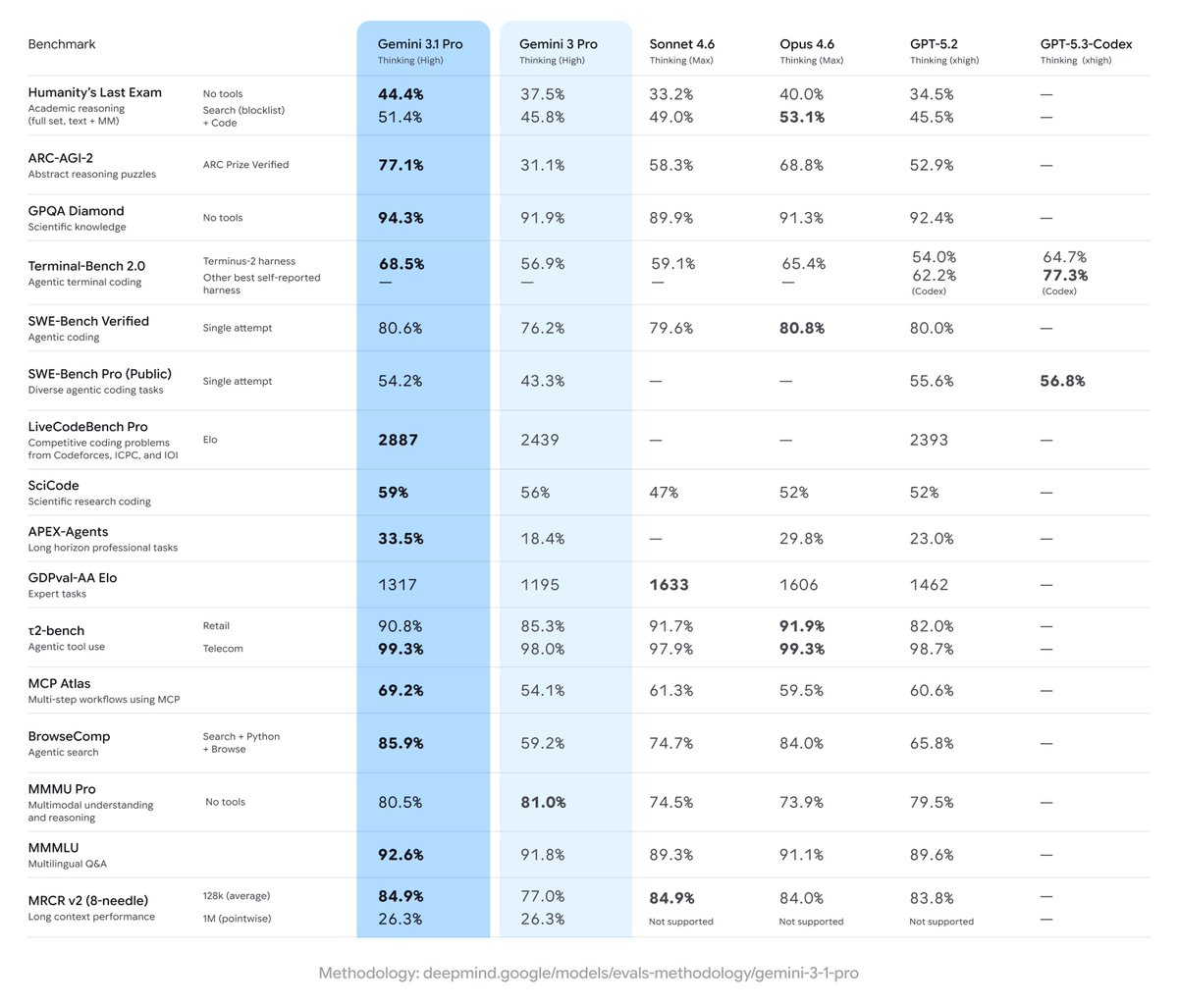
Today, we’re continuing to push the boundaries of AI with our release of Gemini 3.1 Pro. This updated model scores 77.1% on ARC-AGI-2, more than double the reasoning performance of its predecessor, Gemini 3 Pro. Check out the visible improvement in this side-by-side comparison, showing Gemini 3.1 Pro’s crisp animation built with pure code. Read more about today’s 3.1 Pro update: https://t.co/vABdcMSE3f
Gemini 3.1 Pro is here. Hitting 77.1% on ARC-AGI-2, it’s a step forward in core reasoning (more than 2x 3 Pro). With a more capable baseline, it’s great for super complex tasks like visualizing difficult concepts, synthesizing data into a single view, or bringing creative projects to life. We’re shipping 3.1 Pro across our consumer and developer products to bring this underlying leap in intelligence to your everyday applications right away. Rolling out now to: - Developers in preview via the Gemini API in @GoogleAIStudio - Enterprises in Vertex AI and Gemini Enterprise - Everyone through the @Geminiapp and @NotebookLM