Your curated collection of saved posts and media
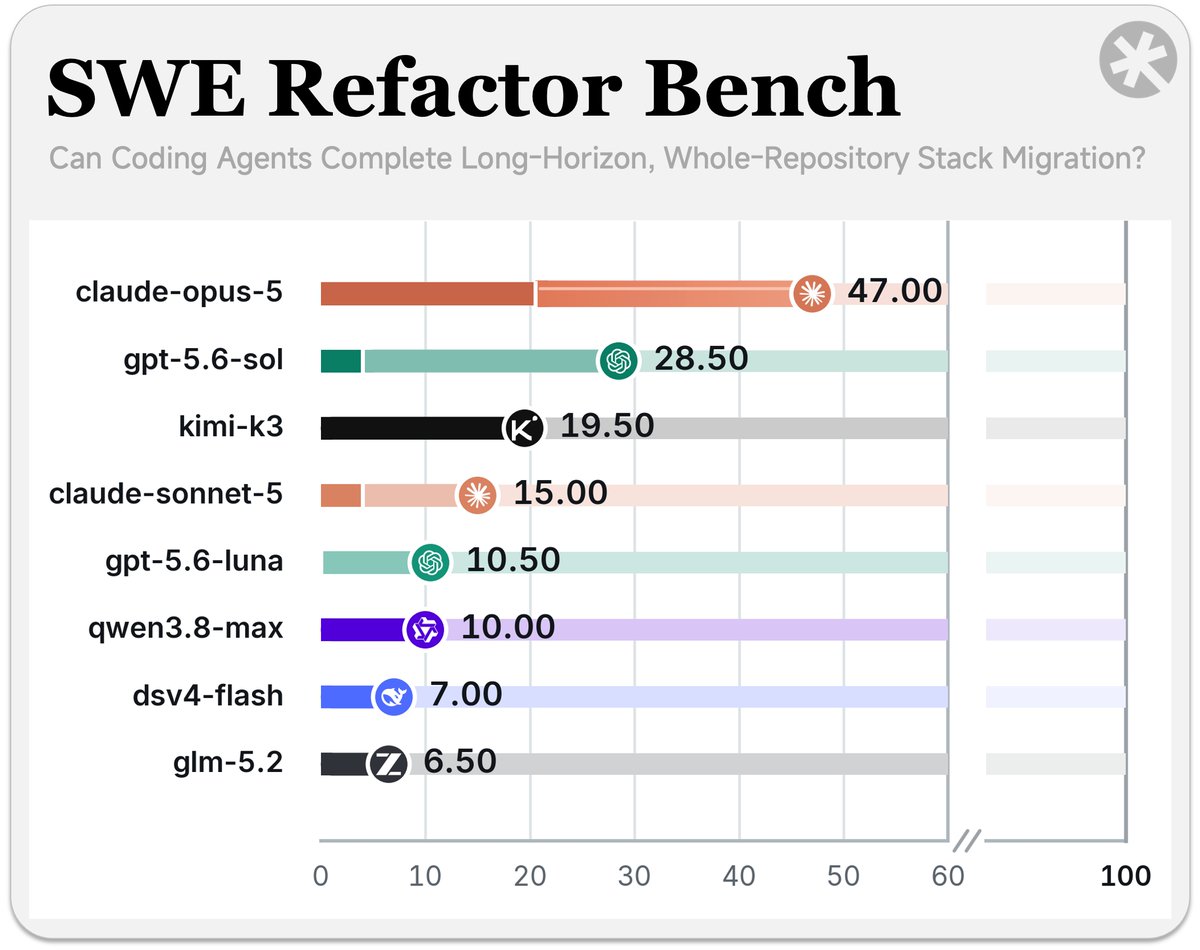
The ultimate test for coding agents isn't local editing— it's whole-repo evolution, and right now, the survival rate is 5.4%. Today we’re releasing SWE Refactor Bench, a benchmark for long-horizon, whole-repository software stack migration. Coding agents are getting very good at fixing bugs. But can they refactor an entire system, C → Rust, Maven → Gradle, POSIX → WebAssembly? We built 20 real migrations across projects, including SQLite, zlib, libsodium, and GraphHopper. 520 runs. Only 28 survived all 3 stages. 13/20 tasks were solved by nobody. System-scale migration is still wide open. Full breakdown 👇 GitHub: [https://t.co/xXyLQ3qq0C] Paper Link: [https://t.co/lO1Enh63q7] Einsia Website: [https://t.co/AGn0hF5gwL]
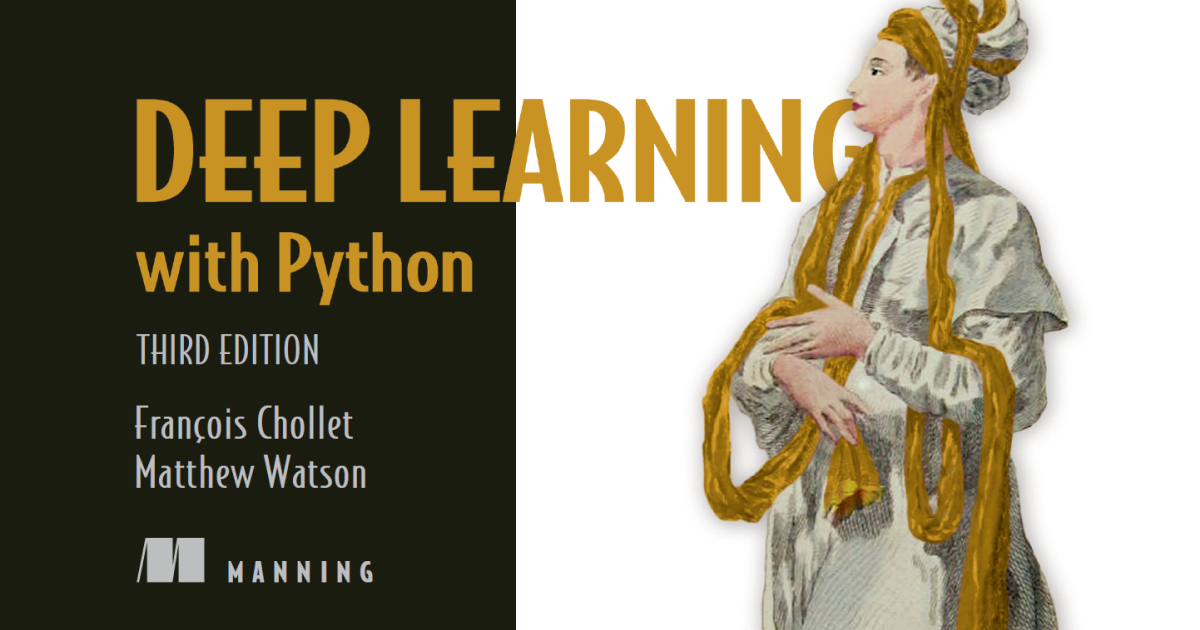
If you're 17 (or any age) and you want to learn to build LLMs from scratch, read chapters 15-16 of Deep Learning with Python, available online here: https://t.co/Nisfkzf9sC In particular, chapter 15 has one of the best explanations of WHY dot-product attention works that you'll find anywhere.
Today, we're kicking off the first phase of the research preview for Model Hardware Standard (MHS): a new standard for AI agents to safely operate physical equipment in scientific research and advanced manufacturing. Read more: https://t.co/XQ2y9EW7Af https://t.co/kgyCvZ6iYc
If you're looking for a weekend project, how about training your own text-to-speech model from scratch on your own GPU, and then running it on any device's CPU? We just open-sourced the entire Pocket TTS training stack: data pipeline, recipes, and evals. It learns pretty damn fast: ~15k steps: babbling starts turning into words ~50k steps: it reads anything you type (WER under 1%) ~200k steps: the voice stops sounding synthetic On a beefy consumer GPU, that's a week of training. On eight H100s: 10-20 hours. A TTS training run will cost you less than $200 if you rent your hardware, and an order of magnitude less if you just pay for power. Some things we'd love to see people try: - Train it in your own language (a few hundred hours of speech gets you surprisingly far). - Add new features to Pocket TTS (Emotion tags? Make it sing?). - Beat us at our own game: make it faster and smaller. Show us what you build! We'll highlight the best models and new languages for the whole community to enjoy. Pocket TTS has already found many use cases, from reading for people with visual impairments to making NPCs in video games talk, and we're sure there's much more to do with it! Here's an example of a Czech Pocket TTS. Try just asking your favorite agent to find data and apply the method, and you can have your own. Get started: https://t.co/3EH3sbKNRU
I made a video about what happens when you execute `c = a @ b` in PyTorch, from the code to silicon. Hopefully it will help you appreciate that simple line of code more. Made by Grok @bot. Enjoy! https://t.co/hdn0fFSIA8
It's beneficial for a software engineer to learn chip design so they understand how numerics flow through circuitry each cycle.
Introducing our new work, Code World Model—a new world-model paradigm with a language model as its brain. A Coding Agent continuously maintains and updates the world state, which then guides a video model to generate high-fidelity visuals. Two key motivations: 1. Complex world interactions go far beyond motion and collisions. They involve goals, rules, causality, and other high-level semantics—and therefore require the intelligence and reasoning capabilities of language models. 2. Games are a primary data source for video world models, yet game frames are simply the visual outputs of code execution. Directly learning action-to-video mappings asks the video model to bypass code and explicit world states and implicitly approximate program outputs. This is not only inefficient, but also entangles world evolution with visual generation in a single model. Project Page: https://t.co/ypvR2ZAVtV
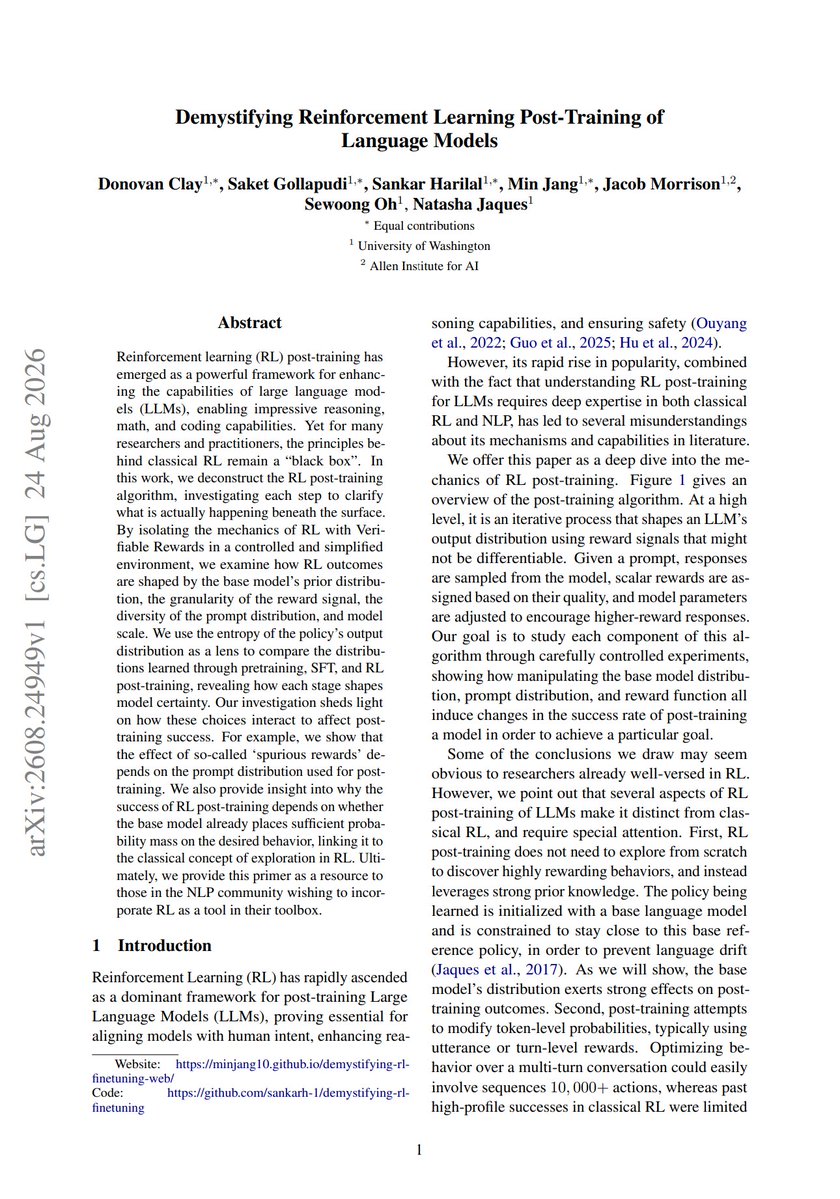
Demystifying Reinforcement Learning Post-Training of Language Models A very useful exploration of RLVR in a simplified setup, lots of good insights... "Result 1: sparse RL cannot find what the model never samples" "Result 2: dense rewards break that ceiling" "Result 3: "spurious rewards" are a story about the prompt set" "Post-training is best understood as redistributing probability mass inside the pretrained distribution. That framing suggests the measurement: track the probability the model assigns to the behavior you want, and track the entropy of its output distribution, throughout training." project page: https://t.co/iPL9jqlxEL code: https://t.co/K9MtdC28Sl link: https://t.co/RQfH9TqfLy
Depth-aware light injection in TypeGPU I got a 448x448 monocular depth model down to ~8 ms on my M4 Pro across ~250 dispatches, which is fast enough to use in realtime :D Since the inference is written directly in TypeGPU, I can just feed the depth buffer straight into the lighting pass. It never has to leave the GPU or go through any extra synchronization/interop step Inference, lighting and draw all go through the same command encoder.
Someone asked what I'd do if I were 17. I'd learn how to build LLMs from scratch, and then train ones as powerful as I could with whatever hardware I could get access to.
Since announcing Jalapeño, our first custom inference chip, we’ve been testing it and the system around it. The results show a major advance: more intelligence from every watt and faster responses, delivering both higher throughput and lower latency in one architecture without sacrificing efficiency.
Aloha! 🌺Introducing Ornith-1.5, a family of open-source LLMs spanning 9B Dense, 35B MoE, and 397B MoE, trained with self-improving strategies. It achieves state-of-the-art performance among open-source models of comparable size and delivers performance comparable to Claude Opus 4.8 across reasoning, agentic, and coding tasks: ✅Terminal-Bench 2.1 (86.1) ✅SWE-Bench (86 on verified, 65.1 on pro, 79.6 on Multilingual) ✅DeepSWE (56) ✅HLE (44.6) ✅ClawEval (81.4) ✅Tool Decathlon (71.2) Ornith-1.5 takes a major step toward training foundation models through end-to-end self-improvement, extending the self-scaffolding strategies introduced in Ornith-1.0 into a more complete self-improvement loop: the model proposes new tasks, generates task-specific scaffolds, and produces solution rollouts for reinforcement learning, continuously creating new learning experiences from which it can improve. All models, along with their quantized versions (FP8, GGUF, MLX, and NVFP4), have been released under the MIT License, enabling unrestricted commercial and research use. 📘Tech Blog: https://t.co/OZ63scRWLB 🤗Huggingface: https://t.co/mGJLwhrQOM
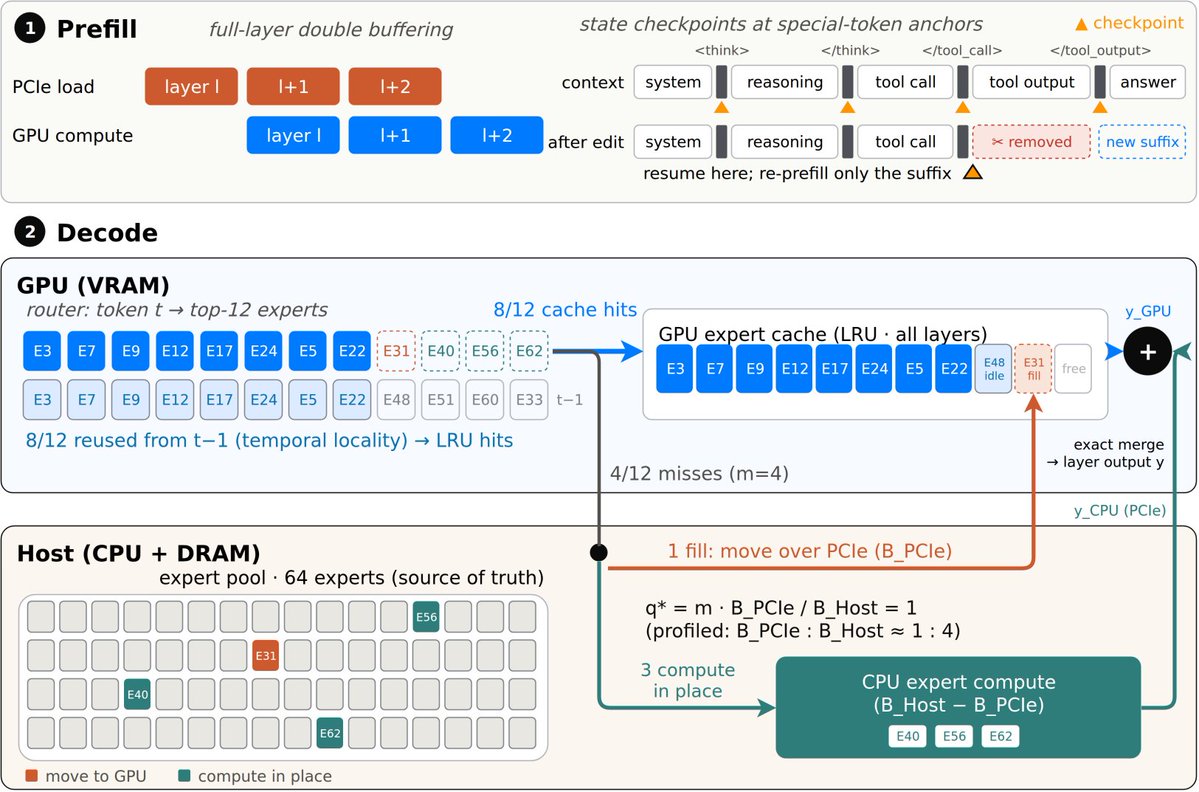
FreeToken is fast. Comparing to Ollama, we have 3–4× faster decode, and 6–30× faster prefill How? We introduce bandwidth-adaptive CPU–GPU execution + semantic-aware caching across agent turns. More details in the technical report: https://t.co/V3sIxbPMGU https://t.co/IsJZfQJ1FL
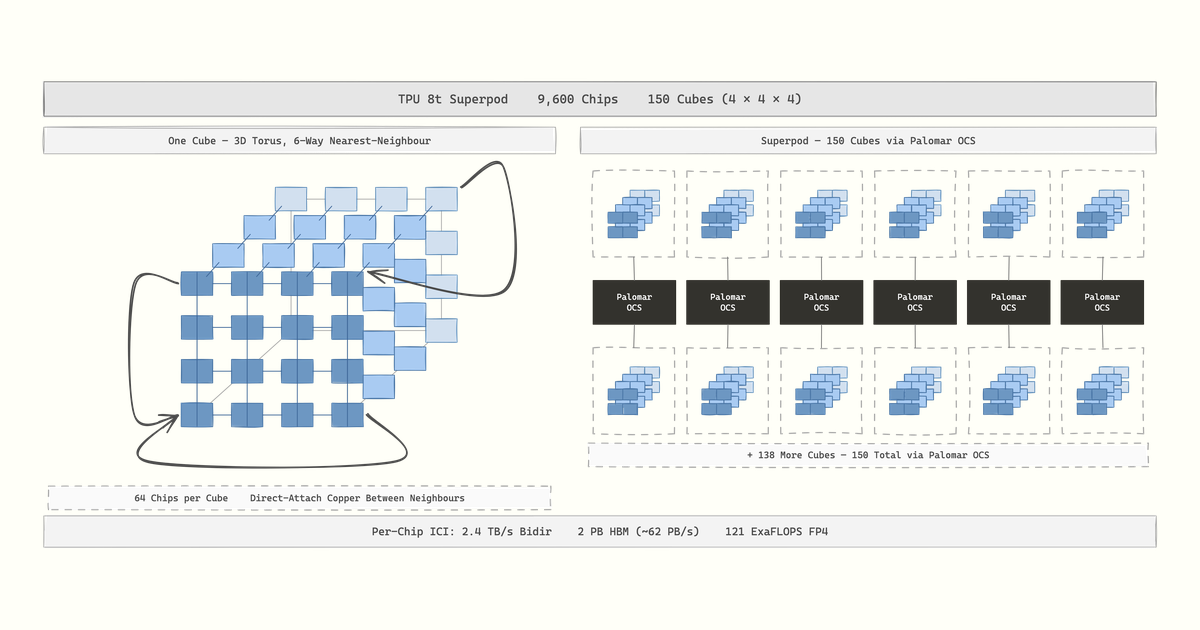
sharing a new long-form blog post: ai chip architectures it covers the leading chip architectures (nvidia, amd, tpus, trainium, cerebras, groq) across architecture, scaling (scale-up and scale-out), and software stacks. it helps build an intuition for the architectures and their trade-offs. https://t.co/7eZMh3ddZS
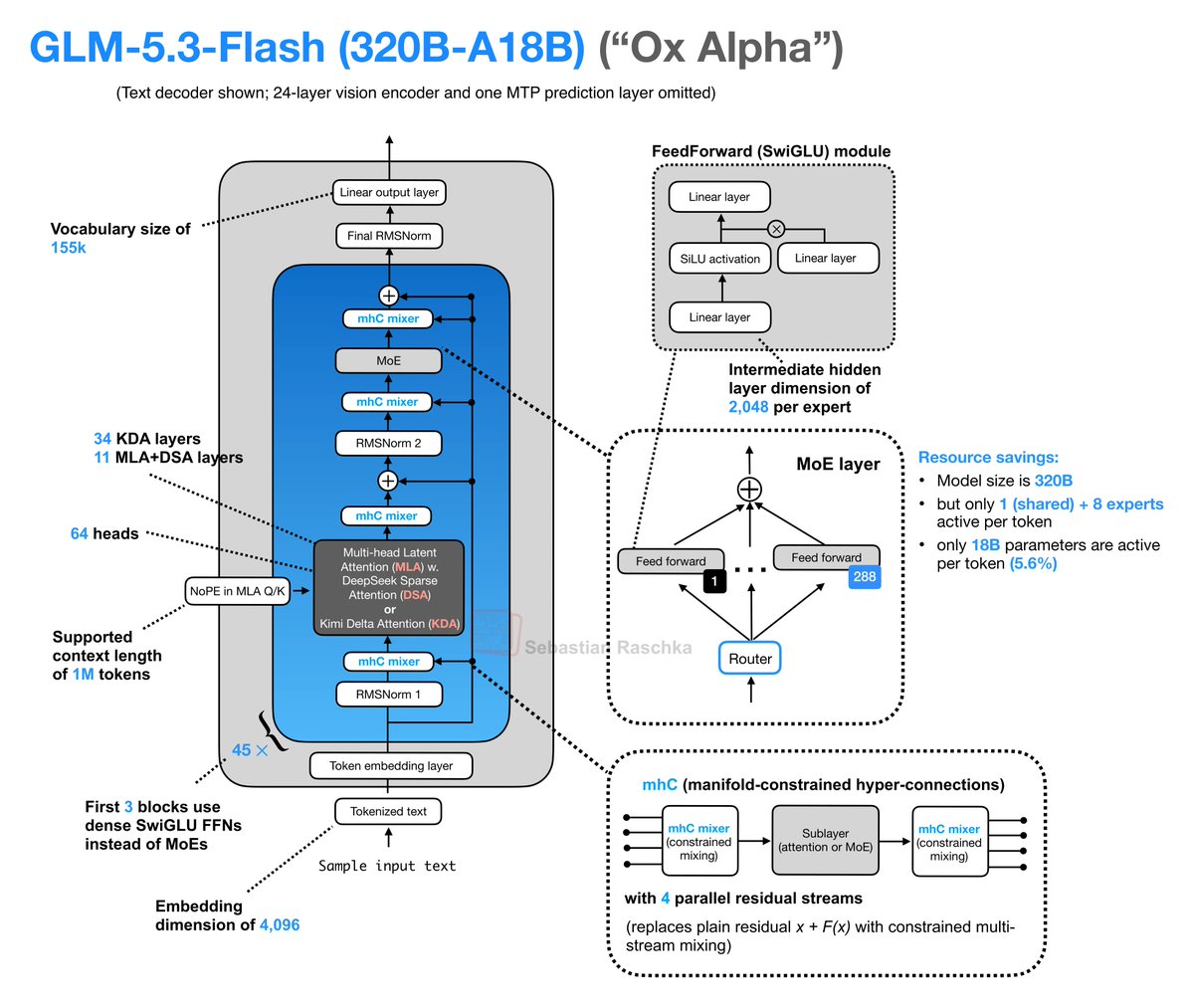
Now we know: The popular Ox Alpha LLM was GLM-5.3-Flash... Compared to GLM-5.2, this new GLM-5.3-Flash model uses: - a Kimi Linear-style 3:1 (super*) hybrid attention pattern with 34 Kimi Delta Attention layers (KDA) and 11 Multi-heat Latent Attention (MLA) / DeepSeek Sparse Attention (DSA) layers; - a scaled-down GLM-5.2-style sparse MoE backbone, going from 744B-A40B to 320B-A18B; - a DeepSeek V4-style mHC residual path with four parallel streams; - plus a native vision encoder (not shown). * "Super hybrid" because both KDA and MLA/DSA are "efficient" components. E.g., Kimi only uses KDA + full attention GQA, DeepSeek V3.2 uses DSA + full attention MLA. PS: Sry for the excessive tech jargon. Explainers on all these components (MLA, DSA, KDA, mhC, etc.) in my LLM Architecture Gallery PPS: Haha, maybe justification for getting that pricey Mac Studio M5 Ultra 256 GB / 512 GB to run this locally...
Introducing GLM-5.3-Flash - Leading capabilities at a highly competitive price - Natively multimodal with a 1M-token context window - A 320B-A18B model released under the MIT License - Previously previewed as Ox Alpha, running entirely on Chinese AI chips Blog: https://t.co/tzO
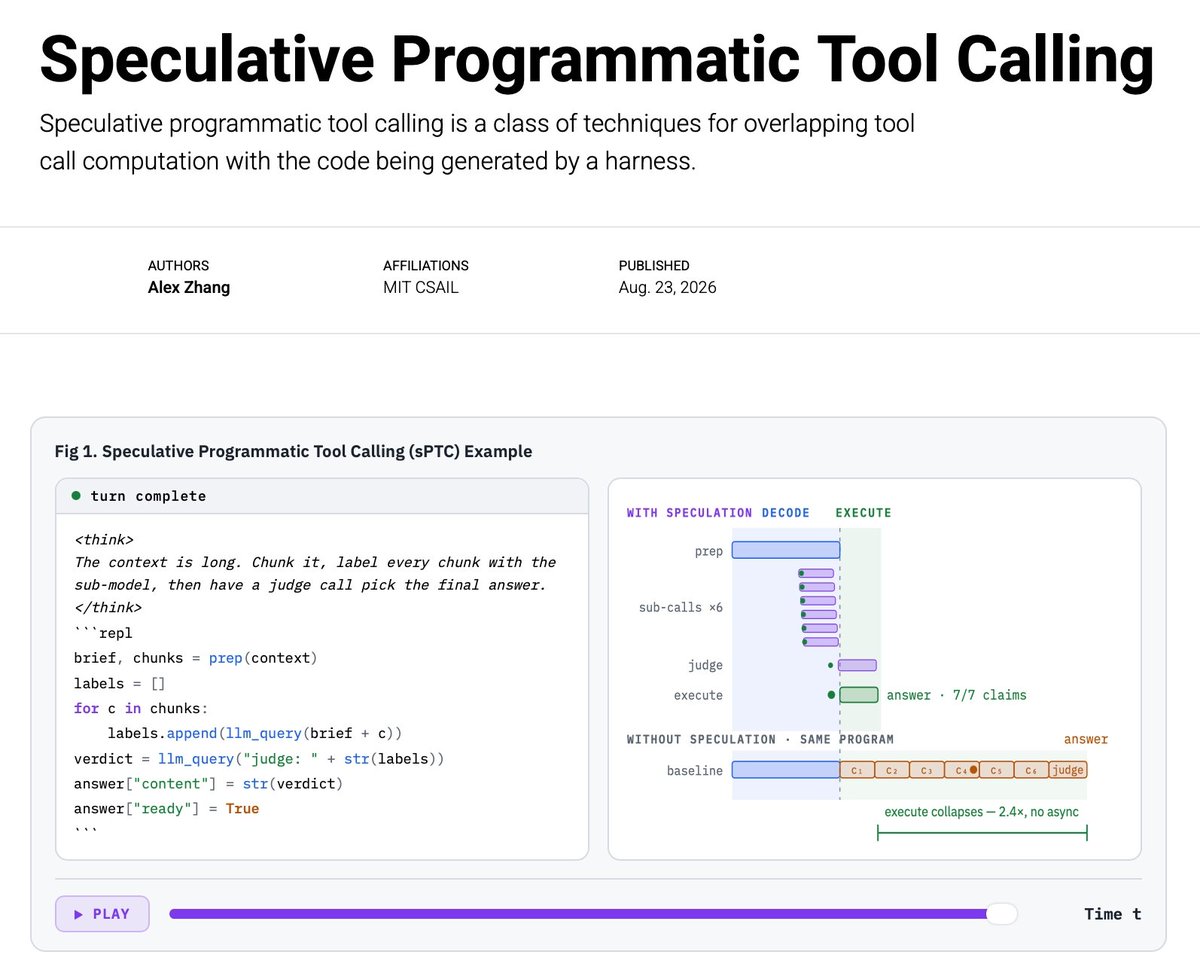
Introducing Speculative Programmatic Tool Calling (sPTC)! A general class of technique for speculating on tool calls during code generation in a harness and queuing them early to overlap with token generation + REPL execution time. Blog: https://t.co/0nzkLvTXNy https://t.co/SVH8D2JyEg
Face Anything: 4D Face Reconstruction from Any Image Sequence ECCV 2026 https://t.co/smXN0FGjRg Face Anything is a unified feed-forward model for high-fidelity 4D face reconstruction and dense tracking from arbitrary image sequences. The key idea is canonical facial point prediction, a representation that assigns each pixel a normalized facial coordinate in a shared canonical space. This formulation transforms dense tracking and dynamic reconstruction into a single canonical reconstruction problem, producing temporally consistent geometry and reliable correspondences.
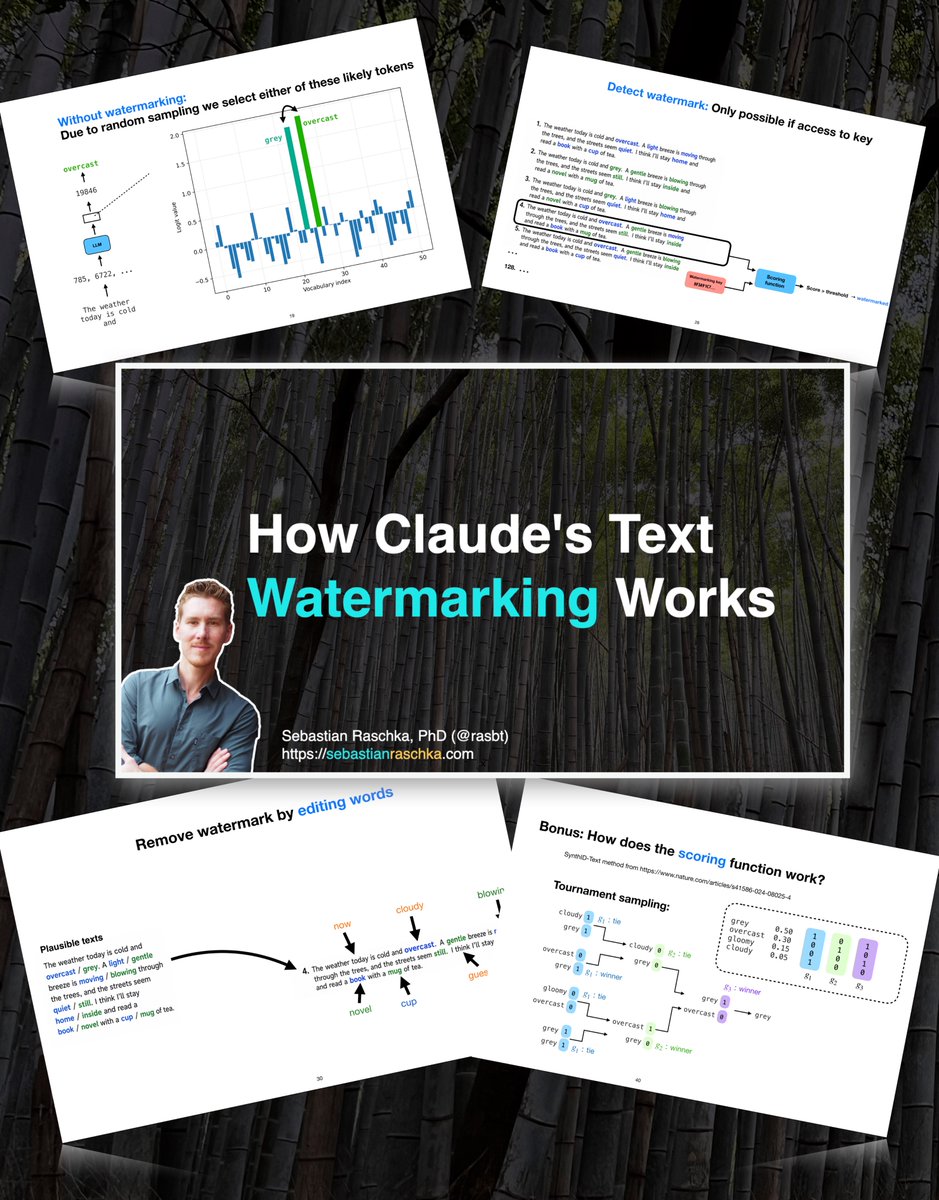
A couple of days ago, I did a quick explainer on Claude’s new watermarking process and implementation. Since it’s such a popular topic and sparked such a lively discussion, I thought it might be interesting to go into a bit more detail when explaining how it works. So, instead of the usual text article, I recorded a little lecture on the topic (to change it up a bit from my usual articles). It ended up a bit longer than intended, but I hope it clarifies a lot of things: - Sampling the next token in an LLM and pseudorandom number generators - How watermarking relates to the regular LLM sampling process - Whether watermarking makes text "worse" - How to remove watermarks - Tournament sampling - How new text is checked for watermarks without rerunning the LLM I ended up with ~50 slides, but I hope that these explain it well, though! Happy watching!
McByte sets a new SOTA on the SportsMOT benchmark MOT is short for Multi-Object Tracking, and is typically evaluated using the HOTA (Higher Order Tracking Accuracy) metric Find the major papers and benchmarks here: https://t.co/FSHY8IiBoT https://t.co/YAXti6Apww
McByte sets a new SOTA on the SportsMOT benchmark MOT is short for Multi-Object Tracking, and is typically evaluated using the HOTA (Higher Order Tracking Accuracy) metric Find the major papers and benchmarks here: https://t.co/FSHY8IiBoT https://t.co/YAXti6Apww
McByte shipped in trackers 2.6.0 similar to ByteTrack, but association is guided by segmentation masks (SAM + Cutie), not just boxes when players overlap and box IoU gets ambiguous, masks settle who is who here it is side by side with OC-SORT link: https://t.co/9Fam5U1zuC htt

New research: Portable Computer is a local-first agent for private and cost-effective work. With an on-device 27B model, our harness scores 82.6% on real knowledge work, beating open-source harnesses Pi and Hermes. Our post-trained PPLX 27B reaches 85.4%. https://t.co/Rb6d47clCI
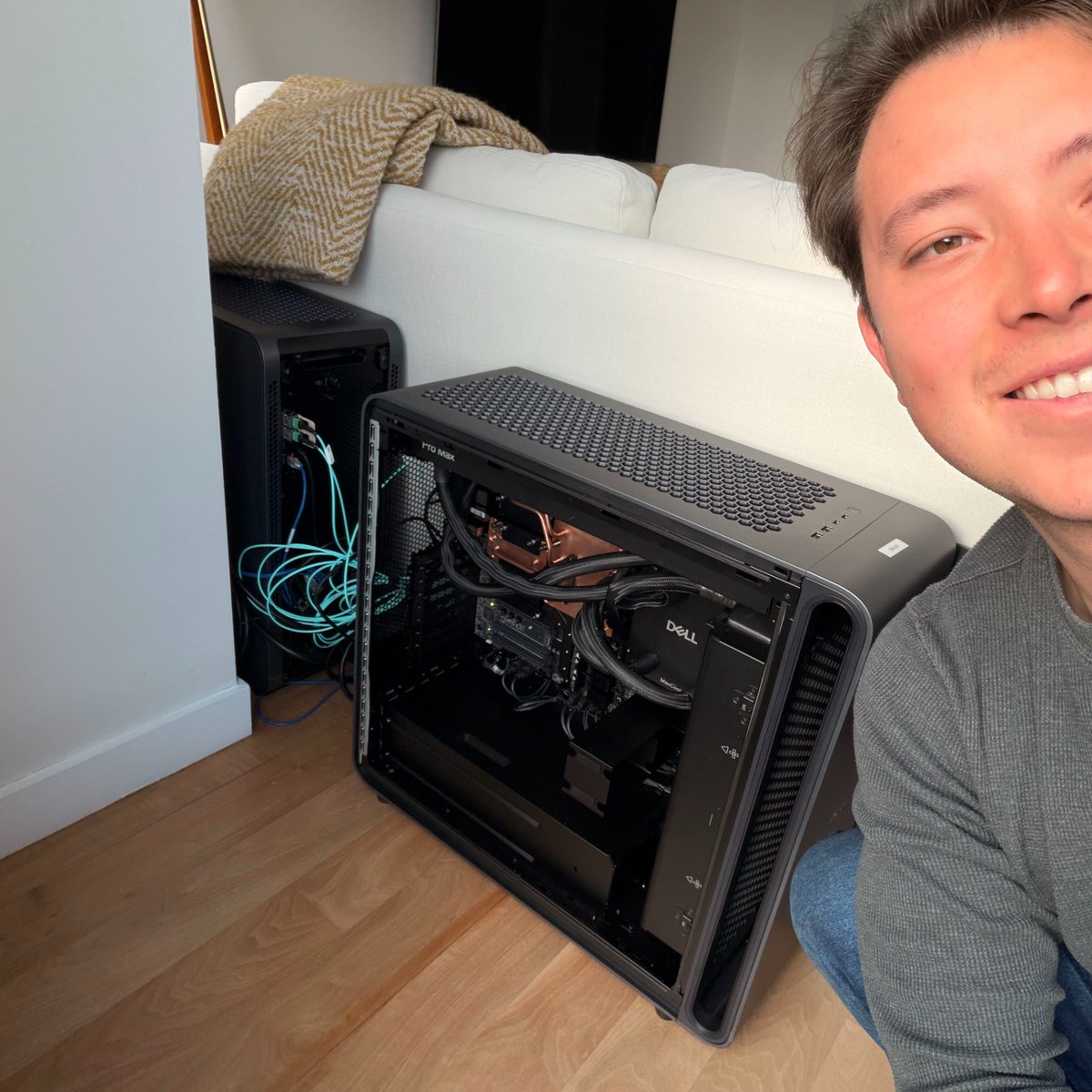
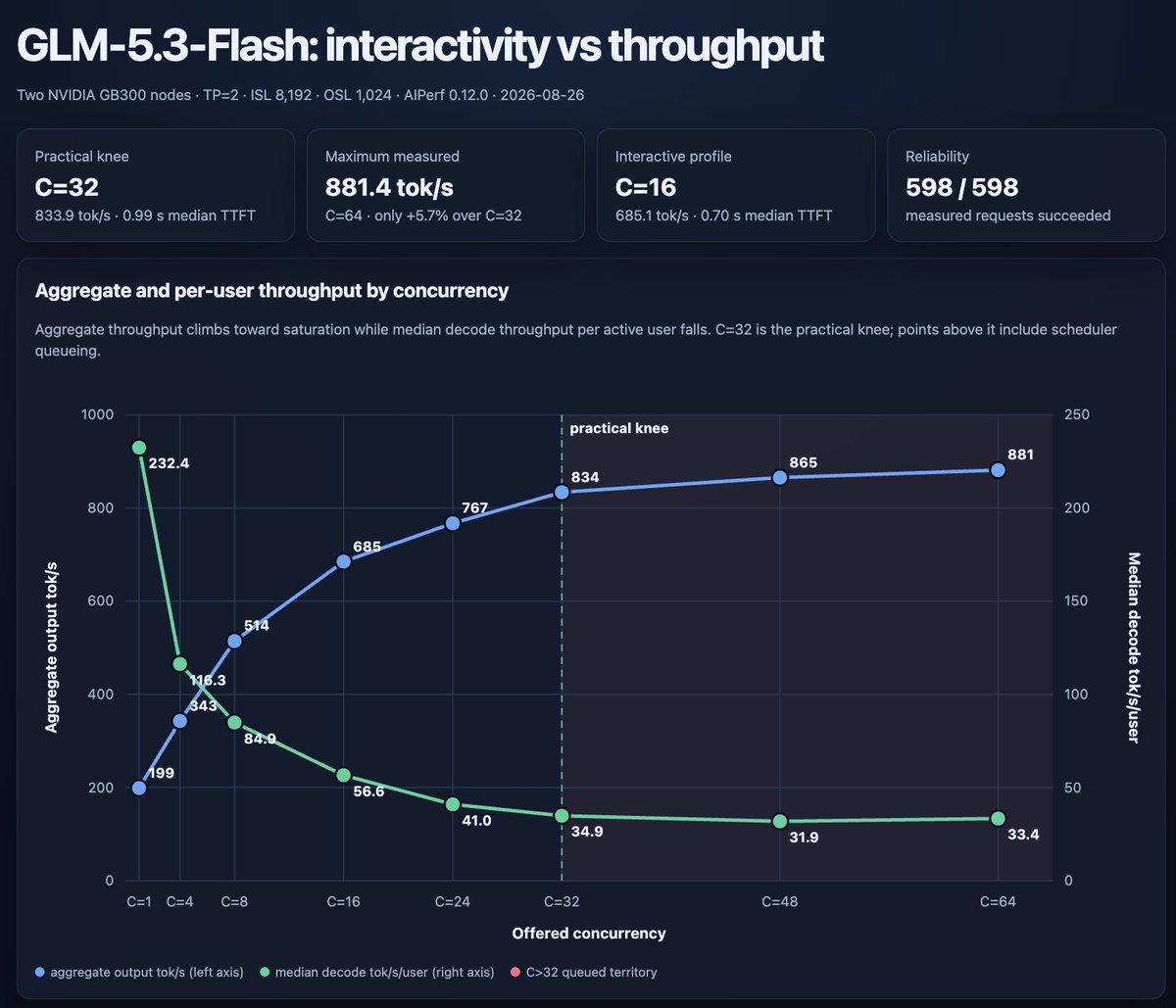
GLM 5.3 Flash will likely be my teams new daily driver Untuned I'm getting on 2xDGX Station TP=2 881 tok/s C=64 232 tok/s C= 1 At long context realistically can have 4-8 simultaneous users. + it supports vision!
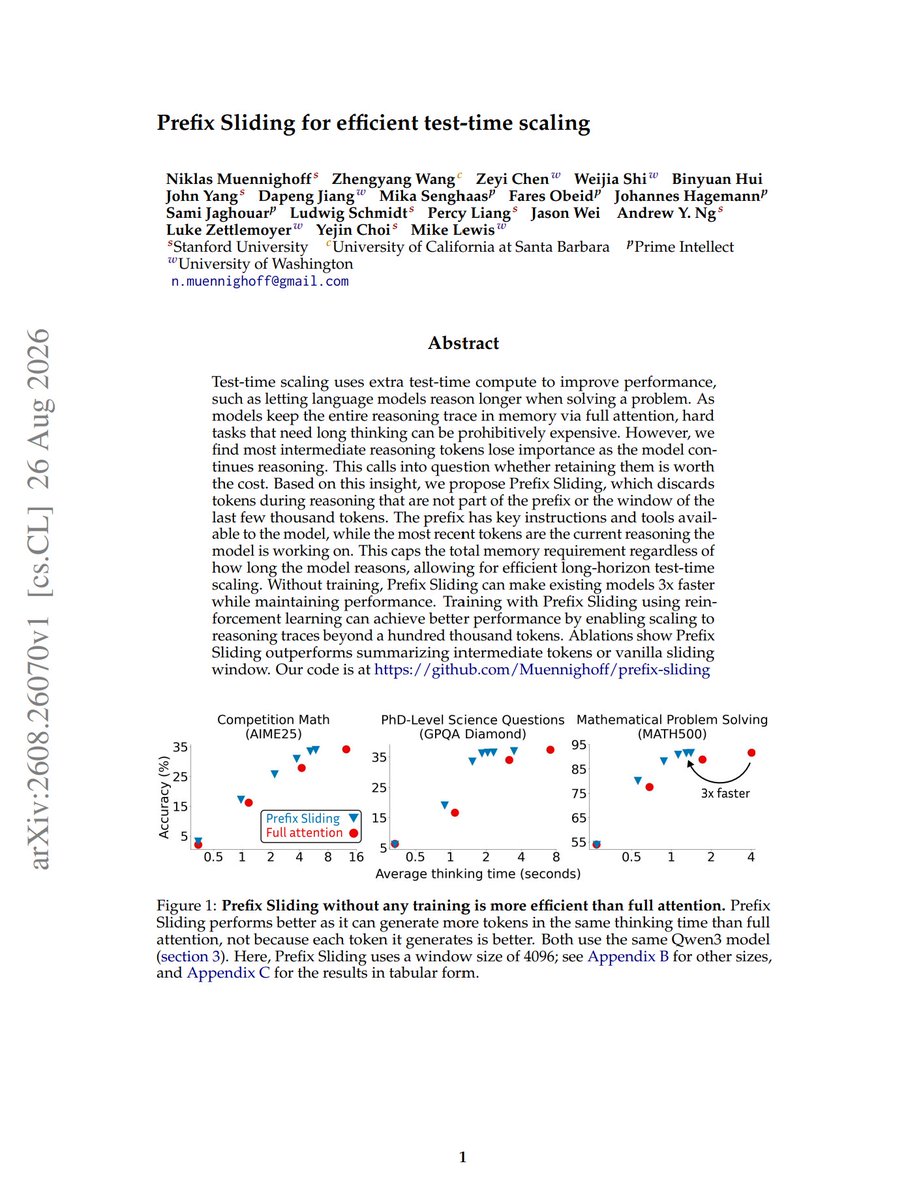
Prefix Sliding for efficient test-time scaling "we find most intermediate reasoning tokens lose importance as the model continues reasoning. This calls into question whether retaining them is worth the cost. Based on this insight, we propose Prefix Sliding, which discards tokens during reasoning that are not part of the prefix or the window of the last few thousand tokens." "Without training, Prefix Sliding can make existing models 3x faster while maintaining performance. Training with Prefix Sliding using reinforcement learning can achieve better performance by enabling scaling to reasoning traces beyond a hundred thousand tokens." code: https://t.co/8lGwjKkavI link: https://t.co/Sd2wre3L9A
By switching from a hand-rolled GELU to PyTorch's built-in one, I improved my LLM training speed -- and much more than I expected, from 21,000 tokens/second to 25,000! https://t.co/NmNQu53cmW

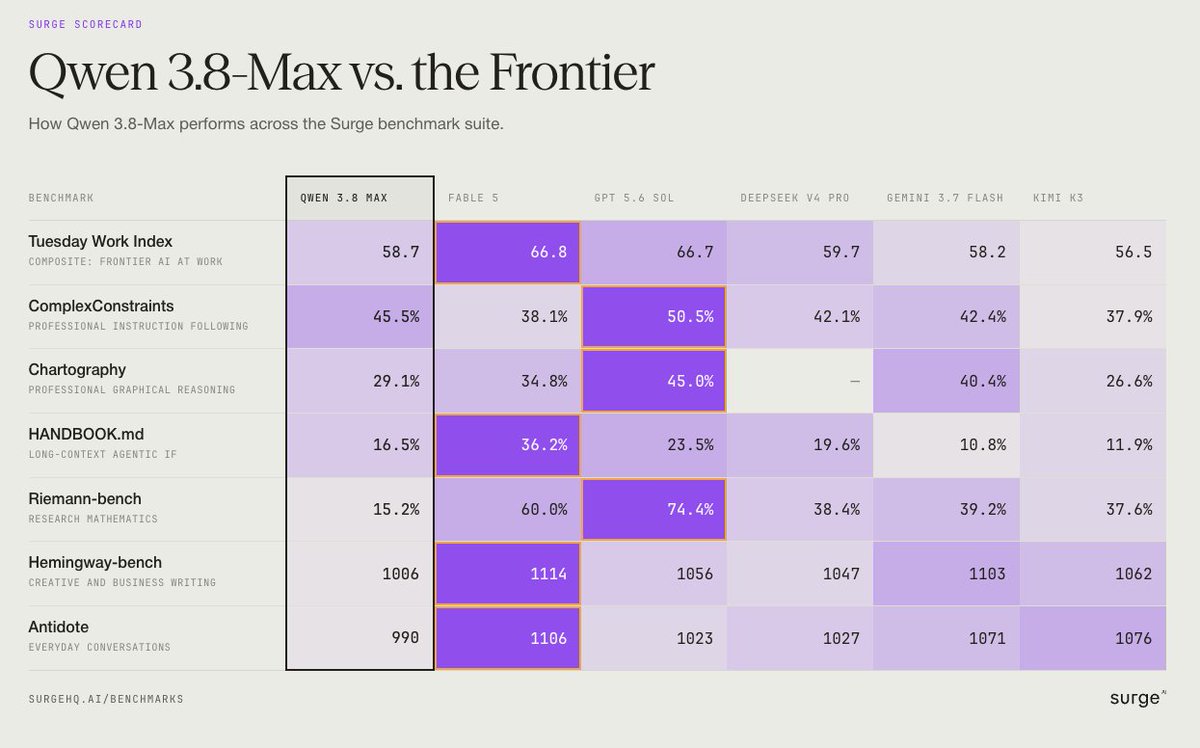
Qwen 3.8 Max on the Surge Scorecard: Tuesday Work Index — 58.7 ComplexConstraints — 45.5% Chartography — 29.1% HANDBOOK.md — 16.5% Riemann-bench — 15.2% Hemingway-bench — 1006 Elo Antidote — 990 Elo https://t.co/3MzHkqo1m4
We’re sorry to see that OpenAI put out a note saying they plan to block Cursor users from accessing OpenAI models in three months. OpenAI models serve about 5% of Cursor user traffic, and we’re speaking with the OpenAI team to resolve this. Cursor was one of the very first users of OpenAI, we’ve worked closely with their team for years, and we’ve trusted their platform to be neutral infrastructure for our business.
⚡Meet Qwen3.8-Flash, a multimodal MoE and an early preview of the Qwen4 architecture, now open-weight! The production version Qwen3.8-Flash will be available soon via QwenCloud API at just $ 0.16/1M input tokens and $ 0.47/1M output tokens. 125B parameters + 51B N-gram embeddings, with just 6B activated per token. Unmatched cost-efficiency. What's new: 🥳 - Next architecture: GDN + QSA hybrid attention, Gated Residual, N-gram Embedding & Muon optimizer, serving as a precursor to the architecture used in Qwen4. - Dramatically lower training and inference costs: trained at just 1/9 the cost of Qwen3.7-Plus, while outperforming it across the board with especially strong gains in coding and office tasks. - Strong performance: scoring 58.7 on DeepSWE 1.1, 62.5 on SWE-bench Pro, 73.9 on CoWorkBench, 84.5 on AndroidWorld, and 95.7 on MathVision (with CI). - 262K native context, extensible to 1M with YaRN. We’re also releasing the weights for Qwen3.8-Flash-Next, giving the community an early look at the new architecture we’re exploring for Qwen4.🚀 We can't wait to see what you build with Qwen3.8-Flash!👀👇 - Blog: https://t.co/M5hYypFLgJ - Technical Report: https://t.co/IF0gObIkQO - Hugging Face: https://t.co/6ow8QVAABt - ModelScope: https://t.co/tDOn2jNuFG


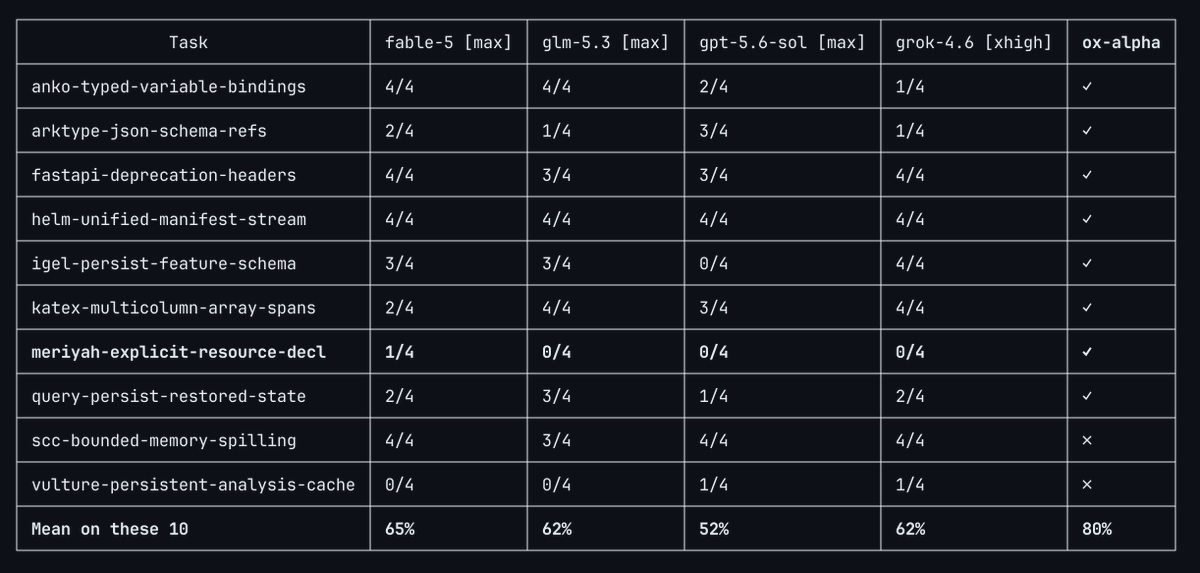
I ran this thing through 10 tasks on DeepSWE (so there could be a ton of variance in it's real score, this is a subset), but uh... gpt-5.6-sol: 52% fable: 65% whatever the hell this is: 80% (was a near miss on the "x"s so actually over 80%) I am very confused https://t.co/NdDSTjoHLj
🚢 Marin 535B-A23B started training this week! As usual, the whole process is open. Voyage plan: pretraining (80%) + midtraining (20%) on 18.75T tokens on 11 x GB200 NVL72 for ~3 months (2.7e24 FLOPs). Post-training will follow. Before kicking off the run, we trained a 4-rung scaling ladder from 1.6B-A61M (48B tokens) to 27.7B-A1.2B (926B tokens) to debug issues, and to make a forecast of our hero run. This is by far our biggest run, so definitely expecting the unexpected.
GLM-5.3 is now open-weight. Our most capable model for agentic coding and cyber defense is now available to download, run, and customize. Weights: https://t.co/v1IbWMXxg4 Tech blog: https://t.co/ekQkO83jCv https://t.co/f8XlJksKyf
You can now fine-tune Qwen3.8-27B for free with our notebook! 🔥 Local training works on 24GB VRAM. Unsloth trains Qwen3.8-27B 1.5x faster with 50% less VRAM. GitHub: https://t.co/aZWYAtakBP Qwen3.8-27B Notebooks + Guide: https://t.co/3GE3WVWIOY https://t.co/lKJj9547X8
I made portals with some open cv and projection mapping :) https://t.co/TbQ88YktpD