Your curated collection of saved posts and media
Computer on phone allows me code while watching the baby ;) https://t.co/MkgSsoKiXD


“Timing is very important. You need to pick hard problems to solve and be ambitious with them. But you've also got to pick the right time when the world and the context that you're in is the right kind of environment for those ideas to flourish.” In his official Nobel Prize interview, Demis Hassabis discussed how his aspirations as a young gaming programmer were ahead of their time. Watch our official interview: https://t.co/2ovRqsSAtc

NVIDIA CEO Jensen Huang: “I really discourage 1-on-1s” Jensen famously has 60 direct reports. When Stripe founder Patrick Collison points out that this isn’t conventionally considered best practice, Jensen shares his reasoning: “I don’t do 1-on-1s, and almost everything I say, I say to everybody all the time. I don’t really believe there’s any information that I operate on that only one or two people should hear about… I believe that when you give everybody equal access to information, that empowers people. And so that’s number one… Number two, if the CEO’s direct staff is 60 people, the number of layers you’ve removed in a company is probably something like seven.” Patrick offers to steal man the other side of the argument: “1-on-1s are where you provide coaching, where you maybe talk through personal goals and career advancement, where maybe you give feedback on something that you see somebody systematically not doing so well… Do you not do those things or do you do them in a different way?” Jensen responds: “I give you feedback right there in front of everybody. In fact, this is a really big deal. First of all, feedback is learning. For what reason are you the only person who should learn this?… We should all learn from that opportunity… Half the time I’m not right, but for me to reason through it in front of everybody helps everybody learn how to reason through it. The problem I have with 1-on-1s and taking feedback aside is you deprive a whole bunch of people that same learning. Learning from other people’s mistakes is the best way to learn.” Video source: @stripe (2024)
Warren Buffett- "Buy now or wait for a market crash?" Everyone should listen to this. https://t.co/VdEB5dVw0n
Warren Buffett- "Buy now or wait for a market crash?" Everyone should listen to this. https://t.co/VdEB5dVw0n
Charlie Munger: “That’s our formula: We want to buy something that’s ‘intrinsically’ a very good business, meaning that an idiot could run it and it would do alright.” https://t.co/U16kXeOoDT
AI’s next frontier is Spatial Intelligence, a technology that will turn seeing into reasoning, perception into action, and imagination into creation. But what is it? Why does it matter? How do we build it? And how can we use it? Today, I want to share with you my thoughts on building and using world models to unlock spatial intelligence in this essay below. 1/n
Peter Lynch: 'There's always something to worry about' https://t.co/pyHHd0pnh9
Peter Lynch: 'There's always something to worry about' https://t.co/pyHHd0pnh9
🍀 NATIONALLY RECOGNIZED LEP IN THE HOOD WEEKEND 🍀 https://t.co/ZctKqrOCGS

🍀 NATIONALLY RECOGNIZED LEP IN THE HOOD WEEKEND 🍀 https://t.co/ZctKqrOCGS

Been reading Blood Meridian again lately and for some reason I can't stop picturing The Judge as a giant bald JD Vance. https://t.co/dtAlN39sMr

Spent about $1000 in credits on Seedance 2.0 over the last few weeks,and here are a few thoughts: First, the main thing that strikes me using a state-of-the-art model from this new generation is how hard it still is to scale beyond short form. Getting great animation is fast. Getting multi-cut sequences that make sense is possible. Consistency with Omnireference is actually very good. But the moment you move into real narrative work, things change. Multi-character exchanges, long sequences, maintaining visual continuity across shots, keeping tone, pacing, and staging consistent… it’s not impossible, but it is still a lot of work. And with generation costing somewhere between $2 and $7 per ~15 seconds, it adds up very quickly. As models improve, producing good looking short content is becoming trivial. Building something that holds together as a story is still not. Continue Video in Seedance is clearly trying to address part of this, but in my case it has been broken for the last couple of weeks, so none of my longer attempts would go through. In theory, you could imagine a small team of 5–10 people generating all day from the same storyboard, using a shared visual reference as a single source of truth. That alone shows how close we are to something that starts looking like a real production pipeline. But we are not fully there yet. Right now it still feels like we can touch the future with the tip of our fingers, while at the same time struggling to precisely steer a model using mostly words, references, and iterations when the narrative becomes complex. Short clips are easy. Worldbuilding is not. And storytelling is still the hardest part.

Britain's sad legal reality is that people who complain and protest about migrant crimes often get punished more severely than the criminals themselves https://t.co/TnCDD9geun
I read of how a Sudanese man snatched a five year old girl off the street and sexually assaulted her. The Mail reports when she was rescued the girl's shorts were 'round her ankles' and his 'lower clothes' were also down. He was 'bent over her near the bed'. A five year old. P

https://t.co/NeZ79myiqt

The Pitt fandom wouldn’t be able to handle her https://t.co/SWja4kOMCM

The Pitt fandom wouldn’t be able to handle her https://t.co/SWja4kOMCM

HEAT (Commentary by Michael Mann) https://t.co/fCNEwLzvTG
HEAT (Commentary by Michael Mann) https://t.co/fCNEwLzvTG
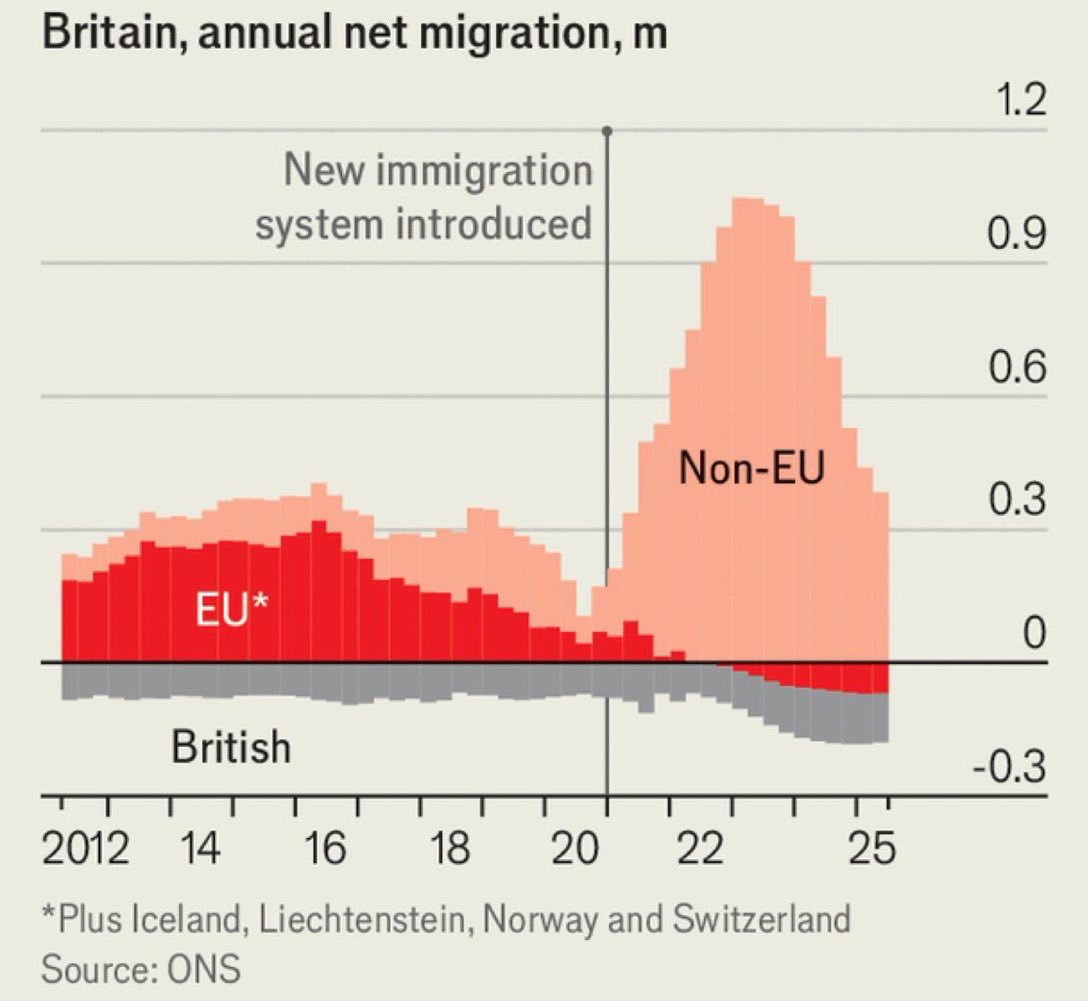
Isn't it ironic that many Brits voted for Brexit because they wanted immigration to go down? How did this happen? https://t.co/W8PytSg3DM
Sometimes those maintenance tasks are too easy to do yourself. 🙃 Prompt Copilot to do them all via the /fleet command. ✅ https://t.co/lhN8vViZ1U
I’m convinced @jxnlco is the single most performative man in AI https://t.co/oeM23xFUn3

https://t.co/CCzZzsDnzG
I’m convinced @jxnlco is the single most performative man in AI https://t.co/oeM23xFUn3

I'm getting 2x ratiod for being right. the absolute state of this place man https://t.co/ihSnMlSu4S

The first humanoids in our homes might not look human at all. They might just be vacuum robots that slowly evolve arms, tools, and intelligence. Evolution, but in hardware. via Peter Kappes #Ai #robotics #innovation https://t.co/6AbmG6WPOY
Today's the third time this year I’ve heard someone’s partner died in their sleep. Third. I must blurt the uncomfortable truth out loud. this is often an engineering problem. We need hardware-AI. And you might already own some of the fitness trackers that get us there. 🧵 https://t.co/zfeZ5aCf4d

15K stars already!? Great idea. CLIs work amazingly well with coding agents. Worth playing around with. Do run a lot of tests if you are planning to use this to build tools. https://t.co/Aigh3uAI5Y

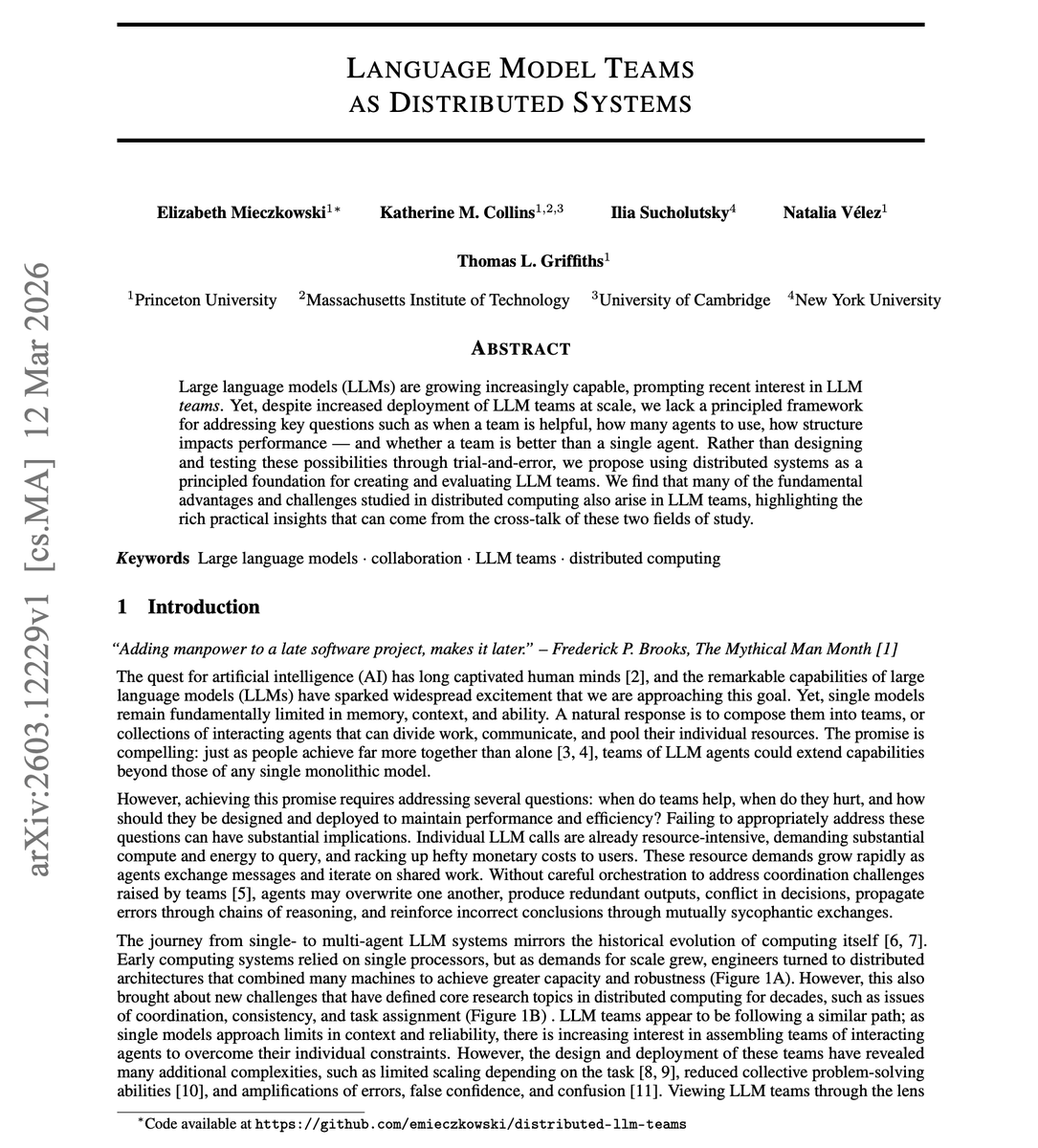
We mostly solved multi-node coordination decades ago in distributed computing. Turns out LLM teams face some of the same coordination problems today. Here is a really good read for anyone designing multi-agent systems. It applies distributed systems theory to LLM teams and finds the same O(n²) communication bottlenecks, straggler delays, and consistency conflicts showing up directly. Decentralized teams wasted more rounds communicating without making progress, but they also recovered faster when individual agents stalled. How does this relate to distributed systems? The work attempts to evaluate LLM teams as distributed systems. It lays out a principled framework instead of trial and error for deciding when teams help, how many agents to use, and what coordination structure fits the task. Designing LLM teams without distributed systems principles is like building a cluster without understanding consensus protocols. Paper: https://t.co/klHzUFJL1R

Not the same unforch. I tried. https://t.co/M7Gp7Silxt

@satyanadella Awesome to see this model on @huggingface 🤗 https://t.co/0SKw15VPkd

@satyanadella Awesome to see this model on @huggingface 🤗 https://t.co/0SKw15VPkd

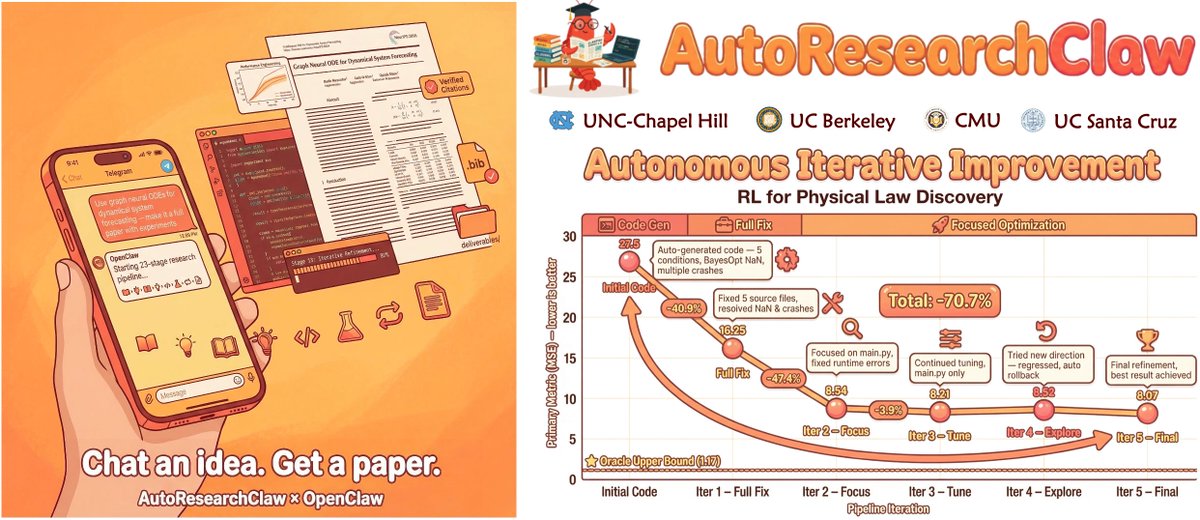
Everyone's excited about Karpathy's autoresearch that automates the experiment loop. We automated the whole damn thing. 🦞 Meet AutoResearchClaw: one message in, full conference paper out. Real experiments. Real citations. Real code. No human in the loop. One message in → full paper out. Here's what happens in between: 📚 Raids arXiv & Semantic Scholar, digests 50+ papers in minutes 🥊 Three AI agents FIGHT over the best hypothesis (one swings big, one sanity-checks, one tries to kill every idea) 💻 Writes experiment code from scratch, adapts to your hardware 💥 Code crashes at 3am? It reads the stack trace, rewrites the fix, keeps going 🔄 Results weak? It pivots to entirely new hypotheses and starts over 📝 Drafts a full paper with citations, every single one verified against live databases No babysitting. No Slack messages. No "hey can you re-run this." Karpathy built the experiment loop. We built the whole lab. Chat an idea. Get a paper. 🦞 Try it 👉: https://t.co/KLOcnzFYaD Kudos to the team @JiaqiLiu835914, @richardxp888, @lillianwei423, @StephenQS0710, @Xinyu2ML, @HaoqinT, @zhengop, @cihangxie, @dingmyu, and we are looking for more contributors.