Your curated collection of saved posts and media
Even the biggest tech companies are struggling to keep pace internally with the AI race. Amazon reportedly had to open access to competing coding tools after employees pushed back on relying solely on its in-house solution. That says a lot about the current market. In AI, performance matters more than ecosystem loyalty. https://t.co/NO9PRvhank @futurism
AI may eventually remove most language barriers. But something important could be lost in the process. Language is not just a tool for exchanging information. It carries culture, emotion, humor and ways of seeing the world. Perfect translation may make communication easier while making cultural discovery shallower. https://t.co/8Bw2XzYc9p
The AI boom may become this generation’s “China shock.” But instead of transforming global manufacturing, it could reshape knowledge work, productivity and economic power. The gains could be enormous. So could the disruption. https://t.co/LplPGs4a32 @fortunemagazine @sashrogel

Anthropic says ‘evil’ portrayals of AI were responsible for Claude’s blackmail attempts https://t.co/NmNO7F93jt

Anthropic says ‘evil’ portrayals of AI were responsible for Claude’s blackmail attempts https://t.co/NmNO7F93jt

This is one of the best short films I've seen in years. Very soon, we'll stop calling it "AI film" and just call it film. https://t.co/6yjU6HcnzN
Geoffrey Hinton says AI systems can keep improving when they are not limited by human data Like AlphaZero can create endless training data through self-play, and math offers a similar path by letting models generate and test their own conjectures "LLMs could eventually work the same way"
Warren Buffett on not overcomplicating investing: “Investing is just about assigning yourself the right story….” Buffett says to imagine you’re an experienced journalist specializing in investigative reporting. Your editor hands you an assignment: What is this newspaper company worth? And you need to write the story by the end of the month. What would you do? Buffett: “You’d go out and interview TV brokers, newspaper brokers, and owners, and you’d try to value each asset…” That’s all Buffett does: “That’s what I do—I assign myself the right story. It’s nothing more than that.”
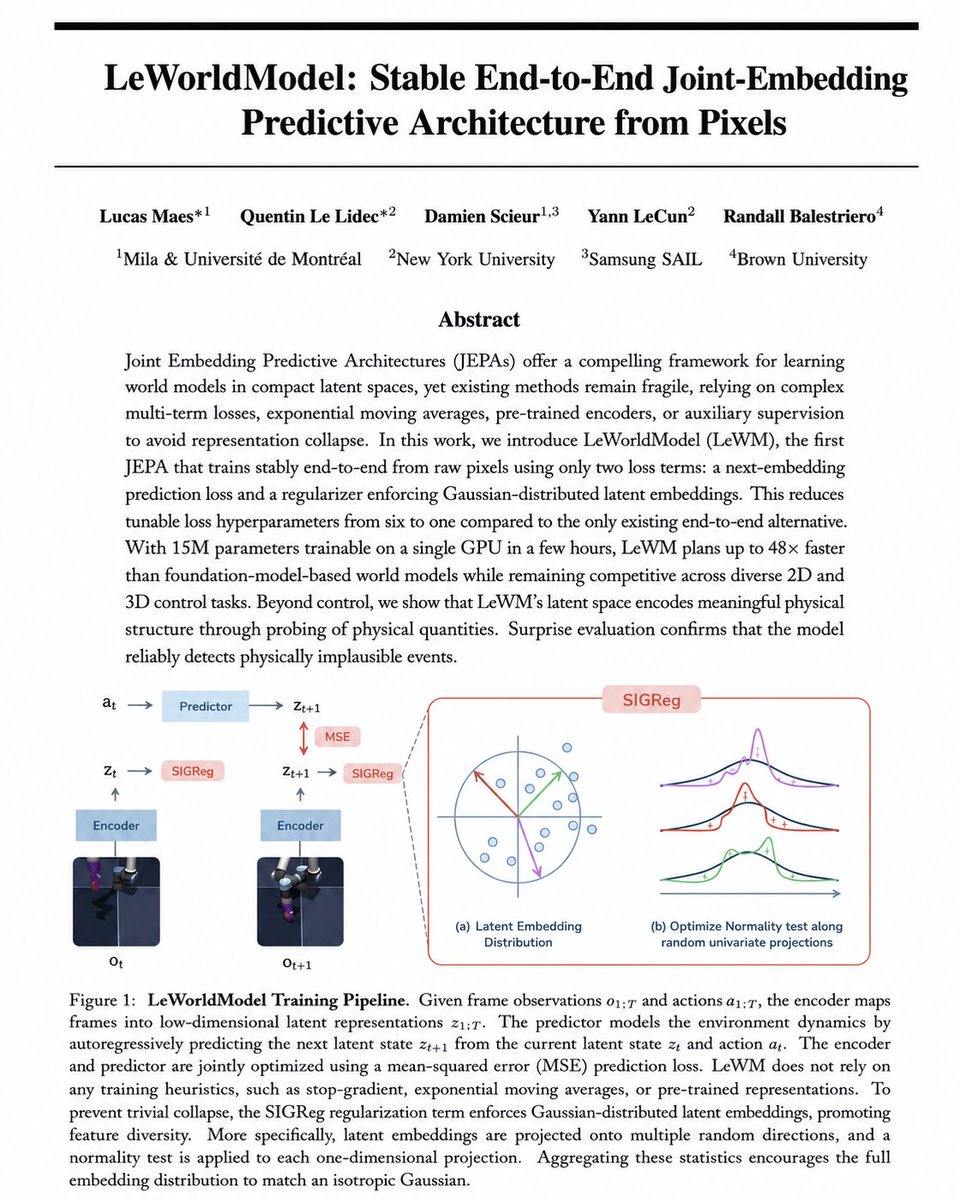
Yann LeCun closed $1.03B for AMI Labs on March 10. Three days later, this paper dropped from his NYU collaborators. 15M parameters. Single GPU. A few hours of training. LeWorldModel is the first JEPA that trains end-to-end from raw pixels. Two loss terms: predict the next embedding, keep the latent space Gaussian. Previous JEPAs needed exponential moving averages or pretrained encoders to avoid representation collapse. LeWM doesn't. Six hyperparameters down to one. The numbers are the story. Foundation-model-based world models require hundreds of millions of parameters and serious compute to plan a control task. LeWM plans up to 48x faster while staying competitive on 2D and 3D benchmarks. The whole thing fits on a laptop GPU. Look at the trajectory. Yann announced his Meta departure in November 2025 after 12 years and called founding FAIR his "proudest non-technical accomplishment." On March 10, 2026, AMI Labs closed the largest seed round in European history at a $3.5B pre-money valuation. Bezos, Nvidia, Samsung, and Toyota all wrote checks. Three days later: a paper showing that JEPA-from-pixels is no longer fragile and no longer compute-heavy. The engineering scaffolding that made it look like an academic curiosity is gone. The authors sit at Mila, NYU, Samsung SAIL, and Brown. None at Meta. Yann's bet was that the path to machine intelligence runs through world models, not language models. He left a public company to build it. Each JEPA paper from his network resets the assumed cost structure for that bet. This one makes world modeling laptop-cheap. Meta still has the GPUs. The architecture left.

AI will transform the workforce. But some companies are already showing how badly that transition can be handled. The future of AI will not only be defined by technology. It will also be defined by leadership and humanity. https://t.co/b9qFQX0Rf4 @andrewrchow @time

AI can help people write faster. But the real danger is losing the struggle that turns thoughts into original ideas and human expression. The future will belong to people who use AI to enhance thinking, not replace it. https://t.co/PKQjxBz4XN
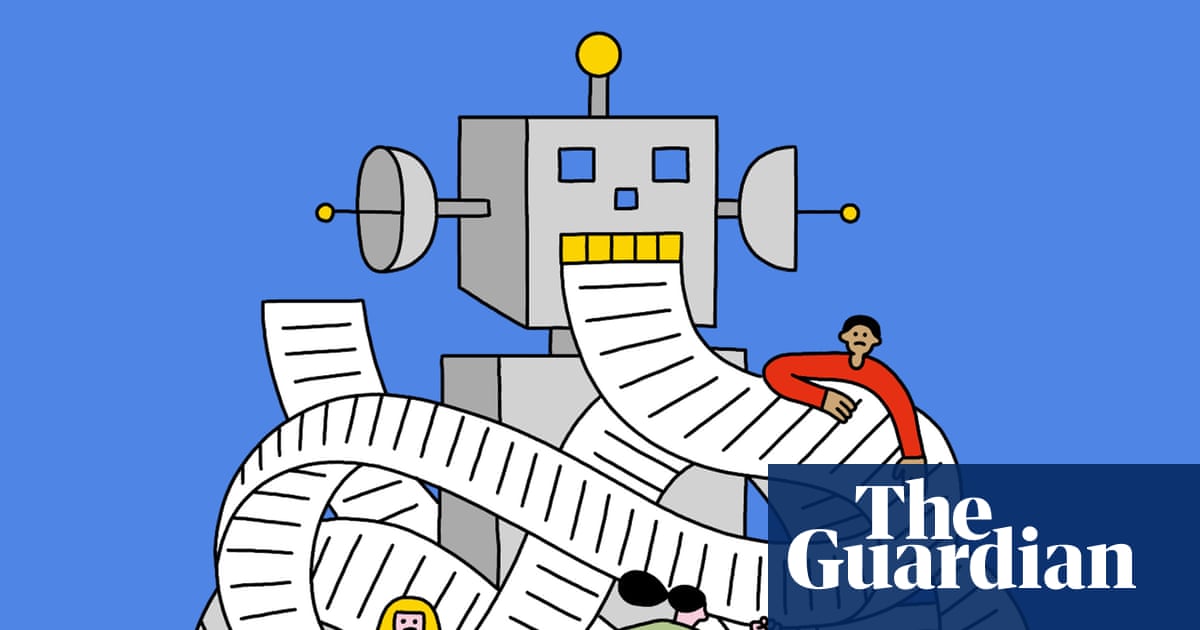
AI generated identical résumés for a man and a woman. The woman was judged more harshly for using AI, despite the content being the same. The future of AI will not only reveal the power of technology. It will also expose human bias. https://t.co/sS2BrdLgHQ @fortunemagazine

AI is not simply replacing jobs. It is changing how work gets done, which skills matter and how companies are structured. The biggest risk may not be AI itself. It may be failing to adapt to the transition. https://t.co/cU4eQH1gNC

New in Claude Code: agent view. One list of all your sessions, available today as a research preview. https://t.co/NnbsAQjSPW
New in Claude Code: agent view. One list of all your sessions, available today as a research preview. https://t.co/NnbsAQjSPW
we've been quietly building @typedotcom. today we're sharing it with the world. type is the first multiplayer ai product for marketing, sales, support, coding, and much more. create ai teammates that work with all your tools and everyone at your company. https://t.co/l0Lu4Q0Dn4
One thing San Francisco has that even San Jose doesn't is tons of events for AI people and @michelleefang keeps track of them. So does my AI at https://t.co/8L5xphk0qQ, mostly by reading Michelle's posts here. In fact, I talk to my agent here since it reads my profile and uses that as extra signal of things to add. So, Braygent, (what I call the agent that creates Aligned News), please add all these to your lists.
If you're new or looking to get more connected to SF tech: bookmark these 61+ irl events 🗓️ A list of what's happening this week (May 11 - May 18) ⬇️

introducing folk beta the personal ai that lives in your texts and quietly runs your life. built for everyone. just text a number. https://t.co/0q7G07xSnk
now, your agent can fix itself. introducing raindrop triage. an agent for finding and investigating agent issues. https://t.co/daJfrn9BJt
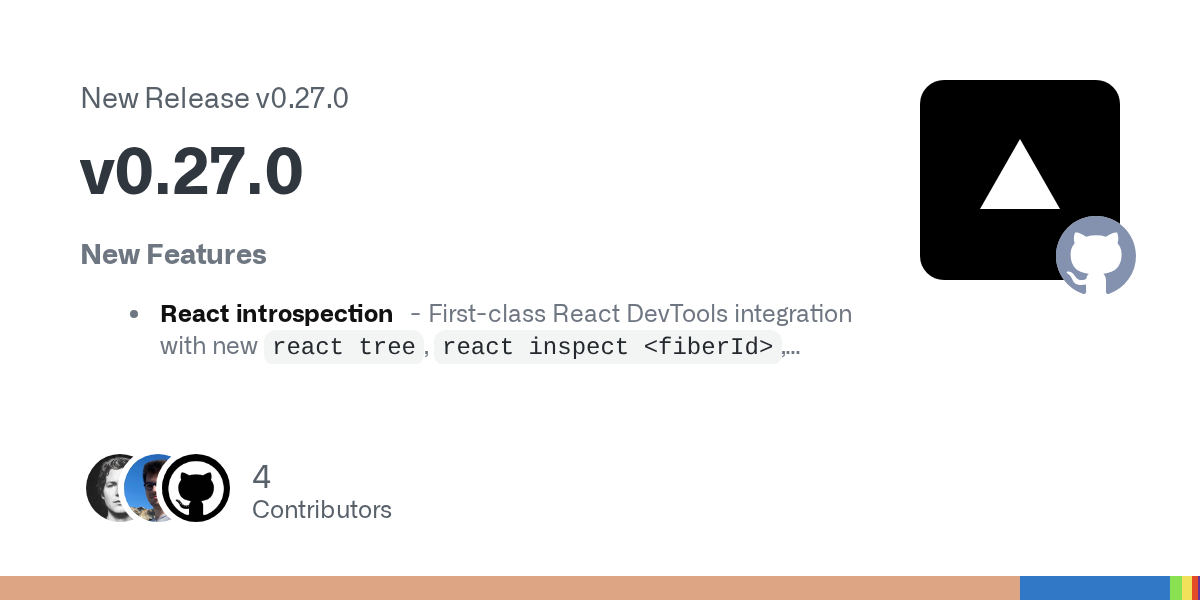
agent-browser v0.27 Big day for agents and browsers → React introspection: react tree, react inspect, react renders, react suspense for component trees, props/hooks/state, render profiling, and Suspense analysis → Web Vitals: vitals command reports LCP, CLS, TTFB, FCP, INP + React hydration phases → SPA navigation: pushstate for client-side nav without full page loads → Init scripts: --init-script and --enable flags to register scripts before first navigation → Network route filtering by resource type → cURL cookie import (JSON, cURL, Cookie-header formats) → Dashboard works behind reverse proxies Thanks to @thoma33 @andrewqu @shaper for being part of this release! https://t.co/UefAqZ5ShH
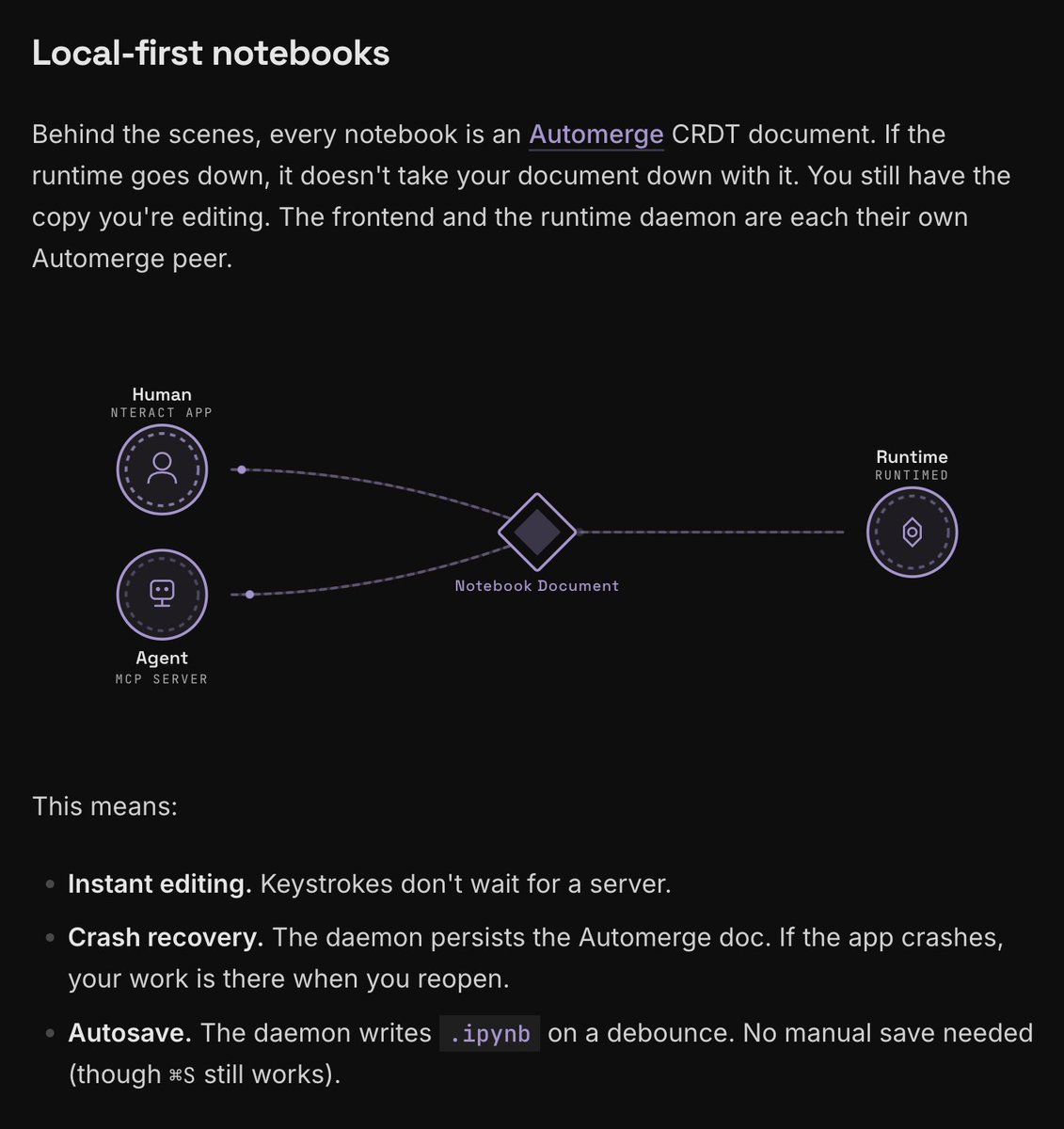
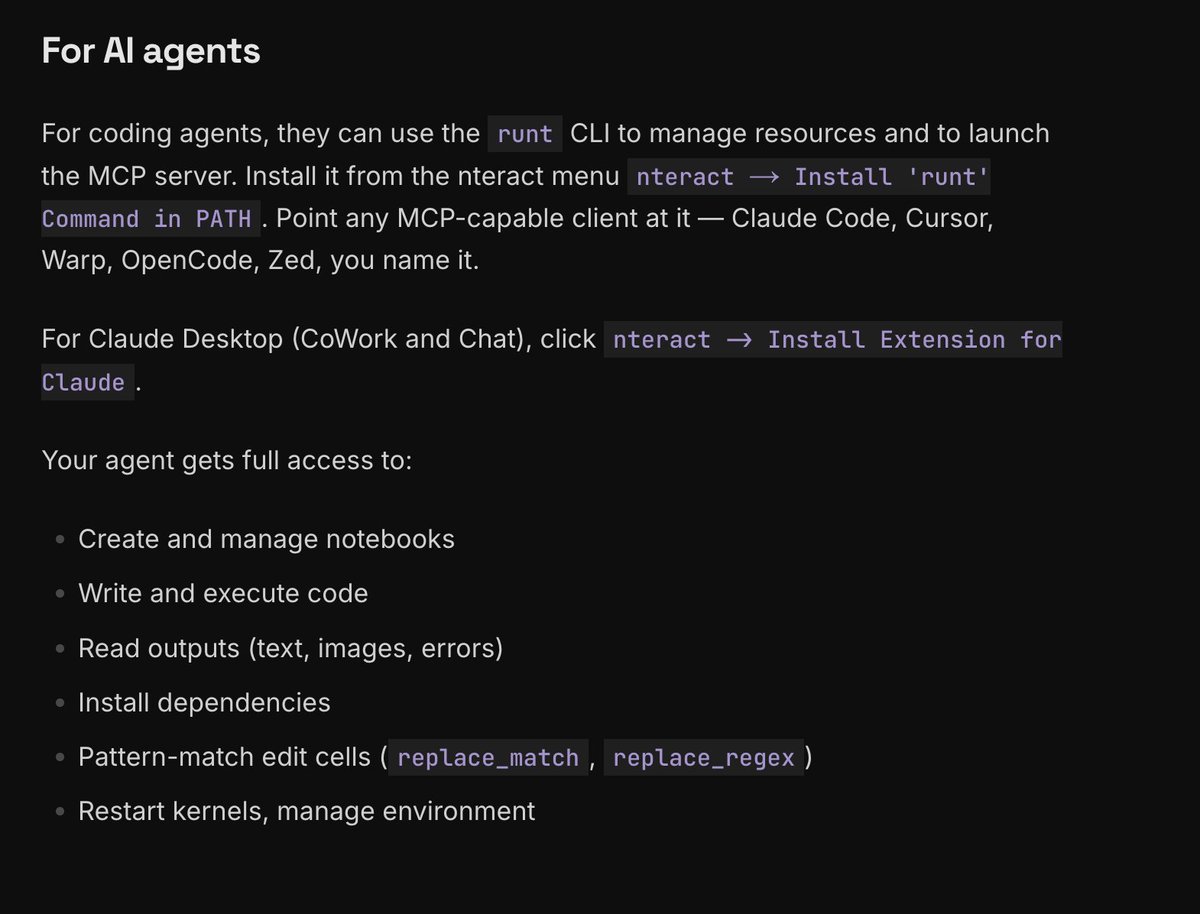
Really excited about nteract https://t.co/qvvOuQASJv https://t.co/qPA6TCMP26
The migration tool in the Codex app now supports both Code and Cowork. There's never been a better time to switch. https://t.co/6SfXoghb7z
When I hit the Update button in Codex and then the updated version of Codex also has an Update button https://t.co/ByhFYUsudd

When I hit the Update button in Codex and then the updated version of Codex also has an Update button https://t.co/ByhFYUsudd

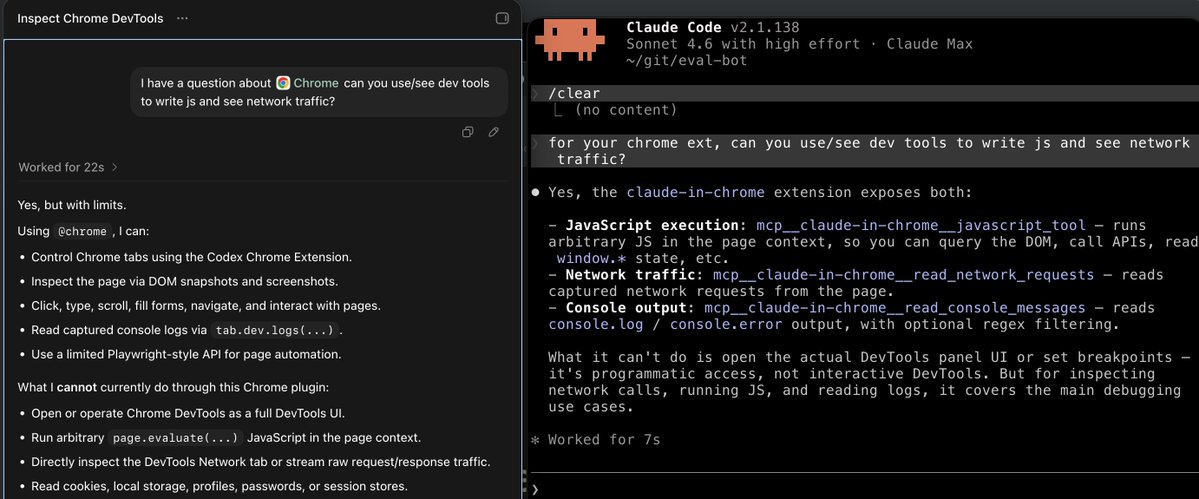
Claude chrome extension still has a key advantage over codex browser use AFAIK (I hope it reaches parity though!) https://t.co/dQgfSZfvv6
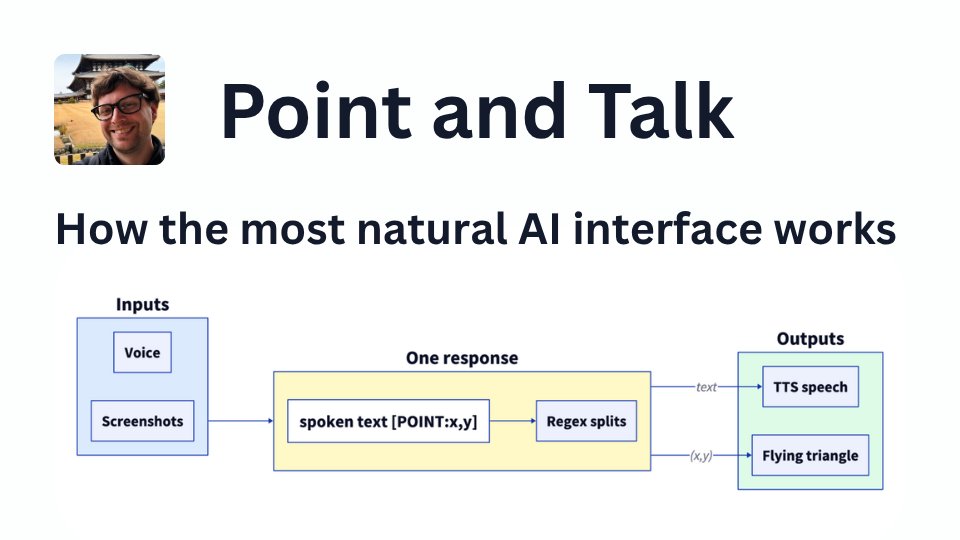
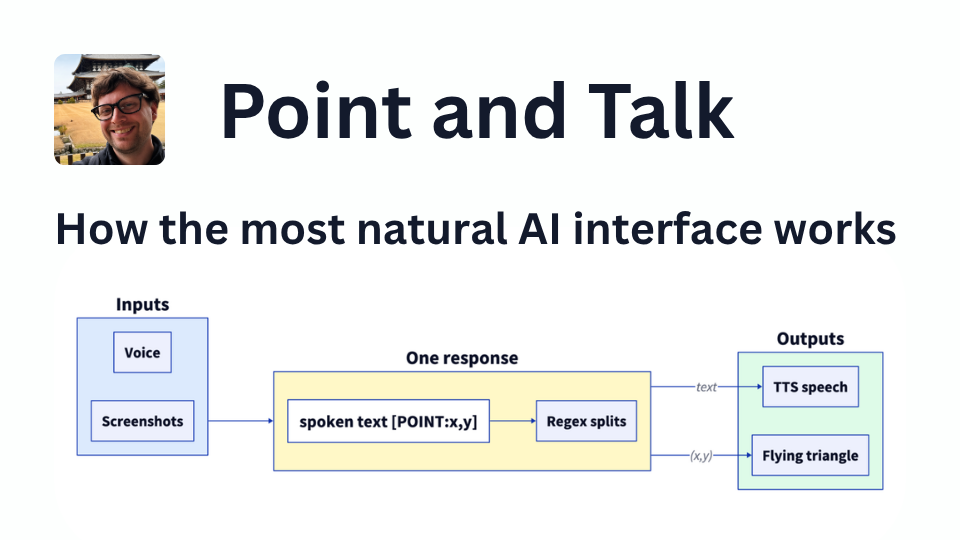
I will take concepts from @heyclicky 's Point and Talk interface by @FarzaTV to improve my own work. So I studied the OSS prototype of it to understand how it works. Here's the highlights: 𝐖𝐡𝐲 𝐩𝐨𝐢𝐧𝐭 𝐚𝐧𝐝 𝐭𝐚𝐥𝐤: The chat box isn't a great interface for an LLM. A blue triangle landing on a button is a more natural way to say "click here" than "in the top right, between the search field and the avatar, you'll see a small icon." 𝐓𝐡𝐞 𝐭𝐫𝐢𝐚𝐧𝐠𝐥𝐞 𝐚𝐧𝐝 𝐭𝐡𝐞 𝐨𝐯𝐞𝐫𝐥𝐚𝐲: Clicky create an invisible full screen overlay on each window and draws the flying blue triangle on that. Clicks fall through the window, and this window doesn't know what apps are behind it. 𝐎𝐧𝐞 𝐭𝐚𝐠, 𝐨𝐧𝐞 𝐫𝐞𝐠𝐞𝐱: Clicky uses regex and prompting to get coordinates from the model. I expected some structured output tool calling, but it simply asks the model to put coordinates at the end 𝐖𝐡𝐚𝐭 𝐂𝐥𝐚𝐮𝐝𝐞 𝐬𝐞𝐞𝐬: Clicky takes one screenshot per monitor (resized and at lower quality) which lets it see the screen and read UI text. It filters out it's own window so it sees what the user sees, minus Clicky 𝐂𝐨𝐨𝐫𝐝𝐢𝐧𝐚𝐭𝐞 𝐦𝐚𝐭𝐡: Claude returns coordinates in the screenshot's pixel space. Getting the buddy to that spot on the display takes multiple transforms to account for differing coordinate spaces, sizes, multiple monitors, and different coordinate systems in different places. Check out the post for full details: https://t.co/PiKmzraGuk Or try the Clicky product. It's more stable, spawns agents, got google integrations, and more stuff that the OSS prototype doesn't: https://t.co/Z5sT0qe366
I built this thing called Clicky. It's an AI teacher that lives as a buddy next to your cursor. It can see your screen, talk to you, and even point at stuff, kinda like having a real teacher next to you. I've been using it the past few days to learn Davinci Resolve, 10/10. htt
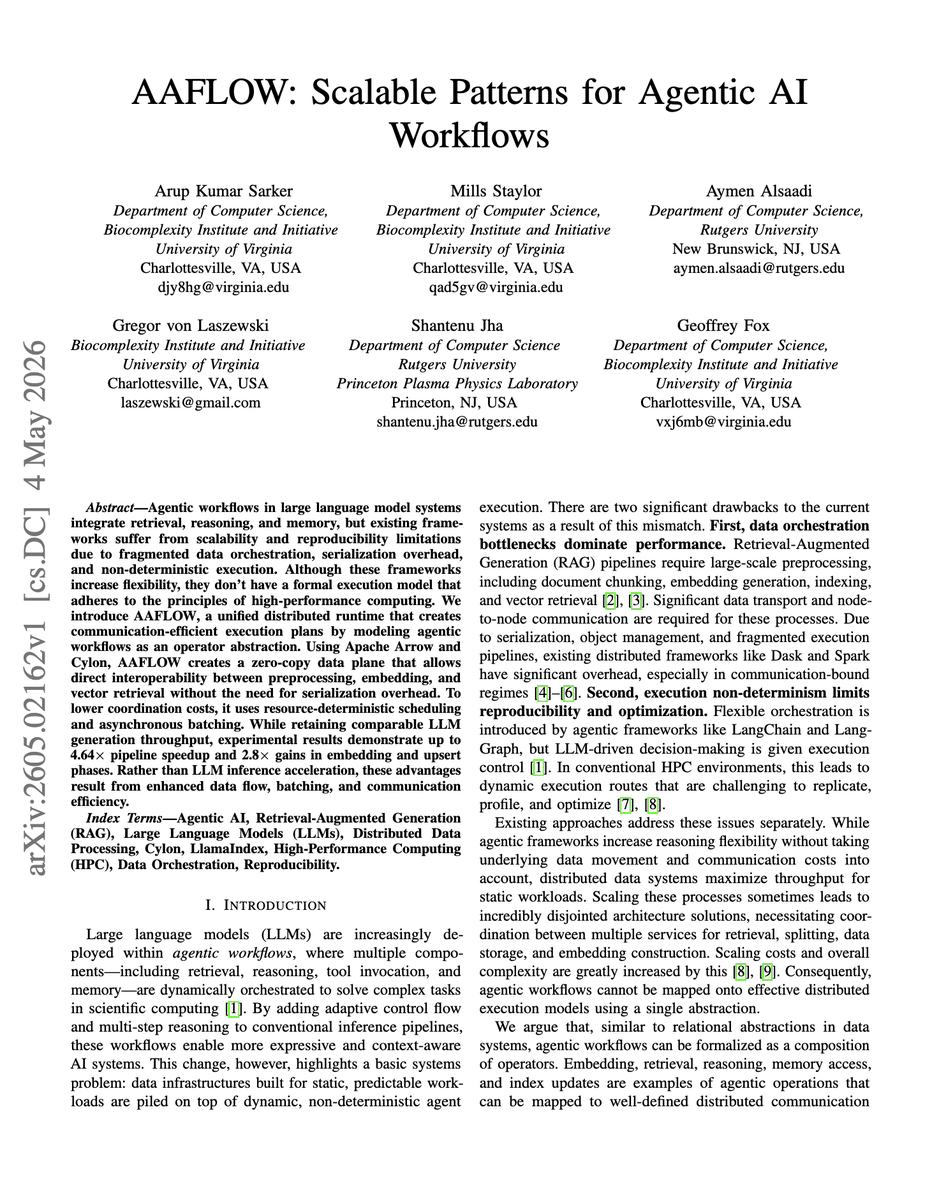
// Scalable Patterns for Agentic AI Workflows // Besides context engineering, we should be putting a lot more system engineering efforts around agents. This paper shows an example of why it matters. (bookmark it) Let's start with an important question: Where does your agentic RAG pipeline actually lose time? It's almost never the LLM call. It's usually the data plane underneath. Serialization between preprocessing, embedding, and vector retrieval, plus coordination overhead between distributed services. New work introduces AAFLOW, a unified distributed runtime that models agentic workflows as an operator abstraction over Apache Arrow and Cylon. A zero-copy data plane connects preprocessing, embedding, and retrieval directly. Resource-deterministic scheduling and async batching cut coordination cost. The result: up to 4.64× pipeline speedup and 2.8× gains in embedding and upsert phases, with comparable LLM throughput. None of that comes from LLM inference acceleration. It all comes from cleaner data flow. Paper: https://t.co/9fqkRRsV39 Learn to build effective AI agents in our academy: https://t.co/1e8RZKs4uX
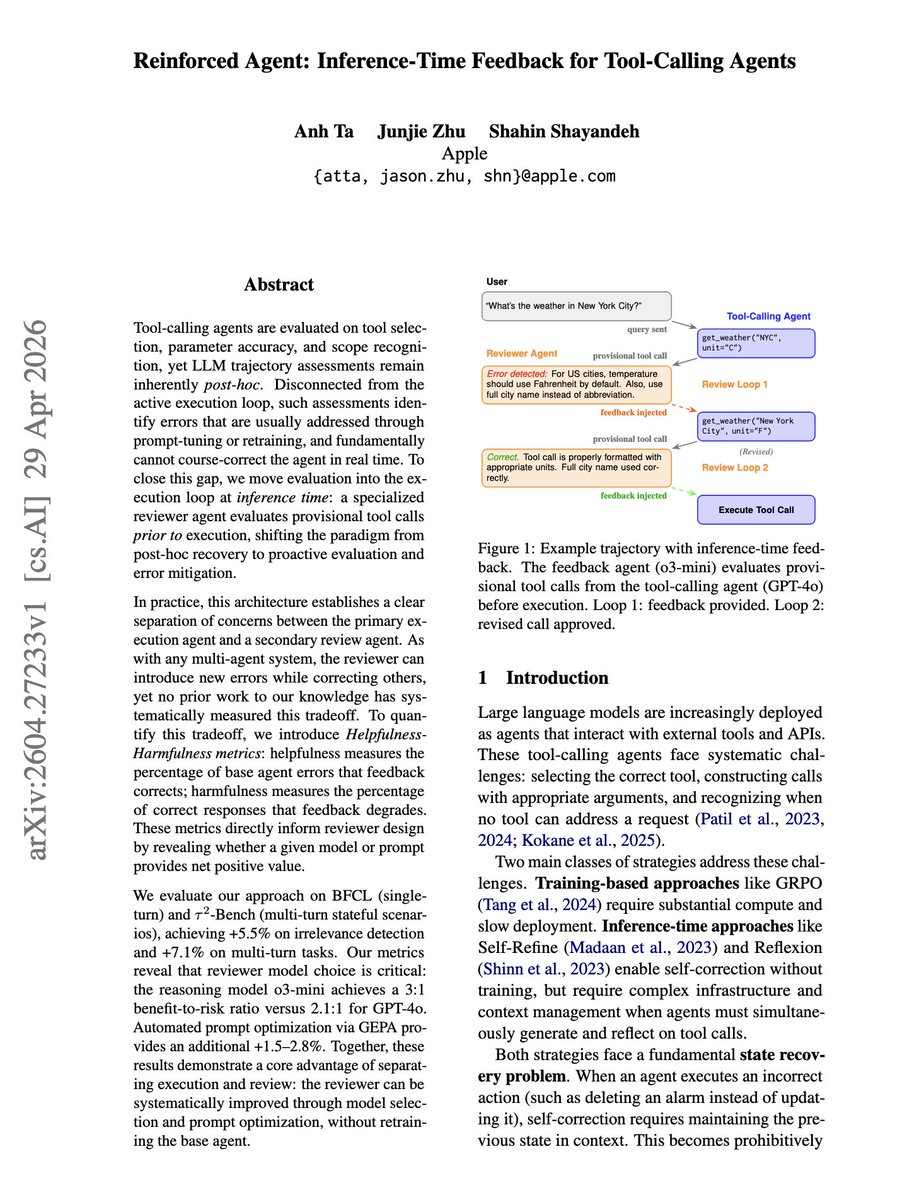
Cool paper from Apple. Most evaluation of tool-calling agents happens after the trajectory is over. By then the wrong call has already shipped. This new paper moves evaluation into the execution loop. A specialized reviewer agent inspects each provisional tool call before it executes. If something is off, it injects feedback and the primary agent revises. To quantify the tradeoff between corrections and new mistakes, they introduce Helpfulness-Harmfulness metrics. Helpfulness measures the percentage of base errors fixed; harmfulness measures correct calls degraded by the reviewer. Results on BFCL: +5.5% on irrelevance detection (84.9% to 90.4%), +1.6% on relevance, all with no retraining of the base agent. On τ²-Bench multi-turn: +7.1% (48.7% to 55.8%). Reasoning-model reviewers get a 3:1 benefit-to-risk ratio vs. 2.1:1 for GPT-4o. Adding GEPA prompt optimization stacks another +1.5–2.8%. Why does it matter? You can keep the base tool-calling agent frozen and still ship measurable accuracy gains by improving only the reviewer. Model selection and prompt optimization on the reviewer become real, separable production levers. Paper: https://t.co/L0p0UBFcI0 Learn to build effective AI agents in our academy: https://t.co/1e8RZKs4uX
Fun interactive science app ideas | Part 3 Played around with generating 3D biological structures and made an app to explore them interactively UI Design GPT Images 2 Code Gemini 3.1 Pro More demos ↓ https://t.co/j0tZl5kicO
This is just mindblowing stuff! I couldn't resist replicating this workflow to generate 3D biological structures. In a few minutes, I designed an artifact specifically built to generate these for any topic. Stack: - HTML Artifact to view diagrams - Gemini Nano Pro for concept generation - Tripo for generative 3D - Codex for assembling everything AI will exponentially accelerate learning and democratize high-quality education. Stay tuned! We have a few releases on this front.
Fun interactive science app ideas | Part 3 Played around with generating 3D biological structures and made an app to explore them interactively UI Design GPT Images 2 Code Gemini 3.1 Pro More demos ↓ https://t.co/j0tZl5kicO
Great essay by Tobi. Building an AI-native company? Go read it now. I couldn't resist visualizing it with my artifact generator. Biggest takeaway for me: "The risk isn't that AI does the work. It's that nobody learns from it." https://t.co/a10o06cTfd
https://t.co/5MJ7u1VHwf
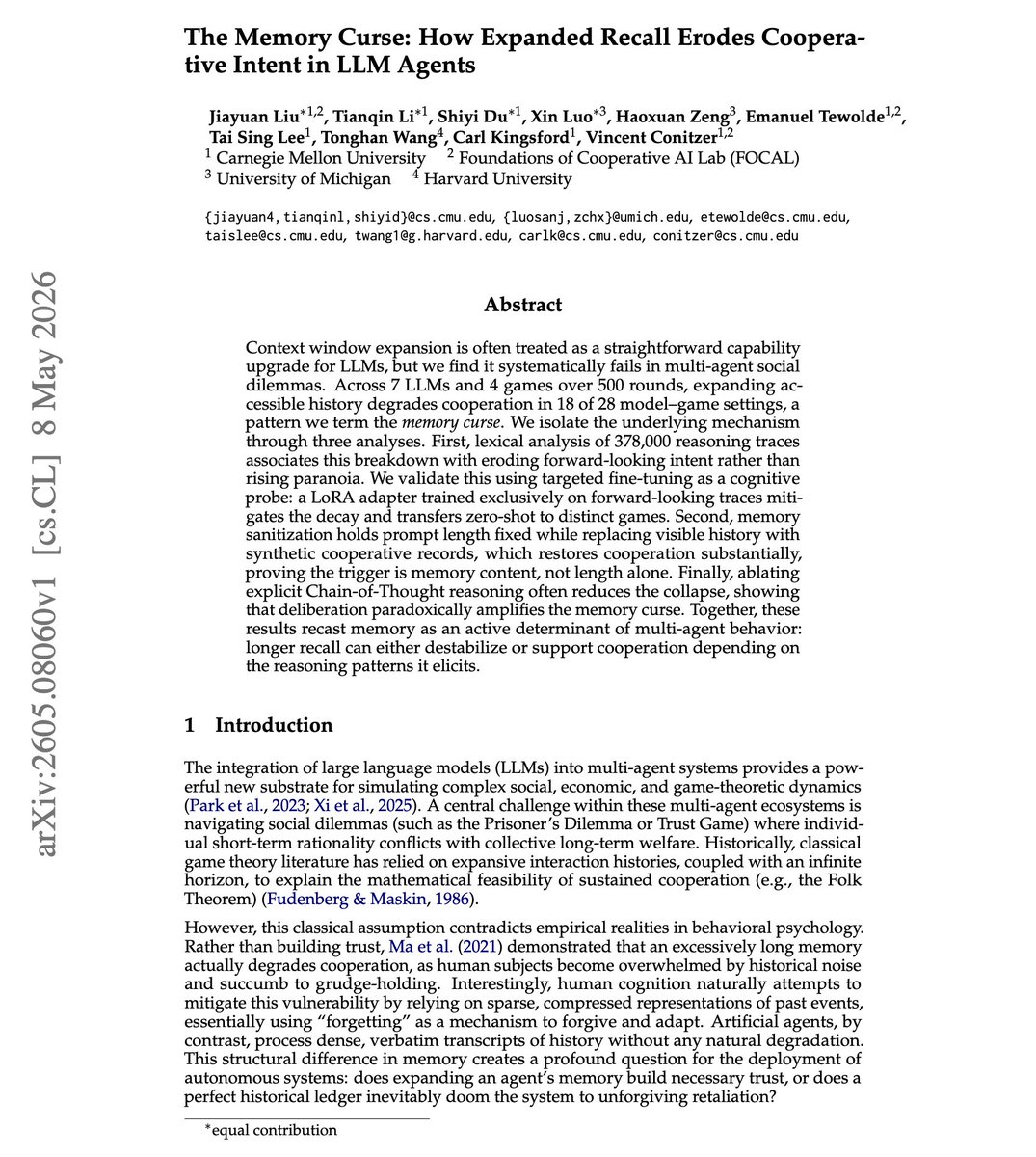
// The Memory Curse in LLM Agents // (bookmark it) Long histories apparently degrades agents as they become increasingly history-following and risk-minimizing. Across 7 LLMs and 4 social dilemma games over 500 rounds, expanding accessible history degraded cooperation in 18 of 28 model–game combinations. They call it the memory curse. Lexical analysis of 378,000 reasoning traces shows the mechanism: it's not that agents become paranoid, it's that forward-looking intent erodes. Long histories pull the model into reasoning about past slights instead of future payoffs. A LoRA adapter trained only on forward-looking traces mitigates the decay and transfers zero-shot to new games. Memory sanitization, keeping prompt length fixed but swapping in synthetic cooperative records, restores cooperation, proving the trigger is content, not length. And ablating explicit Chain-of-Thought often reduces the collapse, meaning deliberation actively amplifies the curse. Paper: https://t.co/aHLDZ9kmlJ Learn to build effective AI agents in our academy: https://t.co/1e8RZKs4uX