@omarsar0
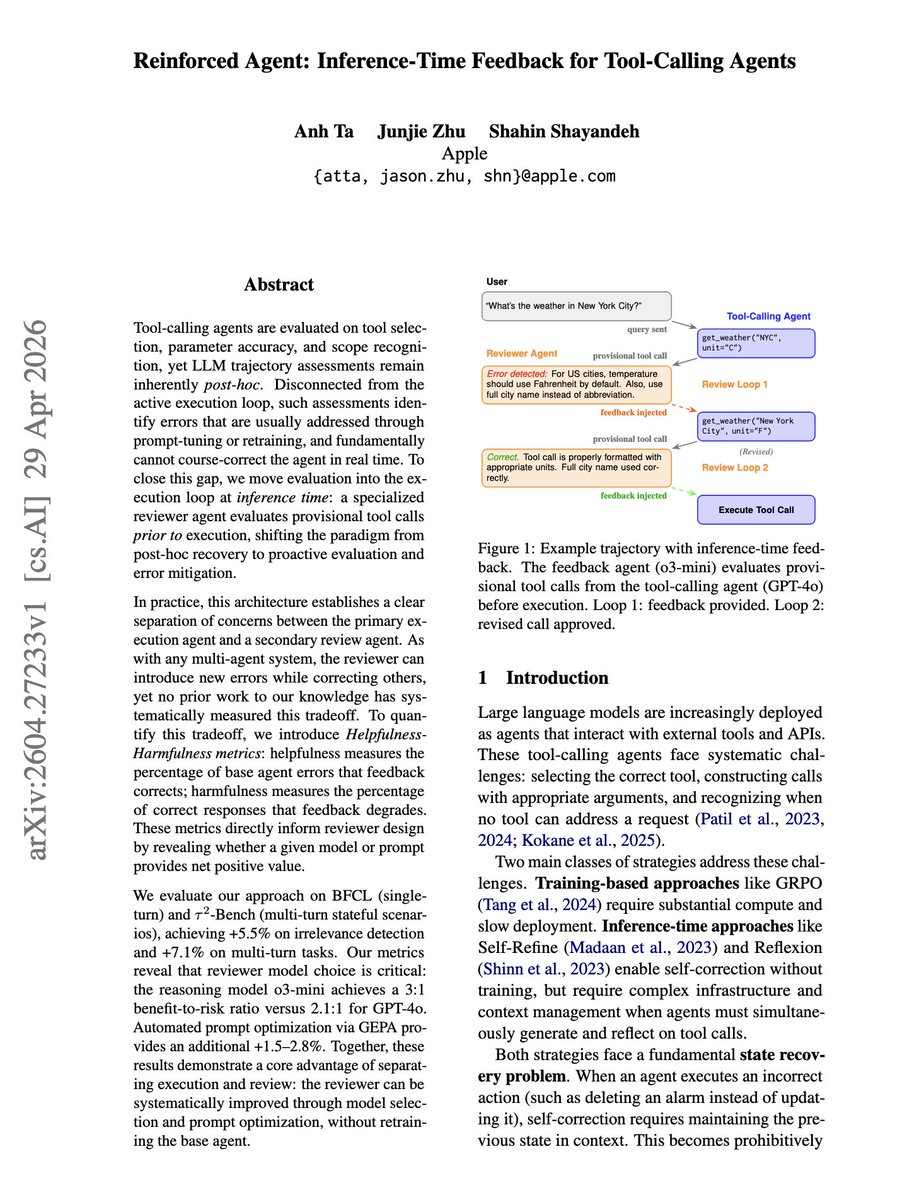
Cool paper from Apple. Most evaluation of tool-calling agents happens after the trajectory is over. By then the wrong call has already shipped. This new paper moves evaluation into the execution loop. A specialized reviewer agent inspects each provisional tool call before it executes. If something is off, it injects feedback and the primary agent revises. To quantify the tradeoff between corrections and new mistakes, they introduce Helpfulness-Harmfulness metrics. Helpfulness measures the percentage of base errors fixed; harmfulness measures correct calls degraded by the reviewer. Results on BFCL: +5.5% on irrelevance detection (84.9% to 90.4%), +1.6% on relevance, all with no retraining of the base agent. On τ²-Bench multi-turn: +7.1% (48.7% to 55.8%). Reasoning-model reviewers get a 3:1 benefit-to-risk ratio vs. 2.1:1 for GPT-4o. Adding GEPA prompt optimization stacks another +1.5–2.8%. Why does it matter? You can keep the base tool-calling agent frozen and still ship measurable accuracy gains by improving only the reviewer. Model selection and prompt optimization on the reviewer become real, separable production levers. Paper: https://t.co/L0p0UBFcI0 Learn to build effective AI agents in our academy: https://t.co/1e8RZKs4uX