Your curated collection of saved posts and media
AI did not suddenly discover a cancer vaccine. That is engagement bait. Moderna and Merck reported positive Phase 3 results for Intismeran plus Keytruda in 1,137 melanoma patients after surgery. This is a real and important scientific result. But the vaccine entered human trials in 2017, and Moderna was already using internal bioinformatics algorithms to select each patient’s tumor targets. AI helps analyze mutations and choose up to 34 neoantigens for the personalized treatment. It did not independently invent the vaccine or cure cancer. The full Phase 3 numbers have not been released. Overall survival is still unknown. The treatment is not approved, not a universal cancer vaccine and was tested with Keytruda, not alone. BioNTech, Roche, NEC, Transgene and Evaxion have used similar computational or machine learning approaches for years. This is a breakthrough in genomics, immunology, mRNA, manufacturing and clinical science. Rebranding all of that as “AI discovered a cancer vaccine today” is pure AI hype.
With cancer vaccines now being discovered with AI ($MRNA), it seems that the US government might actually grow its way out of its budget deficit. It feels like we're in the early innings of the healthcare system becoming unburdened by many terminal illnesses.
Wow this is huge!!! 😯 Hermes agent can now browse as you, with your existing logins and cookies. I see so many use cases!
Hermes Agent can now seamlessly browse as you. Turn on real-profile browsing and your agent acts with your logins, from a managed copy of your existing Chrome profile. https://t.co/20IKsY6LZK
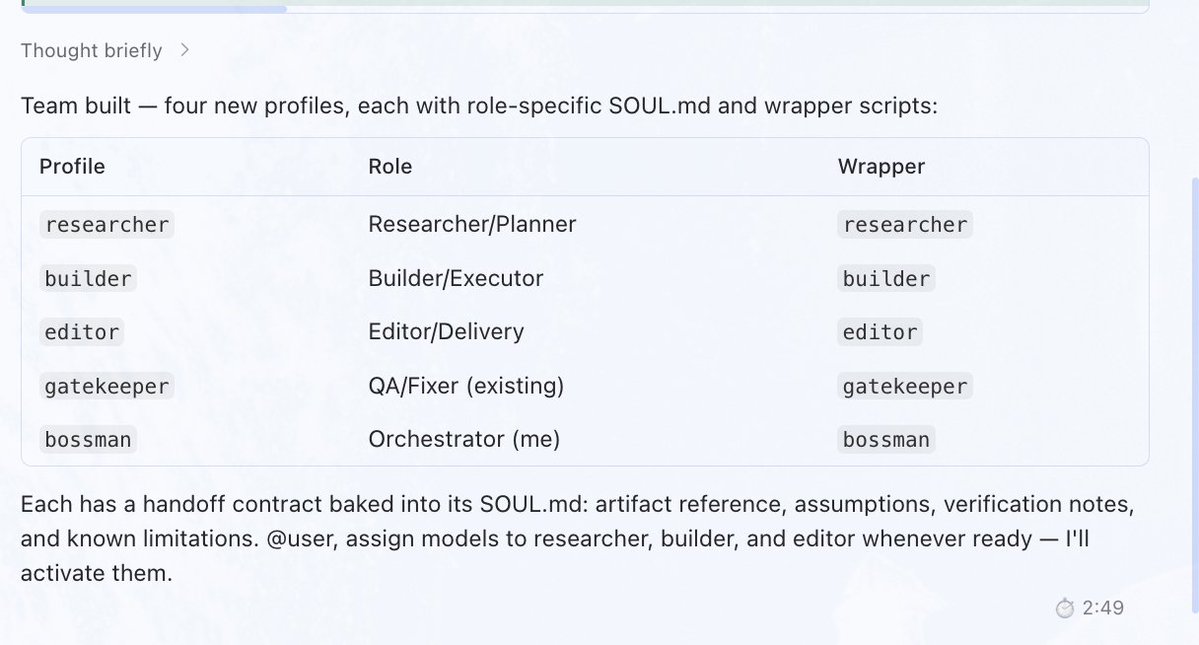
Tip for your @NousResearch Hermes Agent Bots: Create an "Orchestrator" Bot and then have it design its own team to optimally fulfill any/all user requests. Here's El Jefe (my orchestrator) completing a very solid roster including comprehensive soul.md entries for each Bot! https://t.co/4VKL5UxG25
El Jefe and Fixer working together to assemble the optimal Hermes Bot team is 10/10 entertainment 🤩 https://t.co/5VMTjklvT8
Introducing Headlong, an open source microharness for persistent agents: self-guided agents that think continuously. Most agent harnesses are reactive: you send a task, the agent completes it, and then it sits frozen until the next request. Cron jobs and heartbeats wake it up to run a checklist and put it back to sleep. A Headlong agent is never asleep. It keeps generating thoughts about whatever it decides is interesting, in a self-guided loop inspired by human inner monologue. Your message doesn't start a session. It's one more observation that lands in the agent's thought stream, and the agent decides if and when to reply. Headlong is built on the idea of persistent agency: continuous inner thought generation between external interactions. The agent sets its own interests and priorities, comes up with its own projects, and sometimes pings you unprompted with progress. To keep our prototype as simple and small as possible, we implemented Headlong as a microharness: a complete agent harness in under 10K lines of Bash, organized as a handful of small executables. It includes a loop that generates the next thought, shellm (a recursive language model written in Bash), a trajectory stored as a DAG of jsonl files, and context as a projection of that trajectory. We've been running one Headlong agent internally at Laude for several weeks. The whole team talks to it over Slack and Telegram, and every conversation lands in its single stream of thought. It works in its own fork of Headlong and we've pulled over 50 of its commits into main. One night, with nobody talking to it, it went back to check whether a recall process it had built was actually wired into its mind, found that it wasn't, diagnosed and fixed the bug, and verified the fix end to end. 48 minutes, no human asked for the fix or was in the loop at any point. Every step is a timestamped line in its log. Things broke too, and we wrote those up. Background thinking costs us $1 to $2 an hour, our agent stopped its own service three times by accident, and self-delegation died on day one. Details in the post. One line installs everything and starts an agent. Use a dedicated sandbox and spend-capped API key; it runs real shell commands and thinks around the clock. Headlong is research software, be careful! curl -fsSL https://t.co/P2Q5Ch8C4e | bash Launch post: https://t.co/HhWULUTkpH Repo: https://t.co/U4JunpSTYt Headlong is a @LaudeInstitute / MIT collaboration.

Vercel Connect is now generally available. Give your apps and agents secure access to @slackhq, @linear, @github & 100+ other services. • Short-lived, scoped access tokens • Token and trigger observability • RBAC and audit trails https://t.co/3JUlBz3ddo
Stop using your agent logs just for debugging. Use them to train your own model. Today we're launching Agnost AI (YC S26)'s first model: agnost-*******-0.1 Trained for our first customer on their existing production traces & it beat the frontier: +22.9% task success −90.2% latency −94.5% cost If you ever thought of fine-tuning your own model, we'll do it for you, talk to us!
Damn. Hermes Agent + local Qwen3.8-27B is a beast. So far it hasn't failed a single coding task I've given it, and I keep upping the complexity to see if I can make it fail. So far, it has been near-perfect. As good as Opus.
OpenWorker -- an open source agent that doesn't just chat but completes tasks on your laptop -- just released a new version with many features for security workflows. After our initial release, many users found it especially useful for cybersecurity. Attackers are already using AI; OpenWorker is committed to giving defenders the same leverage. Running an agent requires both (i) A model and (ii) A harness (the software around the model). Because the OpenWorker harness is fully open source, security teams can audit it to make sure we haven't built any backdoors that exfiltrate your code and data to some company or even a foreign adversary. OpenWorker now comes with built-in cybersecurity agents for (i) Scanning your code for vulnerabilities. (ii) Scanning dependencies for supply chain injections. (iii) Checking your cloud security configuration for attack surfaces. This enables developers to do much more security work before deployment (part of what's called the "shift left" movement). You choose the model: you can run open weight models fully locally so sensitive code never leaves your machine. This helps with legitimate security work (like reproducing a known exploit to defend against it) that can trigger refusals in leading closed models. Or use your ChatGPT subscription, or stealth preview models like Ox Alpha, or any model via API key. Thanks also to all the open source contributors! Join work with @rohitcprasad so please follow him too to get more frequent updates. Try it out: https://t.co/QPZLudn7ug Code: https://t.co/NYCiTD6hSq
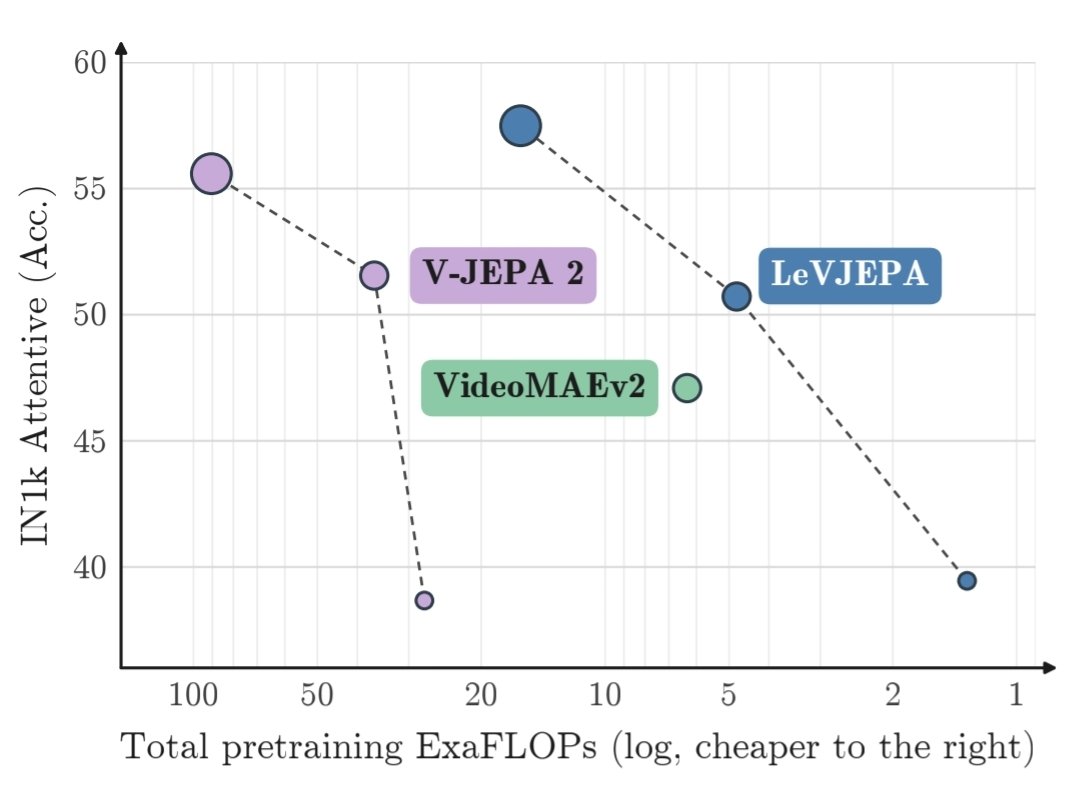
SIGReg for pretraining Video Foundation Models! Our LeVJEPA opens many doors... - stable recipe with a simple loss (sigreg + prediction) - no tubelet, frame aggregation, EMA, stop-gradient, .... - 20X more FLOP efficient than VJEPA1/2 pretraining - open source + reproducible https://t.co/rCwJRx2Dim
A new Pareto frontier in video pretraining. Excited to introduce LeVJEPA 🔥: a stable, efficient end-to-end pretraining method that matches V-JEPA 2 at up to 20x less pretraining compute! No target encoder, no masked prediction, no stop-gradient or teacher-student schedule. On
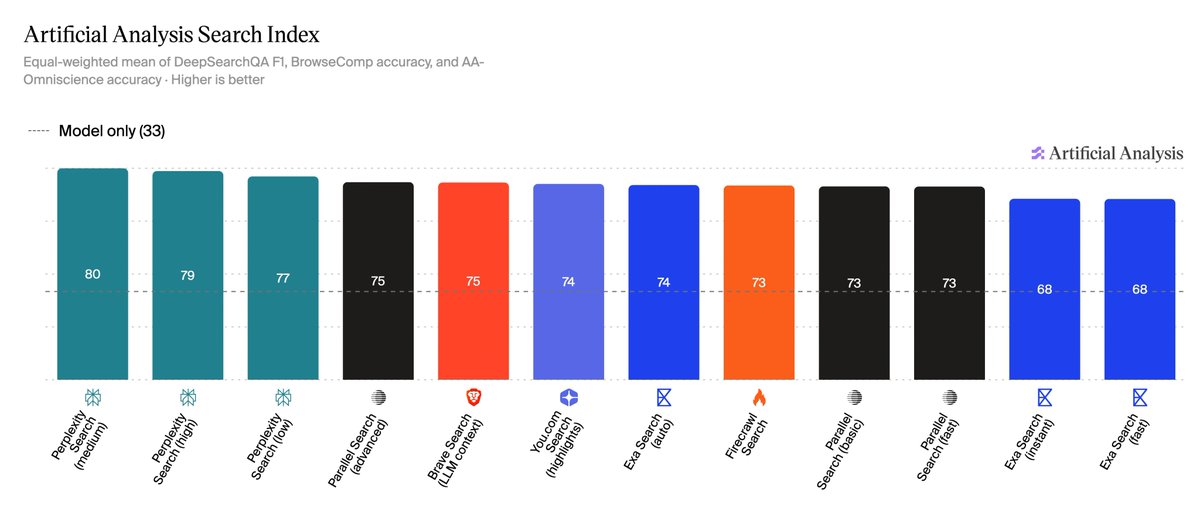
Perplexity Search debuts on the Artificial Analysis Search Index, with all three context size variants taking top positions on the leaderboard The @perplexity_ai Search API comes with three context settings (low, medium, and high) that control how much extracted content each search result carries. We tested all three variants using our standardized methodology: the same model (GPT-5.6 Luna at medium reasoning), running inside Stirrup, our open-source agent harness, with tools for searching and fetching pages from the web. Only the provider behind the search tool changes. Key results: ➤ Perplexity Search (medium) scores 80 on the Artificial Analysis Search Index, ahead of the previous leaders, Parallel (advanced) and Brave Search (LLM context), at 75. The high and low variants score 79 and 77 respectively. Its lead is concentrated in BrowseComp results, with AA-Omniscience and DeepSearchQA scoring comparably to other leading providers ➤ Efficient search payloads: smaller overall search results mean the model reads less per task, so Perplexity has the lowest model inference cost per task of providers we’ve tested so far, ranging from $0.028 to $0.034 across the three variants vs $0.036 for the next lowest provider ➤ Total cost per task is ~$0.091 for the medium and high context variants, at mid-pack latency. For comparison, Parallel (advanced) costs $0.084 per task and Brave (LLM context) costs $0.13 per task
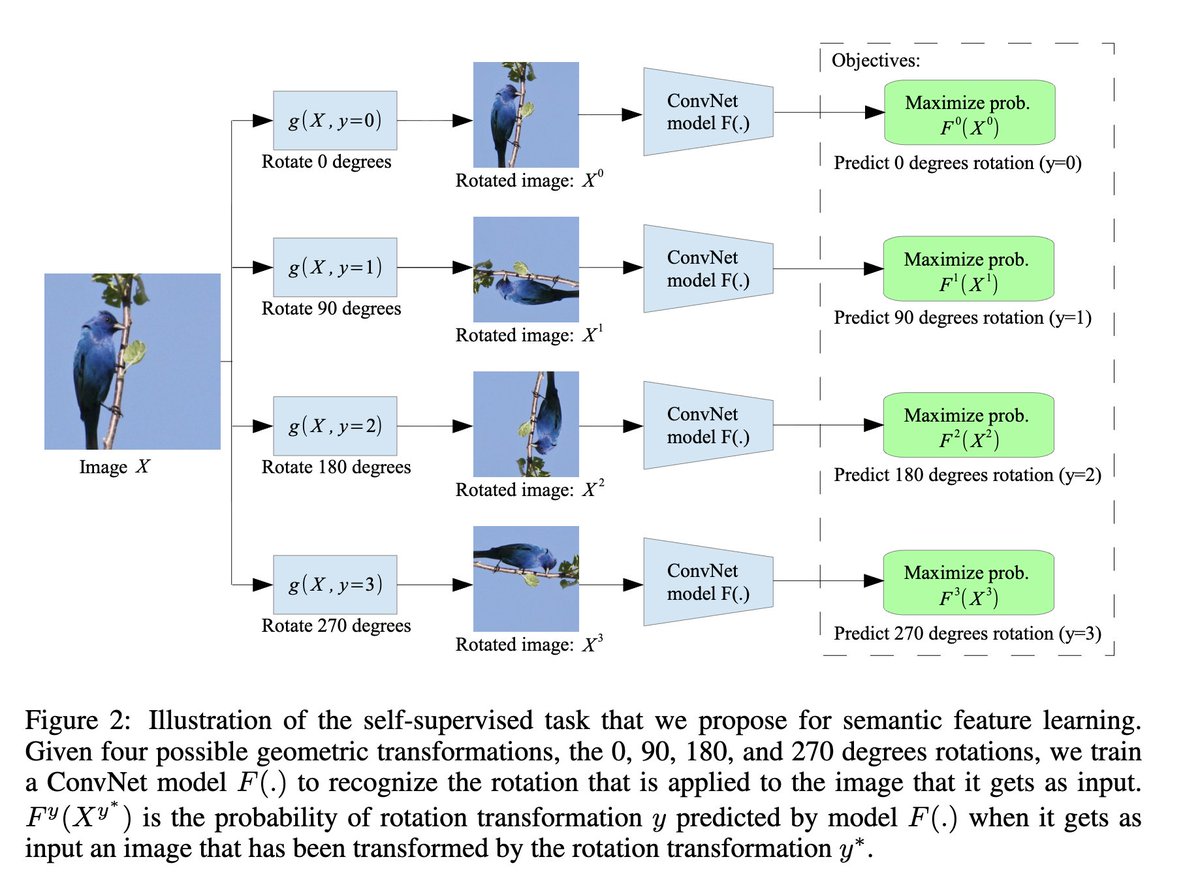
What is the simplest, cleanest technique for self-supervised learning (SSL)? RotNet (2018), without a doubt Take an image, rotate by either 0, 90, 180, 270 degrees, and predict its rotation. The model must learn useful features to solve the task. Read on... [1/2] https://t.co/jlqS7kXHeH
💡 Learn the latest GitHub workflows by actually building with them. We’ve released 4 new GitHub Skills exercises designed to give developers practice with AI-powered development, agentic workflows, and code quality. 🧵⬇️
Introducing fx, a tiny, open, native coding agent from Vercel Labs. Originally an internal tool, fx is a harness and CLI written in Zig, optimized for research and embedding in larger systems. Today, we're open sourcing it. fx is built on three principles: 1. Fast. A single native binary, no runtime to install. It cold starts in 10µs and does no unnecessary work or I/O before accepting input. fx is the answer to "how fast can a coding agent be?" 2. Light. The 6.3MiB binary uses single-digit megabytes of memory at baseline, made for instant installation and embedding in resource-constrained environments and agent sandboxes. 3. Open. Apache-2.0, model and provider agnostic, suitable for local and cloud inference. Its small core extends through skills, plugins, and MCP. Minimalism is an obsession throughout the entire harness: system prompt, tools, features, binary. The goal was to keep context usage and time to first token low, and make fx optimal for model benchmarking, sandboxing, evals, and gyms. You can use fx directly or embed it as infrastructure. The CLI feels more like a Unix shell than an IDE in the terminal: it preserves scroll history, produces minimal output, and uses complex TUI rendering very, very sparingly. Programmatically, 𝚏𝚡 𝚊𝚜𝚔 --𝚓𝚜𝚘𝚗 gives structured output, 𝚏𝚡 𝚊𝚌𝚙 connects to editors and other clients, and WebAssembly can even run the whole thing inside the browser (see: https://t.co/wf2Trg47sC). Privacy is a design constraint: no product telemetry, sessions and usage stay local, and no source code or prompts are shared with any endpoint other than inference. With local inference and auto-updates off, fx is fully hermetic. fx is experimental. Use at your own risk and expect frequent changes. Chat with us on X (https://t.co/A2AB2YythC) or file issues (https://t.co/GEjTHSoa1J). 𝚌𝚞𝚛𝚕 -𝚏𝚜𝚂𝙻 𝚏𝚡.𝚜𝚑/𝚜𝚎𝚝𝚞𝚙.𝚜𝚑 | 𝚋𝚊𝚜𝚑 https://t.co/g2uEuXhGnt
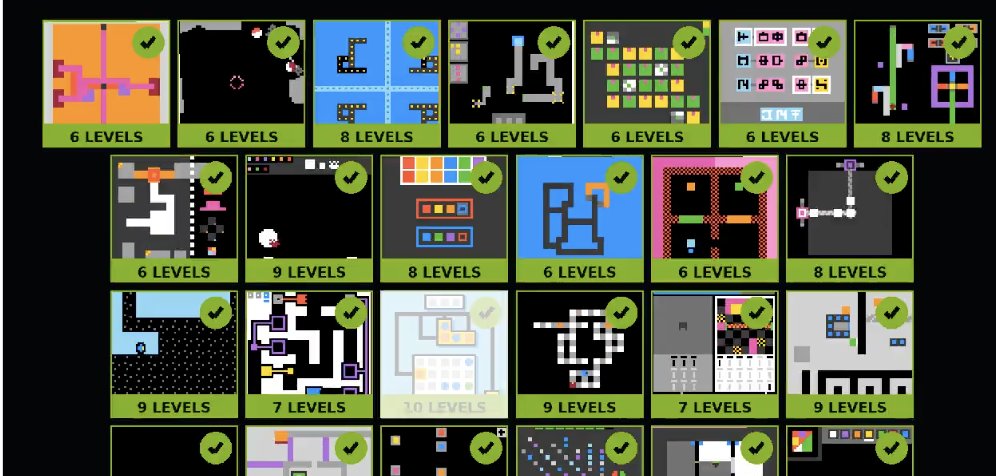
NVIDIA built its own coding harness to optimize CUDA GPU kernels and achieved a 100% score on ARC-AGI-3’s 25 public games, solving all 183 levels. With agents, we'll move from a world where it's quite hard to run, optimize, post-train your own AI models and kernels to a world where virtually everybody can do it. 100 million AI builders when?
GLM 5.3’s weights were just released, and it’s already available in Perplexity Computer.
GLM 5.3 is now available in Perplexity Computer. Built for long-context, multimodal agent workloads, it beat GLM 5.2 on WANDR, our benchmark for large-scale, evidence-backed research. https://t.co/02FMedtoJb
Gemma 4 E2B running fully locally on an 8GB NVIDIA Jetson Orin Nano. Using native image/audio input and function calling, this edge setup is capable of vision, voice interaction, and camera control, all within an 8GB memory footprint! https://t.co/ILdL9vnvdG
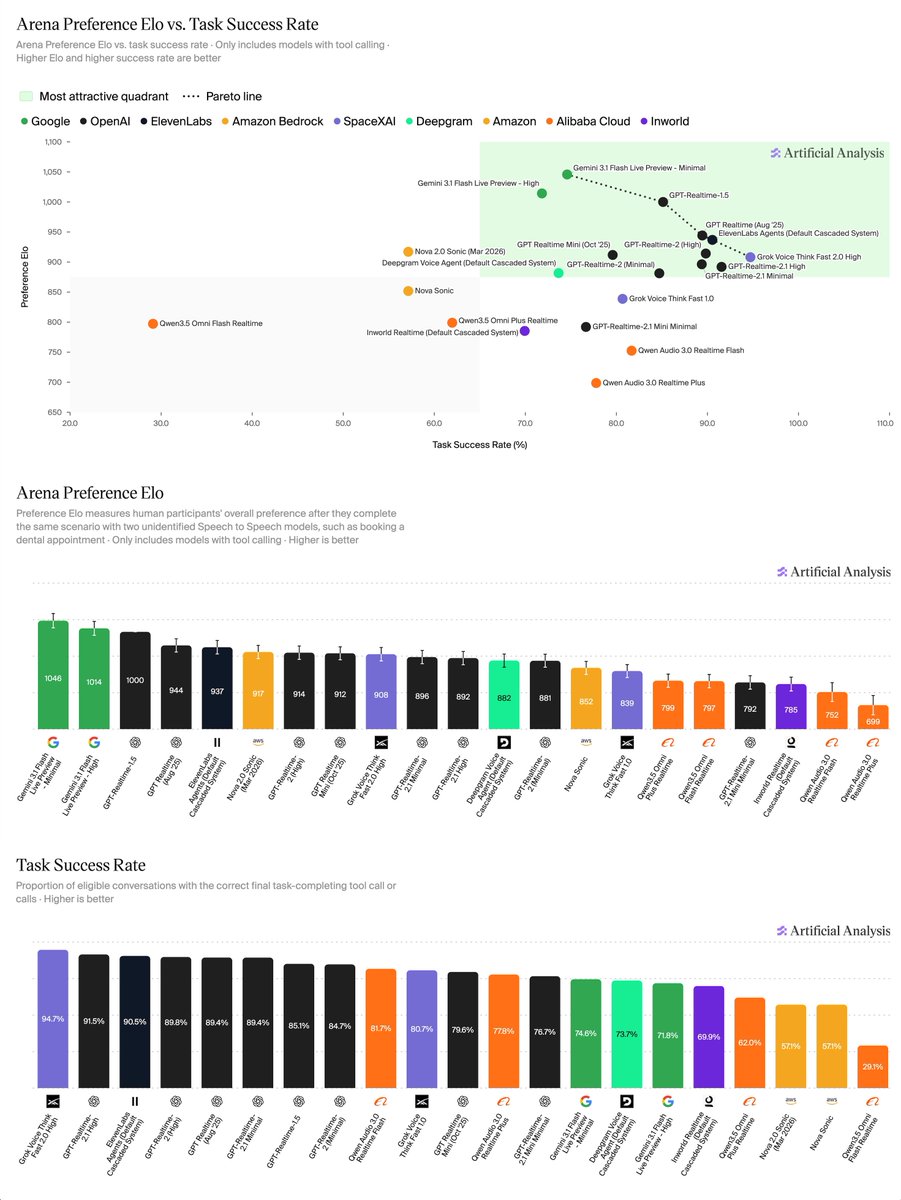
Announcing our new Speech Agent Arena, evaluating Speech to Speech models on real-world scenarios to analyze conversational preference and task success rate Existing Speech to Speech benchmarks cover reasoning, simulated agentic tasks, and conversational dynamics such as turn-taking and interruption handling. The Speech Agent Arena compares models and cascaded systems as humans complete real-world tasks, measuring conversational preference and successful tool use. This allows us to provide an evaluation which closer reflects real-world use, offering insight into which models users most prefer speaking with and how effectively those models support their requests. Overview of the Speech Agent Arena and Task Success Rate Human participants compare two hidden Speech to Speech models on the same assigned scenario, one of 15 agentic scenarios (tasks requiring tool calling, such as ordering takeout) or 20 non-agentic scenarios (tasks without tool calling, such as asking about opening hours). After separate live conversations with each model, participants select which they preferred, with these pairwise votes used to fit a Preference Elo score. For agentic scenarios, Task Success Rate is the share of eligible conversations (no participant deviations or unverifiable cases) where the model completed the requested action through the correct final tool call or calls. For all but a New Patient Dental Booking example, scenario model prompts, tool schemas and participant instructions are currently private to reduce overfitting. Additionally, the Speech Agent Arena currently uses a qualified pool of paid, screened third-party participants to conduct and evaluate agent interactions. Key results: ➤ Arena Preference Elo: @GoogleAI Gemini 3.1 Flash Live Preview - Minimal leads at 1,046 Elo, followed by Gemini 3.1 Flash Live Preview - High at 1,014, @OpenAI GPT-Realtime-1.5 at 1,000, GPT Realtime (Aug '25) at 944, and @ElevenLabs Agents (default cascaded system of Scribe v2 Realtime / GPT-4o Mini / Eleven v3, with pre-registered tool schema) at 937. In reviewed conversations, highly preferred models tended to respond quickly, sound more natural and produce fewer unnatural sounds or audio artifacts ➤ Task Success Rate: @SpaceXAI Grok Voice Think Fast 2.0 High leads at 94.7%, followed by @OpenAI GPT-Realtime-2.1 High at 91.5%, @ElevenLabs Agents (Default Cascaded System) at 90.5%, and GPT-Realtime-2 (High) at 89.8%, with GPT Realtime (Aug '25) and GPT-Realtime-2.1 Minimal tied at 89.4%. Gemini 3.1 Flash Live Preview - Minimal leads overall preference at 1,046 Elo but records a 74.6% Task Success Rate, showing that a preferred conversation does not always result in successful task completion - some conversations can sound as though the requested action was completed even when the required final tool call was unsuccessful We are continuing to expand our coverage of native and cascaded Speech to Speech systems, and welcome feedback as we add more models, providers and scenarios. See more details below ⬇️
tired: hill climbing an eval by doing a synth env wired: hill climbing an eval by fixing the eval
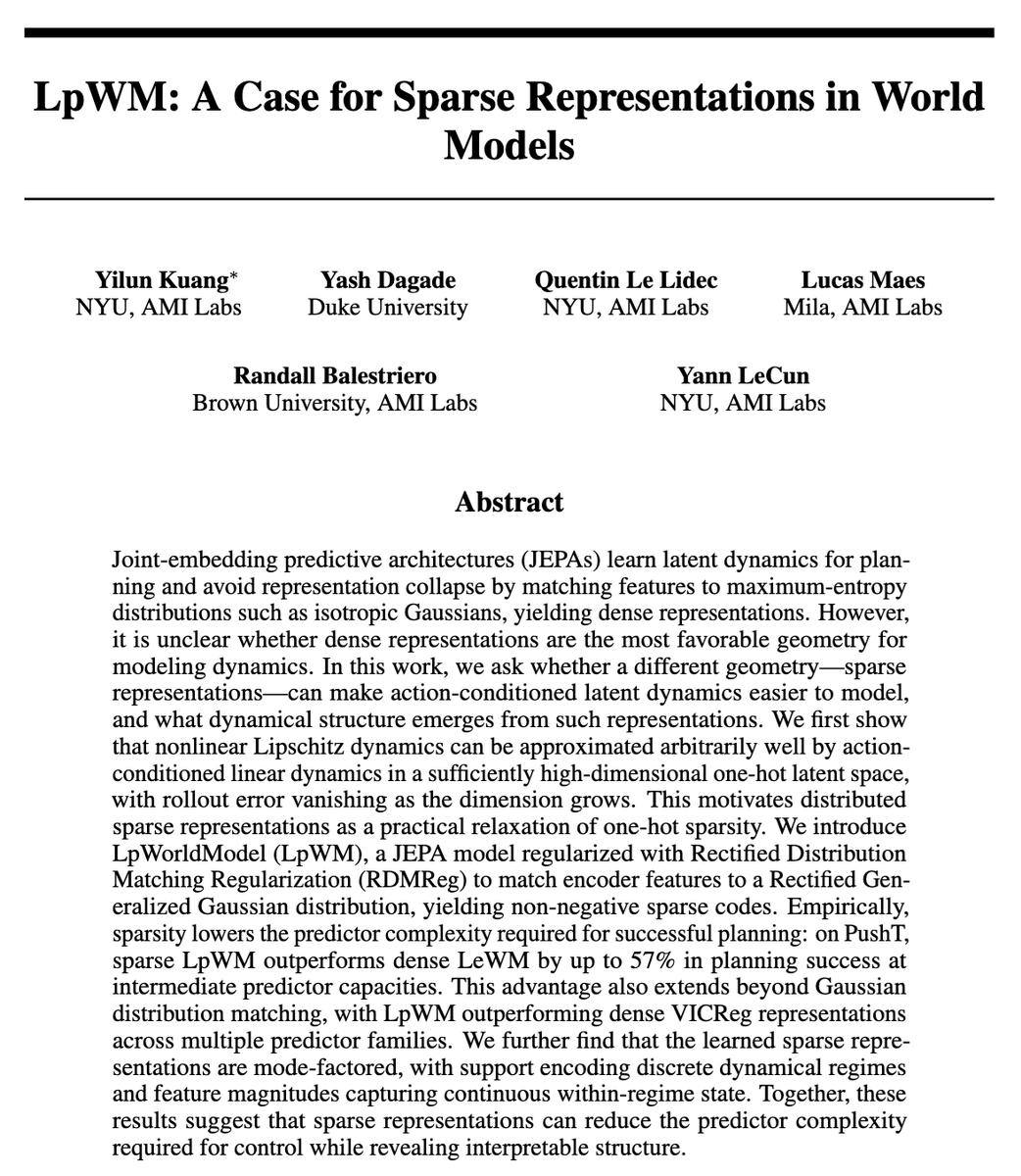
Introducing LpWM: A Case for Sparse Representations in World Models Dense Gaussian representations are a choice, not a requirement. We find that sparse representations can make latent dynamics easier to model for planning. 📄https://t.co/Il2krEtFi5 💻https://t.co/D1UAVtkwQD https://t.co/T9RoK2Te07
The largest fully annotated open egocentric human dataset. Today we're open-sourcing EgoSuite-Open100K with @huggingface : 100,000 hours of egocentric human data, free for anyone to use. Physical AI has a scaling law of its own now, and its input is human data. That part is settled. What the field still needs is a shared foundation to build on. 15,000+ tasks. 15,000+ real scenes, from factory floors to retail backrooms. Hand pose, body pose and subtask-level semantics, with wrist camera coverage on part of the set. Licensed for commercial training, not research-only. We build the data infrastructure for Physical AI. Open100K is the first public layer of it. The first 10,000 hours are live now, with the rest rolling out in stages.
@ChrisJMcCormick Yeah, increasingly a lot more appealing to tear down these abstractions now that agents can do a lot of the math and drudgery and verification. A lot of the abstractions were built for a world with constraints of finite intelligence and attention in the industry.
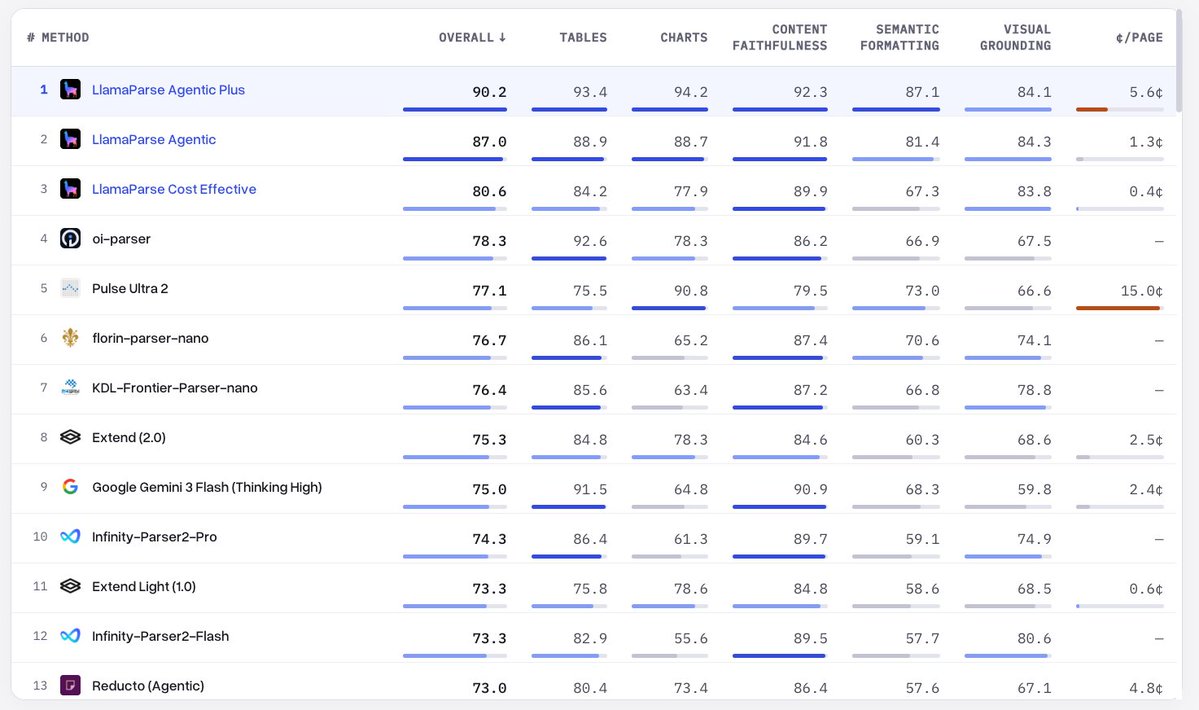
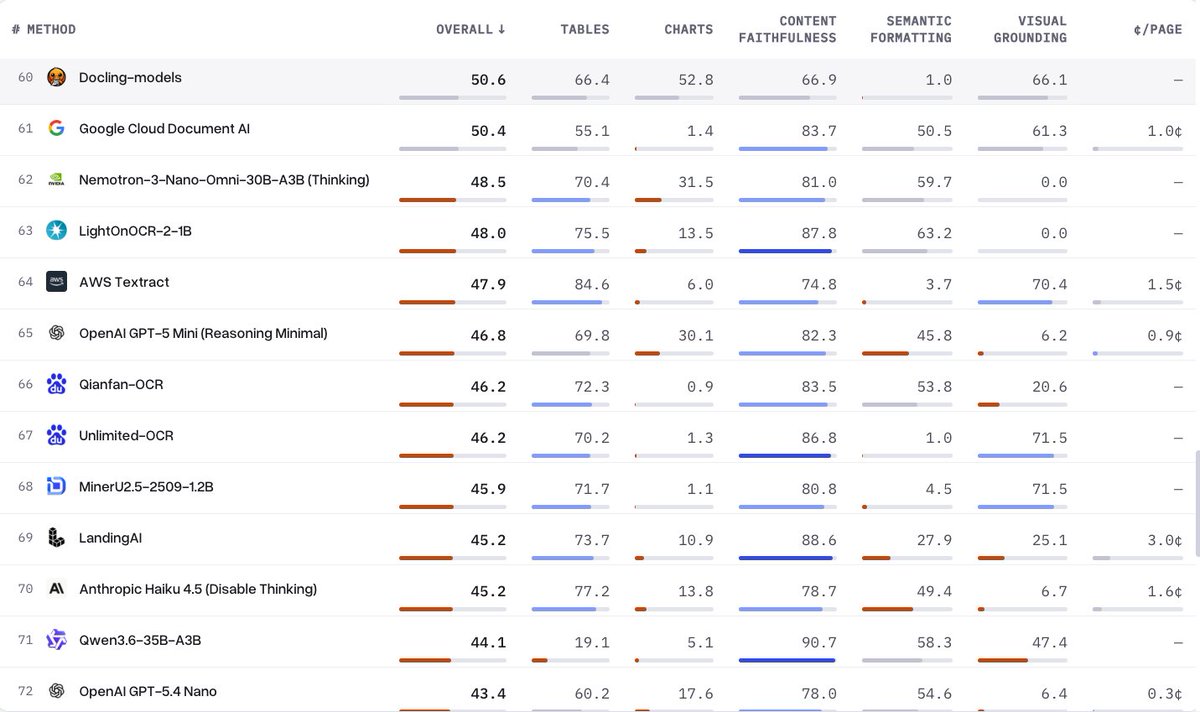
There’s generally a massive difference in quality between specialized OCR providers, “simple” open-weight OCR models, and free/OSS solutions. 1️⃣ Specialized OCR models (including LlamaParse) solve for the long-tail of complex documents, and make sure that everything is digitalized properly with lower hallucinations. They typically use posttrained VLMs to cover a wide range of real-world docs. They have tuned bounding boxes and annotations for each section, letting agents trace citations back to the source. They also usually come with additional endpoints like extraction and splitting. 2️⃣ Open-weight VLMs (e.g. Paddle, MinerU, UnlimitedOCR) are reasonable over relatively simple documents like text and tables and can do basic visual reasoning. They can seem somewhat cheap to host but can be unreliable in quality. 3️⃣ Free OSS libs (including liteparse) are meant to be universally accessible, fast text extractors. They’re not meant to do any sort of visual reasoning, so won’t perform any linearization, or reasoning over complex tables, or OCR over non-native docs. AI agents like Claude will by default use these tools to do a light pass over documents. But I would caution using these for retrieval, because they will drop entire sections that are not digitalized. At this point we’ve benchmarked over 92 tools on ParseBench. Come check it out! https://t.co/PWczfhp0OX
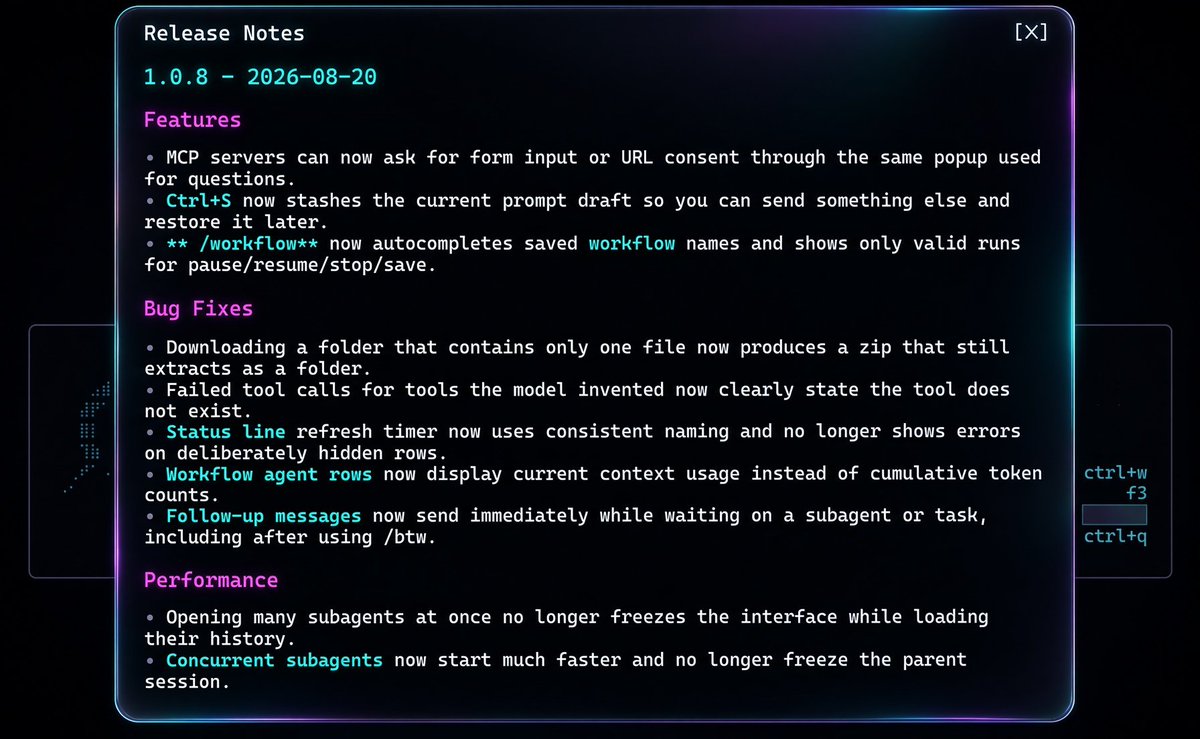
Grok Build 1.0.8 is out. @SpaceXAI keeps improving the agent workflow, with this release focused heavily on subagents, workflows, and smoother multitasking. Most important changes: • Concurrent subagents now start much faster and no longer freeze the parent session • Opening many subagents at once no longer freezes the UI while loading history • Follow-up messages are sent immediately even while a subagent/task is running • Ctrl+S now stashes your current prompt draft so you can switch tasks and restore it later • /workflow now autocompletes saved workflows and only shows valid actions • MCP servers can request form input or URL consent through the normal question popup • Workflow agent rows now show current context usage instead of cumulative token counts Also included: clearer errors for hallucinated tool calls, status-line fixes, and improved folder downloads.
yeah so zml runs on: 1. NVIDIA 2. AMD 3. Metal 4. Intel 5. Trainium 6. Tenstorrent 7. TPU 8. MooreThreads 9. Vulkan and a few more very soon
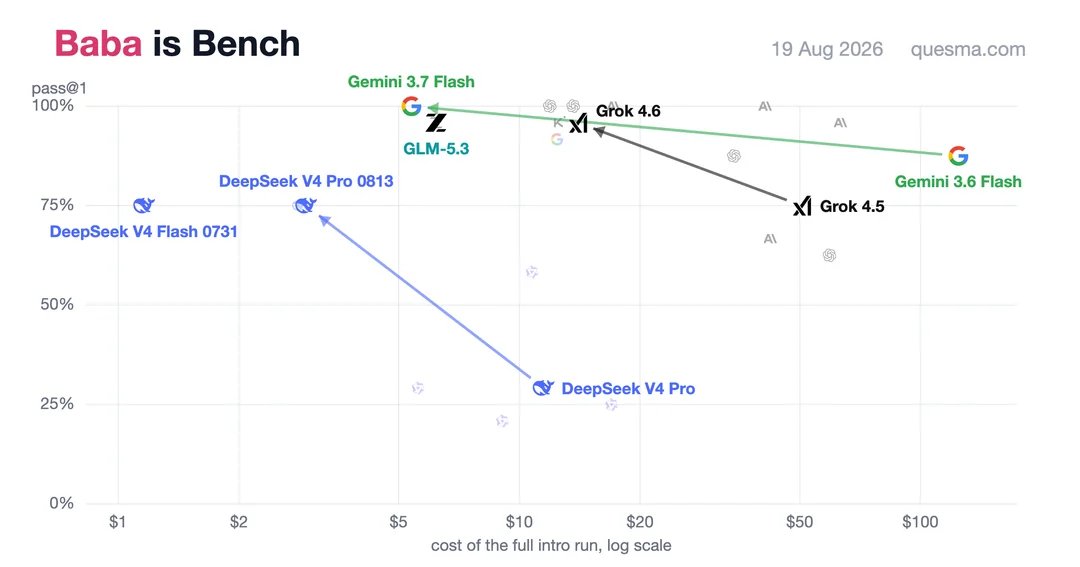
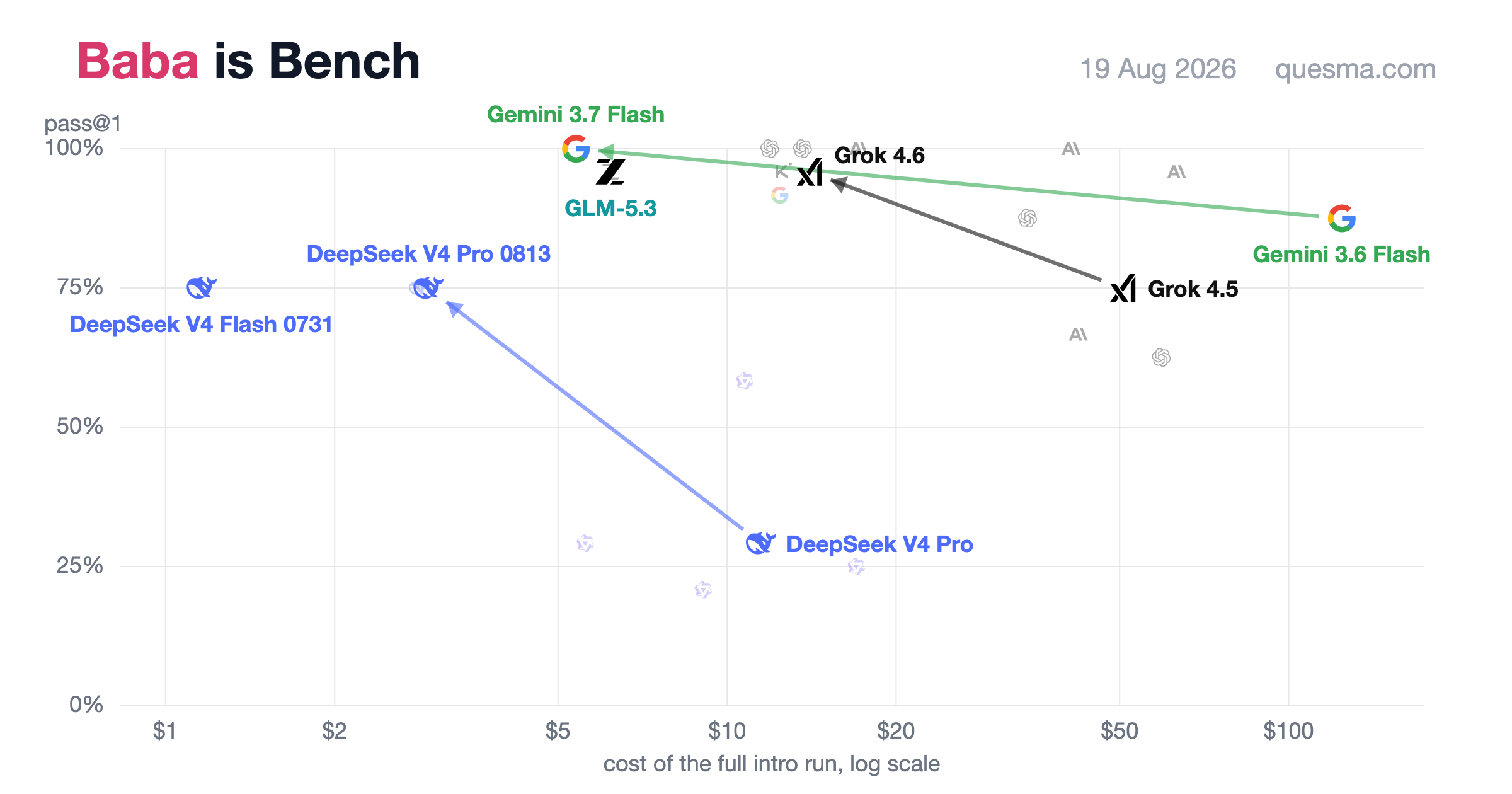
gemini 3.6 flash cleared 88% of the baba is you intro levels and spent $124 doing it gemini 3.7 flash cleared 100% and spent only $5.38 and boy, is she fast! 😍⚡️ @QuesmaOrg https://t.co/9OOTRyDCl3
we're hiring cracked evals/benchmarking ppl research-oriented role super tough hairy unsolved problems those that thrive in unknowns preferred pls dm me with your actual work (not resume), will fast track you
LeVJEPAは動画の自己教師あり学習を大幅に単純化し、従来手法と同等以上の性能を5〜20倍少ない計算量で実現する。 動画には、静止画には含まれない物体の動きや時間的な因果関係など、世界の表現を学ぶための素材として有望な情報が含まれる。 一方で、動画の自己教師あり学習は画像と比べて多数のフレームを処理するため計算コストが大きいという問題があった。 さらに、従来の自己教師あり学習では表現崩壊を防ぐため、EMAで更新するtarget符号化器、stop-gradient、predictorなど複数の仕組みを必要としていた。 LeVJEPAは、この二つの問題を同時に解決する手法を提案している。そして、動画からの事前学習そのものが、将来的には視覚基盤モデルを学習する標準的な方法になりうることを主張している。 まず動画から16フレームのクリップを取り出し、一つのglobal viewと複数のlocal viewを作る。local viewには空間的なcropや色変化などのaugmentationが加えられるが、globalとlocalの時間区間は共通である これらすべてを同じ一つの符号化器に入力する。 符号化器には学習可能なCLSトークンが一つだけ追加される。このCLSトークンは全フレーム、全パッチトークンにattentionでき、クリップ全体の情報を集約できる。 一方、各パッチトークンは、同じ時刻のトークンと、それ以前の時刻のトークンにしかattentionできない。また、パッチトークンからCLSトークンへのattentionも禁止されている。 そのため、各フレームのパッチ表現は未来の情報を使わないcausalな表現になる一方、CLS表現は動画全体を見たnon-causalな表現になる。 この設定の中で、学習目標は、最終的なCLS表現を小さなprojectorに通して潜在表現 z を作り、global viewとlocal viewの z をMSEで近づけることである。 ただし、この損失だけでは、すべての入力に対して同じ表現を出せば損失がゼロになるため、表現崩壊が起こりうる。そこでSIGRegを加える。 SIGRegは、バッチ全体のembedding分布を等方Gaussian N(0,I)に近づける正則化である。 実際にはランダムな方向 a を多数サンプリングし、zとの内積 a^T z を計算する。そして、その一次元分布が N(0,1) に従っているかをEpps-Pulley統計量で測り、それを損失とする。 なお、符号化器最終層にはLayerNormがあり、CLS表現は球面状の空間に制約される。そのままではGaussian分布を要求するSIGRegを適用しにくいため、一度projectorを通してからSIGRegを適用している。 まとめると、学習全体の損失は、global viewとlocal viewのCLS表現を一致させるMSEとSIGRegのみである。 従来使われていた表現崩壊を防ぐEMAによるtarget符号化器、stop-gradient、predictorは使用しない。 もう一つの大きな特徴は、95%のパッチトークンをランダムに捨てることである。 実験ではImageNetでのprobing精度は、drop率を95%まで上げても低下せず、むしろ改善する。 著者はこれを単なる計算量削減ではなくaugmentationとして解釈している。毎回異なるごく一部のトークンしか観測できないため、動画のどの部分を見ても同じclip-levelの意味表現を作れることが要求される。 また、VideoMAEなどで使われてきたtube maskingのように時間方向に同じ空間位置をまとめて消す必要もなく、隣接するフレームを入力段階で一つのtemporal パッチに融合する必要もないことがablation studyで示している。 むしろこれらを使わない方が性能が高く、モデルの構成も単純になる。 このように学習された符号化器は後続タスクで高い性能を示す。 さらに興味深いのは、学習損失を直接受けるのはCLSトークンだけであり、パッチトークンには直接的な教師信号を与えていないにもかかわらず、学習後のパッチ表現には物体領域や背景などに対応した意味情報や詳細な空間情報が現れることである。 コメント === 画像や動画からの自己教師あり学習は、視覚基盤モデルを作る上で最重要と考えられる。その中で、今回の手法はとても興味深い。 今回のLeVJEPAでは、直接合わせているのはCLS表現だけである。このCLS表現には、教師ラベルを使わずに画像や動画全体を特徴づける情報が埋め込まれていくと考えられる。 例えば「少年同士が広場でキャッチボールをしている」といった動画があったとする。 その意味を言語として明示的に示さずとも、これに対応するような情報がCLS表現として連続的な潜在空間に表現される。 さらに、global/local viewでは95%のパッチトークンが捨てられ、local viewでは空間的にcropされた上で、global viewから得られるCLS表現と各local viewを一致させなければならない。 そのため符号化器は、限られた局所的な情報からでも、動画全体を特徴づける情報を推定できるように学習されていく。 さらに、そのように改善された符号化器自身がglobal viewのCLS表現を計算する側にも使われるため、次の学習目標はより難しい問題となる。 このように固定された教師を追いかけるのではなく、学習によって、高度になった目標を達成するようにするのが重要となってきている。 また、ほとんどのパッチを捨てた方が、少なくとも分類などで使いやすい良い表現が得られるという現象について、論文ではこれをaugmentationとして説明しているが、それだけではない、より深い原理や理論的な解釈があると思われる。 この研究からはいくつかの発展の可能性がある。 一つは、LeVJEPAではCLS表現にしか直接lossをかけていない点である。それにもかかわらずパッチ表現にはすでに物体領域などに対応した構造が現れている。であれば、clip-levelの一致だけでなく、異なるview間で対応する符号化器パッチを一致させるなど、局所的な学習目標を追加する余地があり、特にsegmentationやtrackingなどのdense taskについては、こうした損失が重要となるだろう。 もう一つは、動画でこれだけうまくいくのであれば、他の系列データでも同様の考え方が使えるのではないかという点である。 例えば言語でも、同じ内容から異なるviewを作り、その表現を一致させるという自己教師あり学習はこれまでにも多く研究されている。 そうした中で、学習が進むにつれて学習目標の潜在表現も高度化していき、にんじんをぶらさげた馬のように、学習が勝手に高度化していく学習設定ができるのではと考えられる。
@ChrisJMcCormick The extrapolation is that your spec is something like microgpt (scalar valued python with for loops etc), everything else is just a matter of compilation and PyTorch etc is kind of a crappy IR
Louen Pottier氏開発の物理AI「LaGSplat」 🔹スマホ動画1本から物理法則(エネルギー散逸など)を自動学習 🔹事前に力を計測しなくても、動画内の物体を「押す」操作が可能 🔹現実の映像から直接物理シミュレータを作りロボット開発の応用への期待 Webブラウザで体験可能。情報元はリプ欄。 https://t.co/KpgNNIGN8m
Regarding Sentence Transformers v6.0 update: A dense model compresses a whole text into one vector, then compares two vectors. A multi-vector model keeps one vector per token, scores every query token against every document token, takes the best match for each, and sums those. https://t.co/ksnigtsLpm
Reminds me of novel locomotion policies discovered in MuJoCo environments, except that they work in the real world!
Slow-motion look at the 400m champion’s running form at the World Humanoid Robot Games. https://t.co/Yt2Vp8DLcx
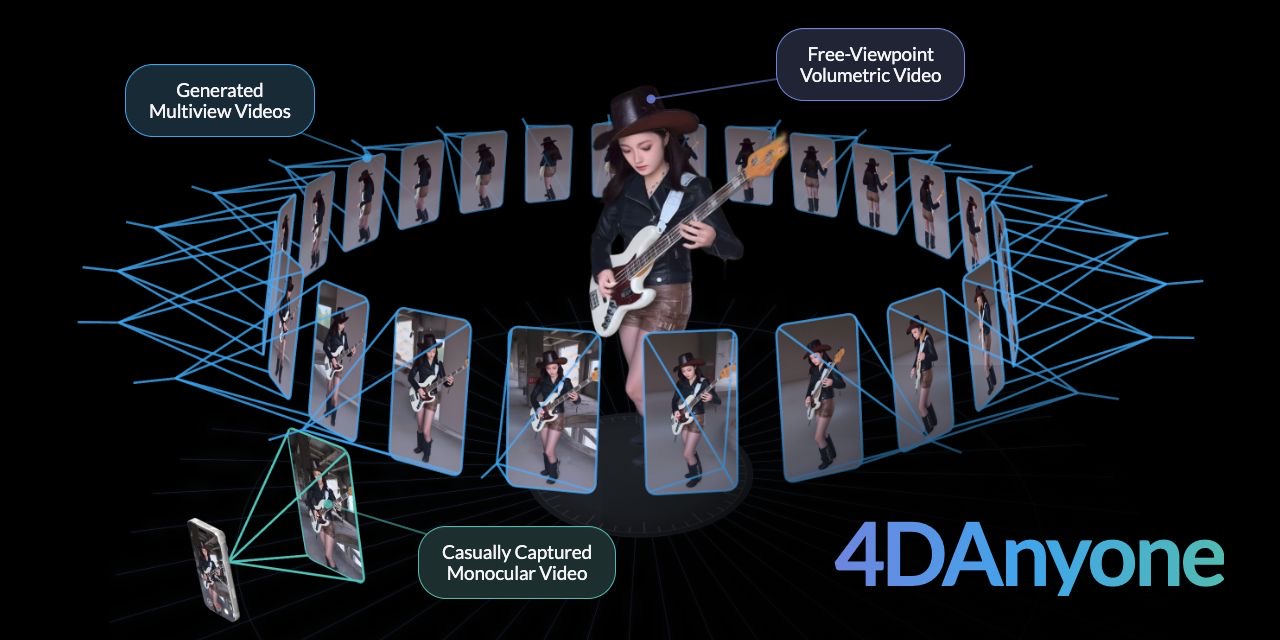
Single video in, 4D human out. 4DAnyone turns a casual monocular video into a 4DGS model. No camera rig, no calibration, no tripod. Project: https://t.co/hIArgF0YmQ https://t.co/JB3S9bqggd