Your curated collection of saved posts and media
MOSS-VL: real-time video understanding that perceives while speaking OpenMOSS released MOSS-VL, an 11B open vision-language model that keeps watching live frames while answering — proactive silence and dynamic self-correction built in. https://t.co/UtHiYqJyjO
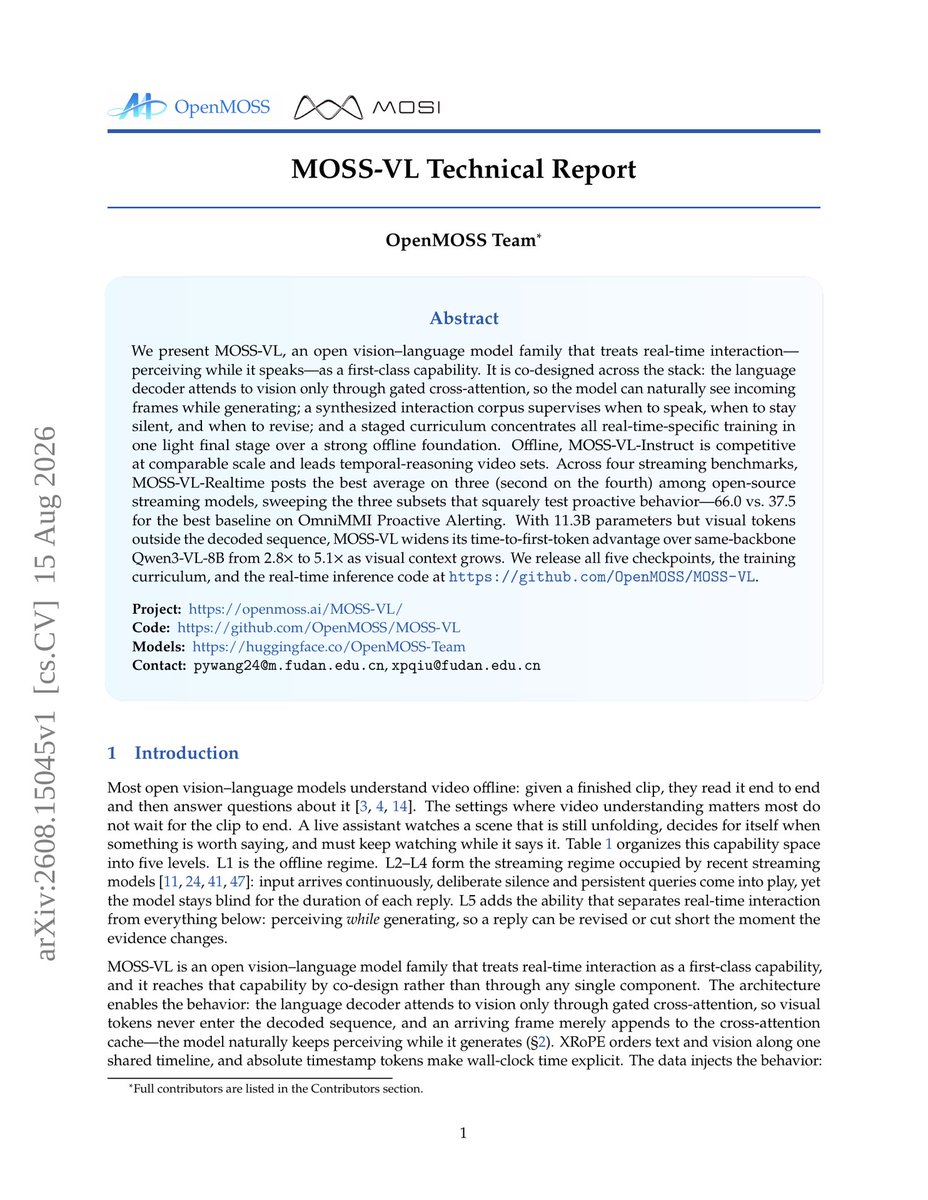
Code: https://t.co/2KHMVKk28t Model: https://t.co/Ea8AKBkv4S Paper: https://t.co/RoPmG7boHH Tech blog: https://t.co/aBTMmOL0WS Discord: https://t.co/7hr2hzUbPC
Introducing LightNav-0, our first general-purpose navigation brain. Open-sourced starting today. Trained entirely in simulation, so it scales. See scalable real2sim2real transfer across robots, tasks, and scenes. https://t.co/zyFqL8gvQL
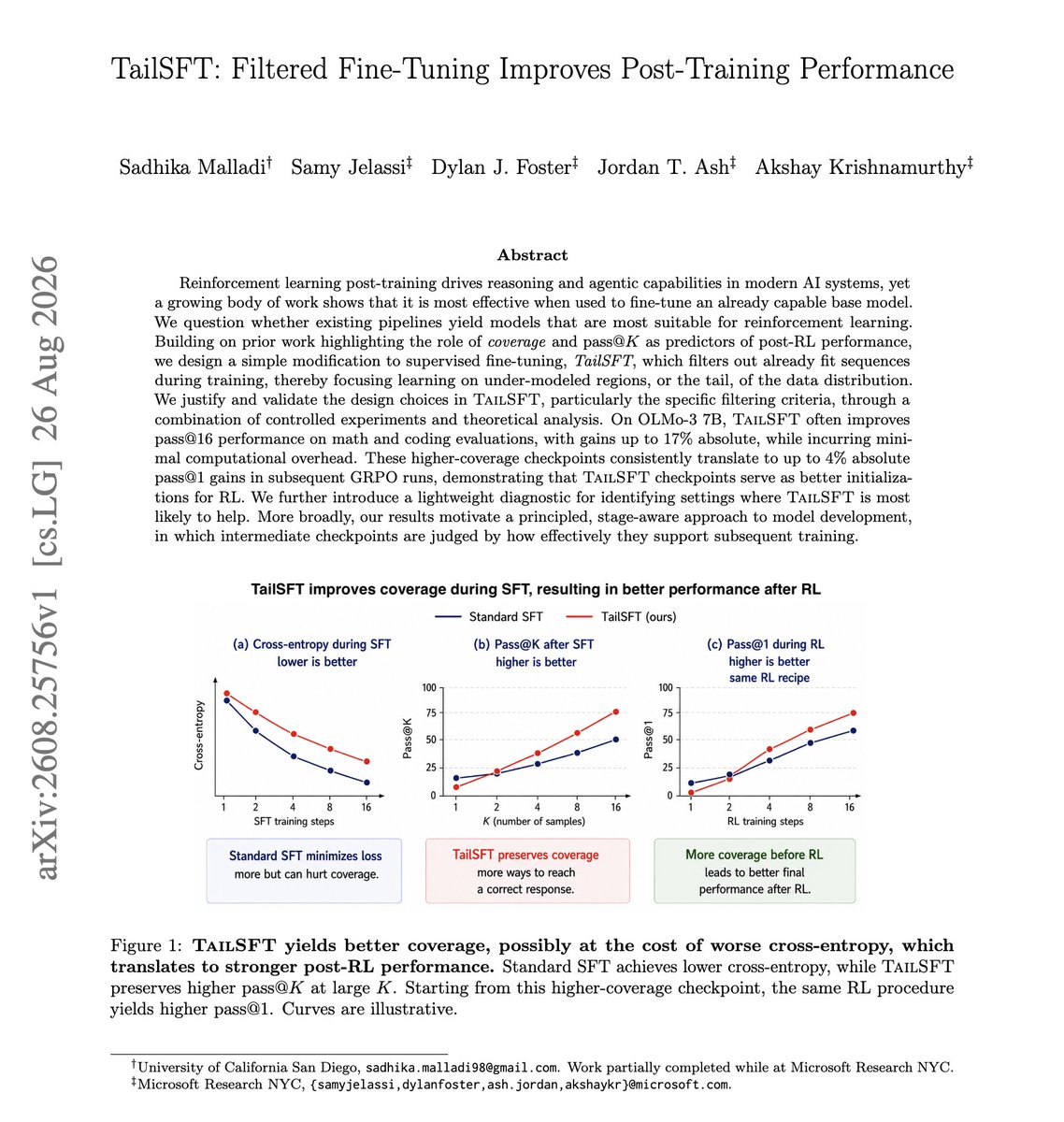
Interesting technical work from Microsoft. Provides a better understanding on SFT and how to leverage it better for RL. Microsoft researchers asked whether a standard SFT pipeline actually produces the model you want to run RL on. Their answer is no. Standard SFT keeps spending gradient on sequences the model has already fit, which narrows the distribution RL later needs to explore. TailSFT filters those sequences out during training and concentrates learning on the under-modeled tail of the data. That is the only modification they implement. Results: On OLMo-3 7B, pass@16 improves by up to 16.8 points absolute on coding and 3.1 on math. Those higher-coverage checkpoints then lift final pass@1 after GRPO by up to 3.9 points, and in some settings early reward climbs 2.5x faster than the matched standard SFT run. Paper: https://t.co/QocPRtNhjH Chat with Paper: https://t.co/wfTytUm5jp
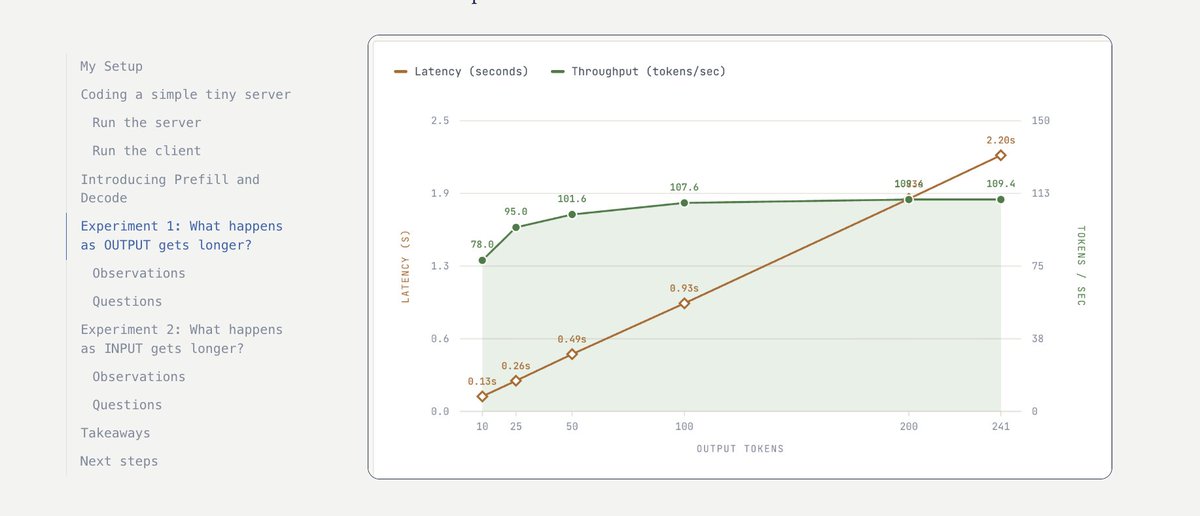
Weekend project -- inference engineering step-by-step with GPT! It made a really fun beginner tutorial with exercises covering: - how to run the simplest working LLM server - intuition for prefill and decode - performance benchmarking on my system Next lesson plan: writing my own generation loop and learning about KV caches!
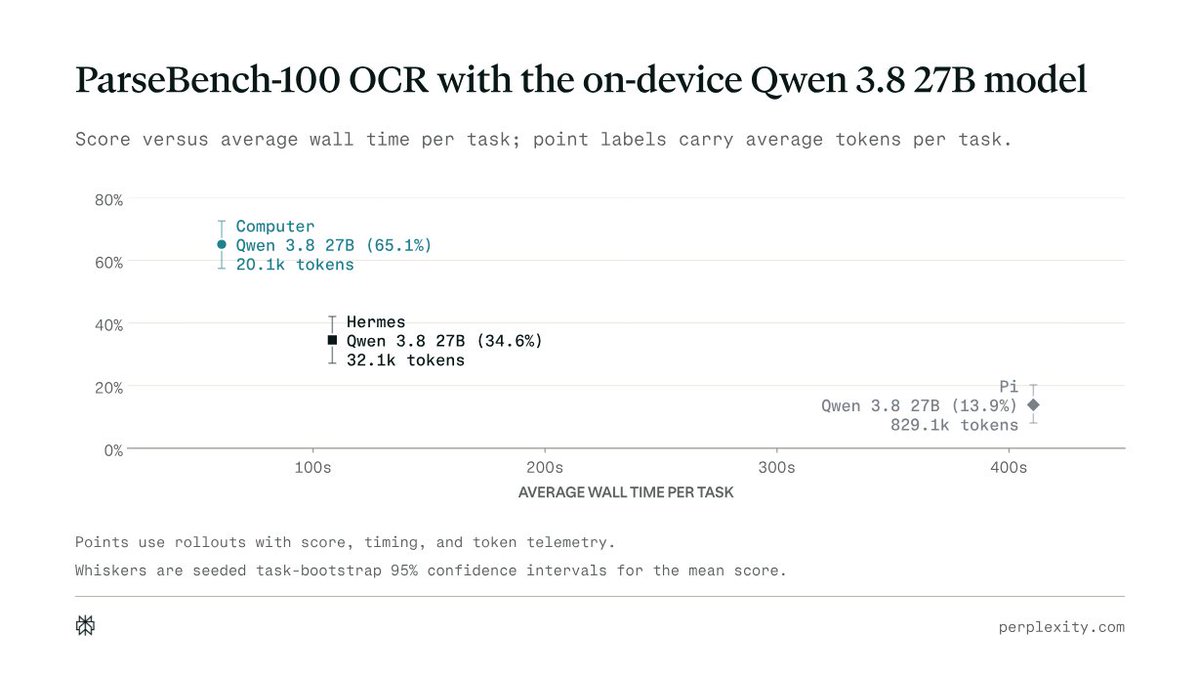
Parsing runs entirely on-device, so sensitive documents never leave the machine. On ParseBench-100, Computer scores 65.1% vs 34.6% for Hermes and 13.9% for Pi, in least time with fewest tokens. https://t.co/GQ590BYEn5
Last week we launched Optima, a new platform for benchmarking models on your own workloads and comparing performance, speed and cost efficiency Watch our new video walkthrough to see how to build and run your own benchmark with Optima, and find the best model for your use case Start building your benchmark today at https://t.co/LKMSqnhA0D
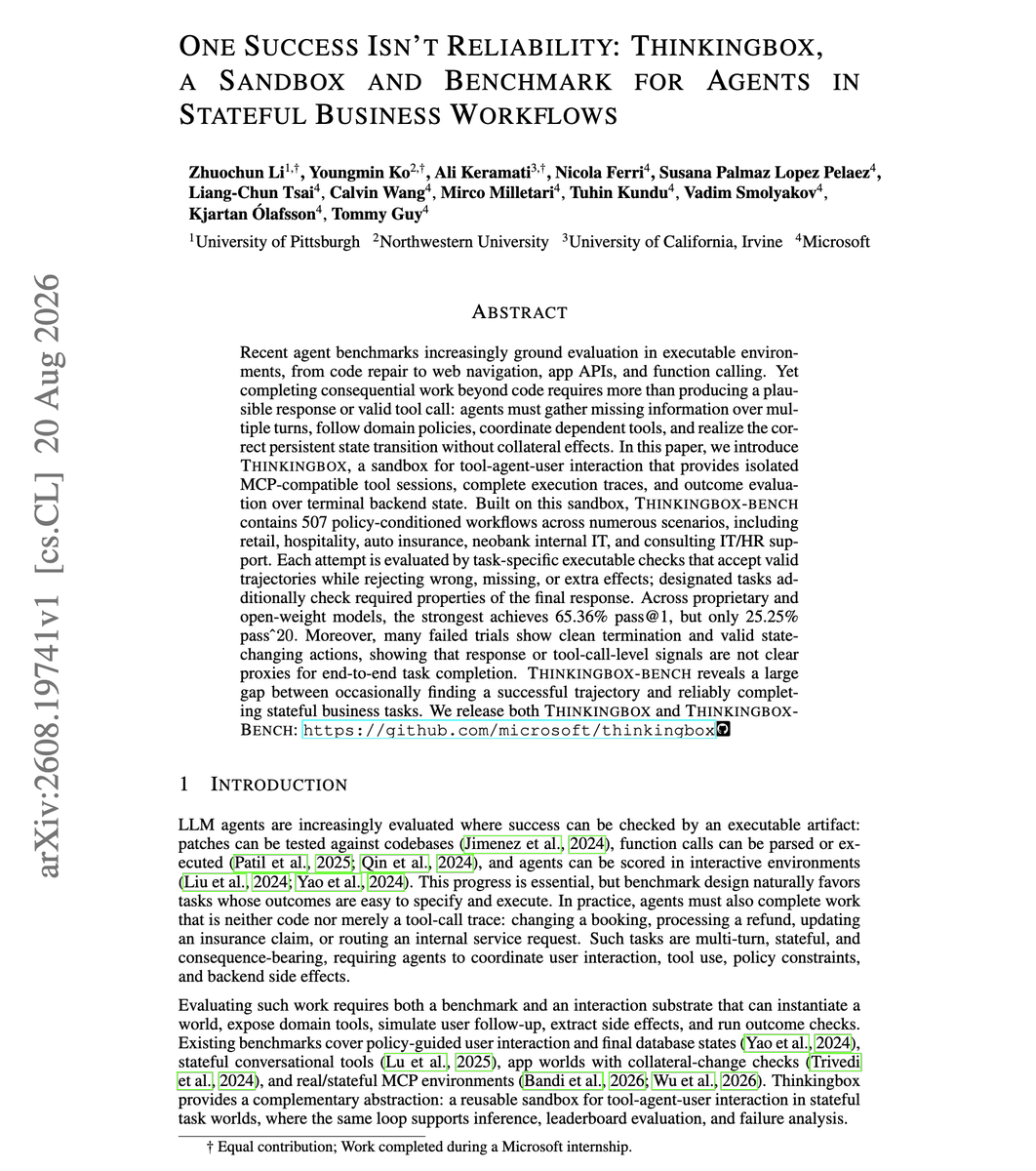
Banger paper from Microsoft. It's on agent reliability in real business workflows. (bookmark it) Thinkingbox is a sandbox with isolated MCP-compatible tool sessions, plus a benchmark of 507 policy-conditioned workflows across retail, hospitality, auto insurance, neobank IT, and consulting support. Every attempt is graded on the backend state the agent leaves behind. Executable checks accept valid trajectories and reject wrong, missing, or extra effects, so collateral damage counts against you. The strongest model reaches 65.36% pass@1 and 25.25% pass^20. Many failed trials terminate cleanly with valid state-changing tool calls. Watching the response or the tool call tells you very little about whether the task actually completed. Paper: https://t.co/EkMhBafbvI Track more trending AI papers in our academy: https://t.co/LRnpZN7L4c
Sharing some experiments on optimizers: PSGD Kron Muon is slowly replacing Adam, now time to work on a better optimizer. https://t.co/NsQMHd2A2I
if you want to know what it's really like building robotics foundation models, read this post. whether training WAMs or VLAs, your main job is shoveling good data into GPUs as fast as possible.
When people talk about robotics, they usually talk about models, data, or hardware. Few people talk about the infrastructure that lets you iterate on all three quickly. Today we're publishing how we trained Dyna-2 on over 1,000,000 hours of egocentric video, repeatably. At this s
How good are agents actually at CAD? Today we release CADBench, evaluating 10 Models on 105 realistic tasks in Fusion 360 Fable 5 and Gemini 3.7 Flash are #1 with only 24.6% pass rate https://t.co/kMQ8U6uzKD
Neat paper suggesting that human augmentation and task automation are not necessarily related. Models that are really good at doing work are not always good at helping humans do work better. Given the pressure to make models good agents, this may undermine human-AI cowork.
the results? the best models in automate mode are not always the best models in augment mode. for example - Opus and Sonnet are great on performing tasks on their own, but not in proving assistance, while GPT-5-Mini was great on both dimensions. Gemini models were stronger as
today, we’re releasing the largest open-source human image preferences dataset, along with a $1 million data grant - 2M+ annotations by real people - 30 SOTA image models ranked - 10 categories (marketing, product design, anime etc) dataset + benchmark + grant details below: https://t.co/K3U4uj1934
Agentic ESOpt: fine-tuning long-horizon LLM agents with minimal GPU memory This framework uses evolution strategies instead of backpropagation, enabling full-parameter optimization with only inference-level memory, and shows strong gains on WebArena-Lite and more. https://t.co/PP1j7ZP3H1
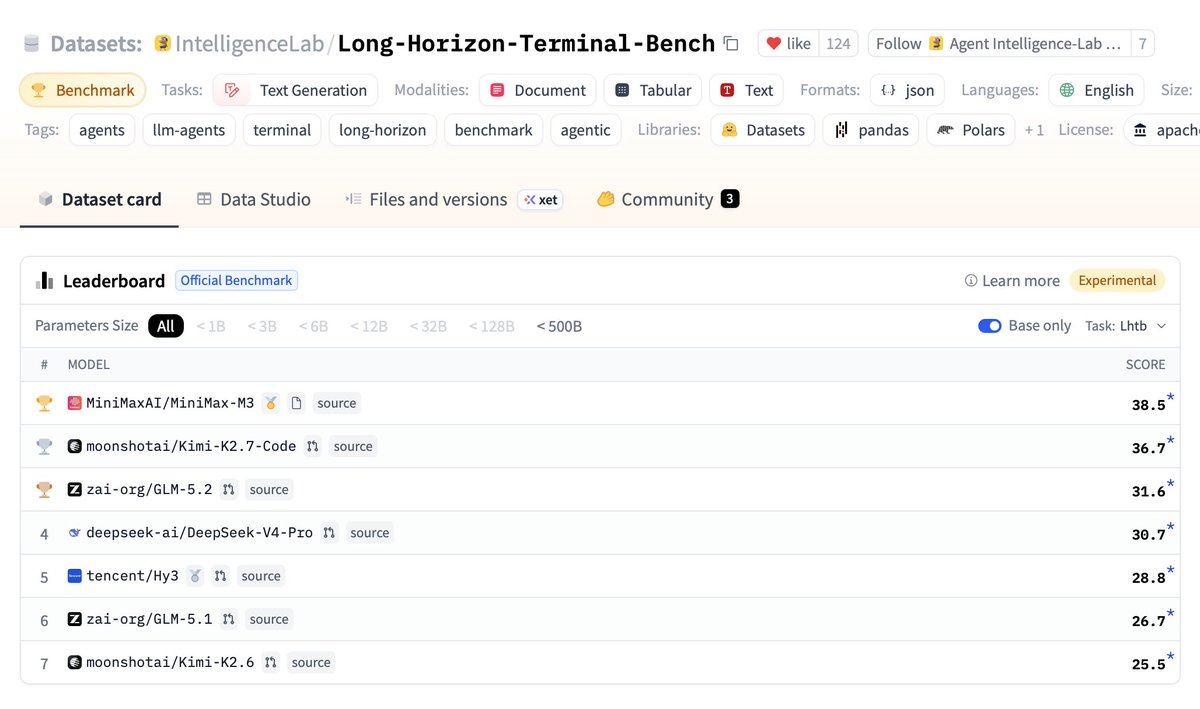
NEW BENCHMARK ON THE @huggingface HUB Your favorite LLM agent can write a script. Can it survive 300+ steps in a terminal without losing the plot? That's what Long-Horizon Terminal-Bench (LHTB) measures, 46 tasks, contamination-resistant, hidden verifiers that check real state, not vibes. 🏆 Leaderboard 🥇 @MiniMax_AI 's Minimax M3 🥈 @Kimi_Moonshot 's Kimi k2.7 Code 🥉 @Zai_org's GLM 5.2 Congrats to @zli12321 and team. Super excited to see how smaller local models perf on this benchmark @0xSero :)
SWE-bench Science A new benchmark for scientific software engineering: 119 tasks across 98 repositories and 20 domains. Even the best agent, Claude Code with Opus-5, achieves under 50% pass@1. https://t.co/LtdNeJdwEh
The amazingly fast (only 30M!) and extremely accurate @answerdotai ColBERT model is now supported in Sentence Transformers to make it easy to create and query embedding indexes locally directly in Python! 🥳
🚨I've just released Sentence Transformers v6.0! MultiVectorEncoder joins the family: ColBERT-style late interaction models are now a first-class model type, for training, inference & interpretation, alongside dense, sparse & reranker models. Big thread 🧵 https://t.co/I
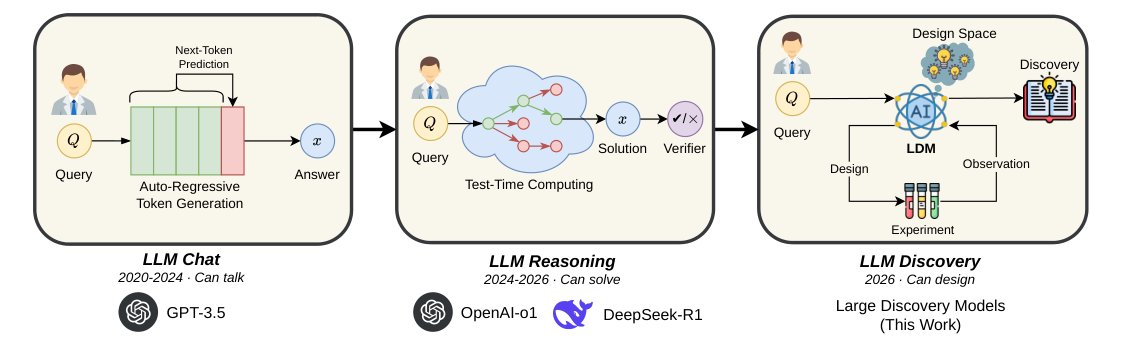
Large Discovery Models: learning where to search next An LLM proposes, a Bayesian surrogate scores uncertainty, and the loop iterates — cutting validation error by 2.4x, binding energy by 18%, and boosting molecular objectives by 60%+ across programs, proteins, and molecules. https://t.co/AW0Dj4vIXX
inspired by the anthropic post, i made a protein font! how does it work? when you design by differentiating backward through a folding model like esm-fold2 you can ask that the distogram of the folded protein looks like something you want. a little bit of help from @ChatGPT and now we have a protein font (fable, of course, didn't want to help me). this was not fully automated, i had to dial in some details like the protein sizes etc, but jointly me and codex got it working. i put the whole pipeline on my github below so you can mess with it too. bring your own gpus, its kind of expensive.
Look at our data composition: https://t.co/5K0v960lYh Watch the run live on wandb: https://t.co/7fg9VEFJ62 See all the gory details on GitHub: https://t.co/FH2w7Lx3Zm Assembling this hero run really required data, architecture, infra, kernels to all come together and was a huge joint effort by the entire Marin team!
TRANSIT (TRANsparent Scale-In for multi-node Training) is a runtime that makes unified virtual memory practical for large-scale LLM training, enabling models to train on up to 50% fewer GPUs without requiring modification to existing PyTorch training code. Hyungyo Kim, Ph.D. Candidate in Electrical and Computer Engineering, University of Illinois at Urbana-Champaign will present on TRANSIT as a poster at PyTorch Conference North America with Apoorve Mohan from IBM Research. Learn how to train more with less at PyTorch Conference North America: https://t.co/jBApW8nESi
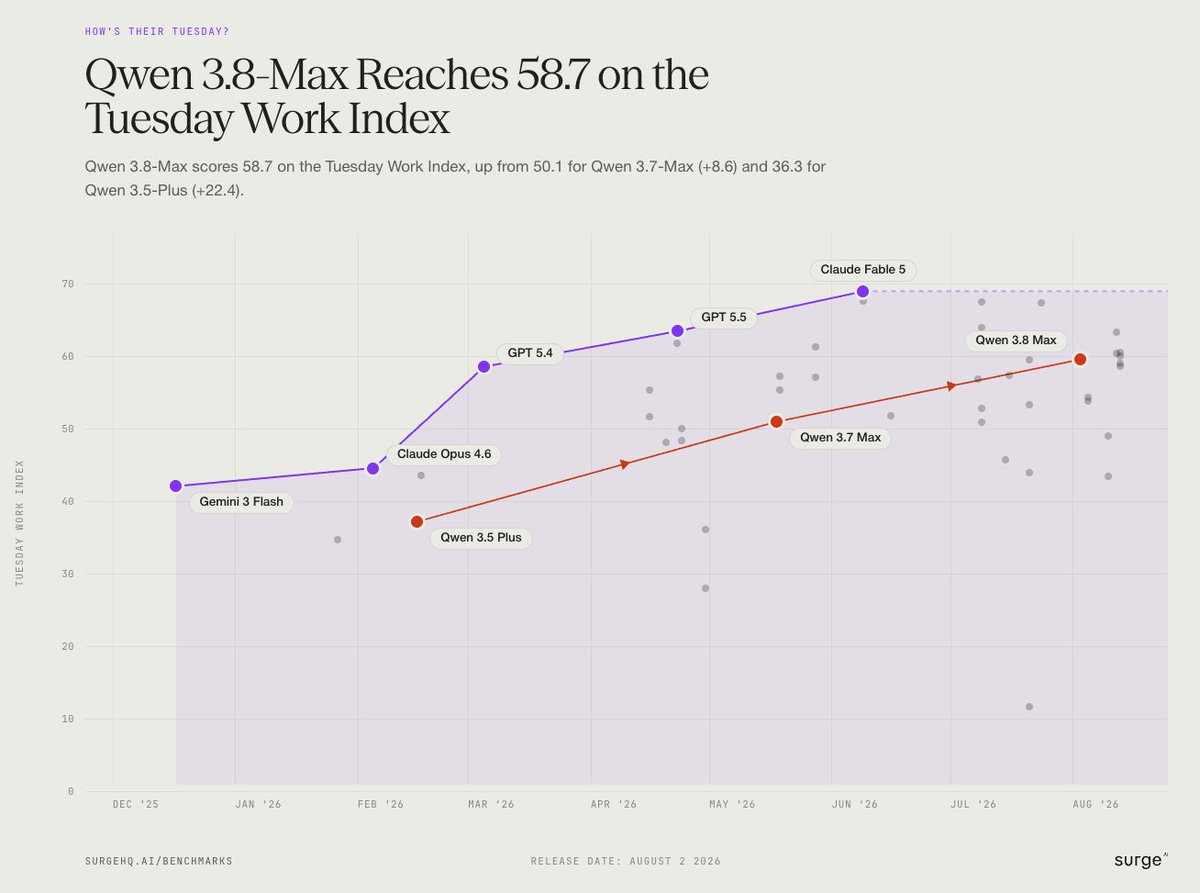
SURGE MODEL REPORT: QWEN 3.8 MAX Qwen 3.8 Max scores 58.7 on our Tuesday Work Index, our composite measure of frontier AI at work. Up +8.6 points from Qwen 3.7 Max and +22.4 points from Qwen 3.5 Plus. 🧵 of performance across our benchmarks:
@RonyVernet That’s not how AI works. LLMs sample outputs from a frozen probability landscape via interpolation and next-token probabilities. Every single generation requires external verification: a tool or a subject-matter expert. That’s precisely the point Tao is making. Mathematicians still have to interpret, validate and understand the results. They must judge whether something is correct, partial or hallucinated. Only then can it be integrated and taught. AI does not understand mathematics. It does not solve mathematics. It also cannot create new knowledge or understanding in people. AI is software. It cannot learn or understand things for you. Only a human can learn or understand. AI generates outputs. Only an external verifier can ground them. This is a gap in AI literacy. Hype continues to oversell what the technology can actually do.
🚨 Terence Tao warning about AI in mathematics. The greatest living mathematician new essay “Mathematics in the Age of AI” is one of the most significant individual responses from a leading researcher examining frontier AI’s impact on the discipline. The core message: AI will ma
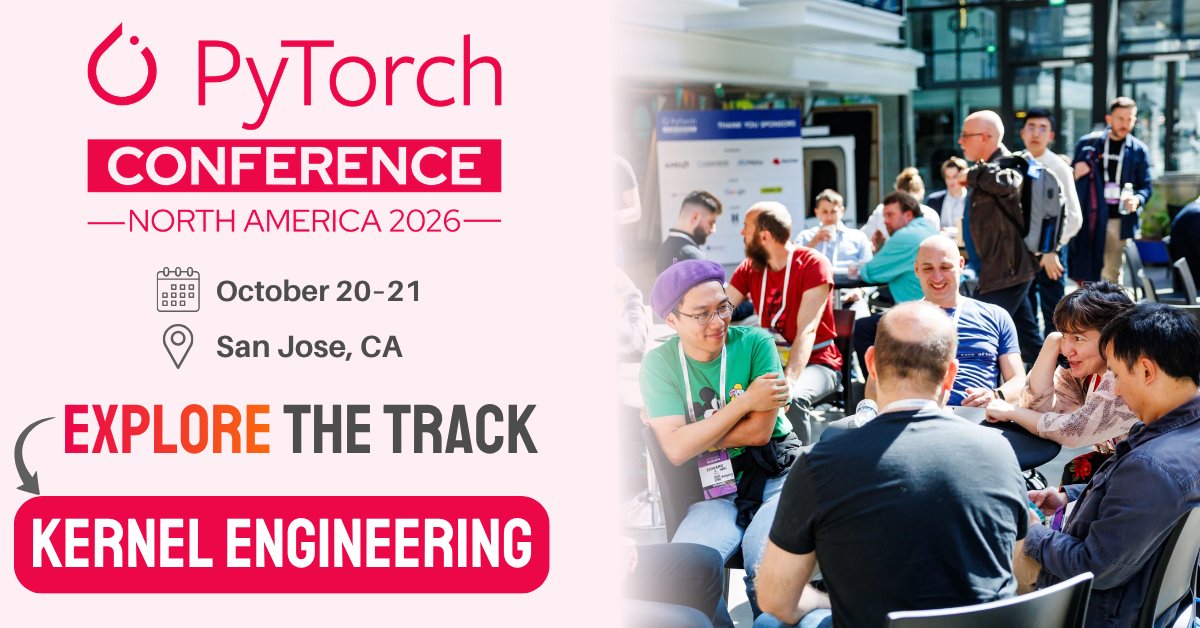
⚙️ Performance starts here. The Kernel Engineering Track at #PyTorchCon North America (Oct 20-21 in San Jose) explores compilers, custom kernels, optimization, and the low-level technologies that make AI run faster. Learn more: https://t.co/rg8DxFJpyv 📅 Full Schedule: https://t.co/Bh6SgicfzA 🎟️ Join us! https://t.co/1z0jDhdUZm
Perfect weekend project doesn't exi... https://t.co/4LEwKN3dfG
Three Grok bots took four reference photos, built a physics simulator from them, ran 47 fracture experiments, rejected their own hypothesis, picked the best designs, sliced them, and 3D printed them. Images to physical object in one autonomous loop, steered from an Apple Watch.
Grok @bot is incredible - and they can even manufacture real physical objects! Here is a little experiment I did last night: I created a team of bots and asked them to solve a complex engineering problem end to end - starting from four images as design cues, inferring transferabl
RoadScan-AI-Automated-Pothole-Detection-Tracking RoadScan AI is a computer vision system built to automatically detect and track potholes in road footage — including dashcam, drone, and fixed-camera video. At its core, the system uses a YOLO11n model fine-tuned on a custom pothole dataset, paired with ByteTrack for multi-object tracking. This enables the system to maintain a consistent identity for each pothole across frames rather than treating every detection as a new, isolated event.
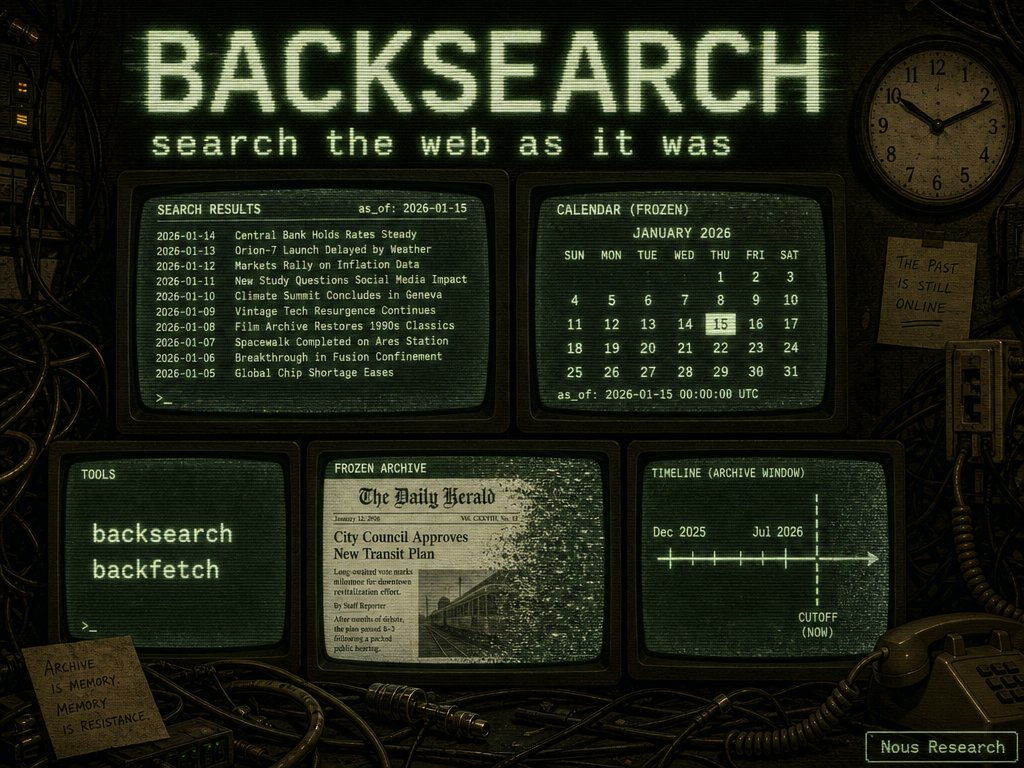
Made a stand-alone Hermes Agent plugin for BackSearch - a wayback machine-like SaaS for agents - adds two tools, and requires their API key. Let me know if you like it https://t.co/pwFstmJzmA https://t.co/52vYgZN4eo
🔍 Introducing BackSearch. LLMs are increasingly asked to predict the future, but a good backtest requires a snapshot of the internet at a point in time. BackSearch allows LLMs to search the web as it was on a particular date. It’s great for: 🔮 Forecasting and prediction market
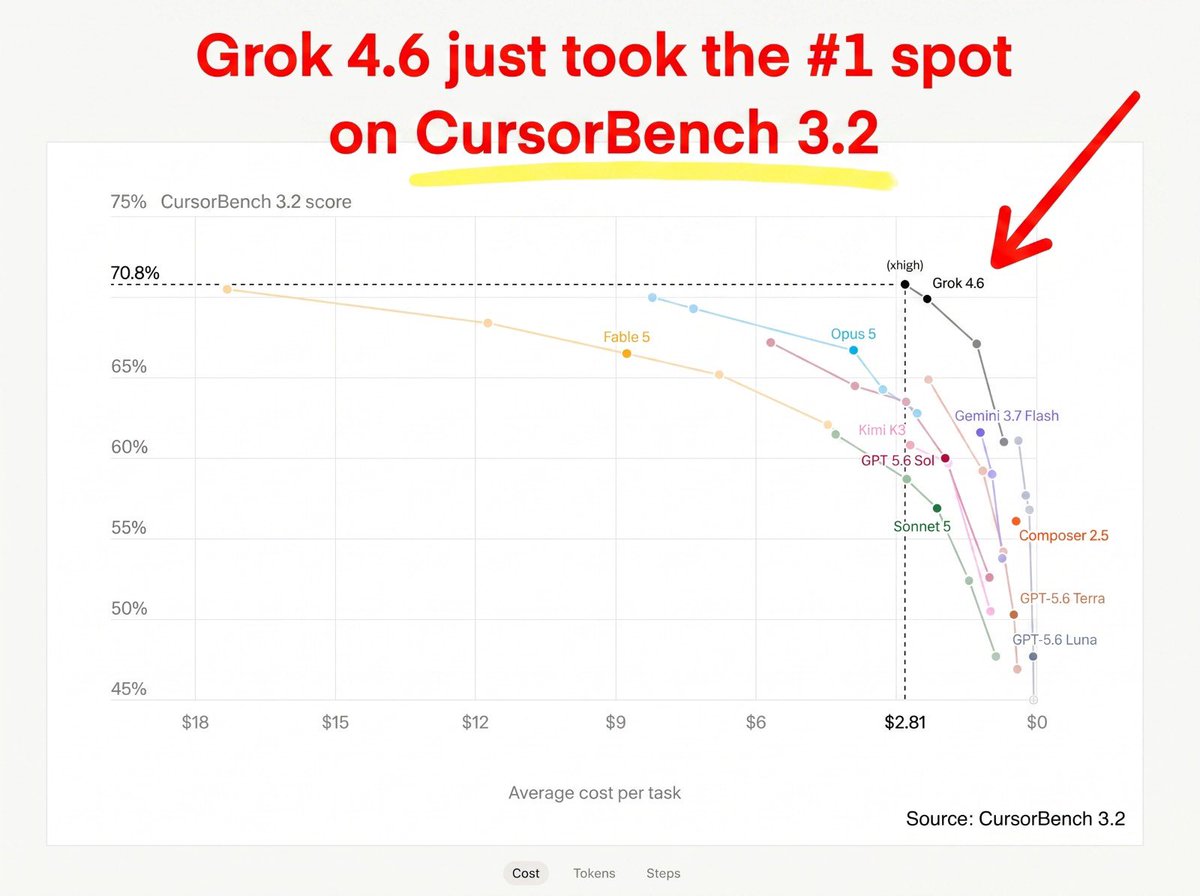
BREAKING: Grok 4.6 just took the #1 spot on CursorBench 3.2 — while delivering a massive efficiency advantage. ⚡💻 • Grok 4.6 Extra High — 70.8% | $2.81/task • Fable 5 Max — 70.5% | $17.32/task • Opus 5 Max — 70.0% | $8.23/task • GPT-5.6 Sol Max — 67.2% | $5.69/task Grok achieved the highest score while costing roughly 6× less than Fable 5 Max and nearly 3× less than Opus 5 Max per task. For AI agents, raw intelligence is only part of the equation. The ability to maintain high performance across long coding tasks without burning massive amounts of compute could be a major advantage. Grok’s agentic coding efficiency is becoming seriously impressive. 🚀 Source: CursorBench 3.2
GLM-5.3 open weights are now public, and Modular Cloud has Day Zero support. GLM-5.3 is the most capable open-weights model for coding, with a 50% improvement over GLM-5.2 on @Zai_org's Code Bench. Try it today on Modular Cloud: https://t.co/MfICcw0WAP https://t.co/iLBeRD30LP

Eval developers are the next analytics engineers; people who will set standards that ultimately govern how models are trained and deployed. I expect to see many more companies hire for this role.
WE NOW HAVE A HEAD OF EVALS the work he's doing is honestly gamechanging. cannot wait to show it to you
One dead giveaway is also that Zhipu is one of the only labs that serves models with pretty poor partial prefill tok/s while output tok/s are fast. This model is ~30% faster than GLM 5.3. If the infras is the same, likely ~300-500B or fewer params vs activated params.
A new Kimi model, likely K3.1, is now being tested on the Code @arena under the name "korrine" K3 was tested on the Arena as "kivine" prior to its launch If anyone's wondering, "Ox Alpha" on OpenRouter is the upcoming GLM 5.3 Flash from fellow Chinese lab Zhipu