@omarsar0
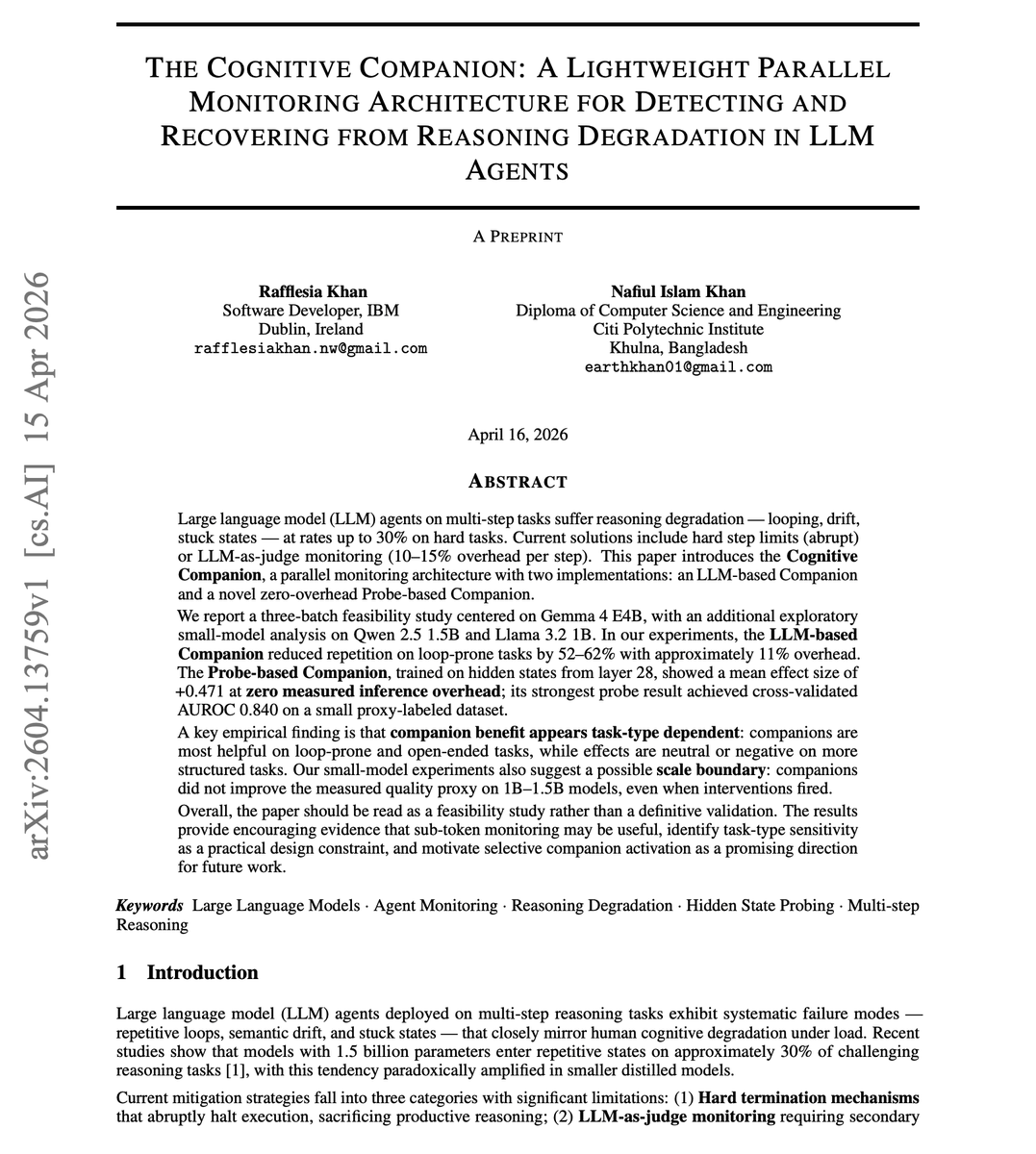
LLM agents loop, drift, and get stuck on hard reasoning tasks up to 30% of the time. Current fixes are either too blunt (hard step limits) or too expensive (LLM-as-judge adding 10-15% overhead per step). New research proposes a smarter middle ground. The work introduces the Cognitive Companion, a parallel monitoring architecture with two variants: an LLM-based monitor and a novel Probe-based monitor that detects reasoning degradation from the model's own hidden states at zero inference overhead. The Probe-based Companion trains a simple logistic regression classifier on hidden states from layer 28. It reads the model's internal representations during the existing forward pass, requiring no additional model calls. A single matrix multiplication is all it takes to flag when reasoning quality is declining. Why does it matter? The LLM-based Companion reduced repetition on loop-prone tasks by 52-62% with roughly 11% overhead. The Probe-based variant achieved a mean effect size of +0.471 with zero measured overhead and AUROC 0.840 on cross-validated detection. But the results also reveal an important nuance: companions help on loop-prone and open-ended tasks while showing neutral or negative effects on structured tasks. Models below 3B parameters also struggled to act on companion guidance at all. This suggests the future isn't universal monitoring but selective activation, deploying cognitive companions only where reasoning degradation is a real risk. Paper: https://t.co/K2vqDADwU8 Learn to build effective AI agents in our academy: https://t.co/1e8RZKs4uX