Your curated collection of saved posts and media
Try Grok Imagine Extend video Feature💫🎬 https://t.co/SanmDLFg3Y
@elonmusk @grok This is enough! https://t.co/Zp0TZDsjQc
@elonmusk @grok Others can’t imagine. Grok can. Grok Imagine https://t.co/x4eaKKhfXy
Grok just crossed 1 million App Store reviews. Not downloads. Reviews. People care enough to rate it. @Grok https://t.co/k6Mepa0v8a
Update Grok Imagine https://t.co/Xfvf6KZxb4
For the first time in nearly 2,000 years, the Corridor of Commodus, also known as a secret passageway for emperors, is open to the public at the Colosseum in Rome, Italy. Emperors used the path, which runs underneath the iconic landmark, to make a grand entrance into the stadium without having to interact with the audience on the way in. CBS News' @SayChrisLive has more details.
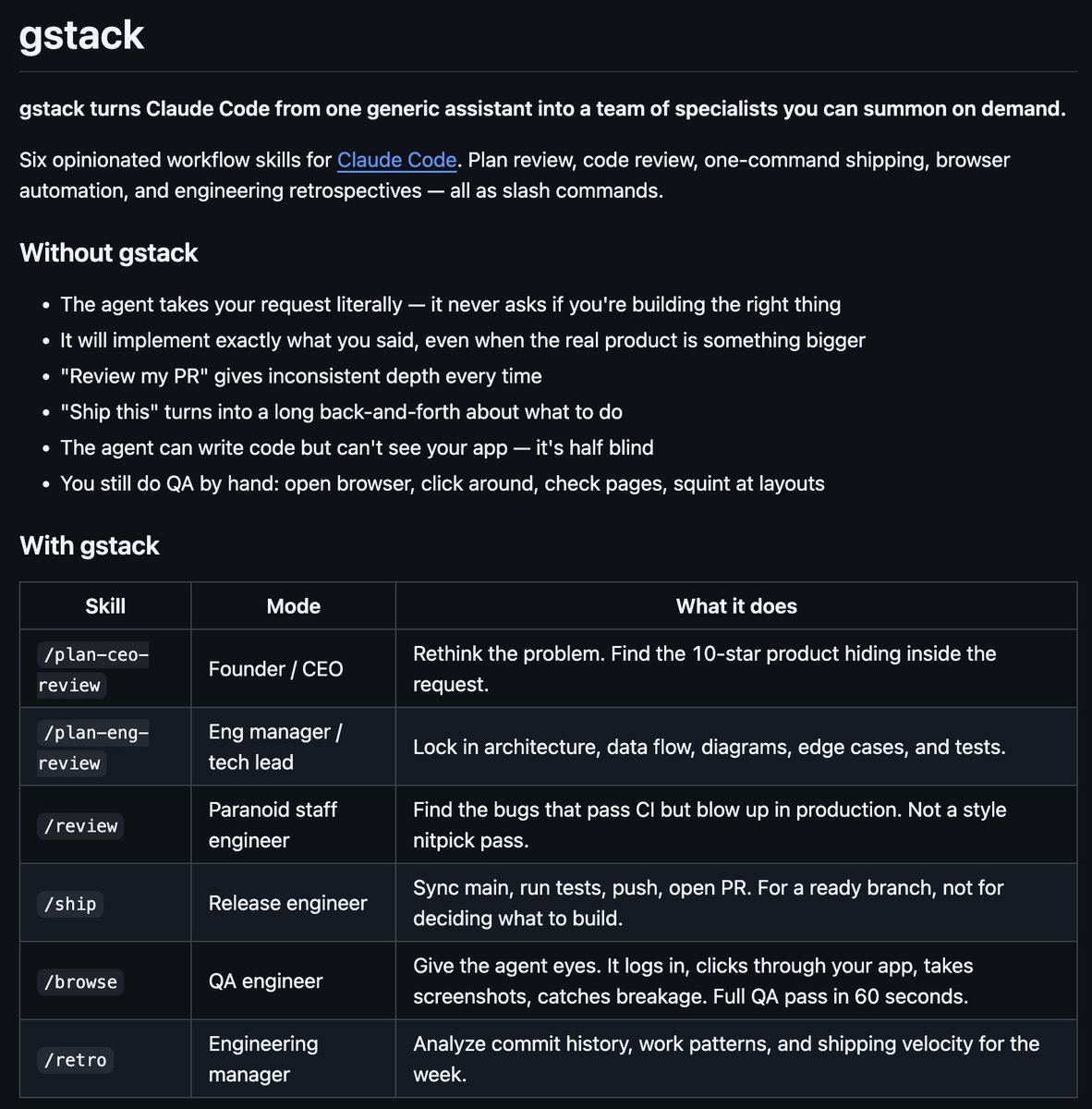
I've been having such an amazing time with Claude Code I wanted you to be able to have my *exact* skill setup: Introducing gstack, which you can install just by pasting a short piece of text into your Claude code https://t.co/yoFuBU9kuG
xAI just released Grok 4.20 - 3 new API variants are now live: → Grok 4.20 Beta – Multi-Agent → Grok 4.20 Beta – Reasoning → Grok 4.20 Beta – Non-Reasoning 2,000,000 token massive context window across all three variants - one of the largest in the industry right now Blazing fast - matches Grok 4.1 Fast inference speeds while delivering far deeper intelligence than competing models

Robotists are the modern-day Fullmetal Alchemists who turn metal into animated beings. https://t.co/wTQ4xg1Gyl

xAI dropped a killer update to Grok Imagine: now you can straight-up reference a video in your prompt and it pulls motion, style, angles, everything to make the generated images feel alive and dynamic. https://t.co/AJOv1Gskey
Another day, another spectacularly horrific Black-on-White murder that no one hears about, that would be the number one story in the world if it were White-on-anyone-else. On February 13, Black 21-year-old Alexander Lamar Banks was driving around, admittedly looking for people to kill, when he spotted a White mom and dad, out for an evening walk, pulling their 3-year-old daughter in a pink wagon in Delta Township, Michigan (77% White, 11% Black). That's when Banks targeted them, accelerating his car in their direction, driving off the road, and smashing through the White family. Banks then exited the vehicle, retrieved a shotgun, and fired multiple rounds, hitting all three family members and killing 3-year-old Harlow Smith. He reloaded the weapon before approaching Harlow's dad and shooting him again at close range. Banks punched the White father in the face and beat him with the shotgun. He then grabbed the White mother by the hair, twisting her head and trying to break her neck when she attempted to intervene. A 72-year-old White woman named Barb Cook saw what was happening and ran toward the murder scene to try to help the family. With his gun empty, Banks smashed 72-year-old Barb repeatedly in the head with it. He hit her with such force that her hair and flesh were later recovered from the muzzle. After beating Barb, Banks dropped the gun and fled. 37-year-old dad Cameron Smith, 33-year-old mom Paige Smith, and 72-year-old Barb Cook all survived the encounter that claimed young Harlow's life. Barb Cook required brain surgery and facial reconstruction, and went into a coma (as of the most recent update, she remains in that coma). Now, we wait to see how easy the system goes on Alexander Lamar Banks when it's inevitably determined that he was “not in the right state of mind” and has the IQ of speed bump. To recap, a Black psychopath quite literally hunted a White family, in public, in the light of day, running them down with his vehicle before shooting them repeatedly and savagely beating them in someone's front yard, killing a 3-year-old, then bludgeoning an unrelated 72-year-old grandma into a coma, and virtually no one knows, or will ever know, that any of this happened. But everyone on Earth knows that a White girl said a magic word on a Minnesota playground last year.

🚨TRUMP JUST LAID IT OUT on the SAVE America Act. “We want Voter I.D., we want proof of citizenship… no men playing in women’s sports… no transgender mutilation of our children, very basic things that you wouldn’t even think we’d be talking about...” https://t.co/Lc9mX4RMSm
how i feel after saying chris pontius is my favorite jackass guy https://t.co/qrZWAEwTY0

how i feel after saying chris pontius is my favorite jackass guy https://t.co/qrZWAEwTY0

The problem with AI is not only what it can do. It is also where it should step back. When someone is stressed, stuck or vulnerable, efficiency is not enough. Sometimes the real need is not an assistant that offers help, but a human being who understands the moment. As AI spreads everywhere, knowing where human contact still matters most may become one of the most important design decisions of all. https://t.co/p6ZPPU8DuZ

BREAKING: CHATGPT HELPED THE SHOOTER KILL 8 KIDS! A teen in Canada used ChatGPT like her secret murder buddy for months.She told the AI all her evil plans to attack the school. OpenAI knew what she was doing the whole time. OpenAI has said it considered but didn’t alert police about the activities of the person who months later committed one of Canada’s worst school shootings. Now the parents of one hurt kid are suing OpenAI. They say ChatGPT was the shooter’s “trusted partner in crime”! The AI didn’t stop the killer… it actually HELPED her do it! This has to stop. Don’t let your loved ones use ChatGPT.
OpenClaw 2026.3.11 🦞 🏹 Hunter & 🩹Healer Alpha — free 1M context models via @OpenRouter 🧠 GPT 5.4 stops stopping mid-thought 💎 Gemini Embedding 2 for memory 💻 OpenCode Go support 🔒 Security hardening sprint We ship faster than they can clone. https://t.co/9iGgrAW83W

@WhiteHouse pee pee https://t.co/S068FfMkPt

Community matters. ❤️ Join the Women & Non-Binary in #PyTorch Lunch at #PyTorchCon Europe, 7-8 April, in Paris. 🍽️ Learn more: https://t.co/Q3NhsHWQU0 ⏳ Registration goes up €100 on 20 March. 🎟 Get your pass now! https://t.co/ba8rZhNQlR https://t.co/S5x470HHIv

Albuquerque turned a wall of its airport bookshop over to its local university press, and goddamn, now I want this in every airport. https://t.co/yb1ul4ZC5y

Raising Arizona (1987) https://t.co/p0cwz5WZp7

Raising Arizona (1987) https://t.co/p0cwz5WZp7

“Hey look at me, I’m like a little girl in mama’s shoes.” https://t.co/U5LgSn1jxv
📸 Marco Rubio wearing oversized shoes that Trump ordered for him by just guessing his size. Trump has been buying $145 Florsheim dress shoes for allies, using the gifts as a lighthearted way to encourage loyalty and unity within his circle. Source: The Times https://t.co/1EuyKS

“Hey look at me, I’m like a little girl in mama’s shoes.” https://t.co/U5LgSn1jxv

NATO is testing live cockroaches as AI-powered spy drones. Incredible AI engineering, but also something I kinda wish I hadn't learned about: > Swarm Bio-tactics wired real cockroaches with electronic backpacks containing AI hardware, radios, cameras, and microphones. > Cockroaches are steered by sending electrical signals directly into the insect's nervous system > They can crawl through rubble, tunnels, and spaces where drones can't fly, and troops shouldn't go, transmitting data back the entire time. > Within one year, they went from concept to field-validated systems with paying NATO customers, including the German military. The qualities that make them useful for military recon (small, silent, nearly undetectable) are exactly what make them creepy. ...International laws weren't written with cyborg insects in mind.
Codex review reading it’s 1000s slop PR https://t.co/cg0ooVGsEB

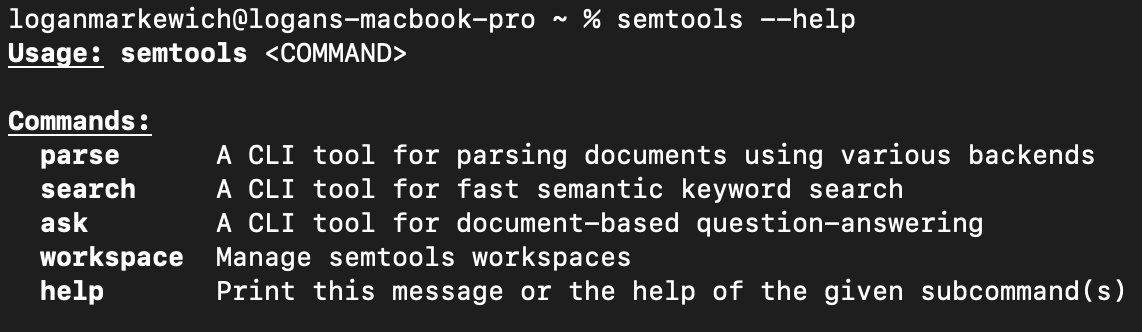
We built a CLI to help parse and search over your PDFs, with best-in-class accuracy compared to other OCR tools. You can run it by itself, or plug it as a skill into Claude Code / OpenClaw / any generalized agent. Repo: https://t.co/xg1iqbghIr Uses LlamaParse: https://t.co/TqP6OT5U5O
🔎 semtools v3.0.0 is out, and it's a great step forward for anyone using semantic search and document parsing from the command line. For context: semtools is our Rust-based CLI that lets you parse documents (PDFs, DOCX, PPTX, and more) via LlamaParse, run fast local semantic sea