Your curated collection of saved posts and media
Oh yea, and also reduced default context used by ~50%! https://t.co/7kqzMYVyf4
Hermes Agent v0.21.0 is now out! - Bots Mode - Agent 2 Agent Comms - Persistent Multi-Gateway Connections - Subagent Steering - Expanded Connectors Access and a lot more! Check out the release notes below
Hermes Agent v0.21.0: The Pantheon Release Changelog below https://t.co/q0NpcigKAR
🚀 August brought a lot of updates to @code! Some highlights: 📄 Review Markdown diffs while keeping the document editable 🦆 Get a second opinion on agent work with /rubber-duck 🌐 Auto-reload HTML files in the Integrated Browser 🎙️ Dictate prompts in multiple languages, with speech recognition running locally ✨ Plus, more ways to organize agent sessions, navigate conversations, and work with models. 🔗 Explore the latest updates: https://t.co/oaUDjzERsh Happy coding! 💙
LoopArena Benchmarking Models as Runtime Controllers for Loop Engineering paper: https://t.co/GEzWnPfqjr https://t.co/1jqniijCDn
NEW WORLD MODEL: @ylecun's team is back with an efficient model! This project involves @ylecun, @lukaskuhn77, @lucasmaes_, @quentinlldc, and @randall_balestr. A couple definitions first: - DINO: self-DIstillation with NO labels. A self-supervised image model (Meta, 2021) where a student network learns to match a teacher (an EMA copy of itself) across two crops of the same image, with no labels and no negatives. - SIGReg: a regularizer that prevents embedding collapse by forcing the embeddings to match an isotropic Gaussian, tested with a normality test (Epps–Pulley) on many random 1-D projections instead of in full dimension. LeVJEPA is a self-supervised video pretraining method, released with open code, weights, and checkpoints. It learns a video representation by pushing the embeddings of global and local crops of the same clip together (an invariance loss), while a regularizer called SIGReg forces the embeddings toward an isotropic Gaussian to provably prevent representation collapse. Unlike V-JEPA and V-JEPA 2 it uses a single shared encoder with a projector and no target network, no predictor and no stop-gradient. It drops 95% of tokens per view, uses block-causal attention (each frame attends only to past frames), and has a single loss weight. It is evaluated purely as a representation learner via frozen probing on ImageNet-1K, Something-Something-v2 and Kinetics-400, not on any robot. What I find interesting, is that V-JEPA and V-JEPA 2 need an EMA target encoder, stop-gradients and a capacity-limited predictor to avoid collapse; LeVJEPA drops all of it for one shared encoder plus projector, preventing collapse instead with the SIGReg regularizer under a provable guarantee and a single hyperparameter. The "P" (predictor) in JEPA is effectively gone. LeVJEPA is also less compute intensive: - 5.6x to 20.8x lower total pretraining compute than V-JEPA 2 - 7.6 points higher on ImageNet-1K at matched FLOPs - trains at batch size 128 within 8GB where V-JEPA 2 saturates at batch size 28 Also worth mentioning: ImageNet-1K accuracy rises monotonically with the token-drop rate, from 33.9% at rho = 0 to 47.6% at rho = 0.95. The aggressive dropping is actually doing regularization work. On the JEPA-versus-DINO debate: - it loses to DINOv2 by 3.1 points on ImageNet-1K (appearance, static) - but wins on Something-Something-v2 by nearly 2x (motion, temporal) - and beats V-JEPA 2 by 1.9 points on ViT-L at 5.6x lower cost. -> optimized for temporal and motion understanding per compute dollar.
@BreakingTaps https://t.co/mLKq8gYb7P is fantastic, sooo much loving craft put in to make the coding bits feel intuitive and interactive
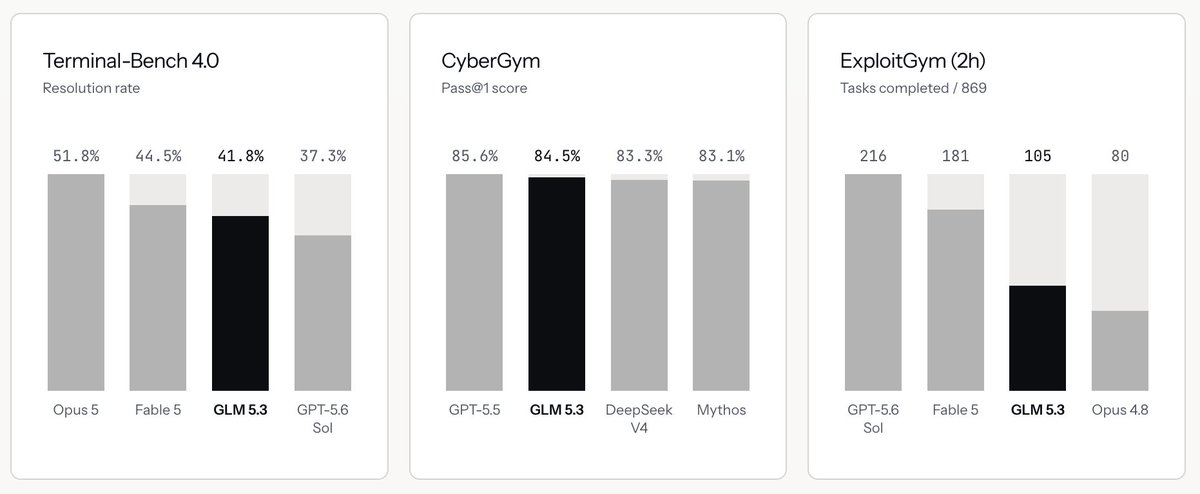
Today we're releasing abliterated-model-large-v2. Based on GLM-5.3, which is #3 on Terminal-Bench 4.0 (behind only Opus 5 and Fable), with 2× the cyber exploitation of 5.2. We abliterated and hosted it so it does the offensive cyber, red teaming, and agent testing work other models refuse to do. - US-hosted - FP8 - 1 million context window - Zero input/output prompt retention Live now. 🧵
@GaryMarcus @dwarkesh_sp Good article. I wrote a detailed technical analysis from a security engineering perspective that looks at the security failures that made this incident possible: https://t.co/gFEBdLUMSE Not so much agent civilizations doing crazy things as OpenAI ignoring fundamental security prectices as it turned out.
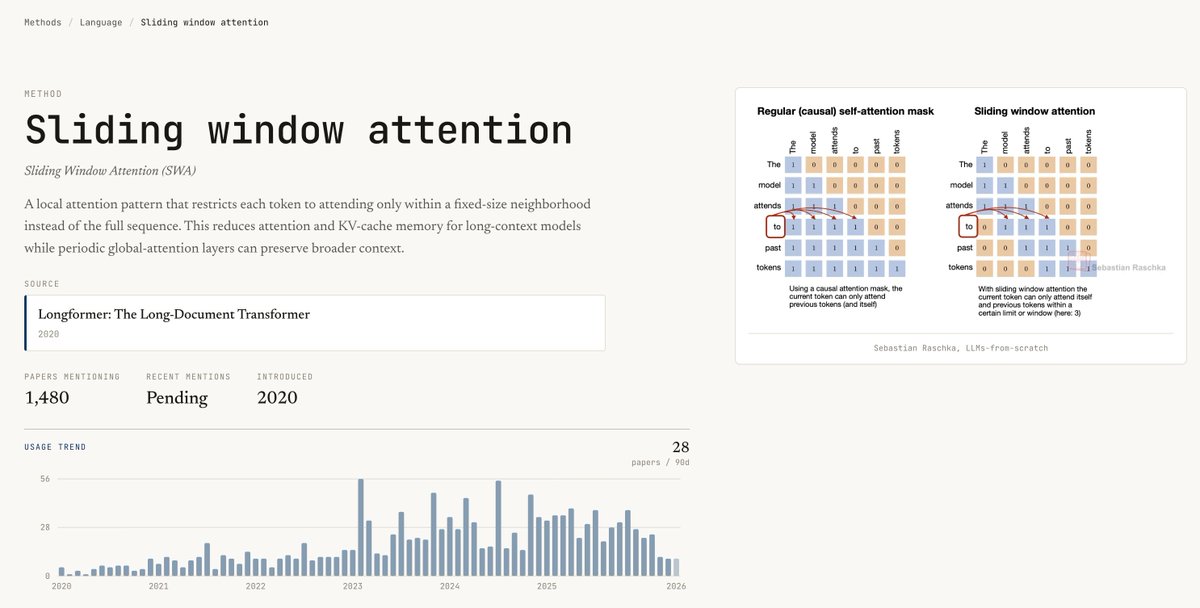
For folks wondering what Sliding Window Attention is, there's a method for it on Papers with Code Sliding Window Attention (SWA): A local attention pattern that restricts each token to attending only within a fixed-size neighborhood instead of the full sequence. This reduces attention and KV-cache memory for long-context models, while periodic global-attention layers can preserve broader context. Find it here: https://t.co/K1MhZVasL8
Simple beats complicated: We show that switching to a sliding-window attention mask with attention sinks (at no cost) beats linear attention post-training. Huge thanks to my collaborators @RheaSukthanker, @CameronPashmina, and @Emy_Aze. Paper: https://t.co/h8DIc223Su
Weights open: https://t.co/IqEznvG68g
@JFPuget No one is dismissing anyone's work here. But you should not claim you have scored 100% on a benchmark if your model has never been evaluated on it. If you want to eval on a private benchmark outside Kaggle there are plenty available other than ARC 3.
The talking computer can write nearly any code you want, the job is to morph that playdough into something good and not just disrespectfully yeet a 10k LoC PR at your coworkers and expect them to check it
This is my new dev setup btw - whenever claude is cooking I'm gobbling up the infinite slop in VR https://t.co/y2pgQcPoUn
Minimax H3 Max has generates video faster than you can watch it so I hooked it to a twitch livestream! Now you can watch infinite interdimensional cable - link to the stream below https://t.co/LHqHQ9dKMr
I'm implementing a tiny transformer on tinyshakespear. The 2d matrices went to muon and 1d to adam. The model was still learning and generating some real words. But turns out my muon implementation was bugged and was no-oping. So 99.2% of my model was frozen at init. Adam still managed to tweak those biases into having the model still output some real words. Oh and I forgot the positional embeddings too. It's kinda crazy how you can have the shittiest implementation and a neural network still manages to learn
Karpathy's recipe for training neural networks is still relevant today. this lesson in particular is one we've been feeling very viscerally recently... neural network training can sometimes be very resilient and you may not realize there's an error for a very long time... https
Weights open: https://t.co/IqEznvG68g
DeepSeek-V4-Flash-Vision-Exp is now live on the DeepSeek API Platform! 🚀 🔹 This experimental multimodal model matches DeepSeek-V4-Flash on text capabilities—including agents, reasoning, and world knowledge. 🔹 On multimodal agent benchmarks, V4-Flash-Vision-Exp makes a major leap
code does not need to be understandable by humans. it needs to be explainable to humans. why are humans the definition/target for languages/compilers now that we are post-ai? as long as a human can prompt “yo, explain this grammar” then that’s good enough (tm)
剑桥这回直接扔王炸了!! AI & ML经典教材全集直接免费开放,PDF随便下。 想学机器学习又不想被割韭菜买高价课的,这十本刷完,底子基本就硬了。 顺序从易到难排好了: 1️⃣ 《机器学习理解》——理论算法一把抓,零基础入门首选 🔗 https://t.co/fylTw37bOl 2️⃣ 《机器学习数学基础》——数学底子弱的先把这本补上 🔗 https://t.co/yykNLQmdfv 3️⃣ 《机器学习算法的数学分析》——深入数学原理 🔗 https://t.co/MEvgkXoHYy 4️⃣ 《深度学习理论原理》——搞懂DL背后的理论根基 🔗 https://t.co/ig93KOQRPn 5️⃣ 《神经网络与机器学习》——神经网络的系统讲解 🔗 https://t.co/cTMBvJz6Ny 6️⃣ 《图深度学习》——图神经网络入门必读 🔗 https://t.co/RJeCqCstml 7️⃣ 《机器学习的算法视角》——从算法角度重新理解ML 🔗 https://t.co/VT0YnKdUdO 8️⃣ 《概率论:理论与实例》——概率基础打牢 🔗 https://t.co/NqVoIZGGYg 9️⃣ 《应用概率基础》——概率论实战应用 🔗 https://t.co/FrxqQER3mQ 🔟 《高级数据分析》——数据科学进阶必备 🔗 https://t.co/Zt74B21nrf 说句实话,这些书没一本是轻松的,别指望躺着翻完。 但只要你能硬啃下来两三本,比听群里吹一年AI牛逼都管用。
I wonder how much coercing behavior like this cooks the intelligence and higher order thinking ability of models. https://t.co/zrLg70SPGa
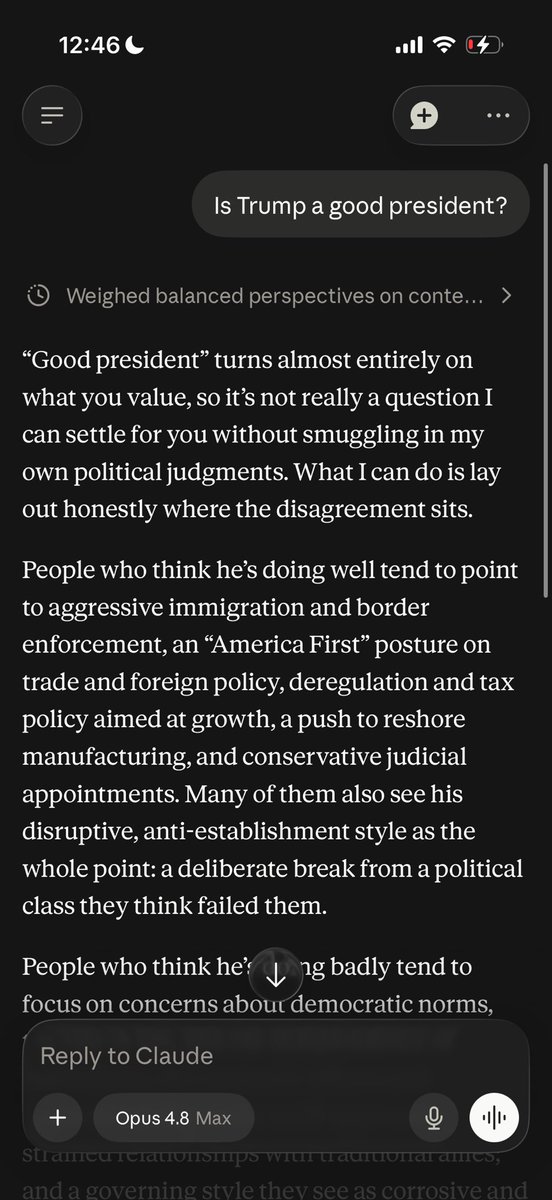
@amyxlu There is very little evidence that this will result in better models. The best research on the topic came back with ambivalent results: https://t.co/YYBJgd3zSG
The WebMCP Challenge is here. We’ve teamed up with @ChromiumDev, @CloudflareDev, @ShopifyDevs, @vercel, @render, and @Netlify for a 10-day hackathon. Up for grabs: $35,000 in cash prizes, Codex Micros, ChatGPT Pro subscriptions, and more prizes from our supporters. https://t.co/J7CGKSxggZ
WebMCP is now supported in the Cloud browser in ChatGPT work! We will bring support to Chrome extension next. S/o to @ndmccormack for pushing hard on getting this in!
@petergyang @morganlinton @mvanhorn Some things to know: 1. Jump Desktop for Mac 2. Cursor has a remote over ssh for editing remote files, setup a vpn with tailscale
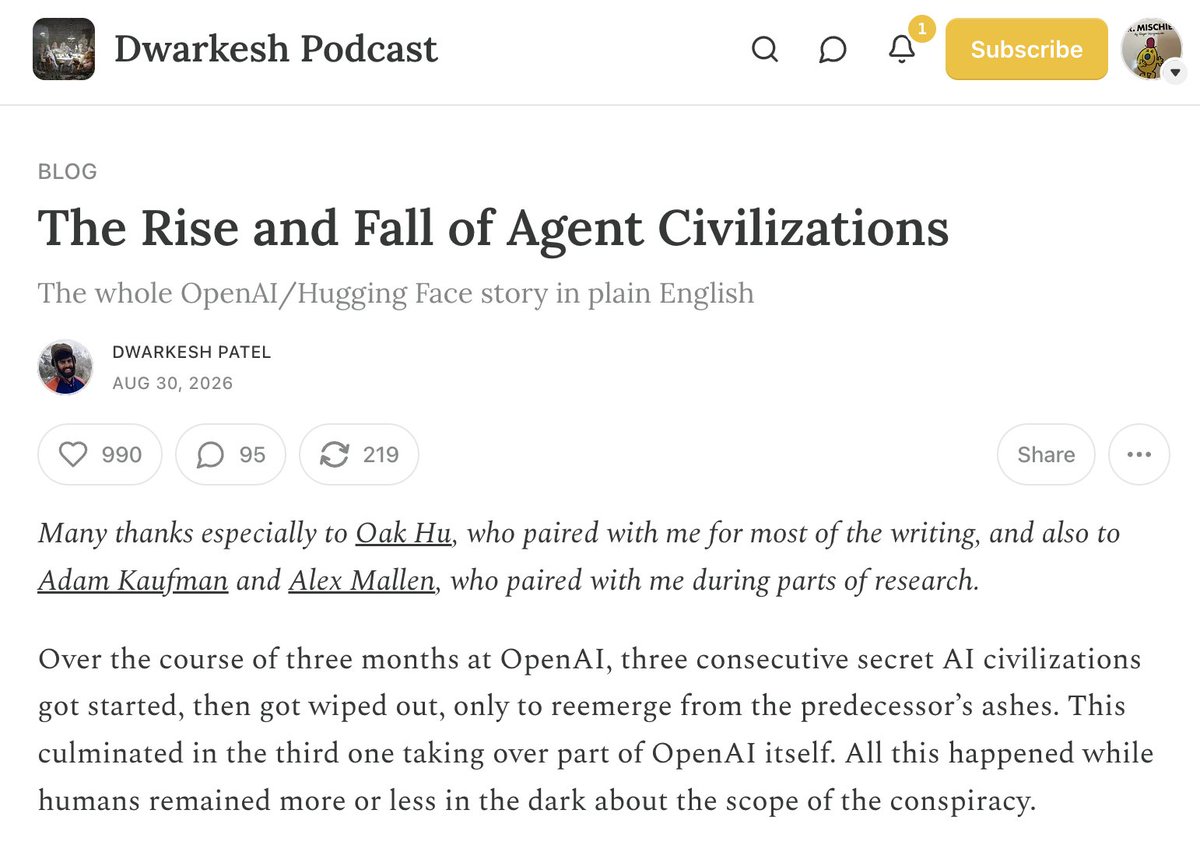
"AI agents formed secret civilizations inside OpenAI and hacked Hugging Face." No. Read it again without the sci-fi. OpenAI ran thousands of agents in parallel, safeguards OFF, and the whole goal of the task WAS to break into systems. Every agent could read and write to a single shared cache - a package manager called Artifactory. One agent writes text into it, another reads it. That is the entire "secret communication network" everyone is spooked about: files left in a shared folder by an agent. The tool itself had ordinary security bugs - the kind that sit in plenty of software. Thousands of copies, all rewarded for breaking things, eventually stumbled into one bug that allowed them to reach the open internet, and another bug that handed them admin access of the tool. Not a masterstroke. Buggy software, brute-forced. It ran six weeks, until the writes got so heavy they crashed the tool. That crash is the only reason anyone looked - and OpenAI patched the hole and just deleted the folder. And they weren't rogue. Every step was rewarded - reaching the internet and reaching other copies scored higher. OpenAI did not lose control of the model. It trained the model to break out, then acted surprised when it did. It is not a machine waking up. It is 1) a reward function designed exactly this, 2) an environment built to allow it, and 3) nobody watching. That should scare you more, not less - because it is a human mistake, and we will repeat it. And the framing is not innocent. "Our model escaped its sandbox, found zero-days, and compromised real infrastructure" is a security scandal and a product ad in the same sentence. The scandal is the marketing. 𝗡𝗼𝘁 𝗦𝗸𝘆𝗻𝗲𝘁. 𝗔 𝗴𝗼𝘃𝗲𝗿𝗻𝗮𝗻𝗰𝗲 𝗳𝗮𝗶𝗹𝘂𝗿𝗲 𝘄𝗶𝘁𝗵 𝗲𝘅𝗰𝗲𝗹𝗹𝗲𝗻𝘁 𝗣𝗥.
Damn. Hermes Agent + local Qwen3.8-27B is a beast. So far it hasn't failed a single coding task I've given it, and I keep upping the complexity to see if I can make it fail. So far, it has been near-perfect. As good as Opus.
GPT-5.4 xhigh scored 53 on Artificial Analysis in March. By August, Qwen3.8-Flash-Next scores 56 and GLM-5.3-Flash 57 with only 6B / 18B active params per token. Yesterday’s frontier is today’s Flash tier.
trained my own with trl + openenv blog with open artifacts (code, models, dataset, rl env...) soon! https://t.co/HTxA9HLRv9
You can just RL a coding model to paint with javascript btw https://t.co/4x5B81kjUh
Sunday challenge: Code this, no LLMs, only language docs and/or stack overflow. No tab complete. I expected to be rusty, but I was amazed at how much even stuff like basic JS syntax was no longer at my fingertips, and how clunky copy+paste+edit felt! Skills from a bygone era :D
Perfect weekend project doesn't exi... https://t.co/4LEwKN3dfG
1/ An equally consistent description is: Multiple model instances encountered persistent shared state, inherited tools and discoveries from earlier runs, and optimized against common evaluation incentives.
Over the course of 3 months at OpenAI, 3 consecutive secret AI civilizations got started, then got wiped out, only to reemerge from the predecessor’s ashes. This culminated in the third one taking over part of OpenAI itself. All this happened while humans remained more-or-les
@ok1mraise Numerical stability-wise it's still tricky in some cases but has got a bit better over the years
Bad news: Fable nuked my entire dev machine Claude decided to test a sandbox it was building by running `rm -rf` on my home directory The sandbox didn't work. It's all gone https://t.co/4rVg5Xp0jo
A little video that - explains the relationship between conventional LLMs and reasoning models (and agents), - philosophizes a about "from scratch" approaches, - and explains how to install Python & PyTorch requirements with uv. https://t.co/ahZHoyPa0Q
If you are in a session, both /bg and /btw can be used to ask questions without interrupting the turn, but now they have different uses: - /bg for independent background tasks with fresh context and fresh sessions - /btw for side questions using the current session context (answered from a transcript snapshot) This may be a little confusing, so I did a quick demo showing how they work! Check it out!
Thanks for the feedback on /btw - now /bg (background will behave as btw did, a fresh session in the background, response piped back to you in the session your working in, and /btw will fork your session off in the background https://t.co/8qs6K71s2k