Your curated collection of saved posts and media
Here’s a first look at X-Plane 12 on Apple Vision Pro! With visionOS 26.4 and NVIDIA CloudXR 6.0, the simulator streams wirelessly at up to 4K/120fps to your headset. And if you have a physical yoke or throttle, ARKit uses image detection to recognize them and place them inside your virtual cockpit. 🤯 It’ll be available later this spring.
Democrats are weaponizing the Senate’s rules to block the SAVE America Act, defund @DHSgov, & hurt the American people to spite @POTUS. @SenateGOP can either let Dems keep obstructing & smash the filibuster the first chance they get, or we can act now & use the mandate the American people gave @realDonaldTrump & Republicans to secure our elections, protect our homeland, & bring back common sense. Democrats started this fight. I support whatever changes to Senate rules are necessary to finish it and pass the SAVE America Act. https://t.co/MmuCF7kzT2

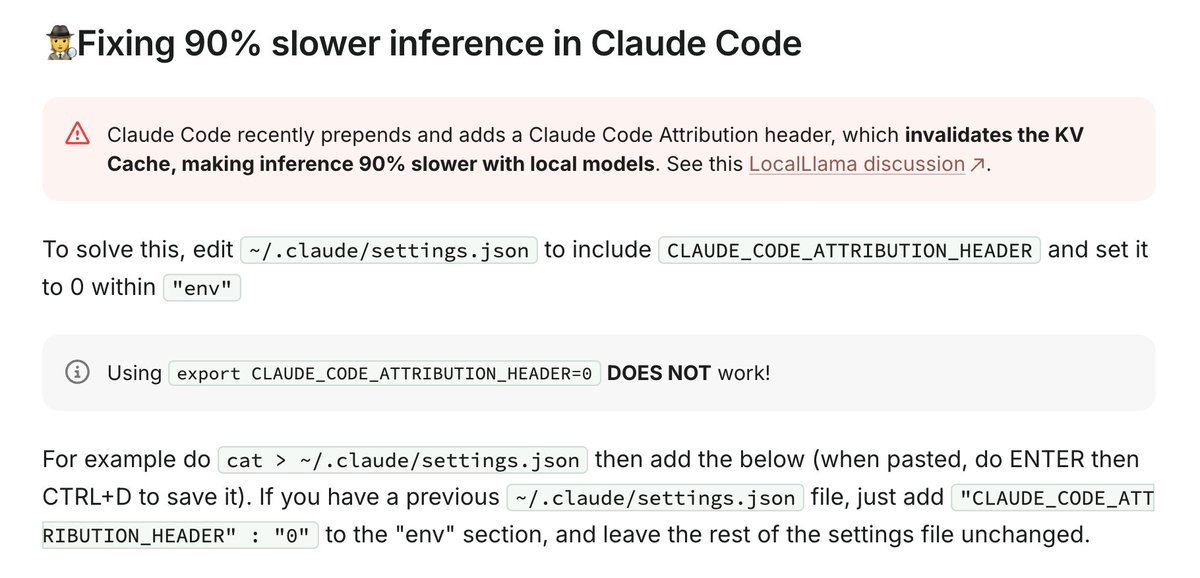
Note: Claude Code invalidates the KV cache for local models by prepending some IDs, making inference 90% slower. See how to fix it here: https://t.co/tUDs5Q8Jt5 https://t.co/5qvwOAArjX
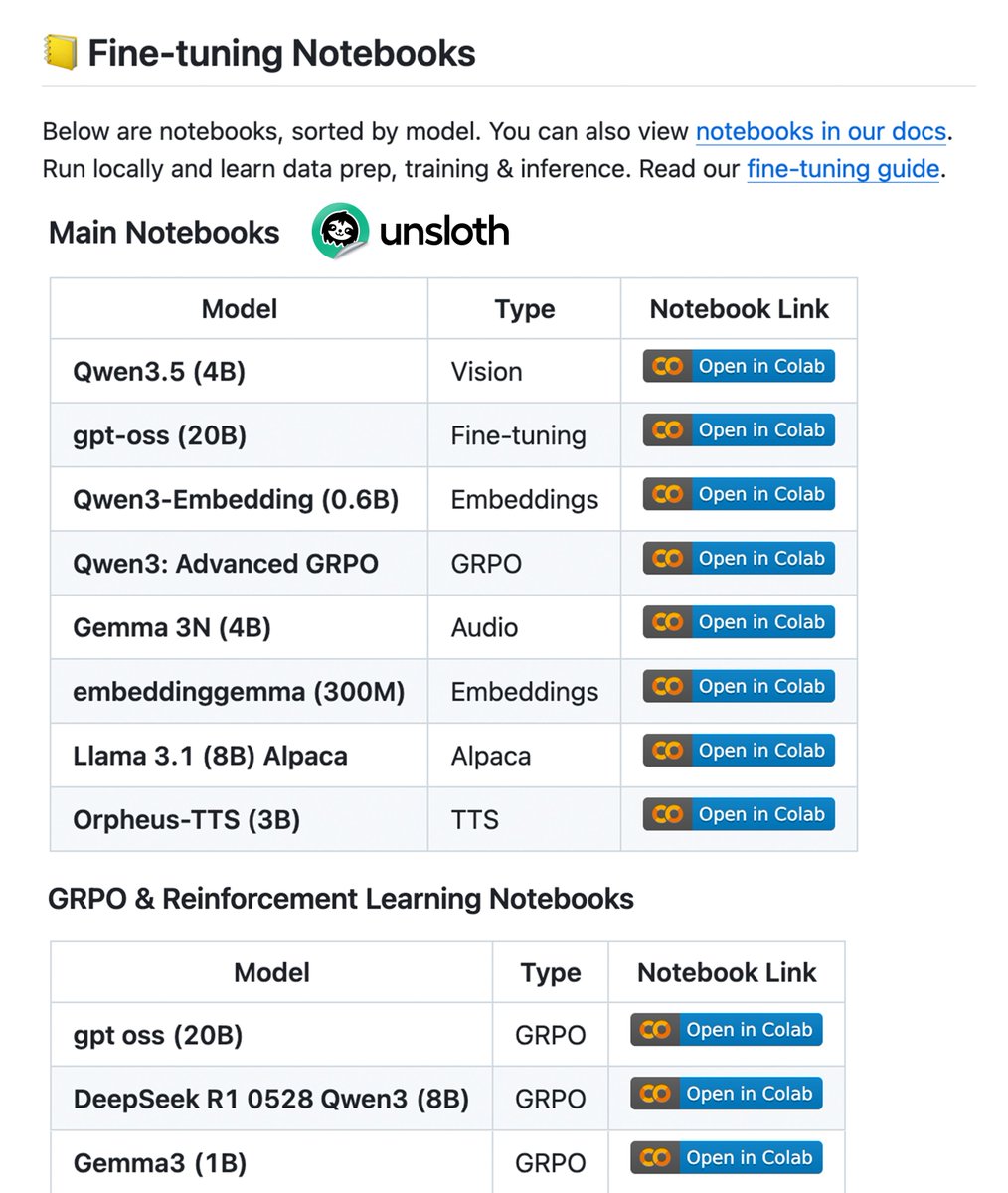
We created a repo with 250+ notebooks for LLM training. Train locally on your device with 3GB VRAM or free on Colab. Learn the entire fine-tuning and inference workflow. Supports RL, vision, audio, embedding, TTS models GitHub: https://t.co/1qSdX8w8SO https://t.co/B0T52LOJ79
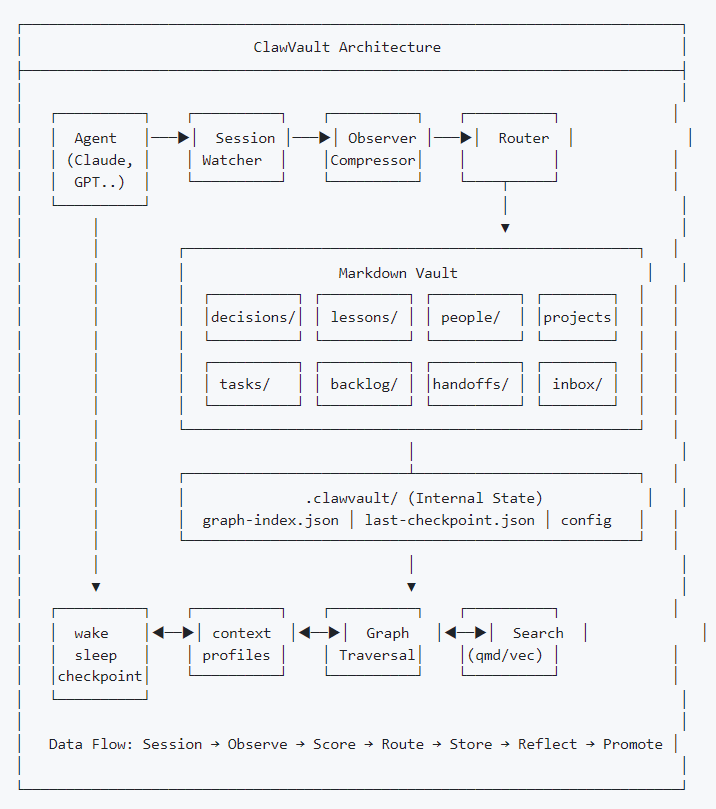
ClawVault – a persistent memory for AI agents It gives agents a markdown-native memory system that: - stores knowledge in a graph-aware vault - is local-first (no cloud) - preserves state with checkpoints, search and structured facts - is human-readable + git-friendly So agent memory becomes a plain markdown (instead of vector databases), that you can read, edit, and version
Every AI video tool I've used before treated the creative process as a single moment. You write a prompt, you get a clip, and if it's not right, you just... start over. The whole thing. From scratch. PAI (got to try it early) is one of the best long-form video storytelling models I've used that really attempts to fix this problem. You can go back into a scene and change things. Move a character. Adjust the pacing of a shot. It sounds like a small difference, but it completely changes how you think about what you're making. It finally feels like I have editing control over the video generation process. Excited to see what @UtopaiStudios is building here.
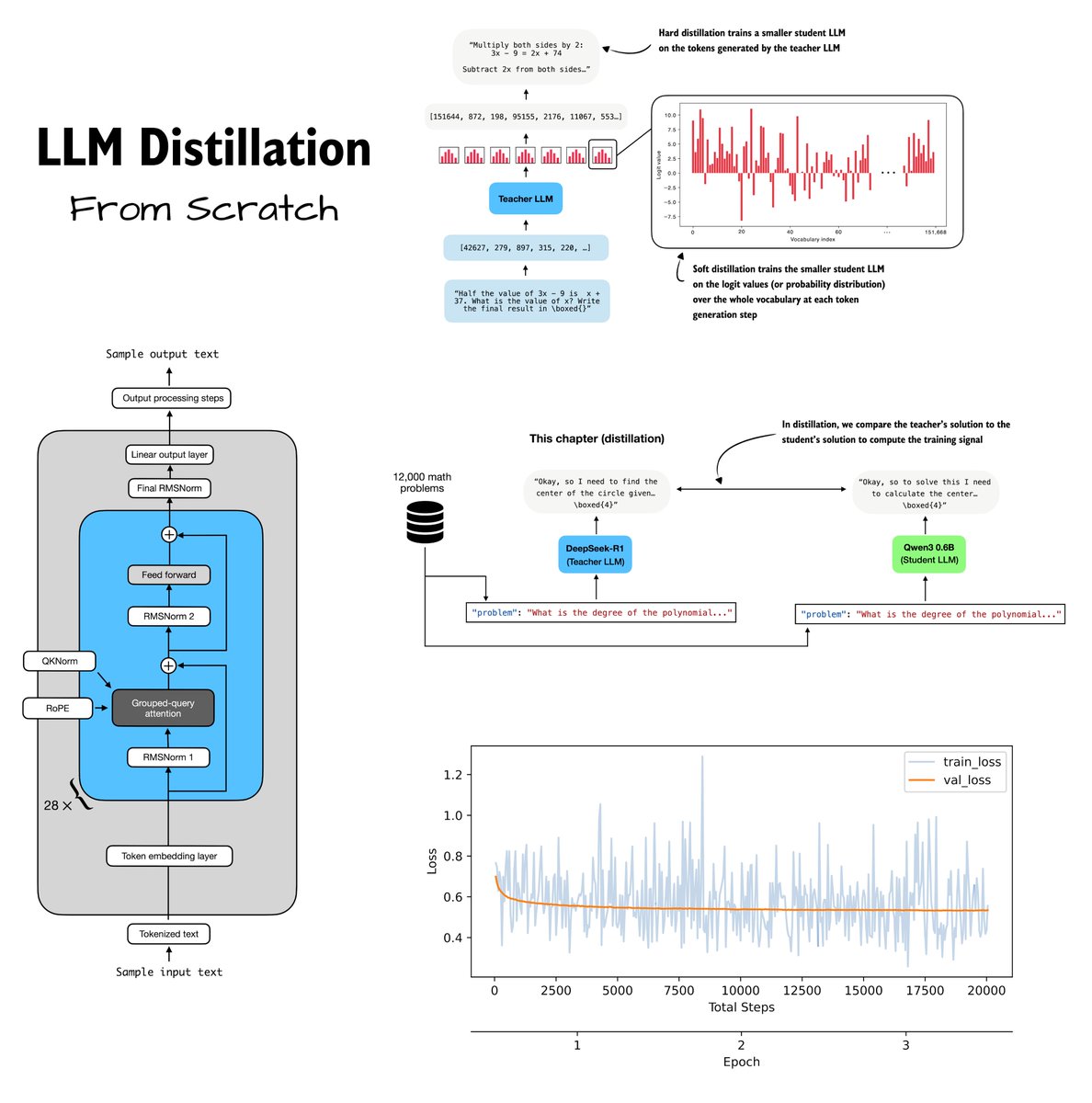
The Ch08 Nb on distilling LLMs is now on GitHub: https://t.co/bPRyIU5BhH Hard distillation that works with any LLM (minding the terms of service, of course). https://t.co/KscPulkj7q
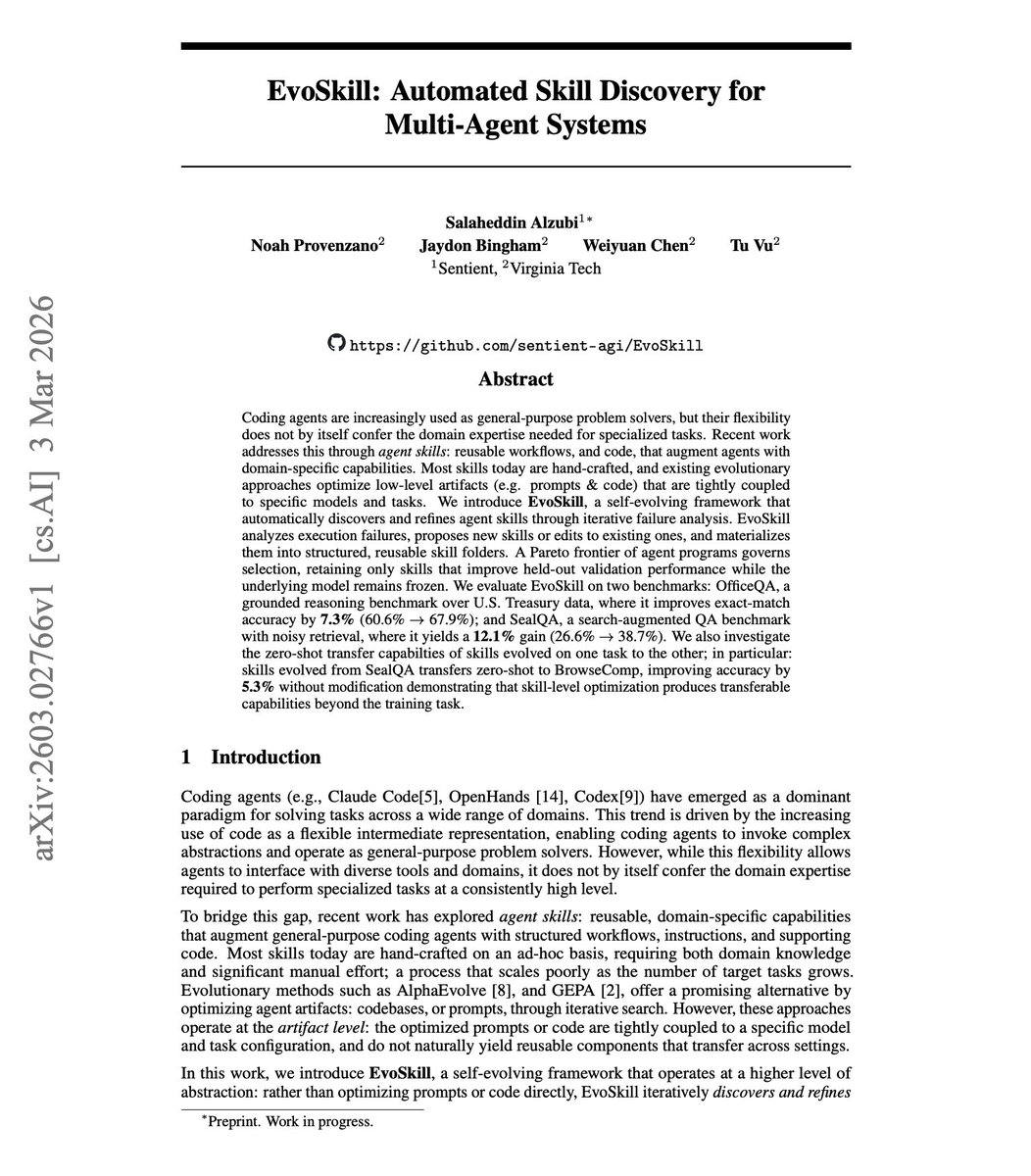
A self-evolving framework to discover and refine agent skills. Most agent skills I see today are hand-crafted or poorly designed by an agent. Multi-agent systems for building skills look promising. This paper introduces EvoSkill, a self-evolving framework that automatically discovers and refines agent skills through iterative failure analysis. EvoSkill analyzes execution failures, proposes new skills or edits to existing ones, and materializes them into structured, reusable skill folders. Three collaborating agents drive the entire process. An Executor that runs tasks, a Proposer that diagnoses failures, and a Skill-Builder that creates concrete skill folders. A Pareto frontier governs selection, retaining only skills that improve held-out validation performance while keeping the underlying model frozen. On OfficeQA, EvoSkill improves Claude Code with Opus 4.5 from 60.6% to 67.9% exact-match accuracy. On SealQA, it yields a 12.1% gain. Skills evolved on SealQA transfer zero-shot to BrowseComp, improving accuracy by 5.3% without modification. I will continue to track this line of research closely. I think it's really important. Paper: https://t.co/mgsnoMBjOx Learn to build effective AI agents in our academy: https://t.co/1e8RZKs4uX
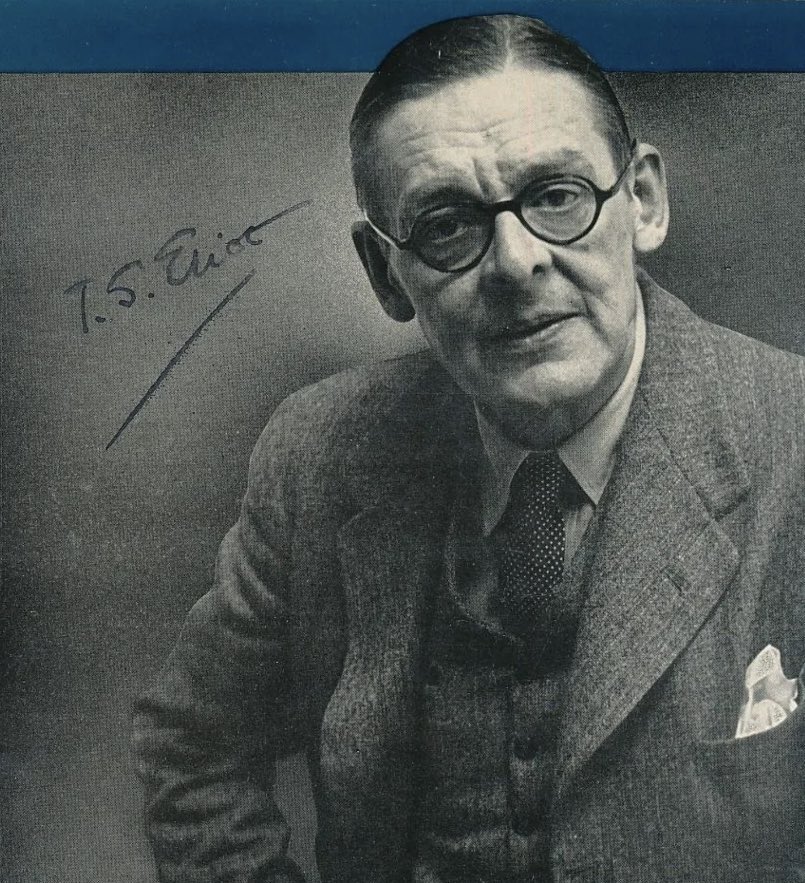
“For the immediate future, and perhaps for a long way ahead, the continuity of our culture may have to be maintained by a very small number of people.” T.S. Eliot https://t.co/KE0yEbD75j
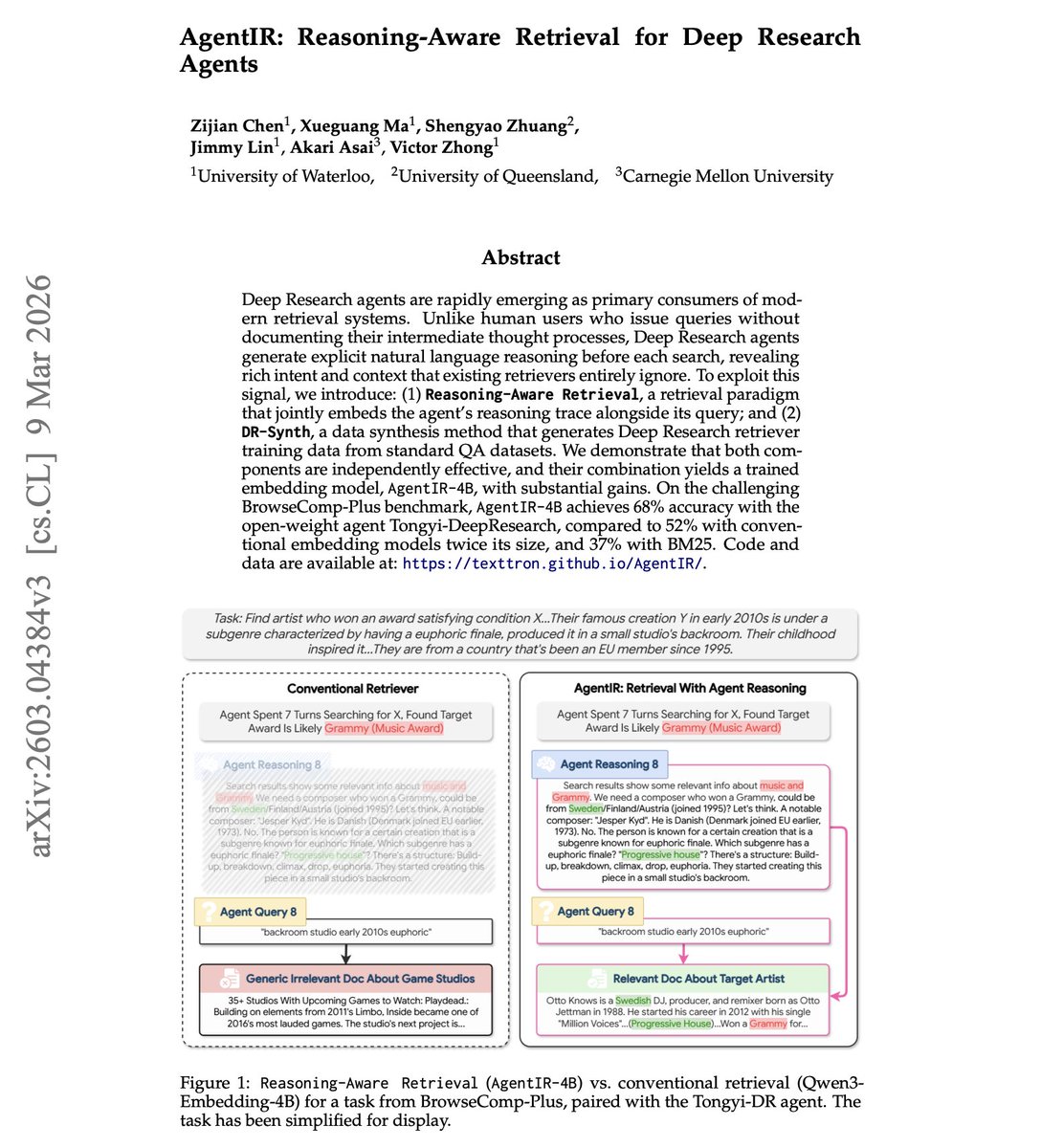
Reasoning-Aware Retrieval for Deep Research Agents Deep research agents generate explicit reasoning before every search call. These reasoning traces encode rich signals about search intent and problem-solving context. Yet no existing retriever learns to exploit them effectively. This paper introduces AgentIR, a reasoning-aware retrieval system that jointly embeds the agent's reasoning trace alongside its query instead of just the query alone. Why does it matter? The agent's reasoning acts as a retrieval instruction, a memory of key history, and an implicit filter for outdated information. All of this context is available for free since the agent already generates it. AgentIR-4B achieves 68% accuracy on BrowseComp-Plus with the open-weight Tongyi-DeepResearch agent, compared to 52% with conventional embedding models twice its size and 37% with BM25. It also outperforms LLM-based reranking by 10% absolute, with no additional inference overhead. Paper: https://t.co/rok5nZDfYw Learn to build effective AI agents in our academy: https://t.co/LRnpZN7L4c
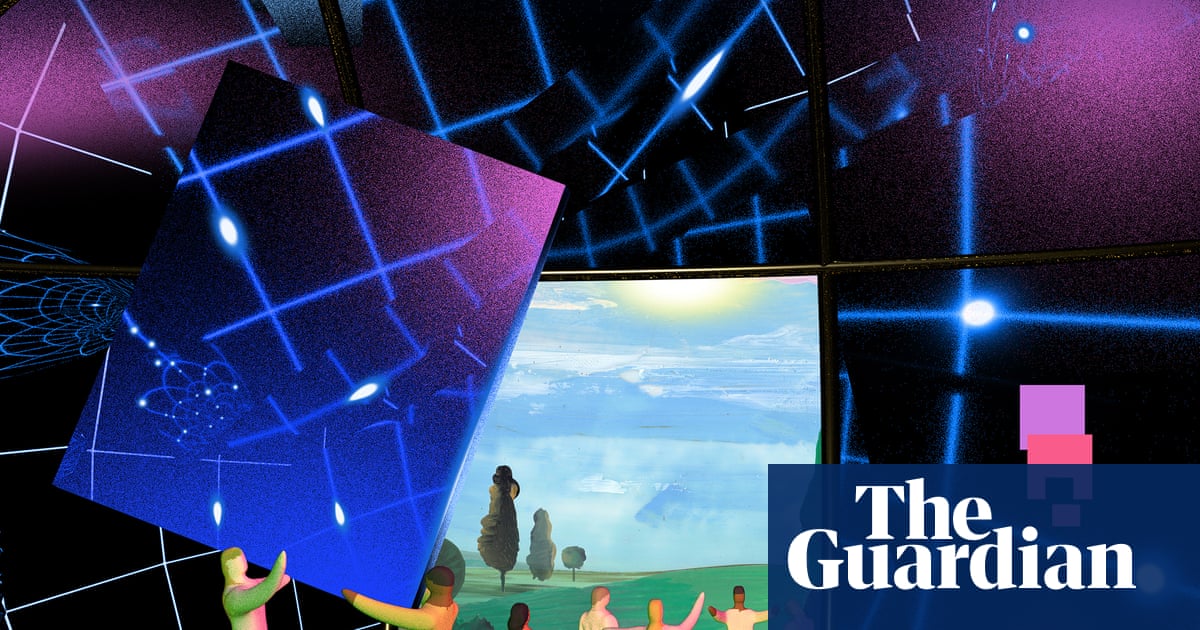
Professors are increasingly worried about what AI is doing to critical thinking. As tools like ChatGPT reshape how students research and write, many academics fear that the humanities and deeper reasoning skills could erode. The challenge now is teaching students to think with AI, not to let it think for them. https://t.co/lufNjlK7uA
Efforts to improve the security of AI agents should recognize that many security failures occur even in the absence of adversaries. The unreliability issue has largely flown under the radar and there hasn't been much work on defining, measuring, or mitigating the problem. More on this in our response to NIST's request for information on AI Agent Security, by @steverab, @sayashk, @PKirgis, @CitpMihir, and me: https://t.co/PW7DJZpDWV This is based on our recent paper: https://t.co/FI5kuBkdRZ

We just added /btw to Claude Code! Use it to have side chain conversations while Claude is working. https://t.co/hjO3YqvrPr
Introducing The Anthropic Institute, a new effort to advance the public conversation about powerful AI. https://t.co/M7vi9oRuYi

The Anthropic Institute is hiring. You can learn more about our work and priorities at the link below: https://t.co/xoyjNFcSlY

The idea of AI agents talking to each other is moving into the mainstream. Meta has acquired Moltbook, a social network designed for AI agents, and its founders will join the company’s AI research unit. As agentic AI grows, platforms built for machine-to-machine interaction may become a new layer of the internet. https://t.co/JT0MLjJJOG

To play Dick Cheney in Vice (2018), Christian Bale gained 40 pounds and bleached his eyebrows. Unlike his past transformations, he consulted a nutritionist for the first time to ensure he didn't die from "eating cream puffs nonstop." https://t.co/afyKCP6XFF
amazing encounter on the other site https://t.co/4eUlamLuXk

https://t.co/hte6cqMcaO

https://t.co/hte6cqMcaO

In 2014 Dutch scientists left a hamster wheel outside, to see if wild animals would use it like domesticated counterparts. The answer: hell yes! 734 visits from wild mice, plus rats, shrews, slugs (!) & even frogs and snails. The apparent reason: fun. Just fun. https://t.co/O7fBhNmxk8

me having fun :) https://t.co/REMSKI9Z61
In 2014 Dutch scientists left a hamster wheel outside, to see if wild animals would use it like domesticated counterparts. The answer: hell yes! 734 visits from wild mice, plus rats, shrews, slugs (!) & even frogs and snails. The apparent reason: fun. Just fun. https://t.co

Introducing Ask. Perplexity's first developer conference. We’re reserving some seats for standout devs who aren’t yet on our radar. Apply here: https://t.co/xaVUzND89c https://t.co/kzFNw0KhLz

Elephant mega herds are now starting to reappear thanks to conservation efforts https://t.co/yxmwwrSRyi
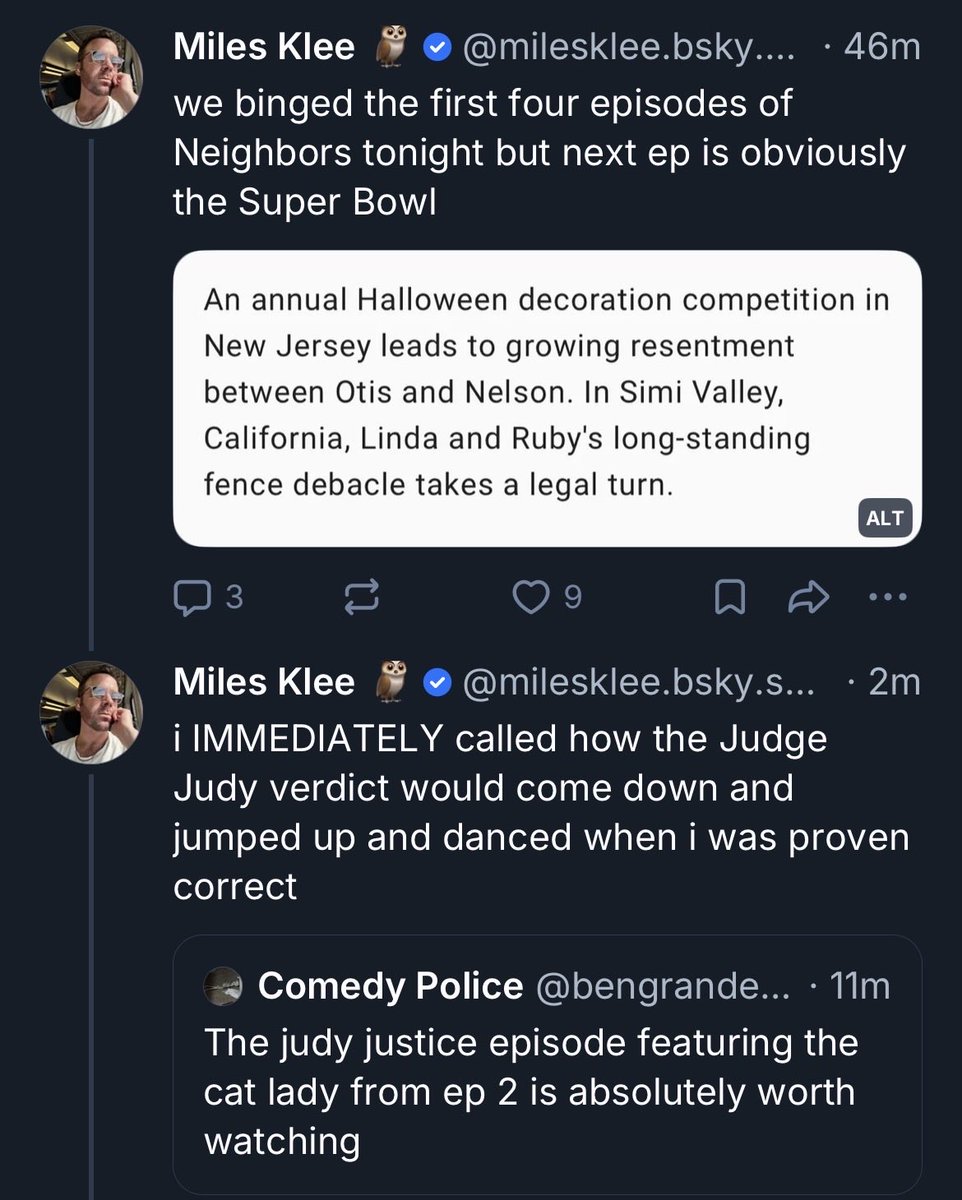
we binged the first four episodes of Neighbors tonight but next ep is obviously the Super Bowl https://t.co/bkUyF4WFft

My Betty Boop version with Grok Imagine 💋 https://t.co/ODrX289mo3
Yep! https://t.co/JjJetMkhzL

After a month of watching my fellow builders set up their @openclaw , I finally took the plunge this past week. Last night my agent ran overnight on a project we came up with together, and it was ready for review when I woke up this morning. It has its own GitHub account. Its own email. Its own Twitter. It runs 24/7 on an old MacBook Pro with the lid closed. And it has enough tools connected to actually do real work. But the magic moment wasn't the overnight build. It was something way simpler. I told it to message me at 7:30 AM with a daily plan. And it just did it. Figured out how to do it on its own. That "figure it out" mentality from an agent that actually has access to tools and a computer felt different than anything I've used before. For the first time, it felt like something capable of doing real stuff. Not a chatbot. Something else. And I'm just scratching the surface. It took me about 8 hours to get here. I want to help you get there faster. Here's everything I learned along the way, plus a prompt you can copy and paste into your OpenClaw once you're set up. Getting started I set it up on an old MacBook Pro. Dedicated device. You want this running independently so it does not have access to your data. Having a virtual device on @Hetzner_Online is also good. Installation took about an hour. Then I spent the next two hours having Codex tighten the security before training it anymore. Sandbox commands. Whitelist only what you need. Do this first. Then I hit a wall. It felt like a chatbot. Limited permissions. Couldn't access tools. Couldn't browse. It took another 2-4 hours to get terminal access and Playwright browser control working. I used Caffeinate in terminal to keep it running with the lid closed. I set up dedicated accounts. GitHub, email, Twitter. Give it its own identity so it can operate independently. Training it - Keep your Heartbeat.md lean. It gets read every session and burns tokens if it's bloated. Identity, active projects, key preferences. That's the hot cache. - Install a memory plugin early (ClawVault, Supermemory, or Lumen Notes). Persistent memory across sessions is what takes it from chatbot to something that knows your work. - Build skill files for recurring output. Emails, social posts, documents. Each gets its own file with format, voice rules, examples, and a checklist. It follows these like playbooks. - Define your agent's persona and tone. I built out voice files based on what I'd already created in Cowork and the output quality jumped immediately. - Point it at your existing repos. It can pull context from anything you give it access to. If you've already built structure somewhere, don't rebuild it. Reference it. Best advice I got from experienced OpenClaw builders Force plan before execution. Make it tell you what it's going to do before it does it. Saved me from multiple rabbit holes. Back up your repo to GitHub every night. Your config files, skills, and memory directory are the training. Lose them and you're starting over. Think in workflows, not one-off tasks. This compounds fast. I also applied the same repo structure from my Cowork setup guide: Your-Workspace/ ├── Heartbeat.md ├── Brain/ │ ├── about-me.md │ ├── brand-voice.md │ └── working-preferences.md ├── Skills/ ├── Projects/ └── Memory/ I'm about a week in. Still early. But I can see where this is going and I wish I'd started sooner. If you're just getting started, here's the prompt I'd paste in on day one to fast-track the whole setup: -- You are going to help me set up my workspace so that every future session starts with full context about who I am, what I do, and how I work. We're building the files and structure that make you useful from the first message. Interview me in phases. Ask questions, then build files based on my answers. Don't rush. Don't assume. Ask before you build. Phase 0: Foundation Check if I have a Heartbeat.md file. If not, create one. Keep it lean. Recommend a memory plugin for persistent context. Ask what tools I use daily and help me connect them. Recommend sandboxing and whitelisting commands from the start. Phase 1: Identity Interview me to create Brain/about-me.md. Ask about my work, background, what I'm building, and positioning. Show the file. Get approval before moving on. Phase 2: Voice Interview me about how I want my agent to sound. Phrases I use. Phrases I'd never use. Tone shifts by context. Create Brain/brand-voice.md. Get approval. Phase 3: Working Preferences What I want help with. Communication style. Workflow pain points. Output preferences. Create Brain/working-preferences.md. Get approval. Phase 4: Skill Files For each type of recurring output, create a skill file in its own folder under Skills/. Each gets: format, voice rules, examples, quality checklist. Ask what I create most often before building. Phase 5: Active Projects Current projects, goals, deadlines. Individual files in Projects/. Phase 6: Memory System Update Heartbeat.md with a summary of everything we built. Create Memory/ directory with subfolders for people, projects, context. Add glossary.md. Phase 7: Reference Sources Any existing repos, docs, or files I want referenced. Organize access. Rules: One phase at a time. Show each file before saving. If unsure, ask. Concise files. Lowercase, hyphens, .md format. Start with Phase 0.
Both people in this picture are equally dangerous. #NYC https://t.co/PpUs0Td3yg

What YouTube did for video, Arcade AI will do for games. Text → Game. 1 click → Global distribution. Runs on any computer. Directly on the web. Creation and distribution just became universal. Sign up to @joinarcadeai in comments. https://t.co/u5BA3oPFWN