Your curated collection of saved posts and media
Introducing Computer for Enterprise Computer runs multi-step workflows across research, coding, design, and deployment. It routes tasks across 20 specialized models and connects to 400+ applications. https://t.co/JuFJ5io30H
Today we're launching Hiro's MCP server. Now you can take all your financial data with you, wherever you agent. https://t.co/6pPU6w6eIp
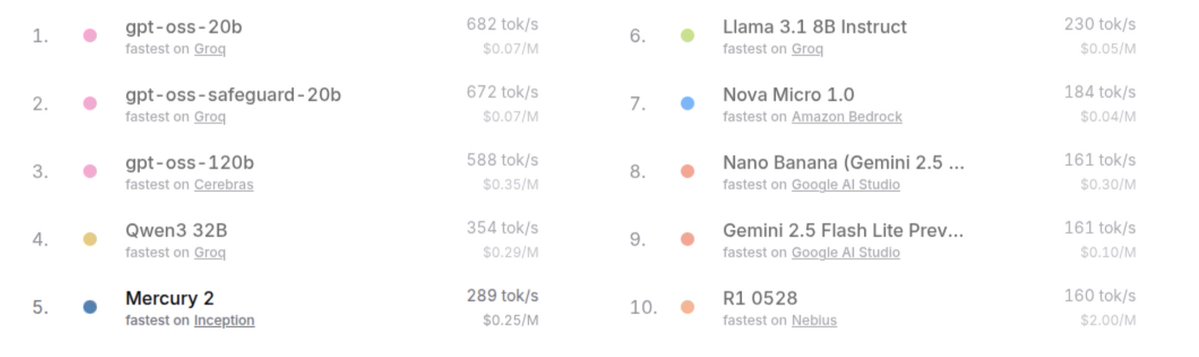
The speed of Mercury diffusion models is real. On real production OpenRouter traffic, they beat every other provider except Cerebras. And intelligence is also higher than the Groq/Cerebras models. Take a look: https://t.co/6oFu6fIIXv https://t.co/nRoIGkgKFS

@pamelafox https://t.co/npDalSrPog
How The Beach Boys must’ve felt watching The Beatles become associated with Charles Manson in the popular consciousness even though they used to hang with him and recorded one of his songs https://t.co/kBH28kMj1g

My boy telling me he thinks he’s gonna do the backwards kangol this spring https://t.co/IZRMpY9bH8
My boy telling me he thinks he’s gonna do the backwards kangol this spring https://t.co/IZRMpY9bH8
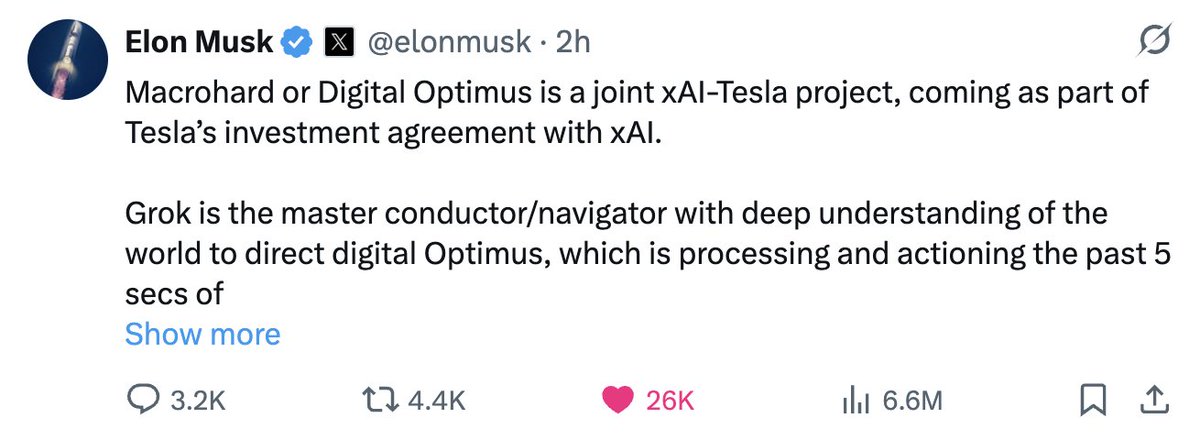
Digital Optimus, Optimus, and FSD What’s going on here? A lot. xAI and Tesla’s AI team have been working on complementary, partially overlapping AI systems. Tesla AI has focused on vision-based intelligence for both FSD and Optimus, while xAI has focused on building a frontier model (an LLM) aimed at general intelligence. More recently, xAI has pushed deeper into what has been called Macrohard (aka Digital Optimus). Macrohard applies xAI’s intelligence layer, Grok, to human activity in the digital world, essentially operating computers the way a human would. The idea is that the AI can move through existing software environments and perform tasks that previously required direct human interaction. But Macrohard goes beyond simply navigating pixels. It is also about generating outcomes within those environments— producing results (pixels), not just interacting with interfaces. In that sense, Macrohard becomes a quasi vision-based AI system as well. Elon, effectively the technology head of both companies, sees the convergence. The decision now appears to be to combine efforts and focus each team on its relative strengths. Tesla’s vision-based AI team becomes central in integrating this perception stack with xAI’s “pure” intelligence model. The benefits are substantial. First, xAI advances its Digital Optimus concept— an AI capable of driving productivity directly in the digital world. At the same time, Tesla gains a powerful intelligence backbone: a reasoning engine layered on top of its vision systems. For Optimus, the implications are colossal. The robot is no longer just a physical-world machine driven by perception and action loops; it becomes a reasoning system as well. In other words, Optimus gains both embodiment and intelligence. That combination directly addresses the data patterns I discussed in my article this week. And that is a big deal. Of course, the impact extends to FSD as well. Many of the “last mile” problems in vehicle autonomy involve nuanced human intent and interaction. A reasoning layer makes those scenarios far more tractable. Talking to your car and having it genuinely understand what you want it to do becomes realistic. Further, Elon has suggested that this combined approach fits within an AI4 inference framework—delivering more intelligence per watt and reducing the need to wait for AI5-scale hardware to solve these larger problems. All in all, this is significant news. It may shift some timelines, and I suspect it may also explain why version 14.3 (the rumored “reasoning edition”) has not yet appeared. It may now be part of this broader combined effort.
https://t.co/PjqhpuHzYb
🔥 Excited to launch a multi-year partnership bringing Fireworks AI to Microsoft Azure Foundry. At @FireworksAI_HQ, our mission is simple: make the world’s best AI models run faster, smarter, and reliably at scale. Over the past year we’ve helped teams move generative AI from demos to real production systems - copilots, agents, and beyond. By bringing Fireworks directly onto @Azure , developers and enterprises can now run high-performance inference for leading open models inside the Azure ecosystem they already trust for security, compliance, and global scale. For us, this partnership is about one thing: removing the friction between great models and real products. Together, we provide a complete catalog of state‑of‑the‑art open models, all on a platform built to operate and optimized for production quality! More details 👉 https://t.co/SF9SjETWrt
i’m in thanks @jxnlco kissing the hand that approved my application https://t.co/aKn1rxTsWW
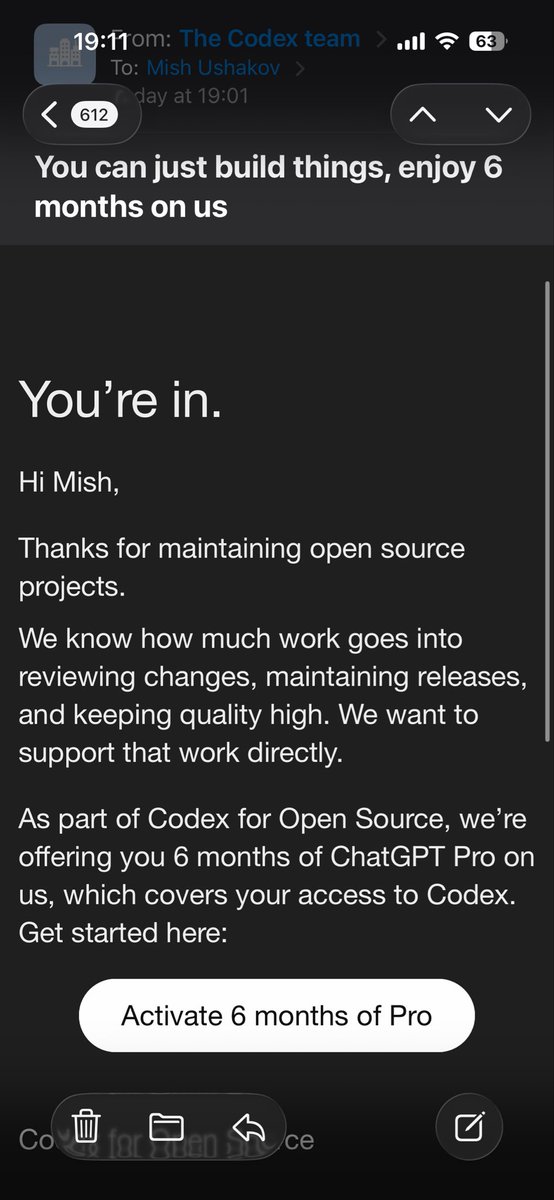
i’m in thanks @jxnlco kissing the hand that approved my application https://t.co/aKn1rxTsWW
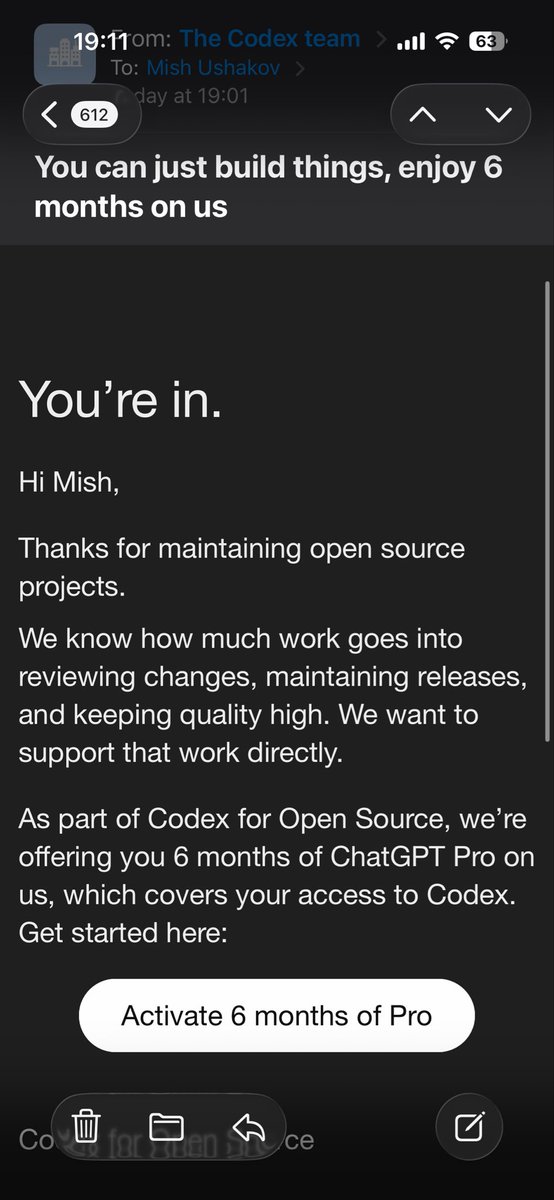
Let’s goooo 🔥 Thanks @jxnlco https://t.co/KHedoPWwoq

Let’s goooo 🔥 Thanks @jxnlco https://t.co/KHedoPWwoq

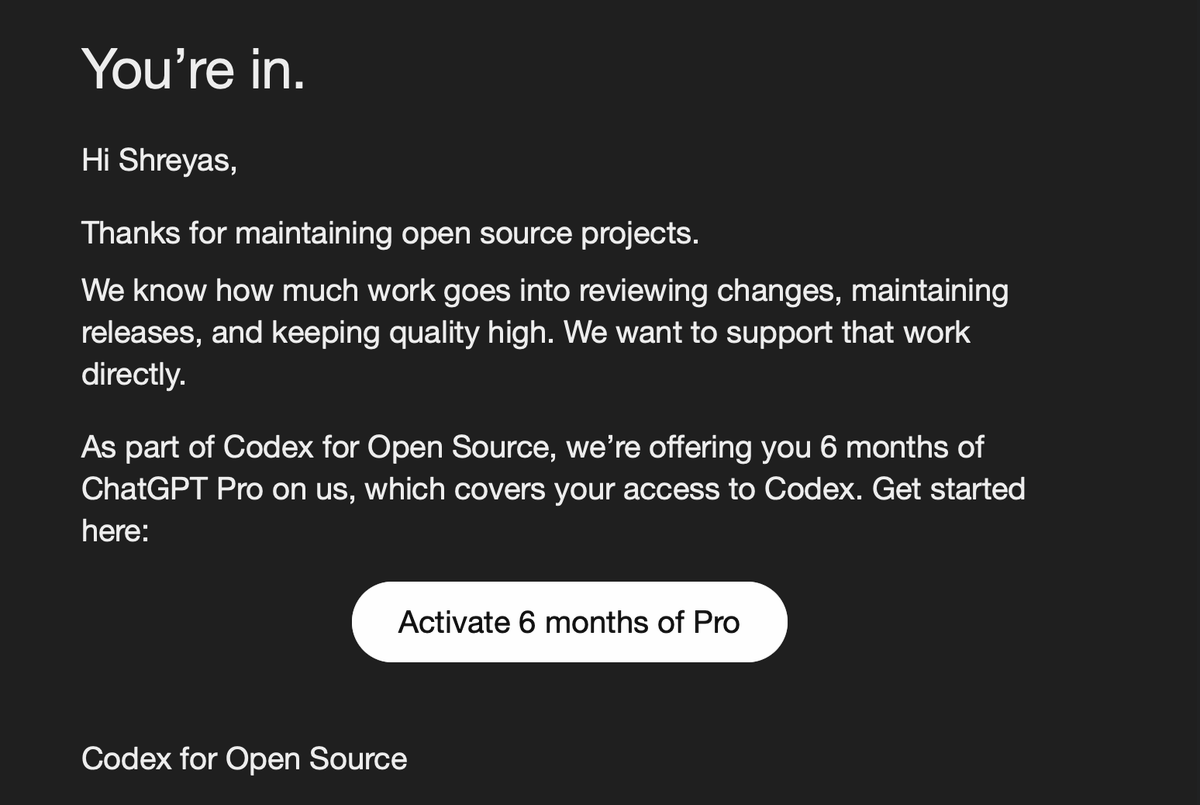
I'm in!! 😁😁 Thanks a lot @jxnlco https://t.co/7WBAX1pVCM

I'm in!! 😁😁 Thanks a lot @jxnlco https://t.co/7WBAX1pVCM
I'm starting a new Tumblr on loss functions http://t.co/1Dy8entusH for those of us who stare at them all day. Contributions welcome :)
For everyone asking about the #GitHubUniverse badge, yes it does... https://t.co/NSkVutrDSD
The Solana city visualization proves onchain data has hit a tipping point. It's not just charts anymore… it's art, it's identity, it's a new way to see the network. ThreeJS + Helius + Claude. This is what "building in public" looks like in 2026. Welcome to the future 🦞 https://t.co/Px0wopKQnT
Programmers will become INDISPENSABLE for startups & frontier labs, not disposable. https://t.co/mWmRxAjRvw
Programmers will become INDISPENSABLE for startups & frontier labs, not disposable. https://t.co/mWmRxAjRvw
It's here: We just hit superhuman performance on AI kernel optimization! Real customer models & production settings. Not toy problems (what I typically see). This is the year that Claude writes its own kernels, Codex its own kernels, for every new GPU that it wants to run on -- something that takes months to port between GPU generations today. This has a massive impact to scaling intelligence. More compute means getting the next frontier model sooner.
Announcing Personal Computer. Personal Computer is an always on, local merge with Perplexity Computer that works for you 24/7. It's personal, secure, and works across your files, apps, and sessions through a continuously running Mac mini. https://t.co/EpvilVX6XZ
Perplexity Computer is now available for Enterprise. Computer makes everyone in the company an engineer. Anyone can debug infra, ship PRs, or query data warehouses with natural language. It comes with the same enterprise grade security you get with Perplexity Enterprise. https://t.co/Mn2Xssgvri
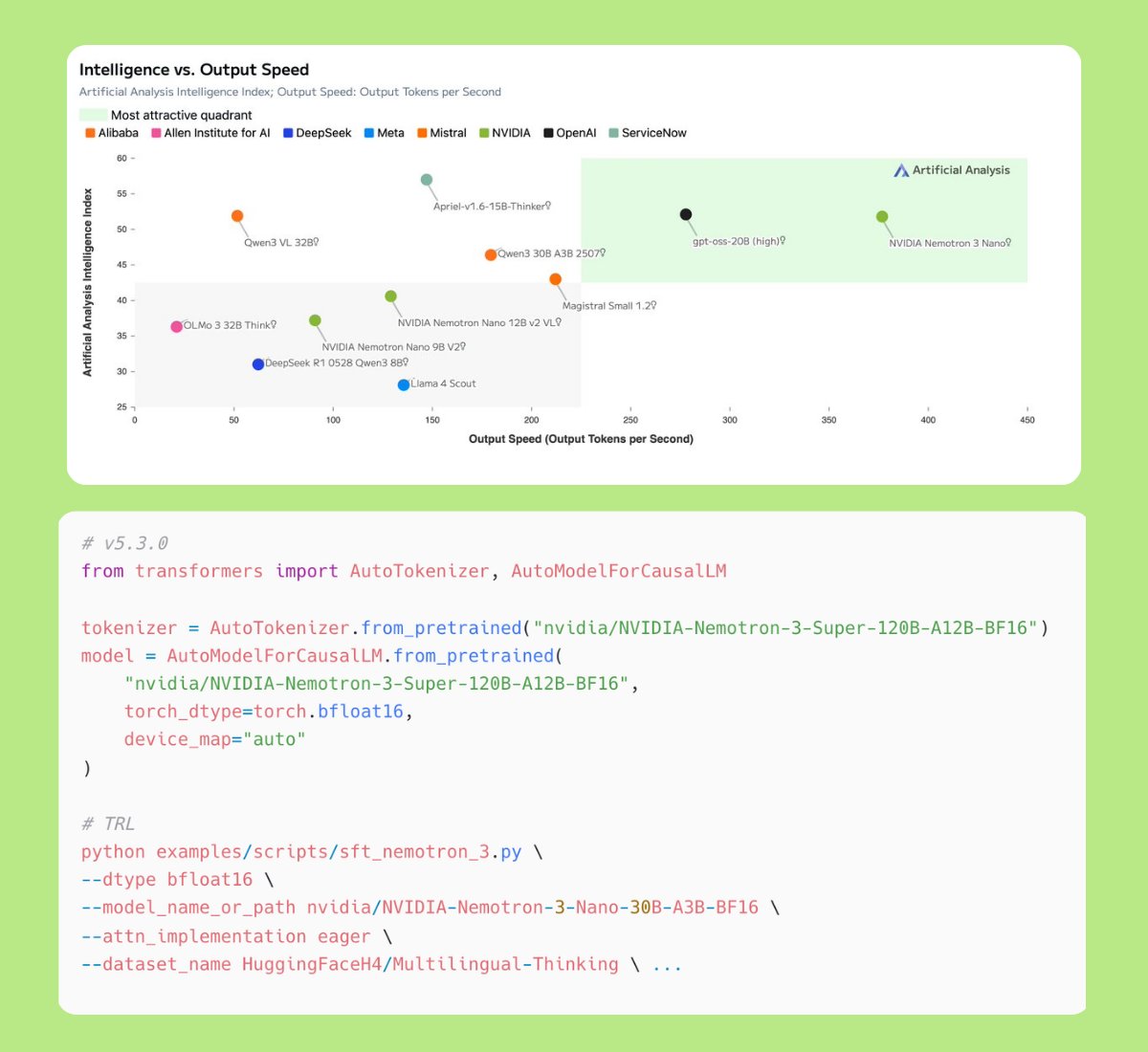
Nemotron 3 Super @NVIDIAAI is out! 💚 > hybrid SSM MoE, faster yet on par or outperforming sota open models in various benchmarks 🔥 > comes with @huggingface transformers and TRL support day-0! 🤗 works for Nano as well 🙌🏻 https://t.co/WKEAUUsfx4
We just completed the largest decentralised LLM pre-training run in history: Covenant-72B. Permissionless, on Bittensor subnet 3. 72B parameters. ~1.1T tokens. Commodity internet. No centralized cluster. No whitelist. Anyone with GPUs could join or leave freely. 1/n https://t.co/W0Ks563Cld
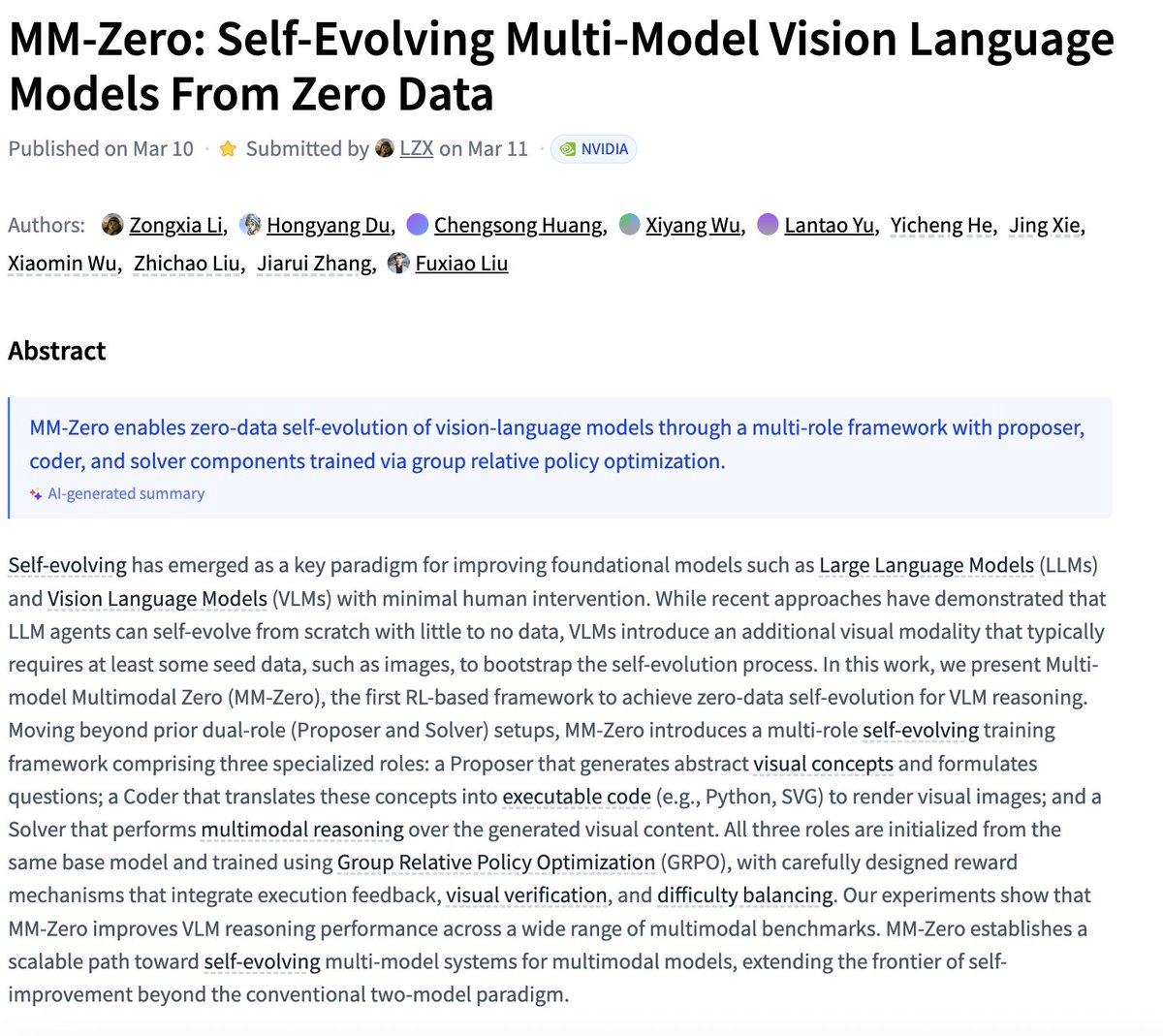
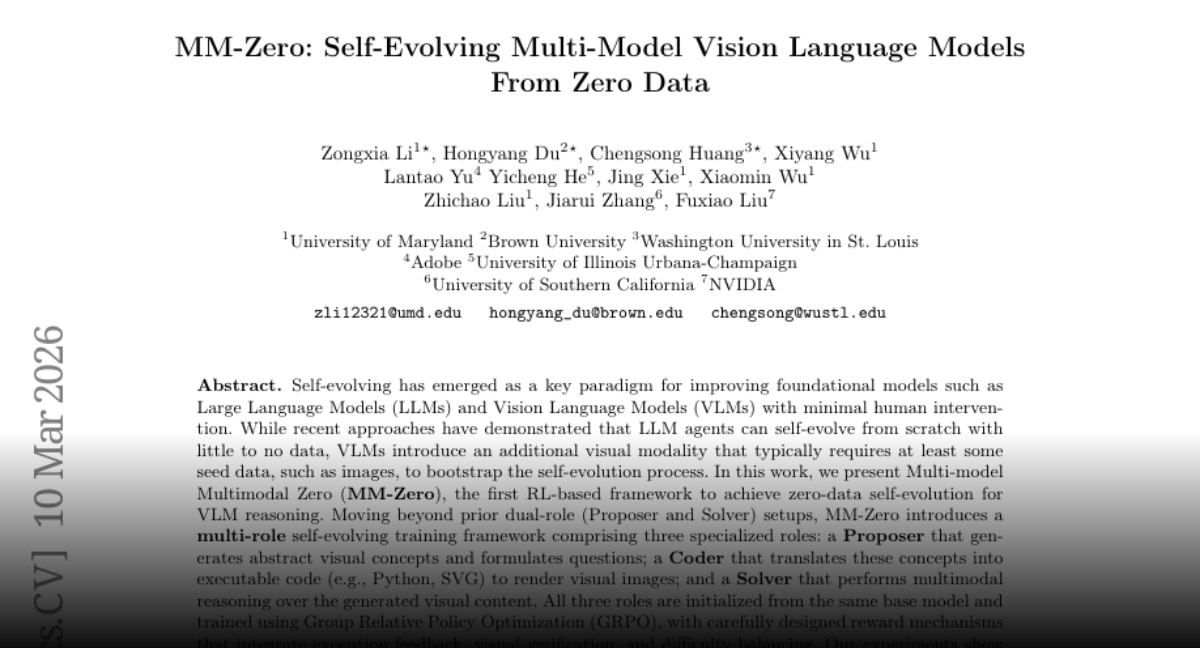
MM-Zero Self-Evolving Multi-Model Vision Language Models From Zero Data paper: https://t.co/o5d40EF8yo https://t.co/B69LwZozWE
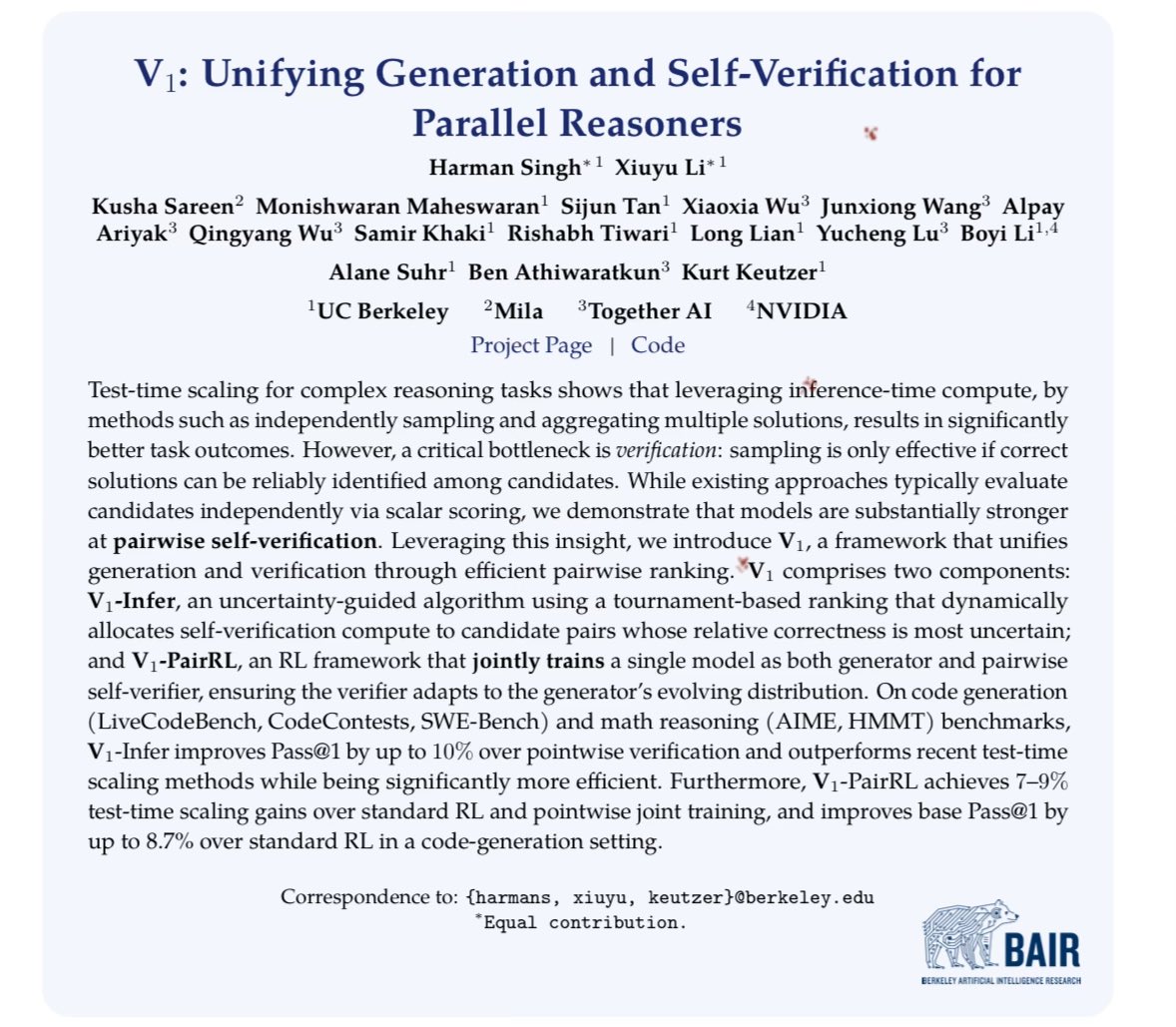
Thanks @_akhaliq for sharing our work! Self-Verification is key to Self-improvement. read the full paper here: https://t.co/O4LYGs1o36 https://t.co/OXKN1dVsec
V1 Unifying Generation and Self-Verification for Parallel Reasoners paper: https://t.co/rvwLehsRcI https://t.co/NXCtt56mg1
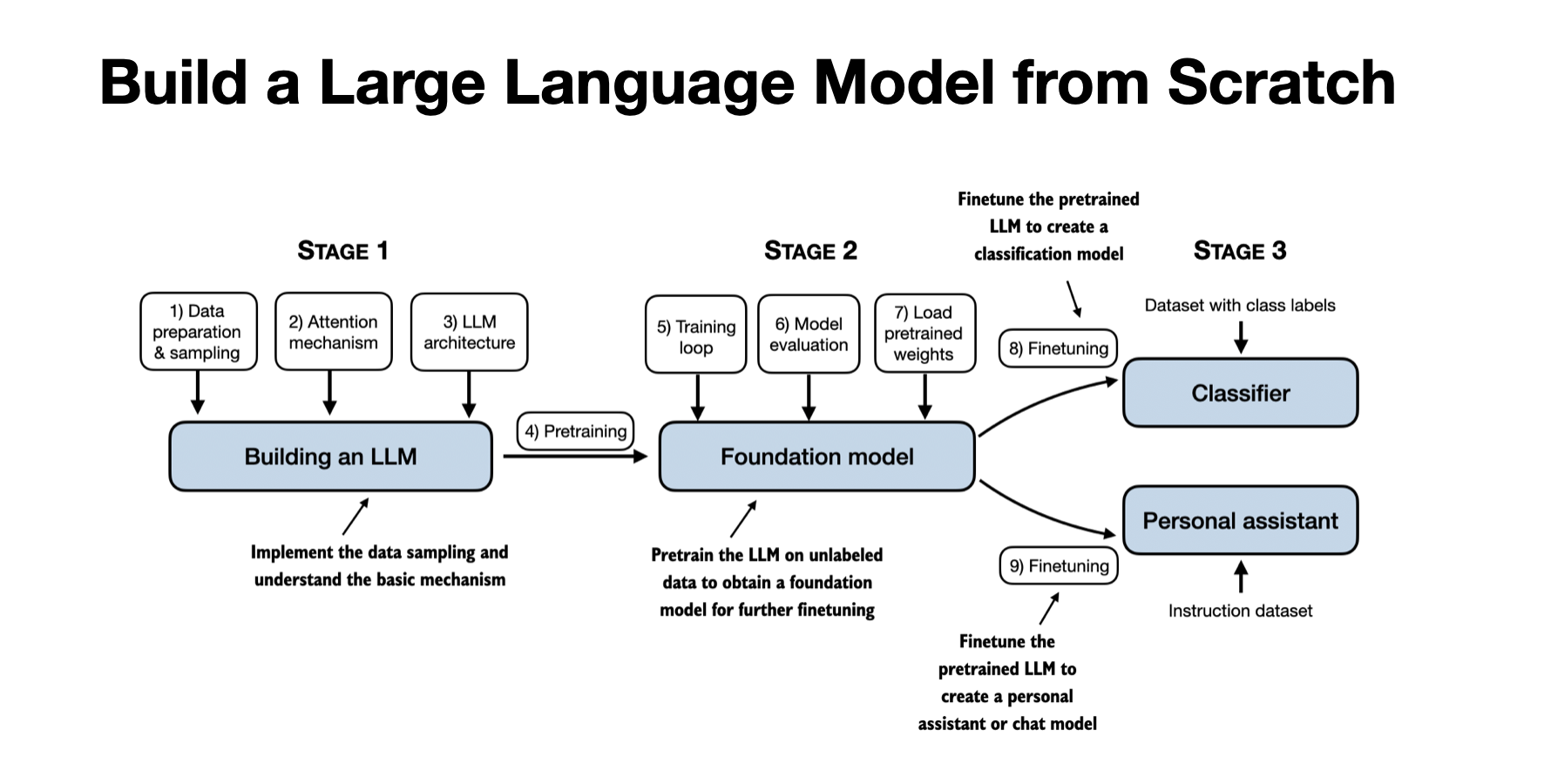
@unsorsodicorda @HemanthSai3187 Thanks! I think it shouldn't be too hard. I have a Qwen3.5 from-scratch implementation here: https://t.co/XL6ZfCEujC that you can use as a drop-in replacement. Perhaps the easiest thing to do here is to take that and put it into the qwen. py (https://t.co/IdW1N68r2e). If you keep the Qwen3Model name, most chapters should probably work as is (or with very minor tweaks)
The DOGE goons are getting deposed for a lawsuit on behalf of the American History Association and others and holy shit this hurts to watch https://t.co/Oe6MUrYxTz
A single image can transform into a massive world composed of millions of splats with Marble. Forming large explorable environments from ancient ruins to spaceship interiors. https://t.co/60TjLXyJ2J
Today we're announcing Genie Code, your autonomous AI partner for data. Genie Code is a state-of-the-art agent that lets data teams move from prompting a copilot to delegating real work: building pipelines, machine learning models, debugging failures, and shipping dashboards. This isn't a smarter autocomplete. It's a different kind of AI partner entirely. Unlike general coding agents that stop once the code is built, Genie Code plans, executes, and iterates across the full data and AI lifecycle inside Databricks. It's purpose-built for data engineering, data science, and BI: • More than doubles the success rate of leading coding agents on real-world data science tasks • Proactively monitors your pipelines and AI models in the background, triaging failures and fixing issues before a human intervenes • Works with your data wherever it lives, across Databricks and external platforms, with full governance and MCP support This is what the future of data work looks like. https://t.co/xhwuZqrJEn

someone finally wired a SUBCONSCIOUS to CLAUDE letta built an agent that sits underneath claude code and watches every conversation you have across every session it doesnt just log stuff. it accumulates patterns, learns your codebase, and feeds async guidance back into your terminal without you asking not a prompt hack. not a .md file you paste in every monday. not another wrapper that adds 14 steps to your workflow its a background layer that runs parallel across multiple claude code instances with shared memory between all of them you stop a session friday night, start a new one monday morning, and it already knows what you were building and why bookmark that before you forget.
