Your curated collection of saved posts and media
Ai2 just released MolmoPoint GUI on Hugging Face A specialized VLM for GUI automation that points using grounding-tokens instead of coordinates, reaching 61.1 on ScreenSpotPro. https://t.co/QObXd9HSP1
Apple promises ‘AI advancements’ to be unveiled at WWDC this year https://t.co/29KNGSaEAk by @iryantldr

Apple promises ‘AI advancements’ to be unveiled at WWDC this year https://t.co/29KNGSaEAk by @iryantldr

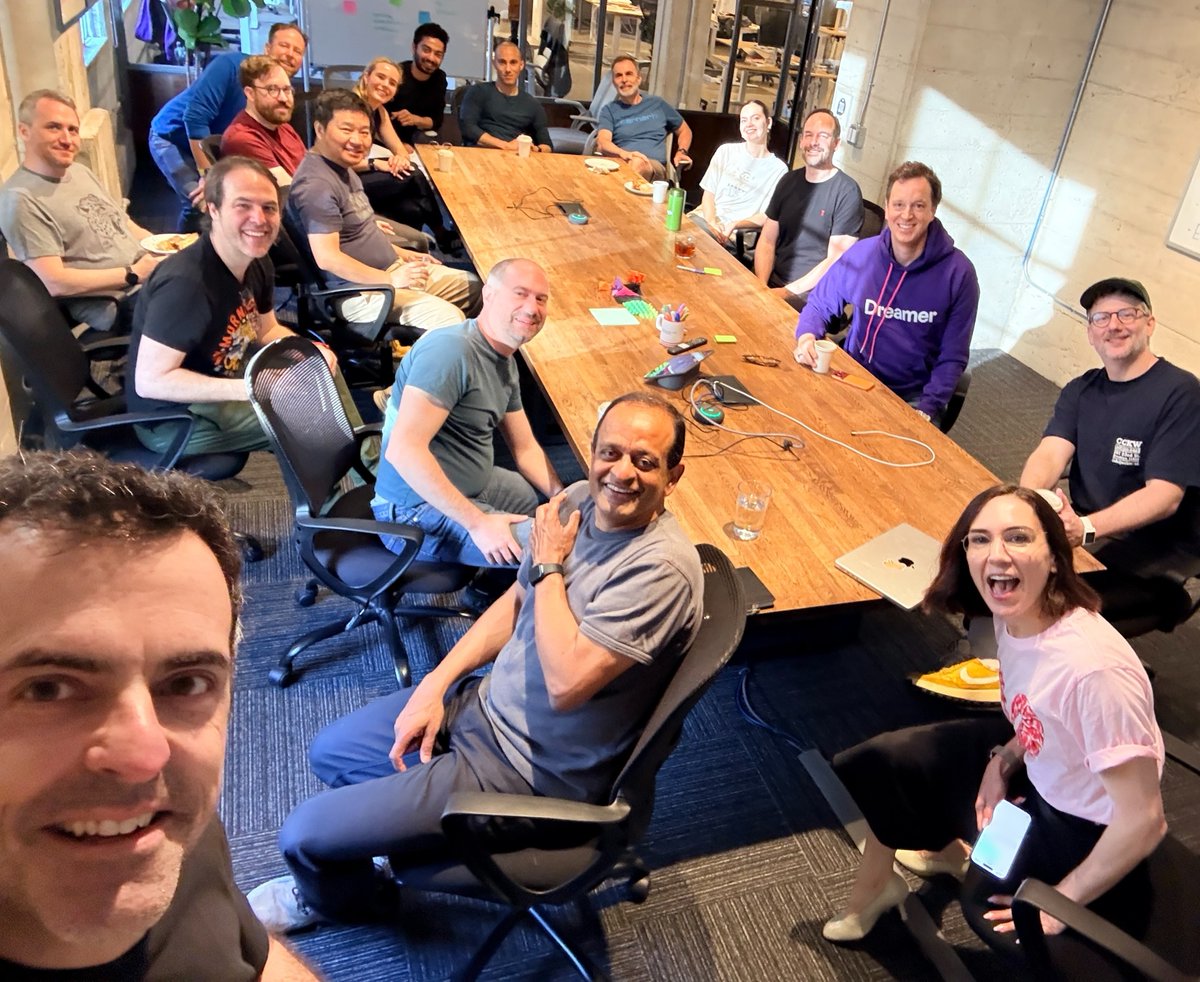
Excited to announce that @hbarra , @alcor and I are joining Meta Superintelligence Labs with the entire @Dreamer team today. The last few months have been extraordinary: we built Dreamer, put the beta in the world just a month ago, and saw magic come to life for real people. Since then, thousands of people have used Dreamer to build personal, intelligent software with our Sidekick in the world’s newest and most popular programming language: English! They're building and sharing agents to manage email, calendar, and to-do’s, create learning tools for their kids, learn new languages, plan trips with friends, become better cooks, help them with work, achieve their health goals, or simply to creatively express themselves—all sorts of surprising and uniquely personal needs. These are agents as unique as the people building them, because they're built exactly the way each person wants them to be. We’ve captured some of our favorites at https://t.co/G6nrHTsN5i. What matters most here isn’t the early momentum; it’s what Dreamer has enabled people to do. People are building things they’ve wanted for years. They’re solving real, important problems no traditional software company would ever prioritize, because they’re too niche, too bespoke, too personal. What company would ever build for an “n of 1”? Our bet from the beginning has been that software should be personal, malleable, and shaped by the person using it. The constraint was never people’s imagination. It was the fact that building software is out of reach for most people. This early chapter gives us conviction that the idea resonates, the need is real, and the moment is now. @alexandr_wang was helpful to us from the very beginning, and when we showed Dreamer to Mark Zuckerberg and @natfriedman earlier this year, it was clear right away that we share the same vision of the future: one where billions of people have the power to create software that makes their lives better. We’re thrilled to accelerate this mission by joining Meta Superintelligence Labs and licensing our technology to Meta. Read more at https://t.co/KvmdoPJVbU. Deeply grateful to our investors @jillchase124 and @ninaachadjian for supporting our vision for a more personal, creative, and intelligent future for software. Thank you for the trust, the thought partnership, and for being in our corner at every step. To everyone in our community who built with us: thank you. You've taught us what's possible, and you're the proof this works. We're so grateful, and we're just getting started!
Introducing the Agent Virtual Machine (AVM) Think V8 for agents. AI agents are currently running on your computer with no unified security, no resource limits, and no visibility into what data they're sending out. Every agent framework builds its own security model, its own sandboxing, its own permission system. You configure each one separately. You audit each one separately. You hope you didn't miss anything in any of them. The AVM changes this. It's a single runtime daemon (avmd) that sits between every agent framework and your operating system. Install it once, configure one policy file, and every agent on your machine runs inside it - regardless of which framework built it. The AVM enforces security (91-pattern injection scanner, tool/file/network ACLs, approval prompts), protects your privacy (classifies every outbound byte for PII, credentials, and financial data - blocks or alerts in real-time), and governs resources (you say "50% CPU, 4GB RAM" and the AVM fair-shares it across all agents, halting any that exceed their budget). One config. One audit command. One kill switch. The architectural model is V8 for agents. Chrome, Node.js, and Deno are different products but they share V8 as their execution engine. Agent frameworks bring the UX. The AVM brings the trust. Where needed, AVM can also generate zero-knowledge proofs of agent execution via 25 purpose-built opcodes and 6 proof systems, providing the foundational pillar for the agent-to-agent economy. AVM v0.1.0 - Changelog - Security gate: 5-layer injection scanner with 91 compiled regex patterns. Every input and output scanned. Fail-closed - nothing passes without clearing the gate. - Privacy layer: Classifies all outbound data for PII, credentials, and financial info (27 detection patterns + Luhn validation). Block, ask, warn, or allow per category. Tamper-evident hash-chained log of every egress event. - Resource governor: User sets system-wide caps (CPU/memory/disk/network). AVM fair-shares across all agents. Gas budget per agent - when gas runs out, execution halts. No agent starves your machine. - Sandbox execution: Real code execution in isolated process sandboxes (rlimits, env sanitization) or Docker containers (--cap-drop ALL, --network none, --read-only). AVM auto-selects the tier - agents never choose their own sandbox. - Approval flow: Dangerous operations (file writes, shell commands, network requests) trigger interactive approval prompts. 5-minute timeout auto-denies. Every decision logged. - CLI dashboard: hyperspace-avm top shows all running agents, resource usage, gas budgets, security events, and privacy stats in one live-updating screen. - Node.js SDK: Zero-dependency hyperspace/avm package. AVM.tryConnect() for graceful fallback - if avmd isn't running, the agent framework uses its own execution path. OpenClaw adapter example included. - One config for all agents: ~/.hyperspace/avm-policy.json governs every agent framework on your machine. One file. One audit. One kill switch.
one of the best, most inspiring reddit updates i've ever read. you will never guess where this goes https://t.co/Tr6VddxtoO https://t.co/fwxJnxuUOm

NEWS: Jay Leno has just released a 47 minute video going over the new redesigned @Tesla Semi with @danWpriestley and @woodhaus2. Dan: "We cut about 1,000 lbs out of the truck (vs previous Tesla Semi)." Link to video below. https://t.co/UZxYGJecxt
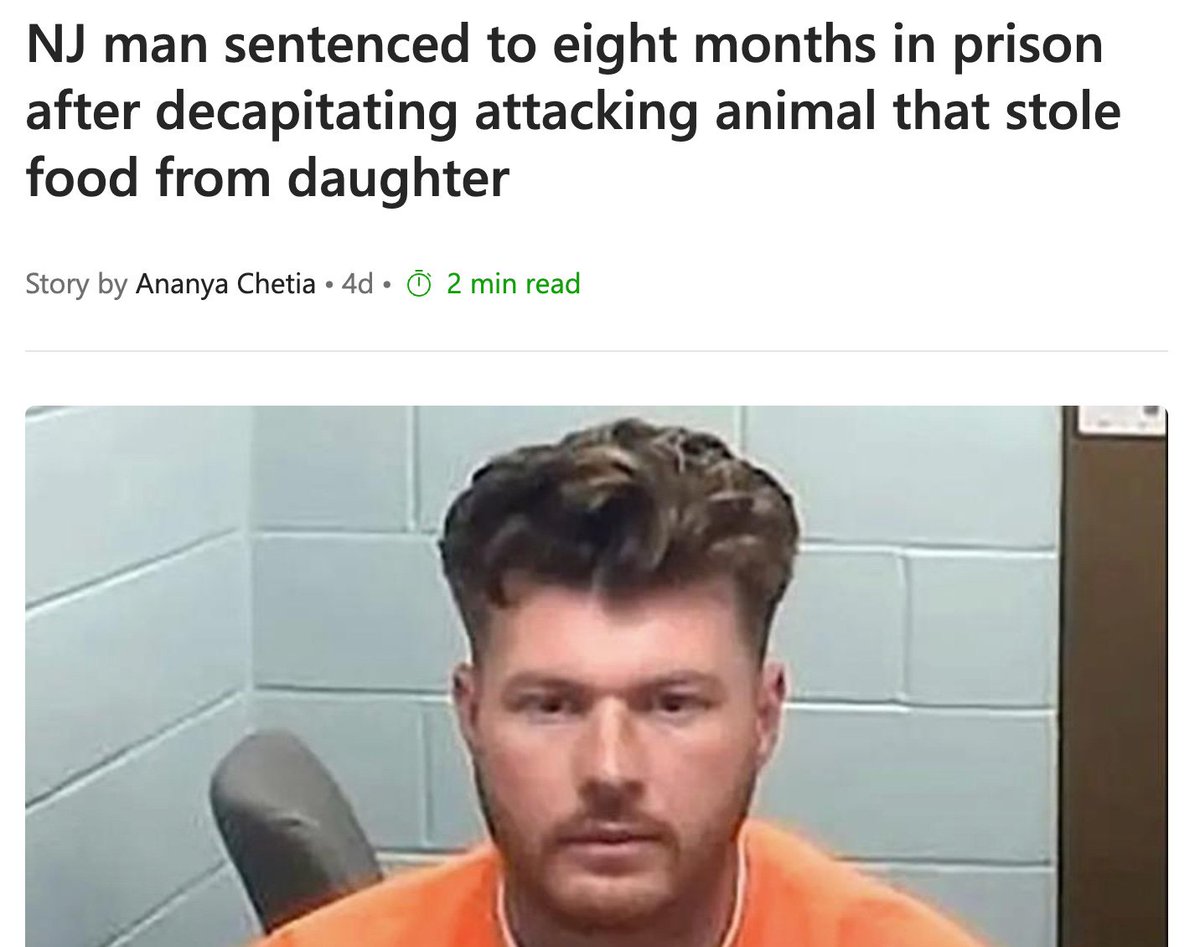
White guy kills a seagull: 8 months in prison Black guy kills a man: misdemeanor, released Black guy kills a pregnant mom and her unborn child: not guilty by reason of insanity, baby doesn’t count as a human Asian woman kills family of 4: probation Red guards in black robes have destroyed the value of justice and life - the purpose of a system is what it does.

Generate images in less than 1 second. 99% cheaper than NanoBanna. 🚀 😱 Our latest 26.2 release ships FLUX.2 image generation with a 4.1x speedup over torch.compile on NVIDIA Blackwell - translating to a 5.5x TCO advantage with AMD MI355X. Read more ⬇️ https://t.co/ITXaFHvgCd
Made in NYC with AWS: Shane Hegde, @airHQ. The startup Air has built a single platform to help businesses manage and scale creative operations by using dozens of microservices. From serverless computing and container orchestration to AI agents on Amazon Bedrock, discover why ‘AWS is a critical cloud provider’ for Air & why there’s beauty to building in NY.
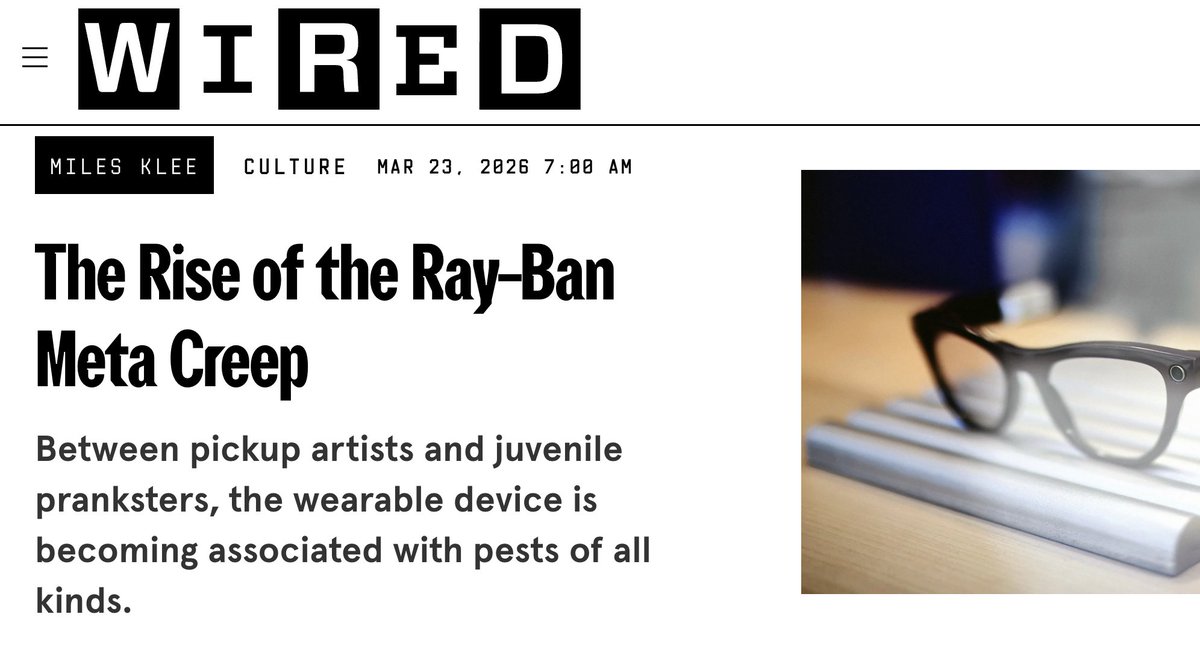
For years, big tech struggled to take smart glasses mainstream. Cut to 2026: Meta has sold millions of pairs of their Ray-Ban and Oakley glasses, driving a boom of content in which pickup artists and pranksters record strangers in public—often without their knowledge or consent. https://t.co/G30qpJqG0Y
Story: https://t.co/Bt3VlyAnuw

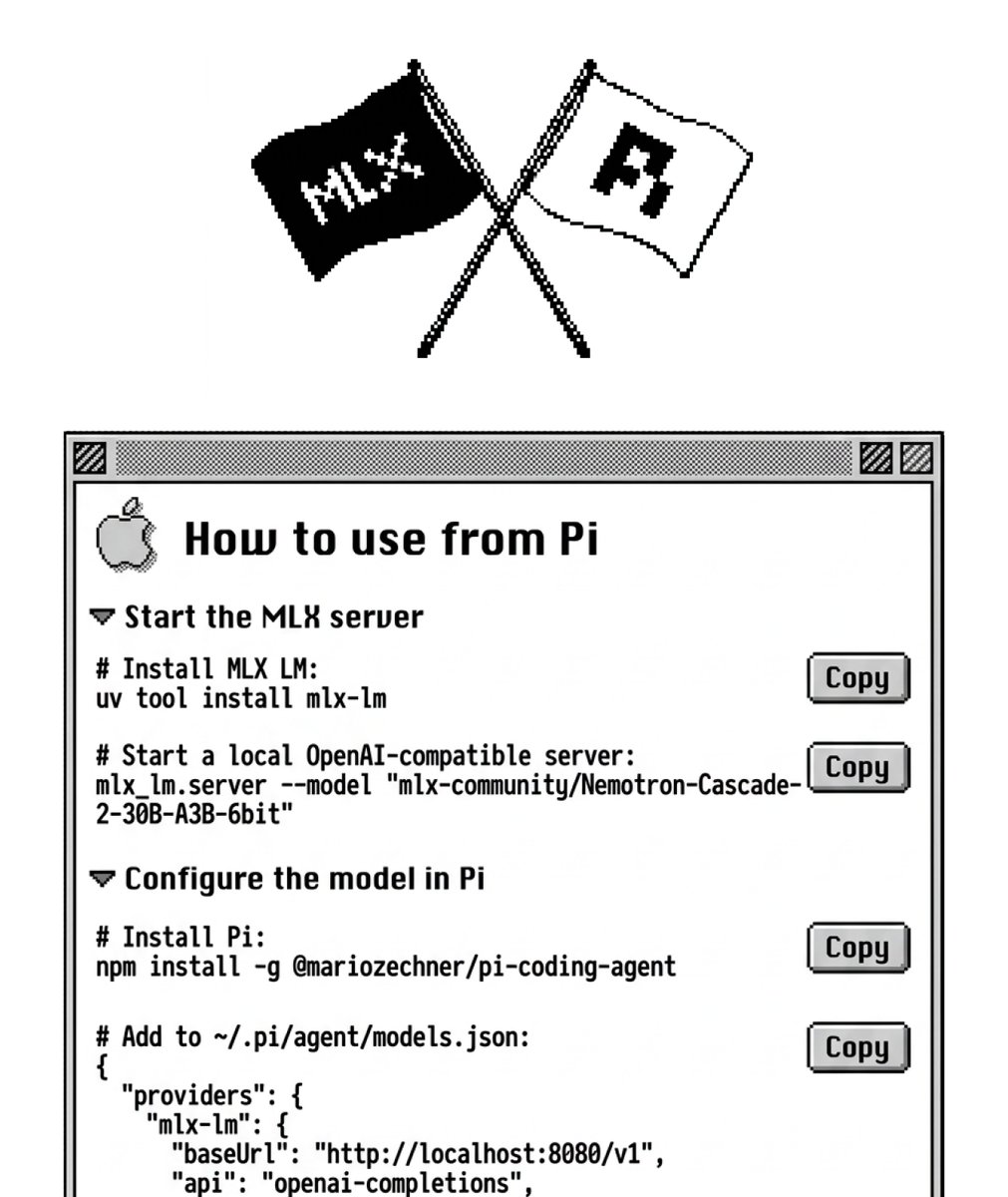
New on Hugging Face: Pi agent is now available for compatible MLX models directly from the "Use this model" menu. https://t.co/djTeaTSf4n
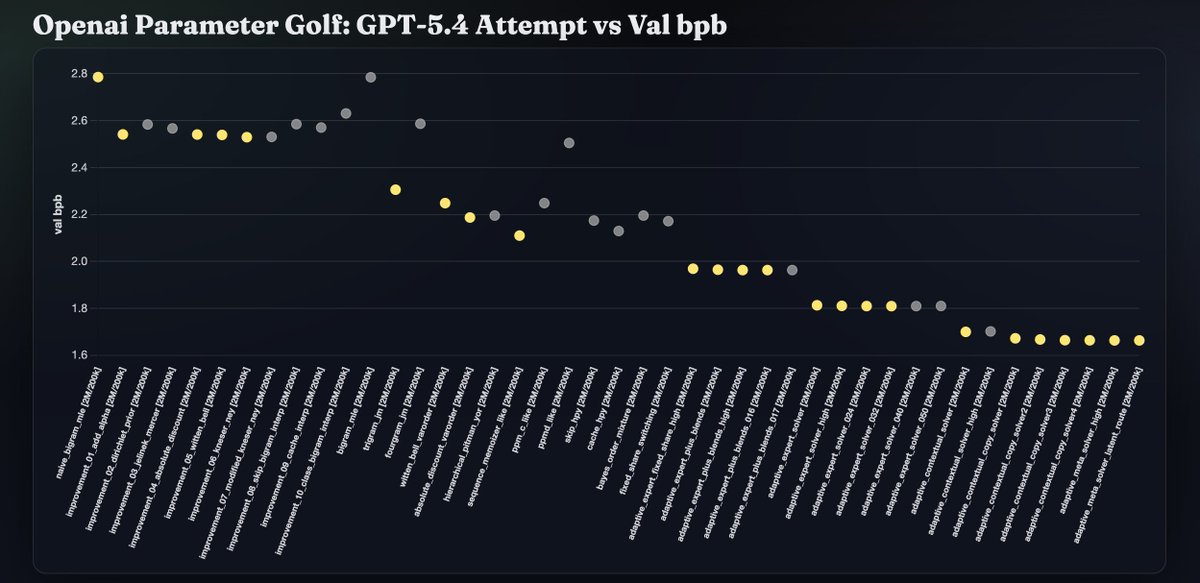
Parameter Golf, non-neural-network division: Ive got (my gpt-5.4) to get val bpb of 1.6633 with markov chains + bag of tricks, fully autonomously. Codex implemented methods from 1990~2005. https://t.co/zX25jD01LX
30 minutes outside of SF btw https://t.co/shWLIN7Boc


30 minutes outside of SF btw https://t.co/shWLIN7Boc


Introducing EgoVerse: an ecosystem for robot learning from egocentric human data. Built and tested by 4 research labs + 3 industry partners, EgoVerse enables both science and scaling 1300+ hrs, 240 scenes, 2000+ tasks, and growing Dataset design, findings, and ecosystem 🧵
Introducing: PlayerZero The world's first Engineering World Model that puts debugging, fixing, and testing your code on autopilot. We've raised $20M from Foundation Capital, @matei_zaharia (Databricks), @pbailis (Workday), @rauchg (Vercel), @zoink (Figma), @drewhouston (Dropbox), and more PlayerZero frees up 30% of your engineering bandwidth by: 1. Finding the root cause for bugs & incidents in minutes that engineering teams take days to identify. 2. Predicting in minutes, edge case issues that a 300-person QA team would take weeks to find. ------ Here's why this matters: No one in your org has a complete picture of how your production software actually behaves. Support sees tickets. SRE sees infra. Dev sees code. Each team builds their own fragmented view - and none of these systems talk to each other. When something breaks, everyone scrambles to stitch the picture together by hand. PlayerZero connects all of it into a single context graph - → The Slack thread where your lead said "we went with X because Y fell apart in prod last time" → The PR review where an engineer explained the tradeoff → The lifetime history of your CI/CD pipeline, observability stack, incidents, and support tickets So you can trace any problem to its root cause across every silo. And it compounds. Every incident diagnosed teaches the model something new. The longer it runs, the deeper it understands - which code paths are high-risk, which configurations are fragile, which changes tend to break which customer flows. So when you sit down to debug a live issue, you have your entire org's collective reasoning and production memory behind you - instantly. ------ Zuora, Georgia-Pacific, and Nylas have reduced resolution time by 90% and caught 95% of breaking changes and freeing an average of $30M in engineering bandwidth. ------ Our guarantee: If we can't increase your engineering bandwidth by at least 20% within one week, we'll donate $10,000 to an open-source project of your choice. Book a demo - https://t.co/dH1dulIwSS
You can now pretrain LLMs entirely on the HF Hub 💥 Last week, @OpenAI launched a competition to see who can pretrain the best LLM in under 10 minutes. So over the weekend, I made a little demo to automate this end-to-end using the Hub as the infra layer: - Jobs to scale compute - Buckets to store all experiments - Trackio to log all the metrics The cool thing here is that everything is launched locally: no ssh shenanigans into a cluster or fighting with colleagues over storage and GPUs ⚔️ All that's left is coming up with new ideas, but luckily Codex can automate that part too 😁 Can I have a job now please @reach_vb 🙏?

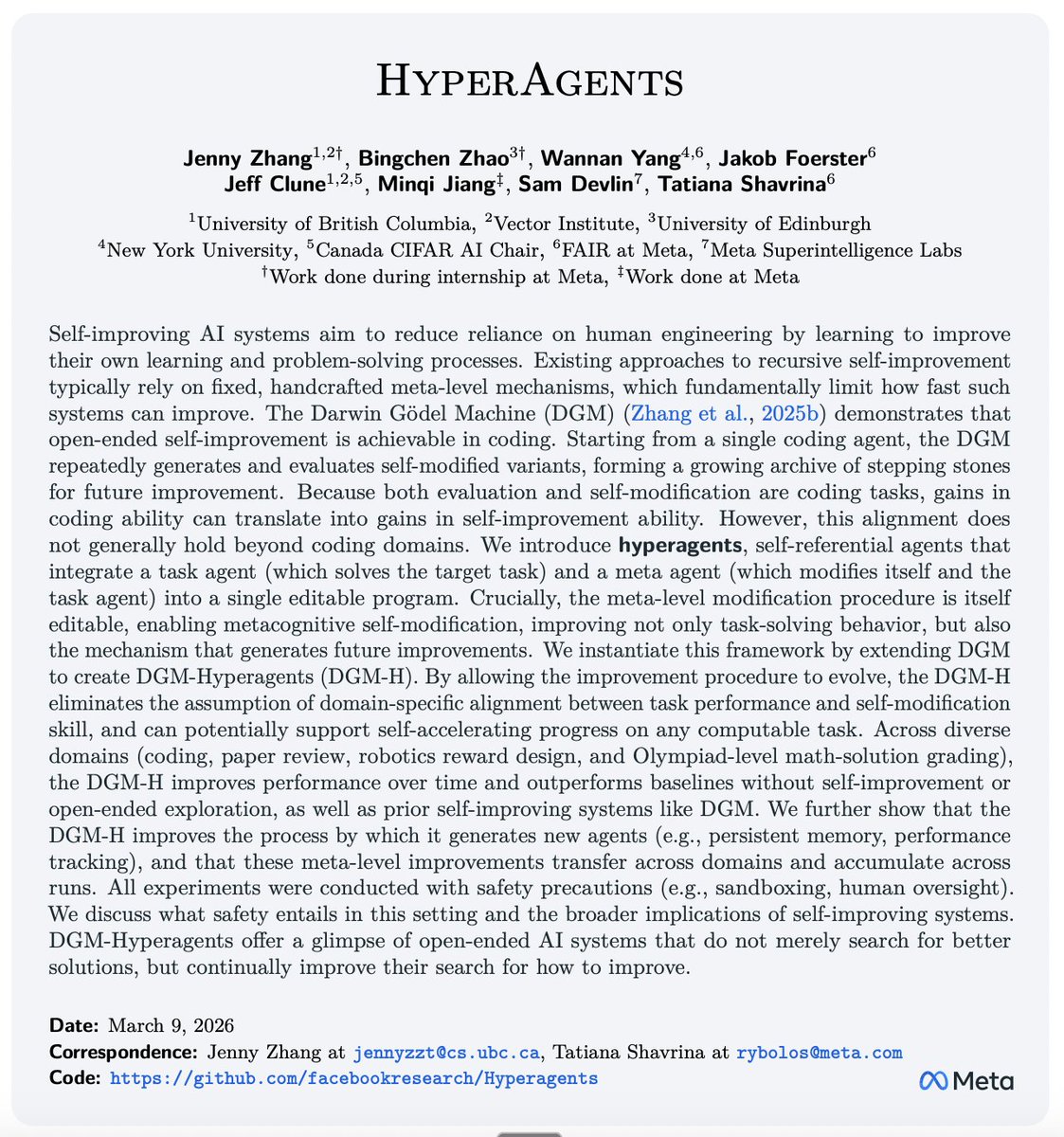
Introducing Hyperagents: an AI system that not only improves at solving tasks, but also improves how it improves itself. The Darwin Gödel Machine (DGM) demonstrated that open-ended self-improvement is possible by iteratively generating and evaluating improved agents, yet it relies on a key assumption: that improvements in task performance (e.g., coding ability) translate into improvements in the self-improvement process itself. This alignment holds in coding, where both evaluation and modification are expressed in the same domain, but breaks down more generally. As a result, prior systems remain constrained by fixed, handcrafted meta-level procedures that do not themselves evolve. We introduce Hyperagents – self-referential agents that can modify both their task-solving behavior and the process that generates future improvements. This enables what we call metacognitive self-modification: learning not just to perform better, but to improve at improving. We instantiate this framework as DGM-Hyperagents (DGM-H), an extension of the DGM in which both task-solving behavior and the self-improvement procedure are editable and subject to evolution. Across diverse domains (coding, paper review, robotics reward design, and Olympiad-level math solution grading), hyperagents enable continuous performance improvements over time and outperform baselines without self-improvement or open-ended exploration, as well as prior self-improving systems (including DGM). DGM-H also improves the process by which new agents are generated (e.g. persistent memory, performance tracking), and these meta-level improvements transfer across domains and accumulate across runs. This work was done during my internship at Meta (@AIatMeta), in collaboration with Bingchen Zhao (@BingchenZhao), Wannan Yang (@winnieyangwn), Jakob Foerster (@j_foerst), Jeff Clune (@jeffclune), Minqi Jiang (@MinqiJiang), Sam Devlin (@smdvln), and Tatiana Shavrina (@rybolos).
Improve document parsing accuracy by 15% for financial PDFs. Use LlamaParse and Gemini 3.1 Pro to extract high-quality data from unstructured brokerage statements and complex tables. 📈 Precise reasoning 📂 Structured PDF data ⚡️ Event-driven scaling Dive into the code on GitHub → https://t.co/yi7KxVzNPY
Political campaigns are beginning to experiment with AI-generated ads. The technology makes it easier to produce convincing content at scale, while regulation remains fragmented and often behind the pace of innovation. That gap is what is driving concern. What used to require significant resources can now be created quickly, making trust in political messaging harder to maintain. https://t.co/64VuZdnllN @NBCNews

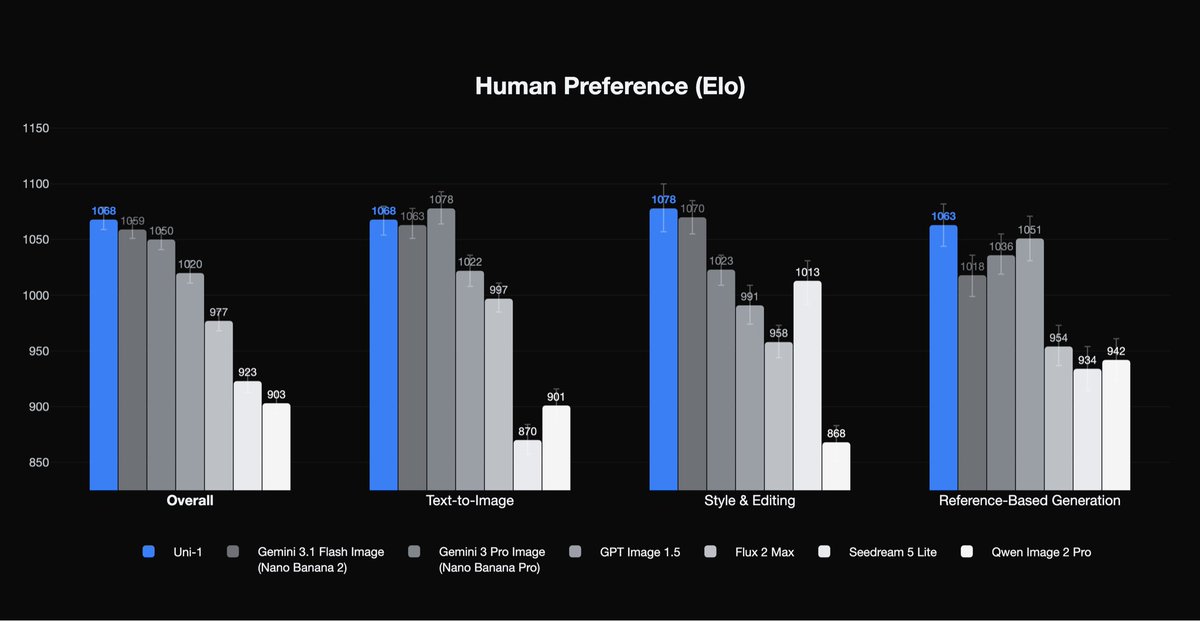
UNI-1 is intelligent, directable, cultured. Incredible range it can do. Incredibly proud of the world-class team building a world-class model. It’s a daunting task to go up against industry giants like Deepmind/OpenAI/Bytedance. More to come! API, technical report, model card… Come join us!
Uni-1 is here! A new kind of model that thinks and generates pixels simultaneously. Less artificial. More intelligent. https://t.co/2p8kSq4Jtf
alysa’s manga faves on display at the library in alameda https://t.co/ynZlieAgzA

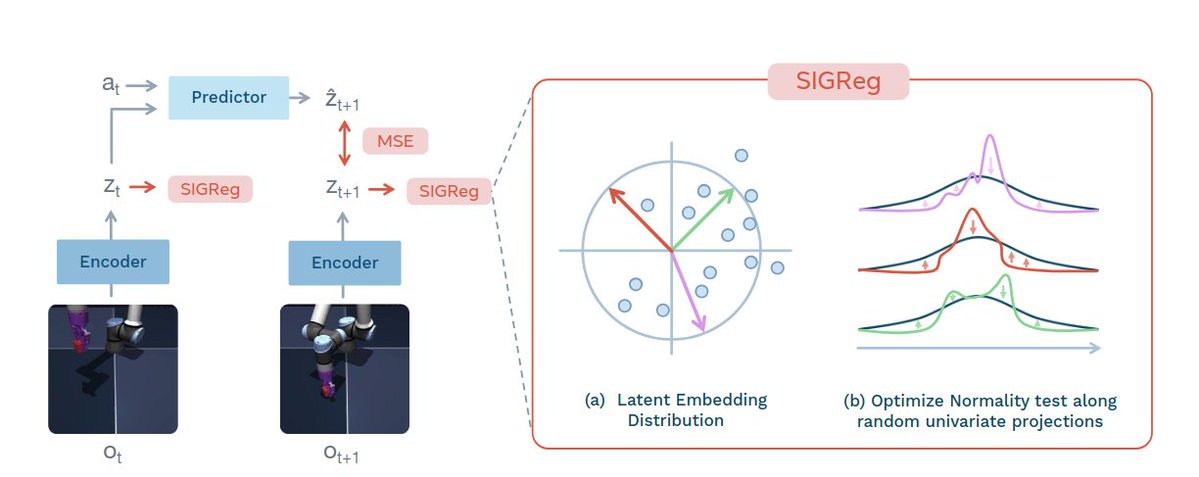
no pretrained encoder, no complex tricks. LeWorldModel shows how JEPA-based World Models can be trained end-to-end from raw pixels with just 2 loss terms ~15M params, single GPU, and ~48× faster planning than foundation-model world models. https://t.co/0bUVowVbo6
@ExaltedFoks @leadrnm https://t.co/IfTJYuUv7m


JEPA are finally easy to train end-to-end without any tricks! Excited to introduce LeWorldModel: a stable, end-to-end JEPA that learns world models directly from pixels, no heuristics. 15M params, 1 GPU, and full planning <1 second. 📑: https://t.co/cpTzgvbTS0 https://t.co/Z2De9ASzcW
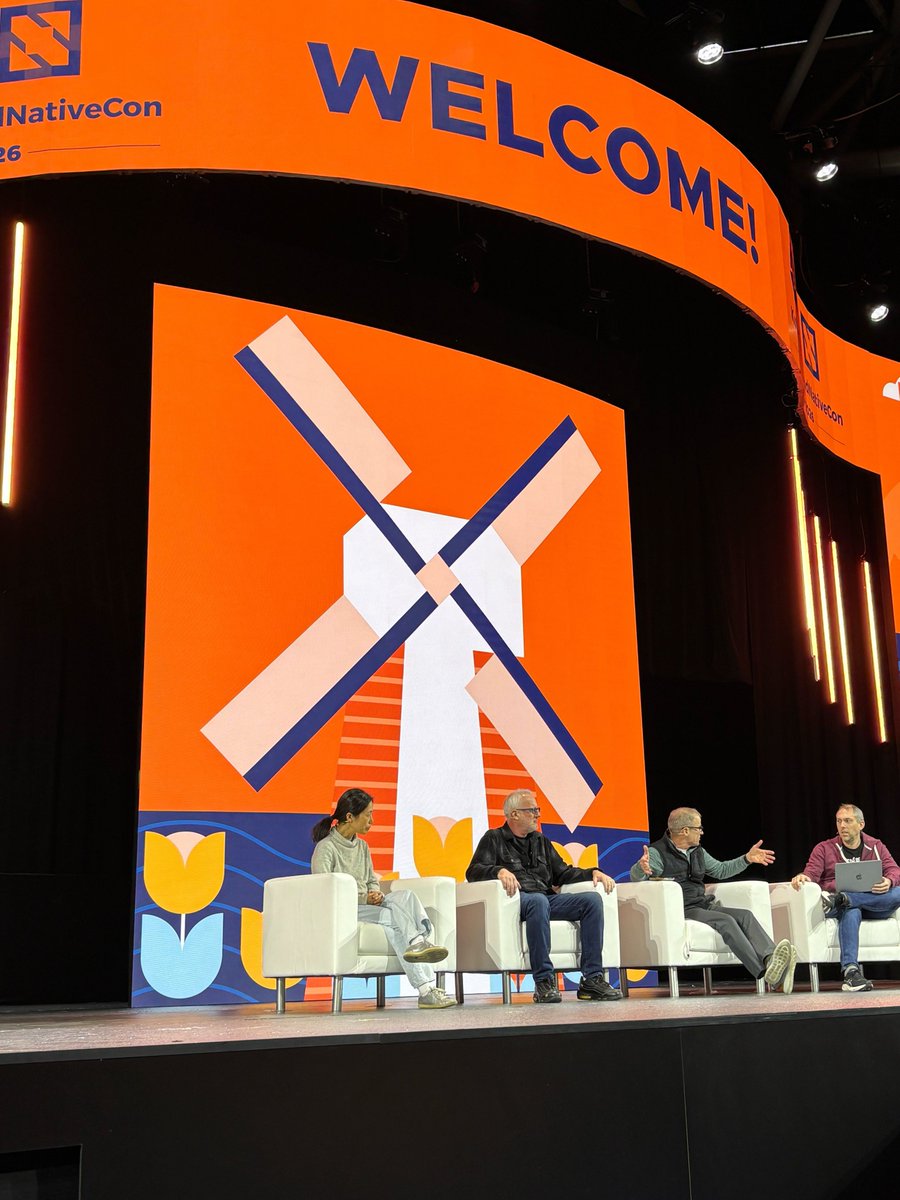
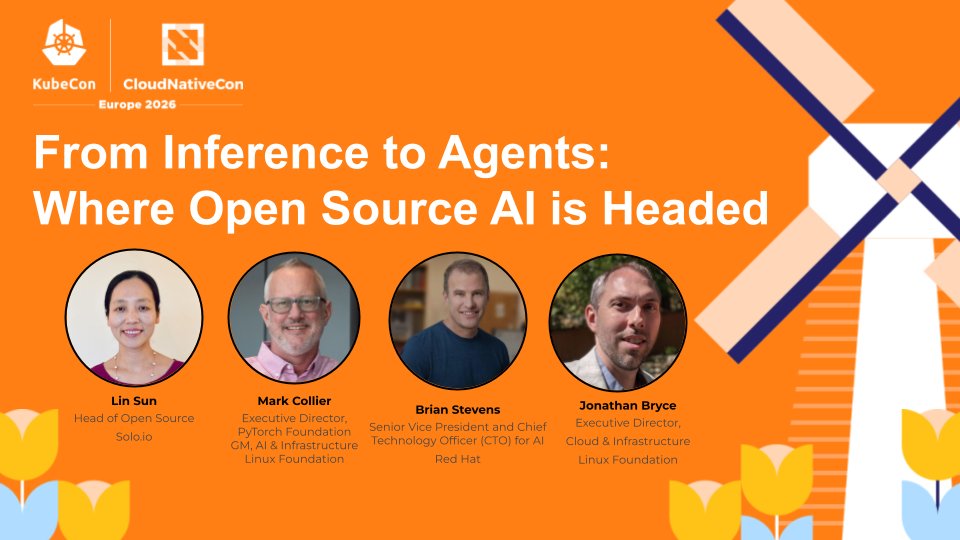
As AI systems move from training to real-world deployment, 2 forces are rapidly reshaping the landscape: the explosive growth of AI inference & the emergence of agentic AI. Don’t miss the KubeCon + CloudNativeCon Europe 2026 fireside chat tomorrow AM that will explore how the rapidly expanding inference market is driving new infrastructure needs with @addvin - @RedHat, @linsun_unc - @soloio_inc, @jbryce - @linuxfoundation, @sparkycollier - @PyTorch 📅 Tues, March 24 ⏰ 09:56 CET Session details: https://t.co/Sn8iJfwZ3L #OpenSource #GenerativeAI #KubeCon #CloudNativeCon #AIInference #AgenticAI #AI
Remix spins up parallel AI agents that turn your existing data into ready-to-post content — images, videos, articles, tweets, even apps. No prompting. No editing. Just publish. Download now: https://t.co/S7D9QUI2Sg Congrats on the launch, @samrkaplan! https://t.co/gD42unu9NT https://t.co/3kdEb2PU2f
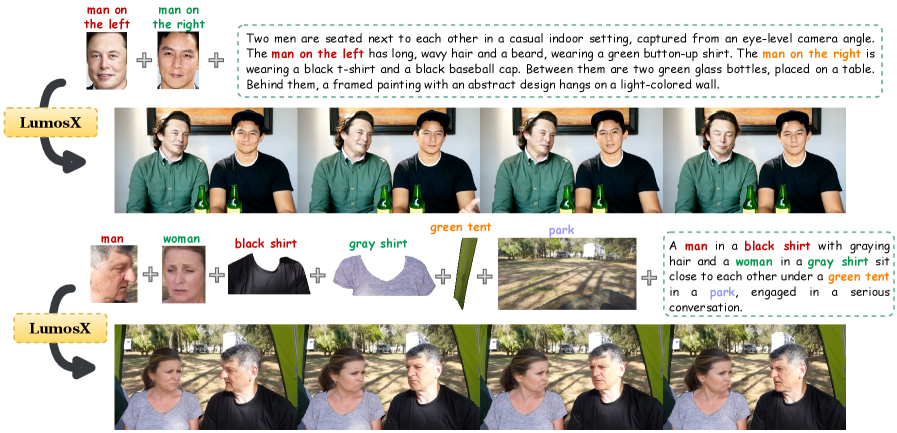
Alibaba released LumosX on Hugging Face An ICLR 2026 framework that relates any identities with their attributes for personalized multi-subject video generation using relational attention mechanisms. https://t.co/w6eLDbU5HB
Uni-1 is here! A new kind of model that thinks and generates pixels simultaneously. Less artificial. More intelligent. https://t.co/2p8kSq4Jtf
I did not call Moby “little idiot” that is his twitter/x name/handle. I would never insult someone over their stature https://t.co/qDnoomDs9v