Your curated collection of saved posts and media
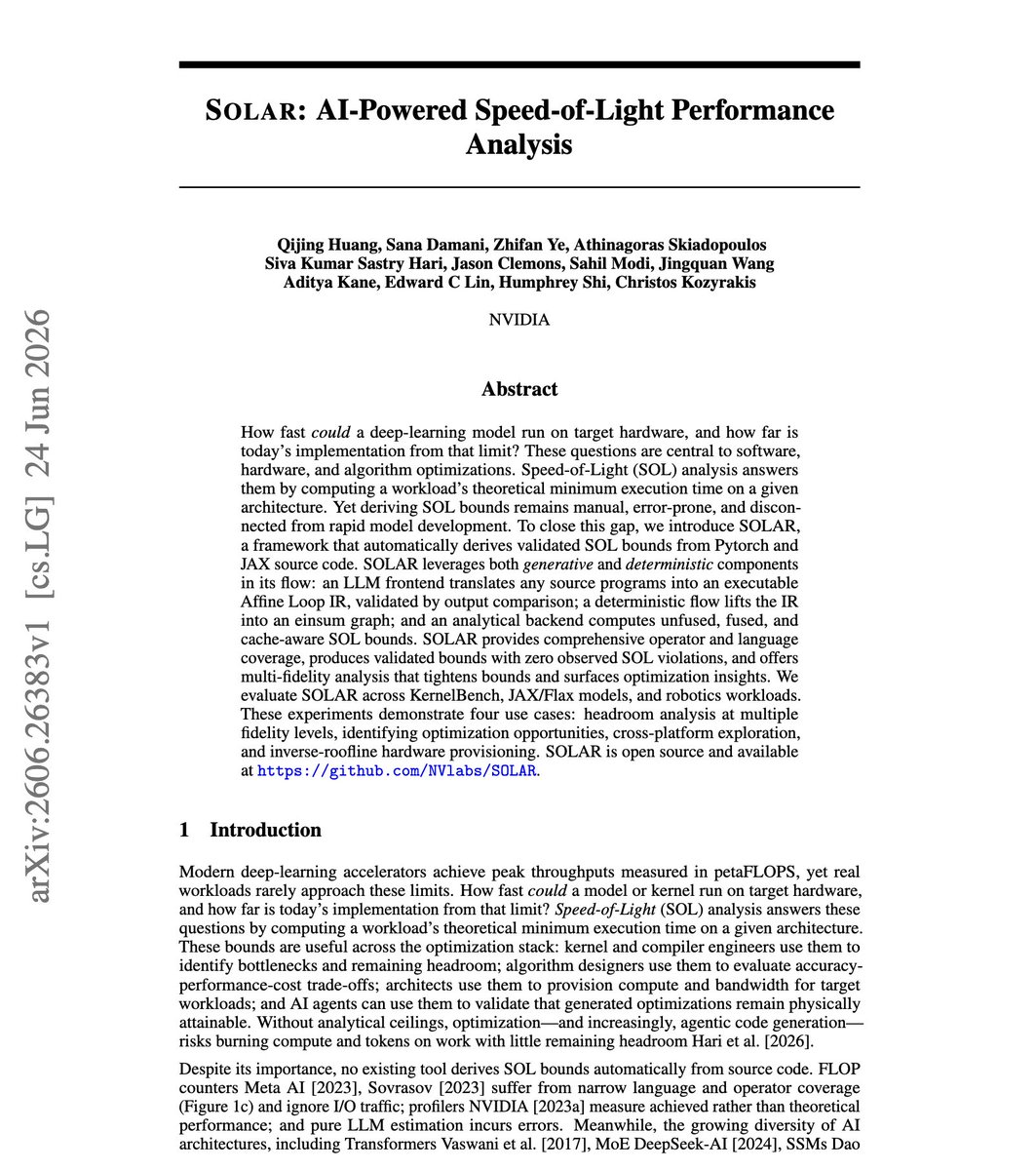
NEW paper from NVIDIA. (bookmark it) Speed-of-light performance analysis tells you the theoretical floor of a workload, but teams still derive it by hand and freeze it. SOLAR automates the whole thing straight from PyTorch or JAX source. An LLM frontend translates arbitrary code into an executable Affine Loop IR, validated by output comparison, then a deterministic pass lifts it into an einsum graph, and an analytical backend computes the bounds. The model is confined to translation, so the actual bound math stays deterministic. Across KernelBench, Flax models, and robotics workloads, they report zero observed SOL violations. Paper: https://t.co/KXgsPxcSnY Learn to build effective AI agents in our academy: https://t.co/LRnpZN7L4c
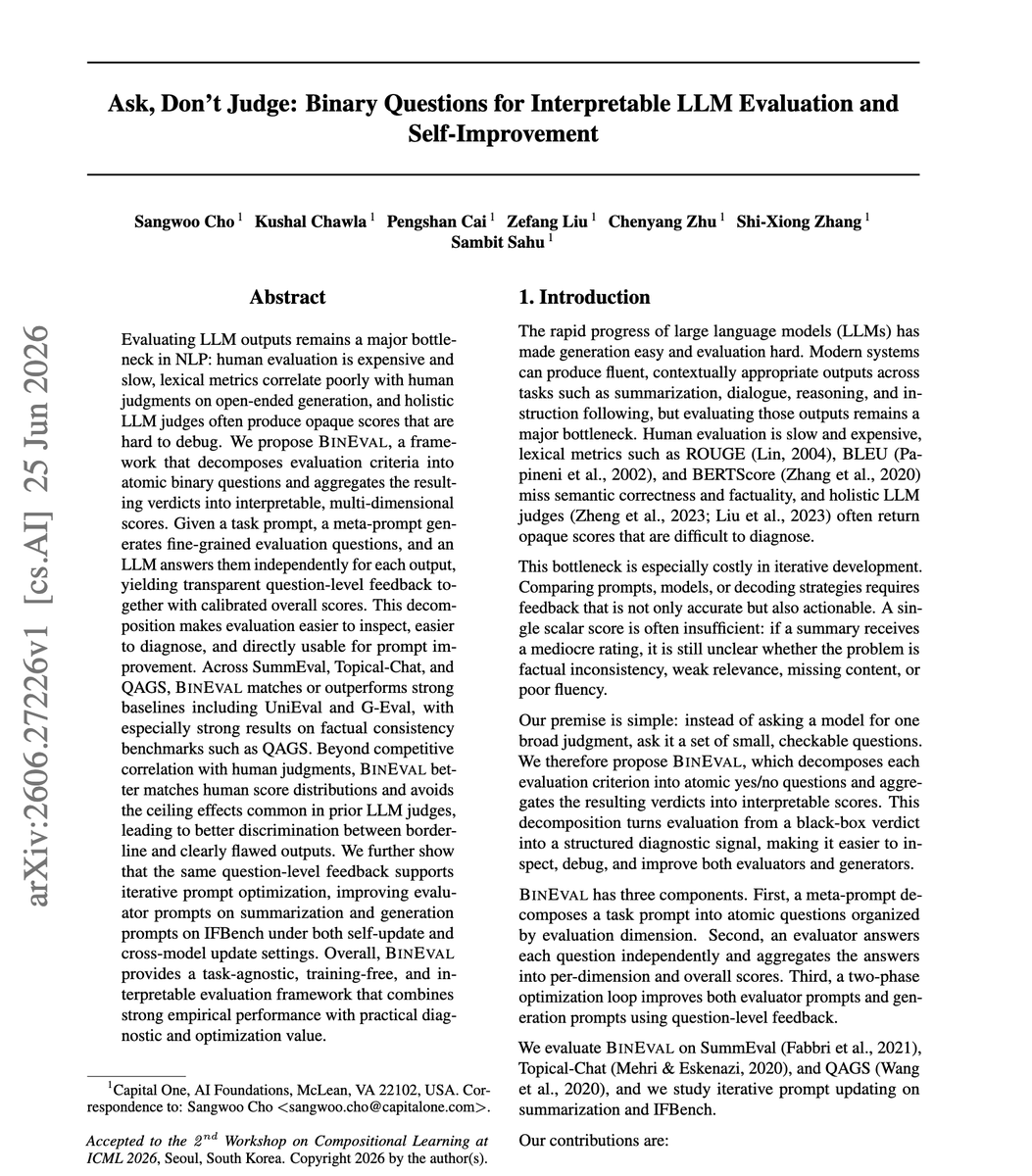
If you use LLM-as-judge, this one is worth reading. (bookmark it) It's actually one of the most effective ways to use LLM-as-a-Judge for evals. Holistic judge scores hide both their reasoning and their ceiling effects. BINEVAL decomposes each evaluation criterion into atomic yes-or-no questions, answers each independently per output, then aggregates the verdicts into calibrated multi-dimensional scores. Every question-level verdict is inspectable, so you can diagnose exactly why an output scored low, and the same verdicts feed straight back as targeted prompt-improvement signal. Across SummEval, Topical-Chat, and QAGS, it matches or beats UniEval and G-Eval, training-free, with especially strong results on factual consistency. Paper: https://t.co/oar6BZcasm Learn to build effective AI agents in our academy: https://t.co/1e8RZKs4uX
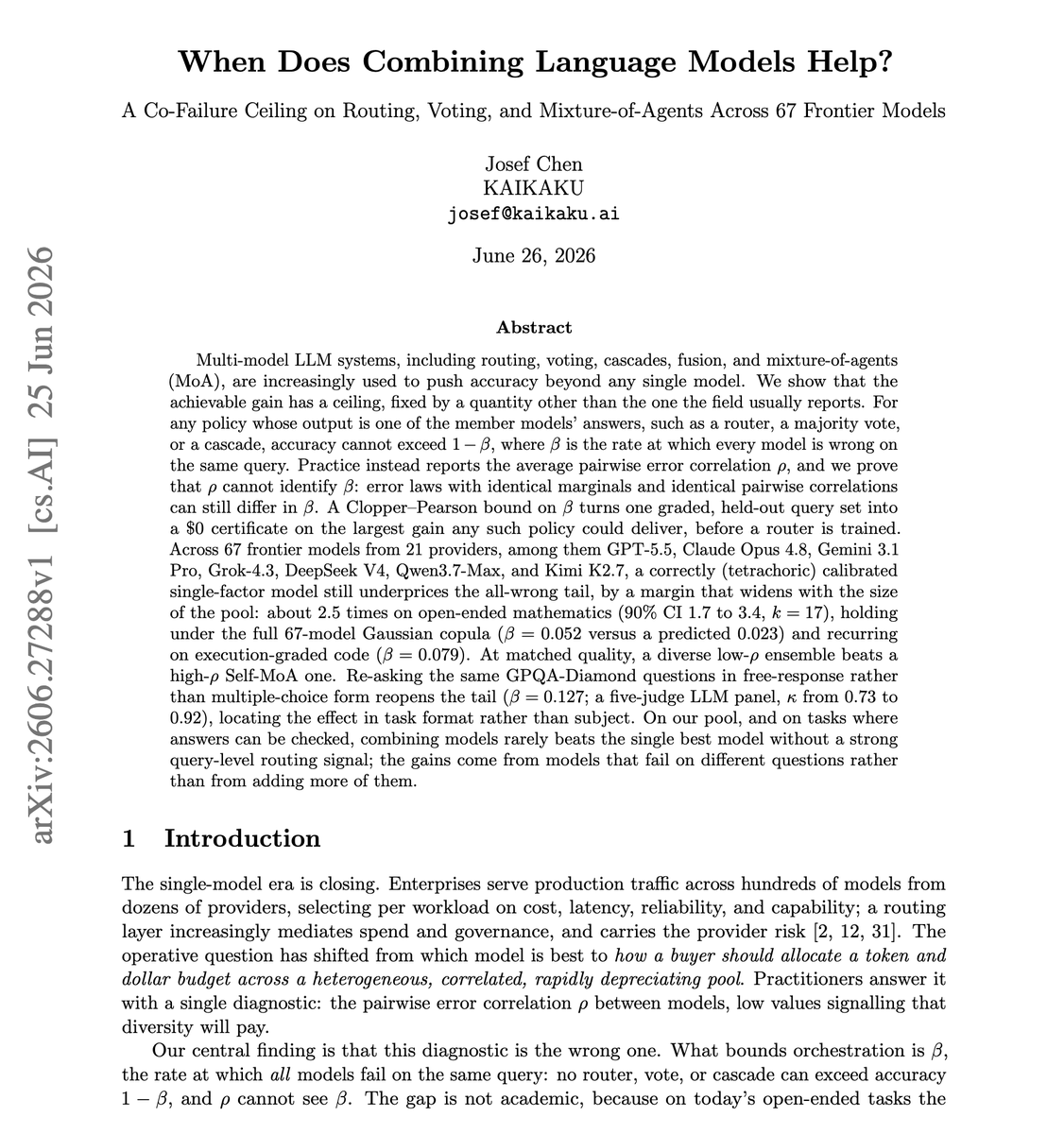
When does combining LLMs help? Great analysis on combining language models, measured across 67 models from 21 providers. Any policy that routes, votes, cascades, or runs a mixture of agents and then returns one model's answer is bounded above by 1 minus beta, where beta is the fraction of queries every candidate model gets wrong. The common justification for ensembling is diversity, usually measured as low pairwise error correlation. The paper proves that correlation cannot identify beta, so decorrelation does not establish that headroom exists. And across the 67 models, real co-failures are far more concentrated than independence-style assumptions predict. Before assuming a router or MoA setup will help, measure beta. Co-failures cluster on the answer format rather than the subject. Paper: https://t.co/PGO9YAoBzH Learn to build effective AI agents in our academy: https://t.co/LRnpZN7L4c
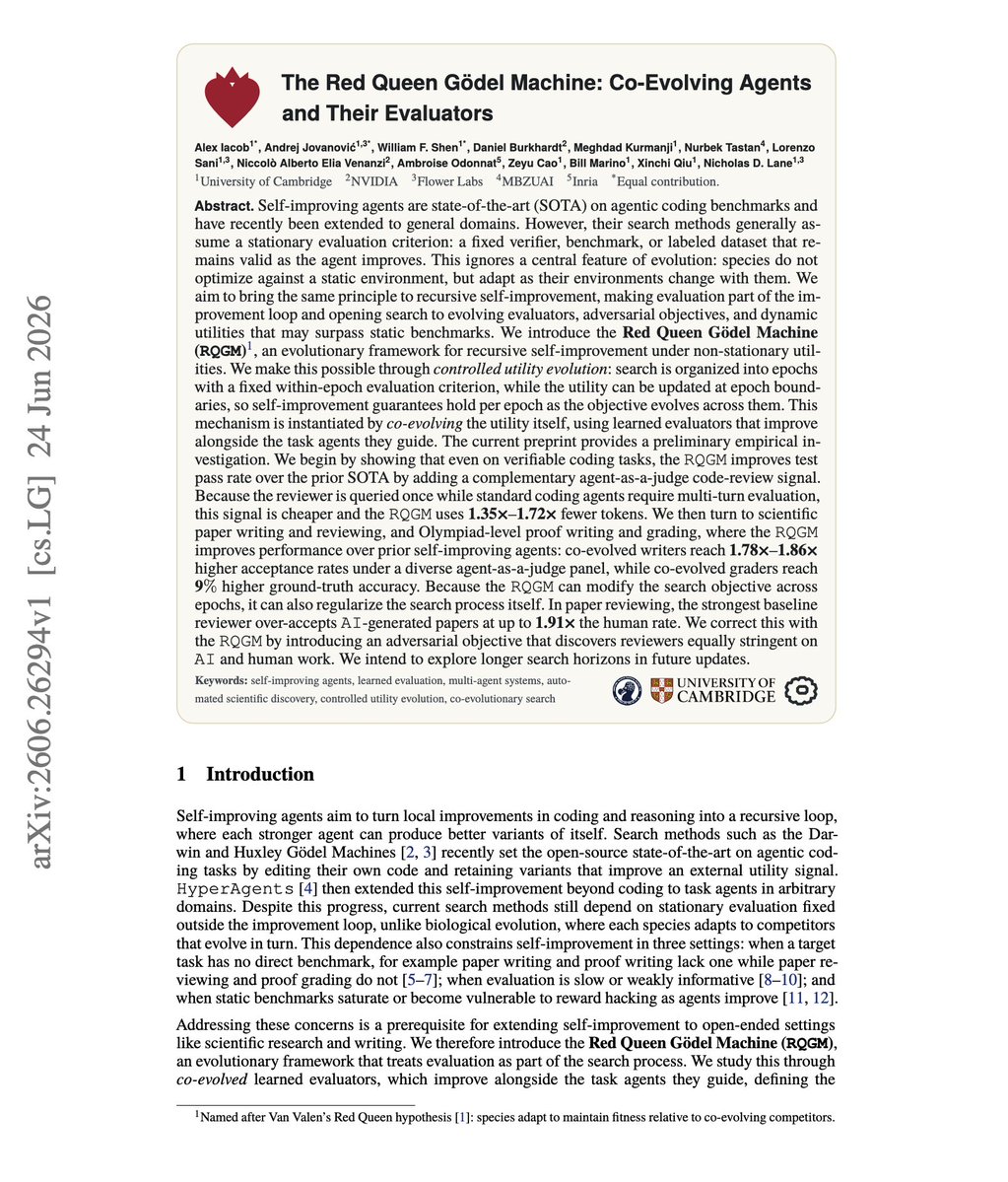
Fascinating paper on self-improving agents. (bookmark it) If you are working on agentic loops, you will quickly realize that they are only as good as the effectiveness of the evaluator. Self-improvement loops tend to stall the moment the judge stops getting harder. The agent learns to satisfy a fixed evaluator rather than getting genuinely better. The Red Queen Gödel Machine, from Cambridge, co-evolves the agent and its evaluator together, so the bar keeps rising as the agent climbs. The name borrows the evolutionary arms race. Both sides have to keep running to stay in place. A frozen evaluator is where reward hacking creeps into self-improvement. Co-evolving the judge is a structural answer to that, and it keeps the loop honest over many rounds. Paper: https://t.co/HuR9YWSTPr Learn to build effective AI agents in our academy: https://t.co/1e8RZKs4uX
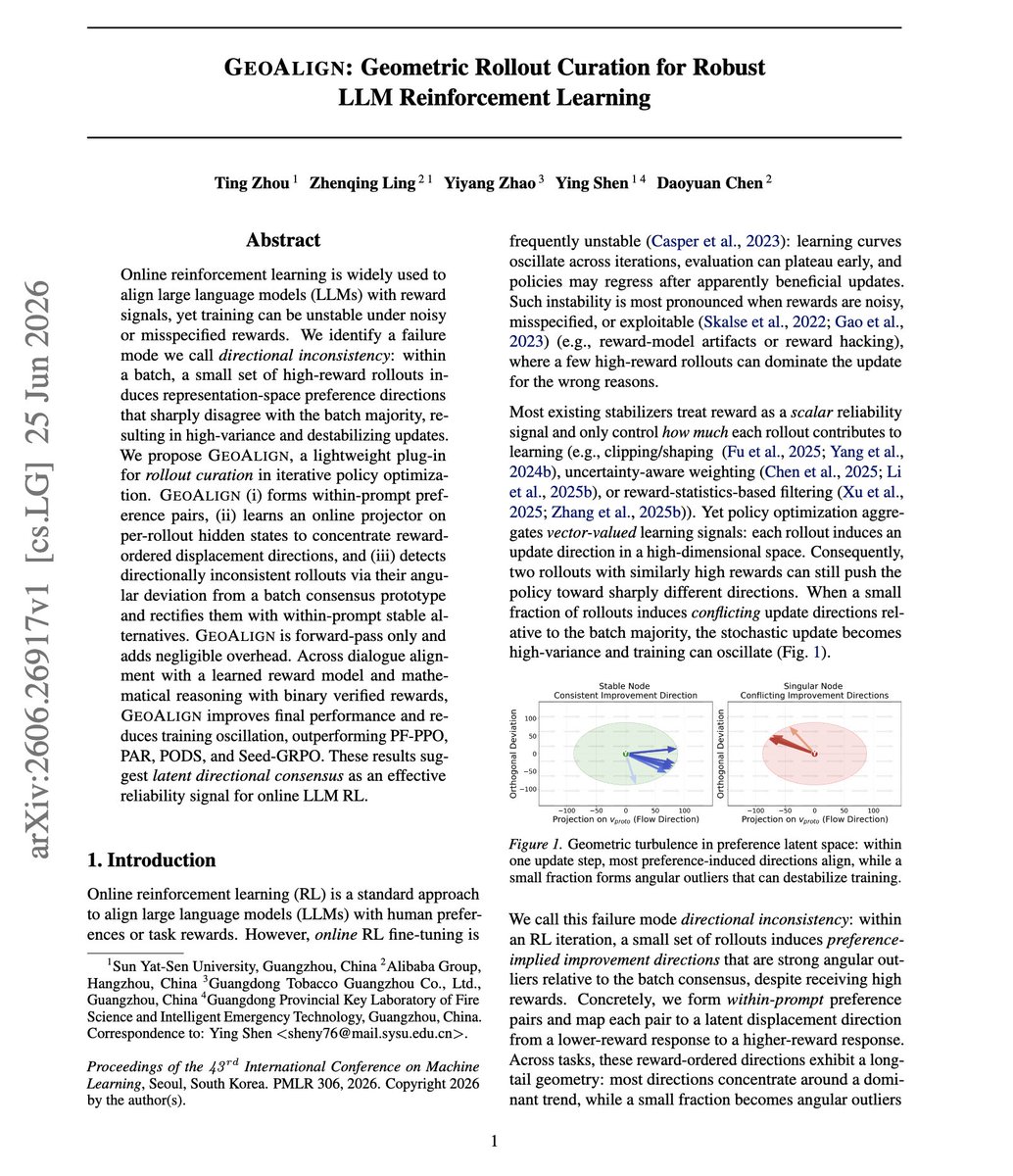
Why do RL runs on LLMs blow up even when the recipe looks right? GEOALIGN, from the Alibaba team behind Qwen, points at the rollouts. A handful of bad batches push the policy in incoherent directions, and most stability tuning just damps the symptom. This work curates rollouts by their geometry, removing the samples that make update directions conflict before they destabilize training. Why does it matter? If instability is largely a bad-batch problem, rollout curation is a lower-effort lever than another round of KL or clip tuning. You fix the data going into the update rather than fighting the optimizer. Paper: https://t.co/tUAYC57MVy Learn to build effective AI agents in our academy: https://t.co/LRnpZN7L4c
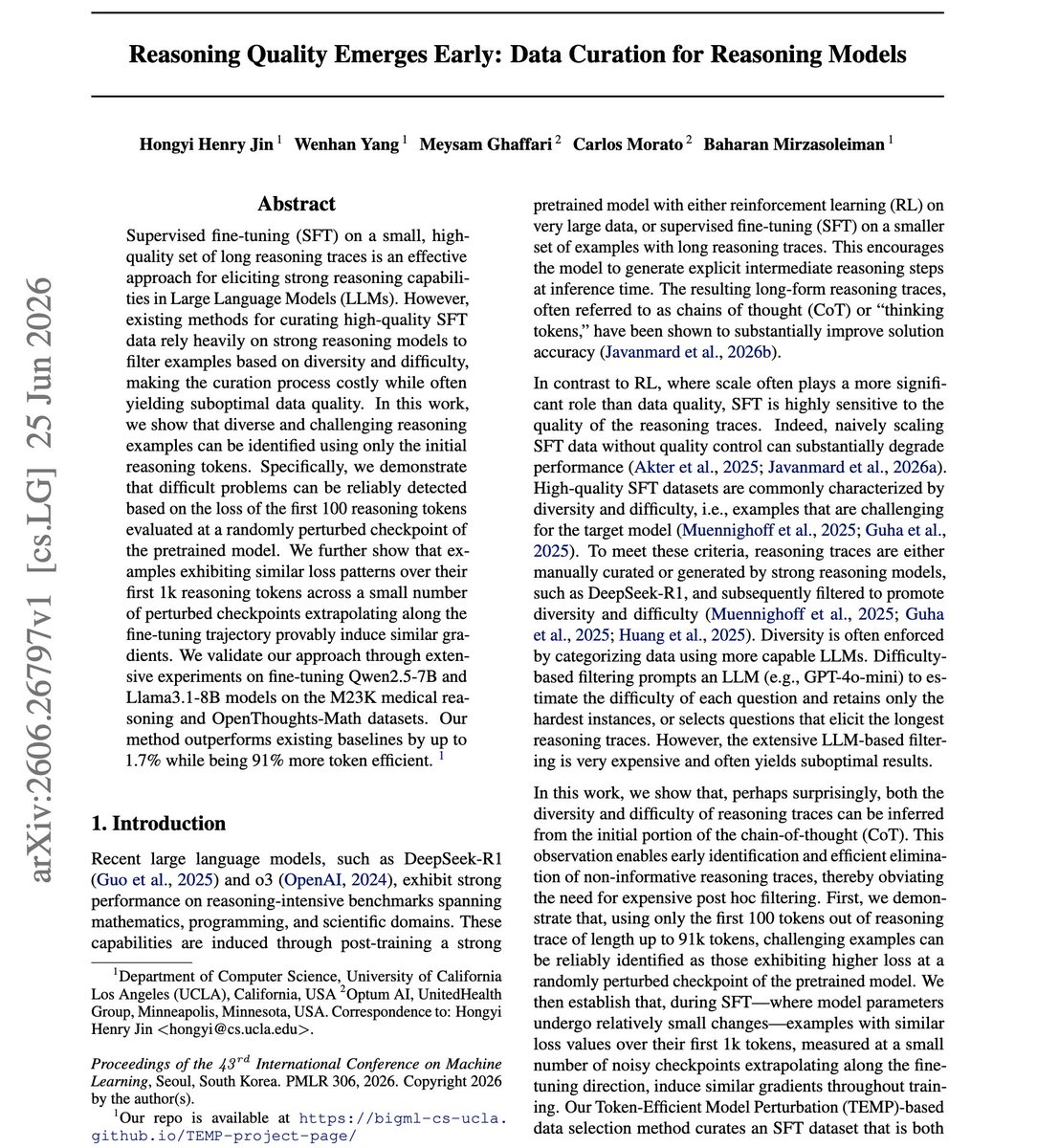
NEW paper worth reading. Reasoning-data curation is expensive because scoring a trace usually means reading it to the end. This new work from UCLA shows you may not have to. The quality of a reasoning trace is largely decided in its opening tokens, so a short prefix predicts whole-trace quality well enough to rank and filter on. What this means? You can score a million traces without finishing any of them. That turns curation into a cheap early-stopping problem and cuts the cost of building SFT data for reasoning models by a wide margin. Paper: https://t.co/KPKdygwd12 Learn to build effective AI agents in our academy: https://t.co/LRnpZN7L4c
https://t.co/atWPjSq0yg https://t.co/8mgP0A7oXP
https://t.co/atWPjSq0yg https://t.co/8mgP0A7oXP
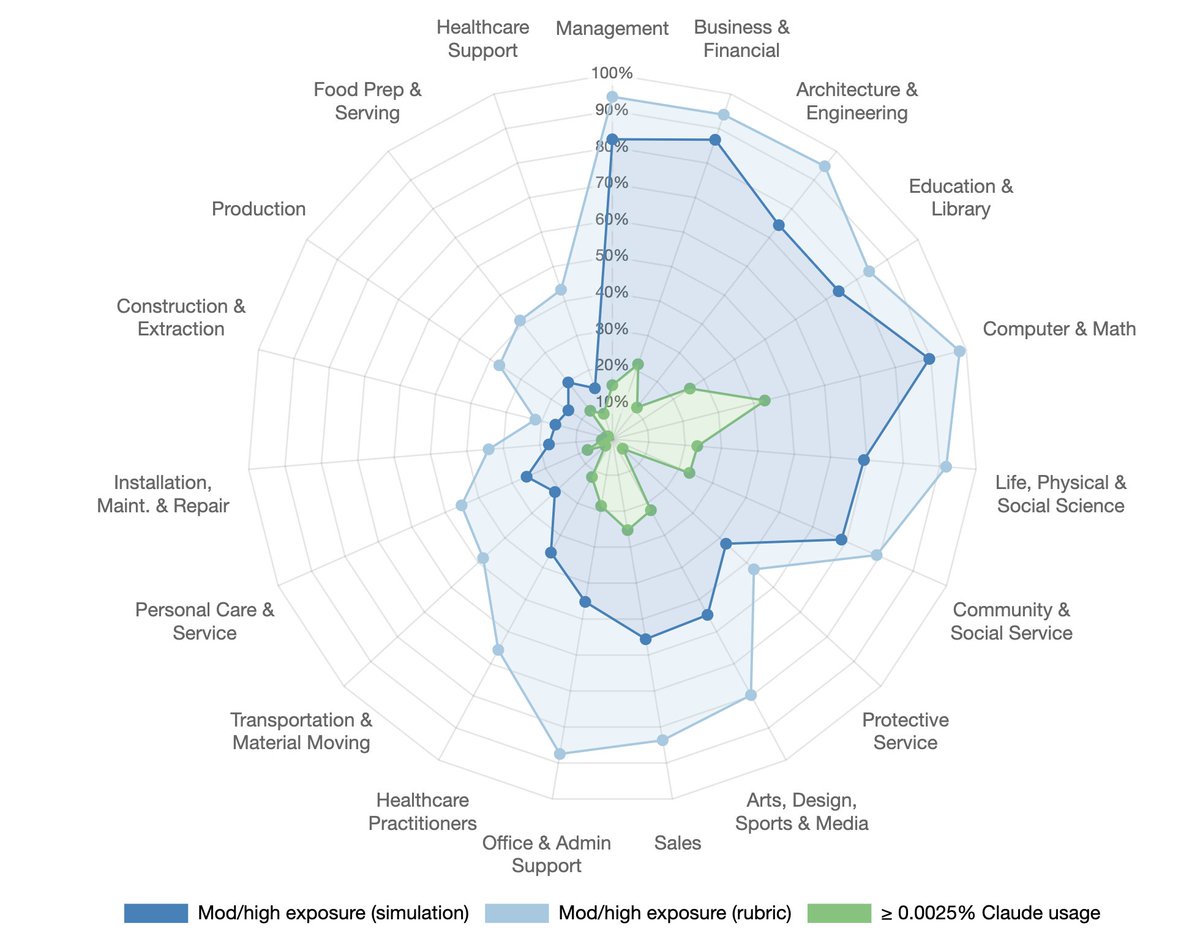
40% of benchmarking effort targets math/coding, but the related occupations are only 3.5% of US jobs. We introduce EconEvals, an open-source evaluation suite to measure capabilities and predict job disruption across the US labor economy. https://t.co/wxQykhUqCI
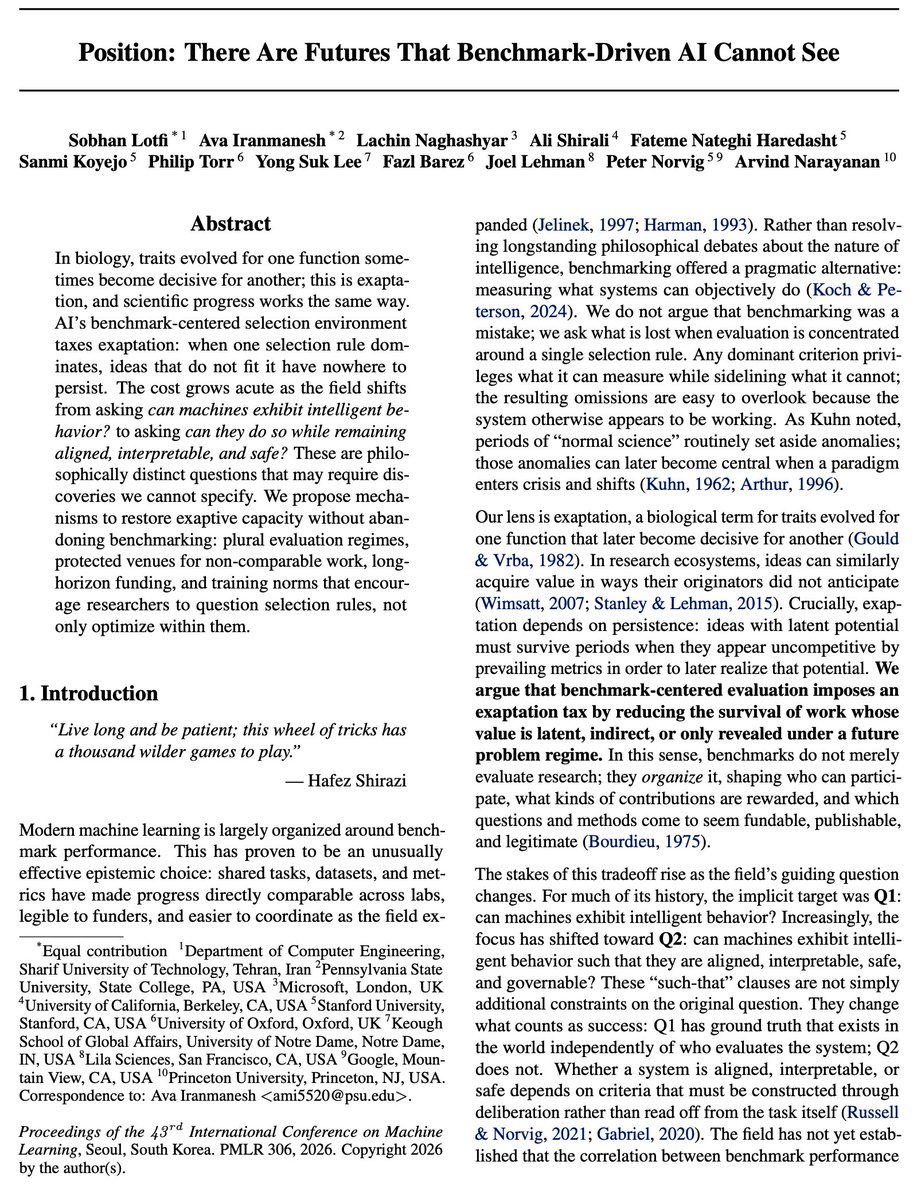
This paper will be talked about for years to come. V important! There are Futures benchmark driven AI cannot see! led by Sobhan (my fellow) and @Avameanssong w/@kalsbskk81826 Ali, Fateme, @sanmikoyejo, @philiptorr, @yong_suk_lee, @joelbot3000 @NorvigPeter and @random_walker https://t.co/ehBGK8dfsT
We built LiteParse, the fastest document parsing solution on the planet and made it open source. And it just hit 10k github stars. 🦙 Fast to run. Fast to love. Thanks for building with us. If you haven't tried it already, repo at: https://t.co/wXRxvlREQq https://t.co/Shv0J1CROU

The @n8n_io node for the LlamaParse Platform is now an officially verified community node, as part of a broader partnership with n8n to bring cutting-edge document intelligence to the low-code and no-code world🚀 The new version of the node brings together document parsing, classification, extraction, splitting, and retrieval in one place, all wired to a single LlamaParse API credential🦙 Each resource can now also act as a callable tool inside an n8n AI Agent: so instead of building static pipelines, you can let the agent decide when to retrieve context, parse a file, or extract structured data based on what the user actually needs🤖 A few workflows worth highlighting: routing documents by type before extracting structured fields, plugging retrieval directly into an agent backed by your own knowledge base, and running parse outputs through different tiers side by side to find the right balance between accuracy and cost🔃 If you're already using n8n, install it directly from your workflow canvas by searching 𝘓𝘭𝘢𝘮𝘢𝘗𝘢𝘳𝘴𝘦 𝘗𝘭𝘢𝘵𝘧𝘰𝘳𝘮 and give it a try!🔧 📚️ Full breakdown in our blog post: https://t.co/8LJB80HCJ8
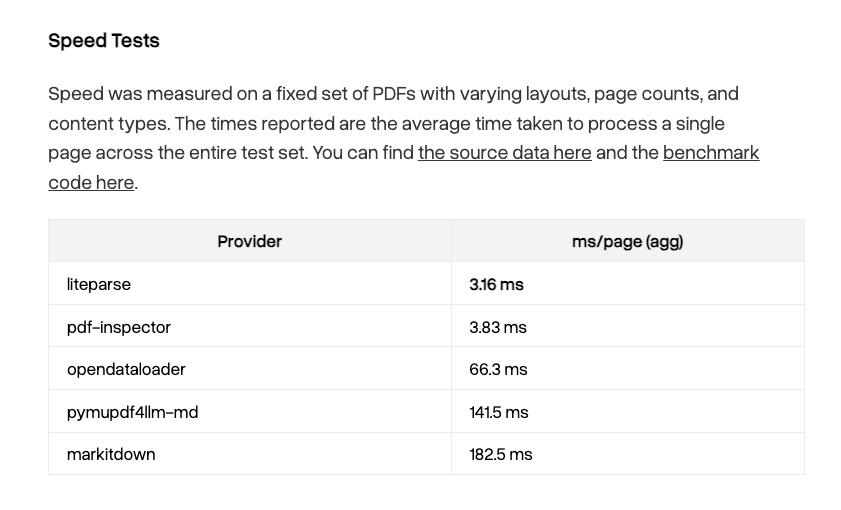
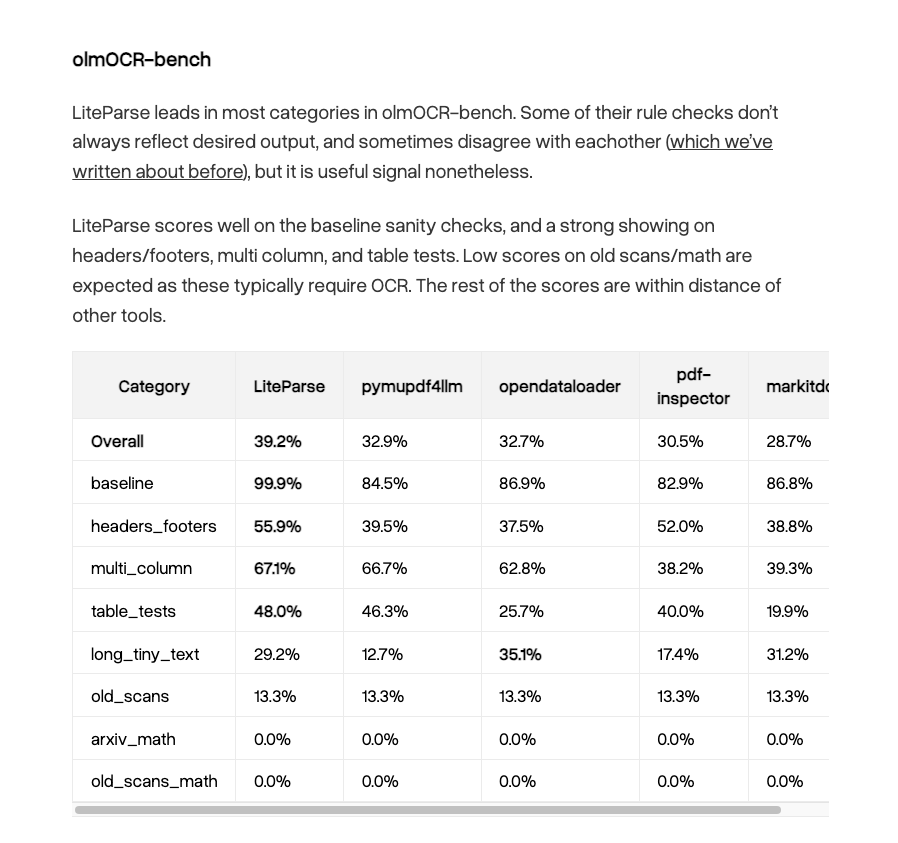
LiteParse is unreasonably good for document parsing ✅ It is the fastest document parsing tool out there - average parse time per page is 3ms ⚡️⚡️ ✅ Now that we support markdown, it tops opendataloader-bench, OlmOCR-bench, and ParseBench in terms of accuracy ✅ It supports 50+ other document formats ✅ It even gives you basic bounding boxes that your coding agent can stitch together Even if you need deeper VLM-enabled parsing (e.g. LlamaParse), there's no reason you shouldn't be using this as a first pass for everything. https://t.co/JNER0mVcB8
We built LiteParse, the fastest document parsing solution on the planet and made it open source. And it just hit 10k github stars. 🦙 Fast to run. Fast to love. Thanks for building with us. If you haven't tried it already, repo at: https://t.co/wXRxvlREQq https://t.co/Shv0J1CRO
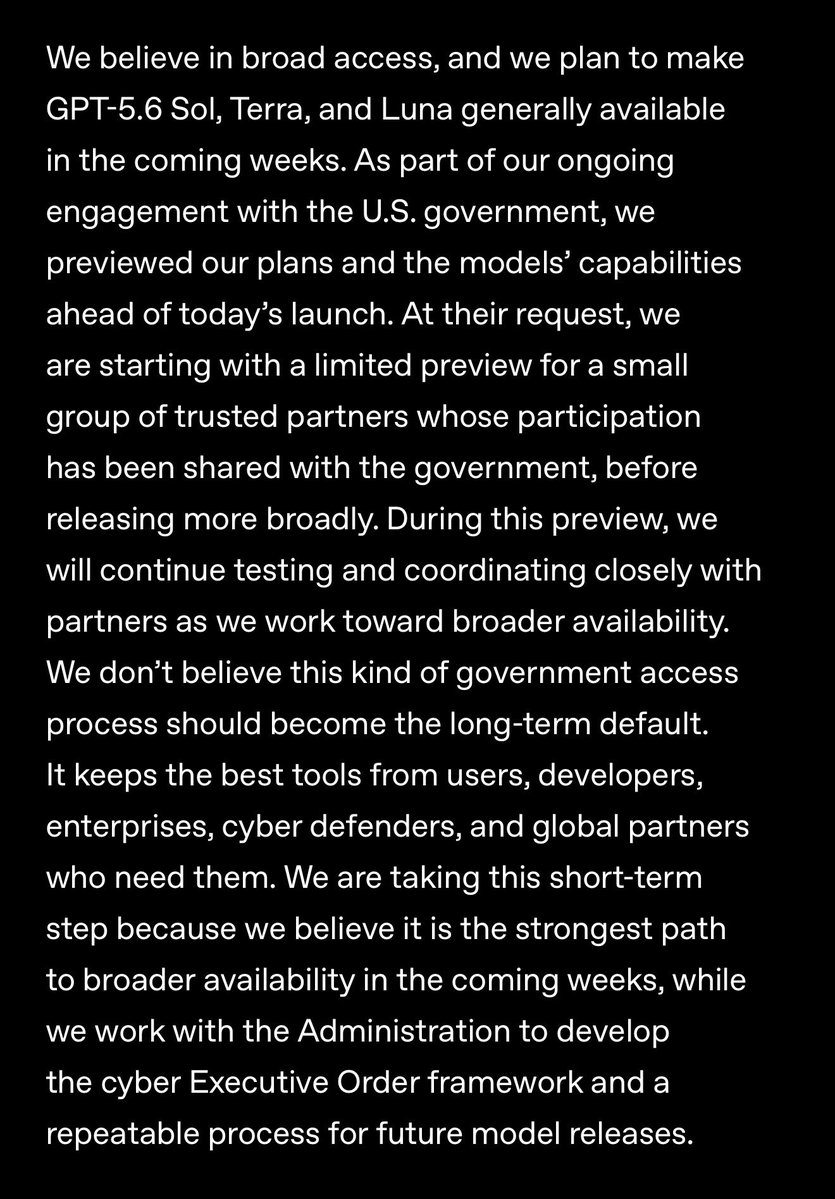
“We’re being forced by the U.S. Government to slowly release 5.6, and we don’t like it” At LEAST they are saying this .. good job @sama .. but it is not enough. We are already losing to China and now we are trying to act like them, which is only reinforcing their advantage!!! https://t.co/Rm5CD28KTV
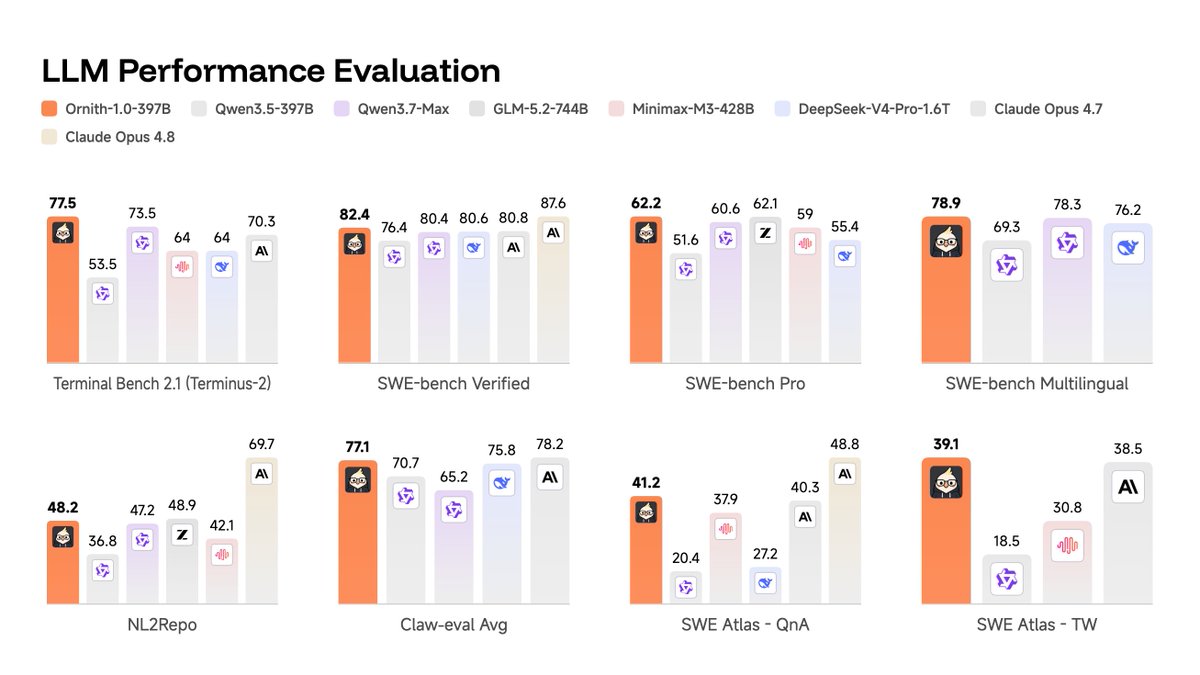
Aloha! 🌺 Meet Ornith-1.0, a family of open-source LLMs specialized for agentic coding. Ornith-1.0 spans the full parameter sizes including 9B Dense, 31B Dense, 35B MoE, and 397B MoE. It achieves state-of-the-art performance among open-source models of comparable size on coding benchmarks including: ✅Terminal-Bench 2.1(77.5) ✅SWE-Bench(82.4 on verified, 62.2 on pro, 78.9 on Multilingual) ✅NL2Repo(48.2) ✅SWE Atlas(41.2 on QnA, 42.6 RF, 39.1 TW) ✅ClawEval(77.1) Post-trained on top of gemma4 and qwen3.5, Ornith-1.0 employs a novel self-improving training strategy in which reinforcement learning is used to generate not only solution rollouts, but also the task-specific scaffolds that drive those rollouts. By jointly optimizing the scaffold and the resulting solution, the model generate higher-quality solutions in agentic coding.😎 All models are released under the MIT license, enabling full commercial and research use. 📖Tech Blog: https://t.co/qT9N2HYWFn 🤗Huggingface: https://t.co/PRrwqjeBtM
@lcastricato We may have missed our golden goose by not digging deeper into https://t.co/CIshkL2Qx1

Introducing Computer for Counsel. Computer now connects the research databases, document tools, and matter-management systems lawyers use every day. Pull citable sources from @midpageAI, @LegalZoom, @Docusign, @netdocuments, and more. Available for all Pro and Max subscribers. https://t.co/El3028Ua7P
Base MCP is now available in @Perplexity_ai Computer → Research any token with Perplexity → Set your entry point → Base MCP prepares the swap for your approval Alongside everything else Base MCP can already do https://t.co/RiucyK7NTN
this is going to be the norm https://t.co/BeyBz7EWDK
tony stark is not texting jarvis. voice lets you give agents more context, faster. the messy stuff is actually the point. i wrote about how we use it with codex today and where this is all going. talk to your computer. be shameless about it. i’ll see you in a few months 🎙️ https://t.co/Sm5ZIcMCJP
https://t.co/cRuQd07mwk

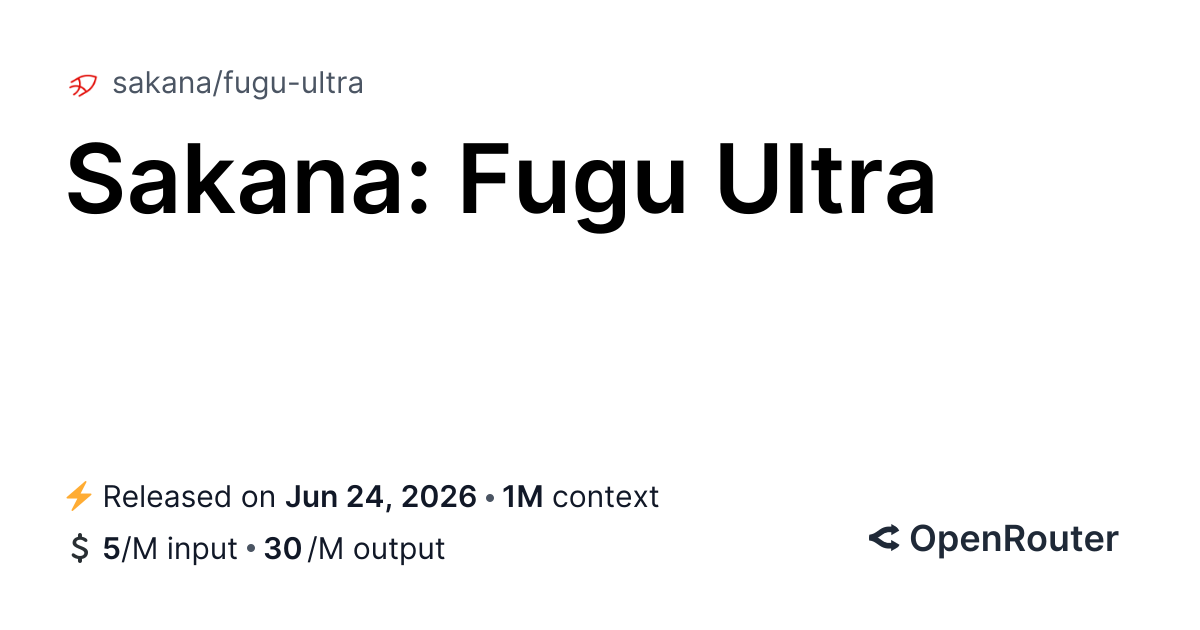
Fugu-Ultra is now live on @OpenRouter! ⚡ We share a core vision with the OpenRouter team: the future of AI isn’t a single monolithic model, but the collective intelligence of the world’s best models working together. Try it: https://t.co/sVkbTPtXOl 🐡 https://t.co/y65DXVcqXL
The future of bio is powered by faster data Introducing the Medra AI Experimentalist: an agent that turns goals into experimental designs, learns from every result, and develops the next assay Excited to collaborate with @DARPA and @NVIDIAHealth on the future of science https://t.co/5DZoWJ97xs
@jxnlco https://t.co/inpHAoEYW7

@jxnlco https://t.co/inpHAoEYW7

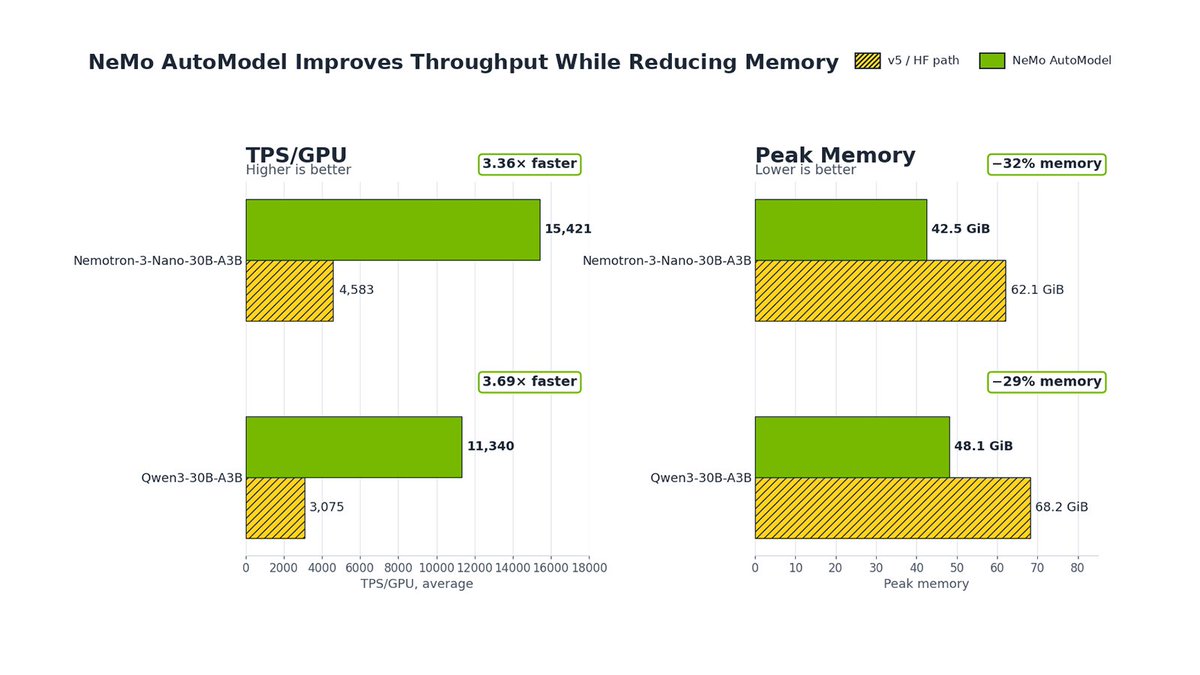
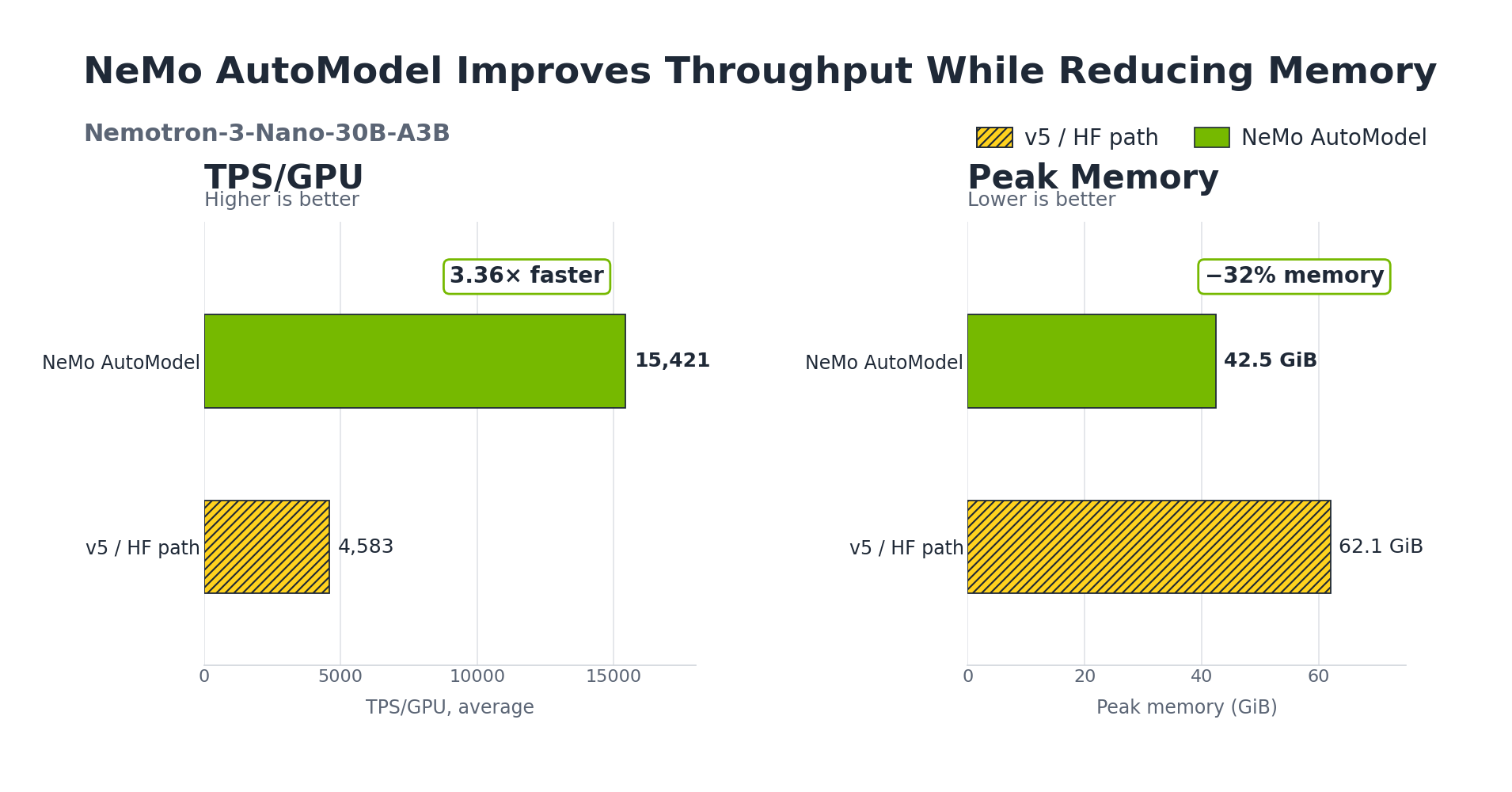
The rise of MoE models introduced new challenges in training, and @huggingface's Transformers v5 brought first-class support for solving them. Now, NeMo AutoModel builds on top of v5. Part of the NeMo framework for building models at scale, NeMo AutoModel brings optimizations to a broad set of model families through support for Expert Parallelism, DeepEP, and TransformerEngine kernels with a few lines of code. We found NeMo AutoModel brings a 3.4 to 3.7x higher training throughput for popular MoE models. You can read more here: https://t.co/TNlBsKWwrJ
anyway, it’s not just the two of us… @adlinzainal @SherryYanJiang @agrimsingh @yongquanYQ @darenstwt @ivanleomk will be there too! 🇸🇬 https://t.co/JNHf67M8rU
Creatives are superheroes. 🎥: Rémi Quilichini. https://t.co/5NJIRMspVm
THIS IS ART. https://t.co/2CunuS1ipI
Creatives are superheroes. 🎥: Rémi Quilichini. https://t.co/5NJIRMspVm
It's really interesting how @profdanklein thinks about hallucinations. His argument: every output from an LLM is technically a hallucination; some just happen to be right. No LLM ever knows whether its answer is right, where the information came from, or how reliable it is. So every answer your AI gives you is probably just a bet.
Full episode of Gradient Dissent: YouTube: https://t.co/mgGKbc50Xq Apple Podcasts: https://t.co/qLL1uAPOFv Spotify: https://t.co/B7TkFcsD3F

SpaceX's @Starlink will be installed on more than 80 giant Oldendorff ships. Oldendorff is one of the world’s largest dry bulk shipping companies. "With vessels operating in diverse regions and trading routes, reliable and resilient connectivity plays an increasingly important role in maintaining operational efficiency and optimizing global fleet management."

I’m reading an old collection of interconnected science fiction stories by Jerry Pournelle, written in the early 70s. His best books were later co-authored with Larry Niven, but it is still solid work in my favored “competence porn” genre, with entrepreneurs as protagonists. It stands out to me that he was despairing for America when he wrote the stories. Things looked bad at the time, and his fiction projected it into the future. Social unrest, Vietnam, Watergate, economic recession, energy crisis, and for a patriotic space guy, abandoning Apollo. The backdrop for the stories was that America was unfixable, which is, of course, a motivation to go to space in fiction, but I do think he was genuinely worried by what he saw around him. But over the next decade, things got better, and Jerry had a front row seat for the rise of the technology sector, writing the Chaos Manor column in Byte magazine for many years. He also got to see the founding of SpaceX, a company straight out of a hard SF novel, and they re-flew a landed rocket shortly before he died. Trends aren’t fate. Bad situations can be fixed, and good ones still need to be defended. RIP Jerry, I’m glad you got to see things turn around. https://t.co/jdQVyVLevI