Your curated collection of saved posts and media
Finally finished building my AI datacenter! 🚀 32x3090s across 4 servers (8 GPUs each), all connected over InfiniBand. The whole setup is solar-powered with a massive battery bank and generator backup. More technical details and benchmarks coming soon. https://t.co/8GfedrSzNp
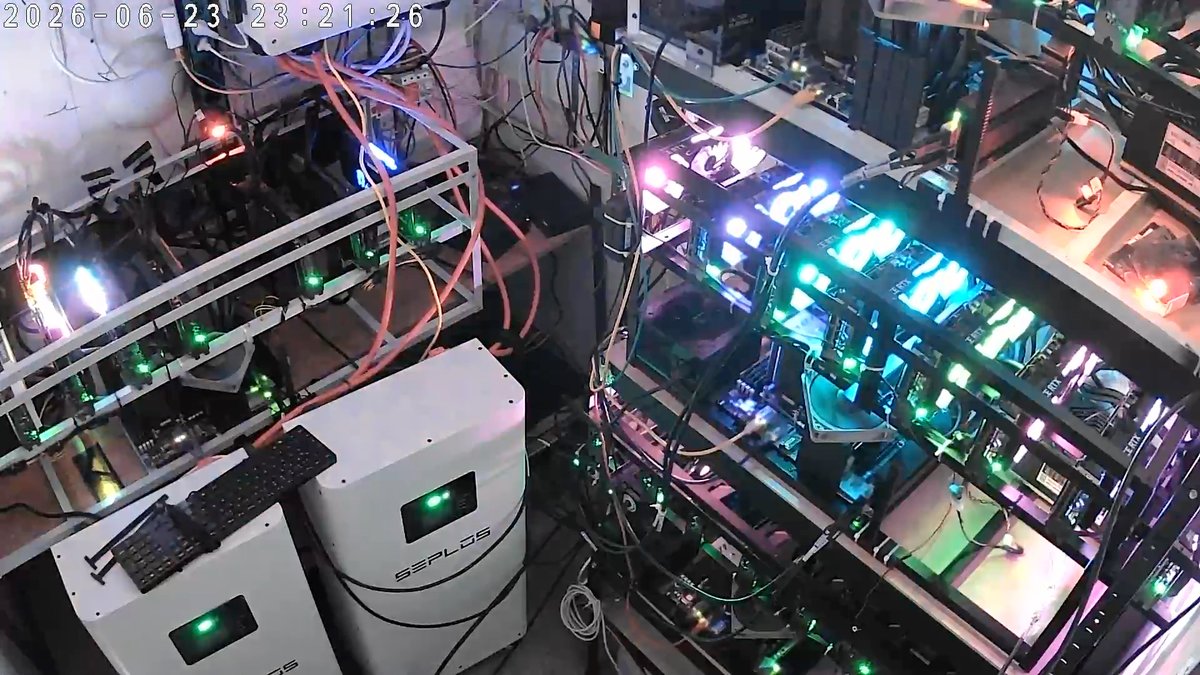
Hoard your physical hardware. Run local AIs. Support open source. Don't let them price you out of freedom. Defend at all costs. Live sovereign. Resist. Die free. Photo by @levelsio https://t.co/vSjNI50YzT

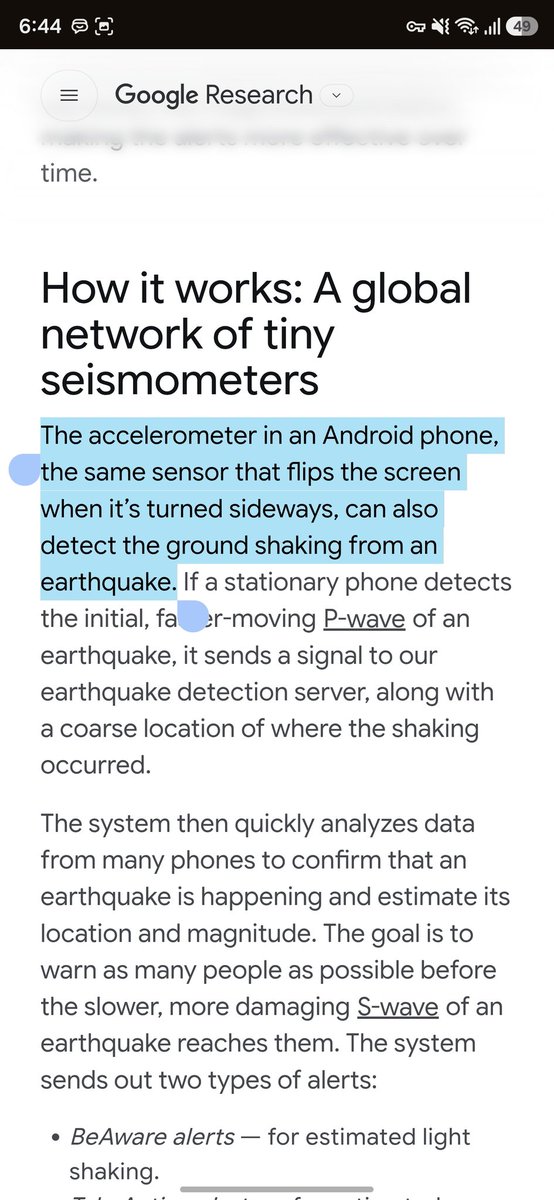
Google fue muy listo; usan los acelerómetros de miles de teléfonos Android cómo una red global de sismos, toda esa data se envía y Google logró una forma de detectar esas ondas a tiempo y enviar las alertas. https://t.co/U7VFGxTCQ5
Google’s Tensor Processing Unit (TPU) uses the systolic array architecture - an idea from 1978 - to accelerate matrix multiplication with far less memory movement. Fun to build a small scale version on an FPGA. Links to original paper and TPU design: https://t.co/cEznMoForH
new logo wyt https://t.co/EnVS05SSzM

new logo wyt https://t.co/EnVS05SSzM

We're all over AI Engineer World's Fair on June 29 to July 2. 🦙 📍Visit us at booth L-G47. LlamaParse demos + Fear of Docs swag 🎤 @jerryjliu0, our Founder & CEO, on agentic document parsing and shipping agents that survive production. Tue 6/30, 11:10 AM, Vision & OCR (Room 2006) 🎤 George He, our Head of Engineering, in a live parse-off, LlamaParse vs the leading LLMs. Thu 7/2, 1:55 PM, Expo Stage 4 🥒 The Agent Open (6/30) RSVP 👉 https://t.co/ZmW5Y1vX8l
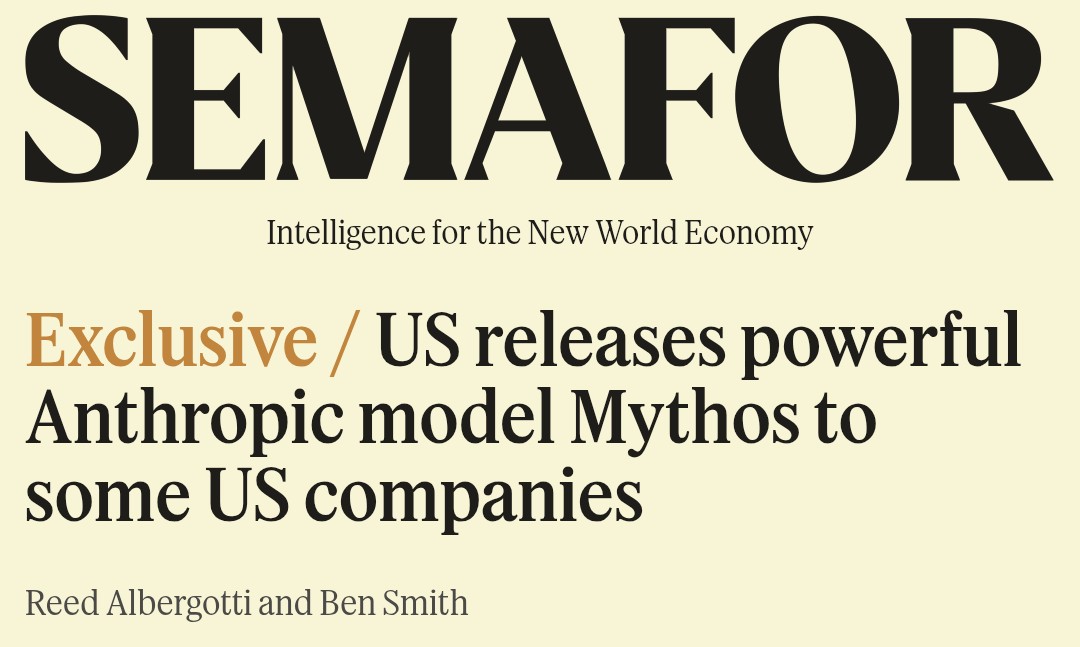
Semafor is reporting that The US government has lifted its block on Mythos 5 in a letter this afternoon from Commerce Secretary Howard Lutnick to Tom Brown. Fable is not included. This is US only, and covers 100 US institutions, including major companies and government agencies. https://t.co/Z0u4bYV9gA
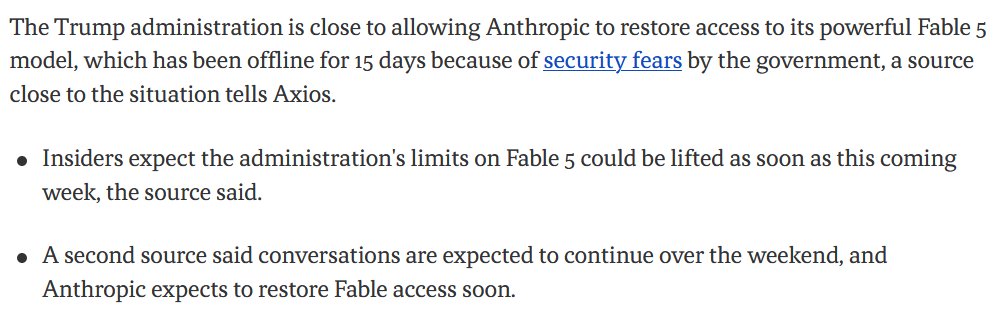
🚨 BREAKING: Anthropic and US Govt insiders expect the administration's limits on Fable 5 could be lifted as soon as this coming week, per Axios. The Pentagon and National Security Agency still have to give Fable 5 the green light, but other government agencies have given the go-ahead.
🦔Ford admitted it had to rehire engineers after replacing them with AI systems that couldn't do the job. The company's VP of hardware engineering said they mistakenly believed AI and adjusted design requirements would produce a high-quality product. Ford has cut over 5,000 workers since 2020 and recalled more cars than any other US automaker this year. The company rehired, newly hired, or promoted 350 experienced engineers to fix the damage. CEO Jim Farley has said AI will replace half of all white-collar workers in the US. My Take Ford fired the engineers, the quality collapsed, and then Ford called the engineers back to fix what broke and train the AI that was supposed to replace them. The VP framed this as a lesson learned. I'd call it something else. Ford planned to use its own employees to build the system that would make them obsolete. The employees left before that could happen. Ford now has the top spot in JD Power's quality ranking for the first time in nearly 20 years, but only after it brought the humans back. The company's response to the whole episode is to add 100,000 more AI-powered tests. Farley still says AI will replace half of white-collar workers. Ford just proved it can't replace 350 engineers without the product falling apart, and the CEO's position hasn't changed. That's the part I can't get past. Hedgie🤗
FOX issues an apology: Kevin O'Leary appeared as a guest on the show and discussed the ongoing controversy surrounding his planned data center project in Utah and made claims relating to the opponents of his product. Mr. O'Leary has now corrected the record and explained he has “no evidence” that they are funded by the Chinese communist party. Fox News media is aware of no evidence they are funded by or acting in the direction of or were in coordination with Chinese interests in opposing Mr. O'Leary's project. Fox News Media also apologizes for the error.
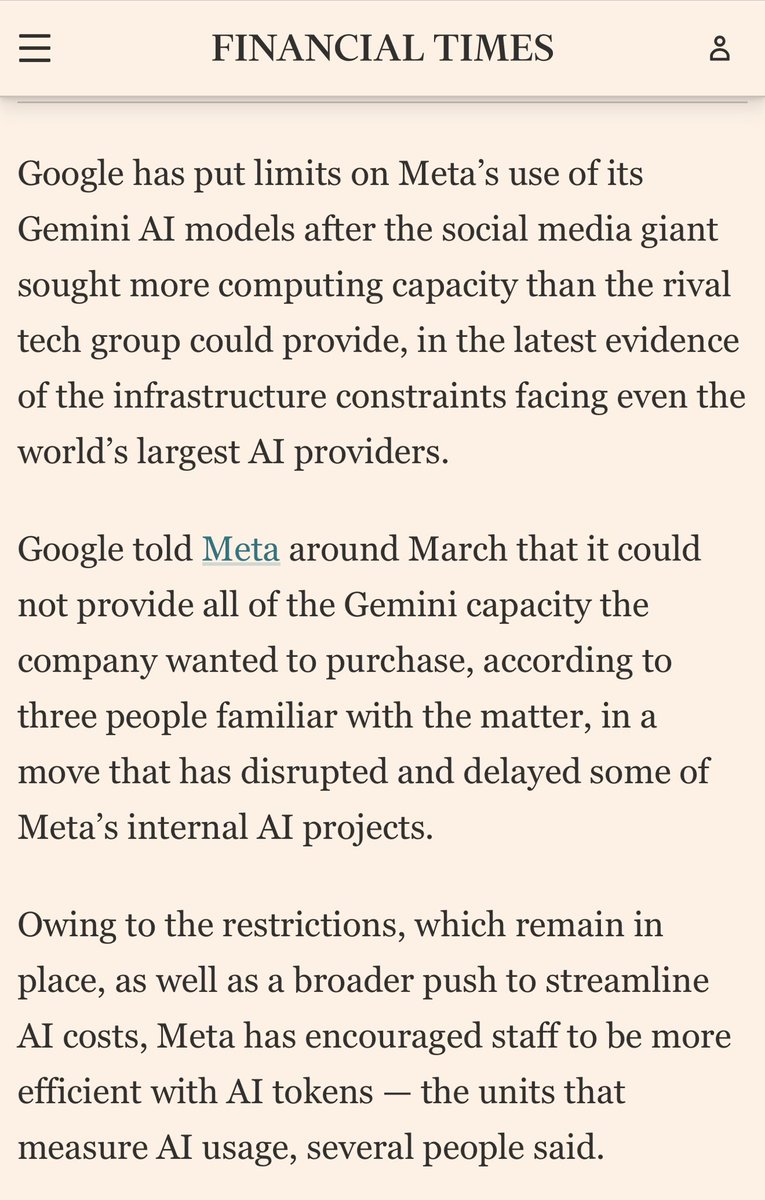
Google reportedly limited Meta’s use of Gemini due to a shortage of compute resources. — FT Google is in a position where it can’t sell Gemini to Meta as freely as it might want to. Compute remains power, and the scarcest resource in AI.
Transformer’s Attention mechanism has come a long way. We’d like to thank the researchers and the engineers in the open-source community for continuing to make high-performance AI accessible. Please celebrate with us by sharing this post, tagging more contributors, and sharing anecdotes to complete the open history of Attention! (1/8)🧵

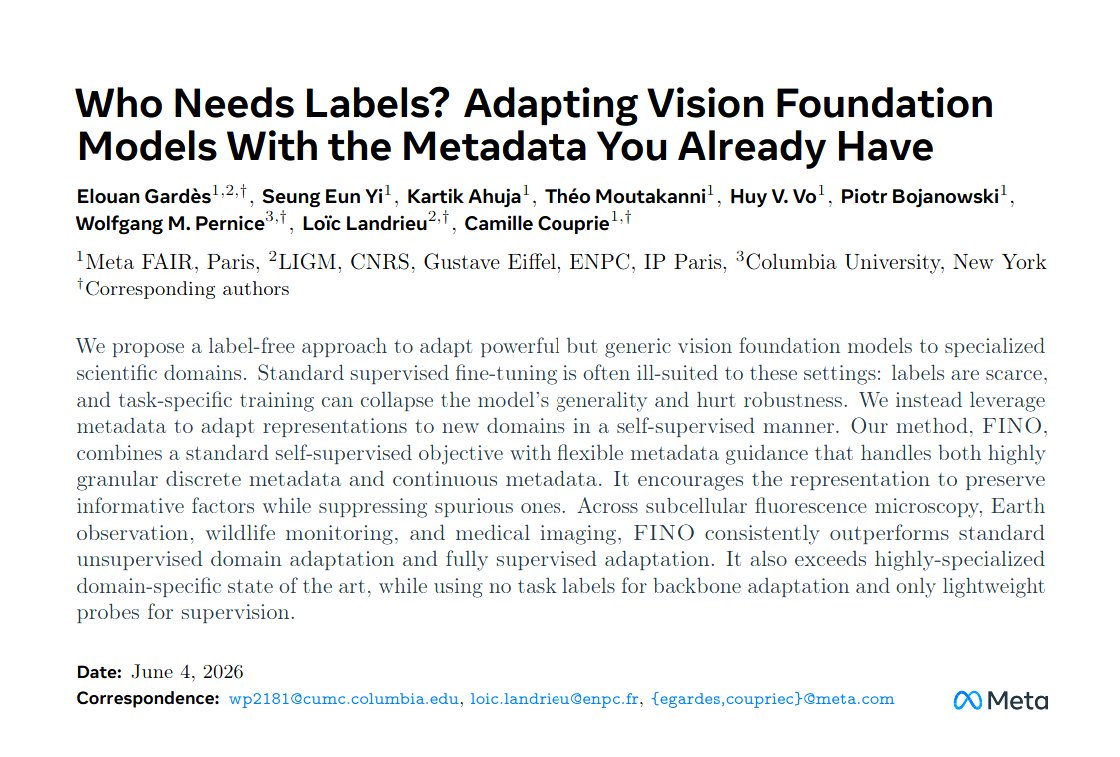
Consider a satellite image. If you have information about the location of the image, the time of day, etc. would you throw away that information or should you incorporate it into the training somewhere? Or what about an X-ray scan? If you have information about patient sex, scanner used, etc. perhaps these are things you want to teach the model to be invariant to. The current DINOv2/3 framework would throw away all of this metadata and treat every image exactly the same.
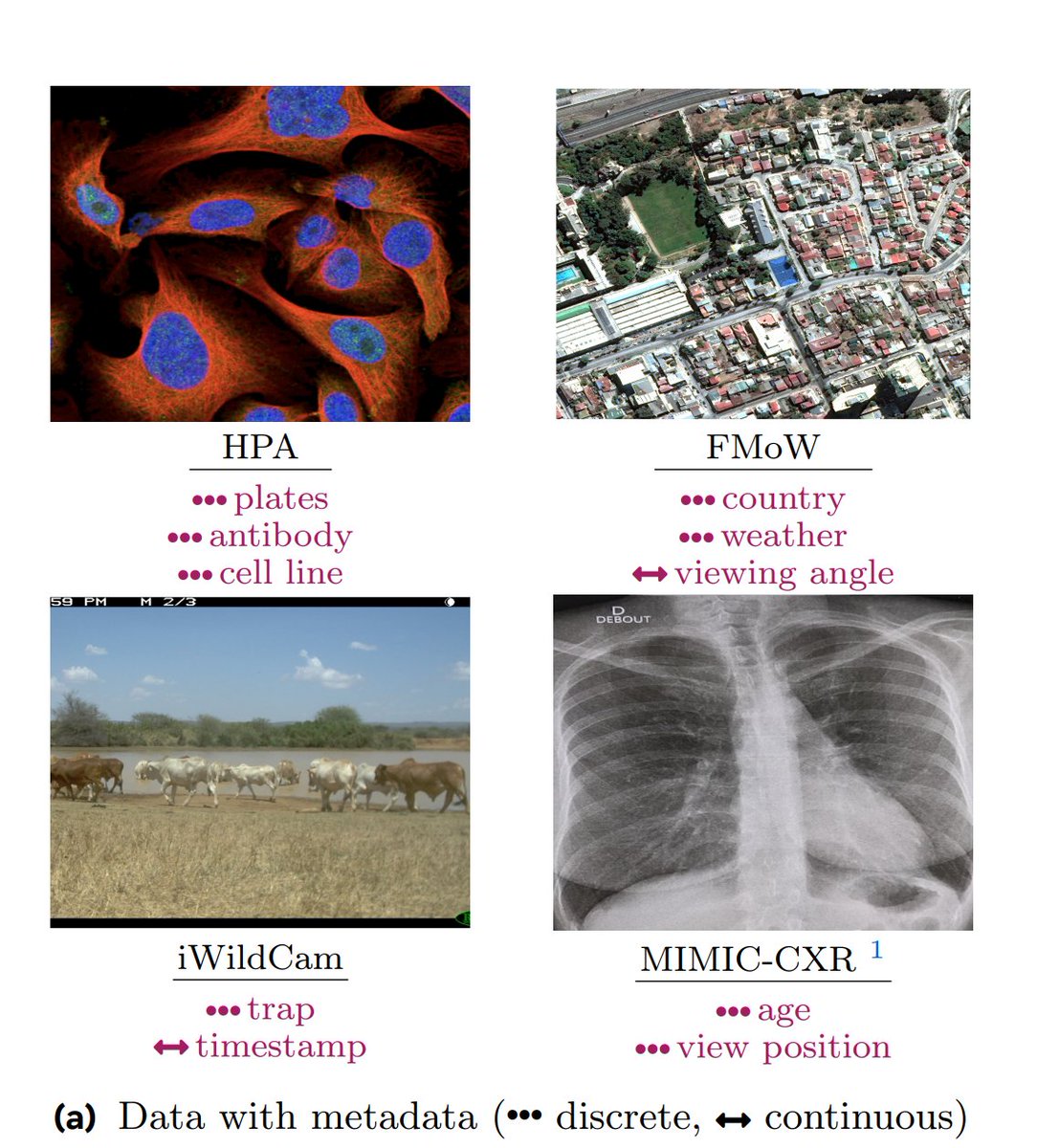
That's where the FINO framework comes in. The main innovation here is the incorporation of guidance with metadata you already have to better adapt the learned representations. The authors utilize two types of metadata to guide training: informative factors that should shape the representation (an antibody label in microscopy, geography in satellite imagery) are encouraged, while spurious factors that just reflect how the data was collected (the imaging plate, the sensor resolution) are actively suppressed via gradient reversal.
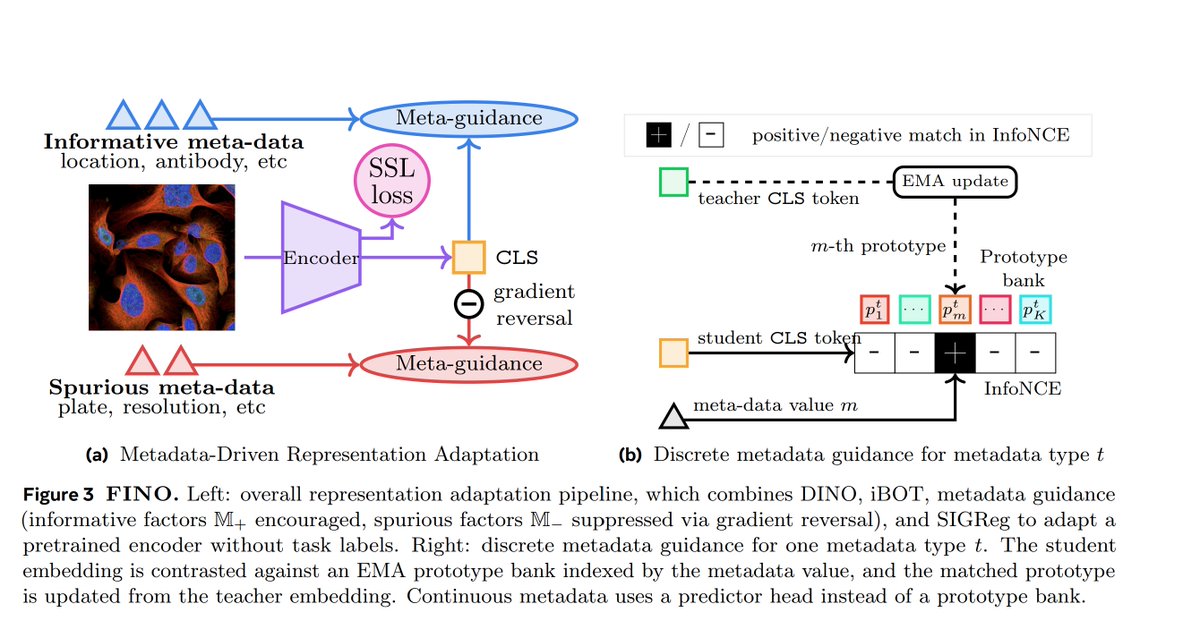
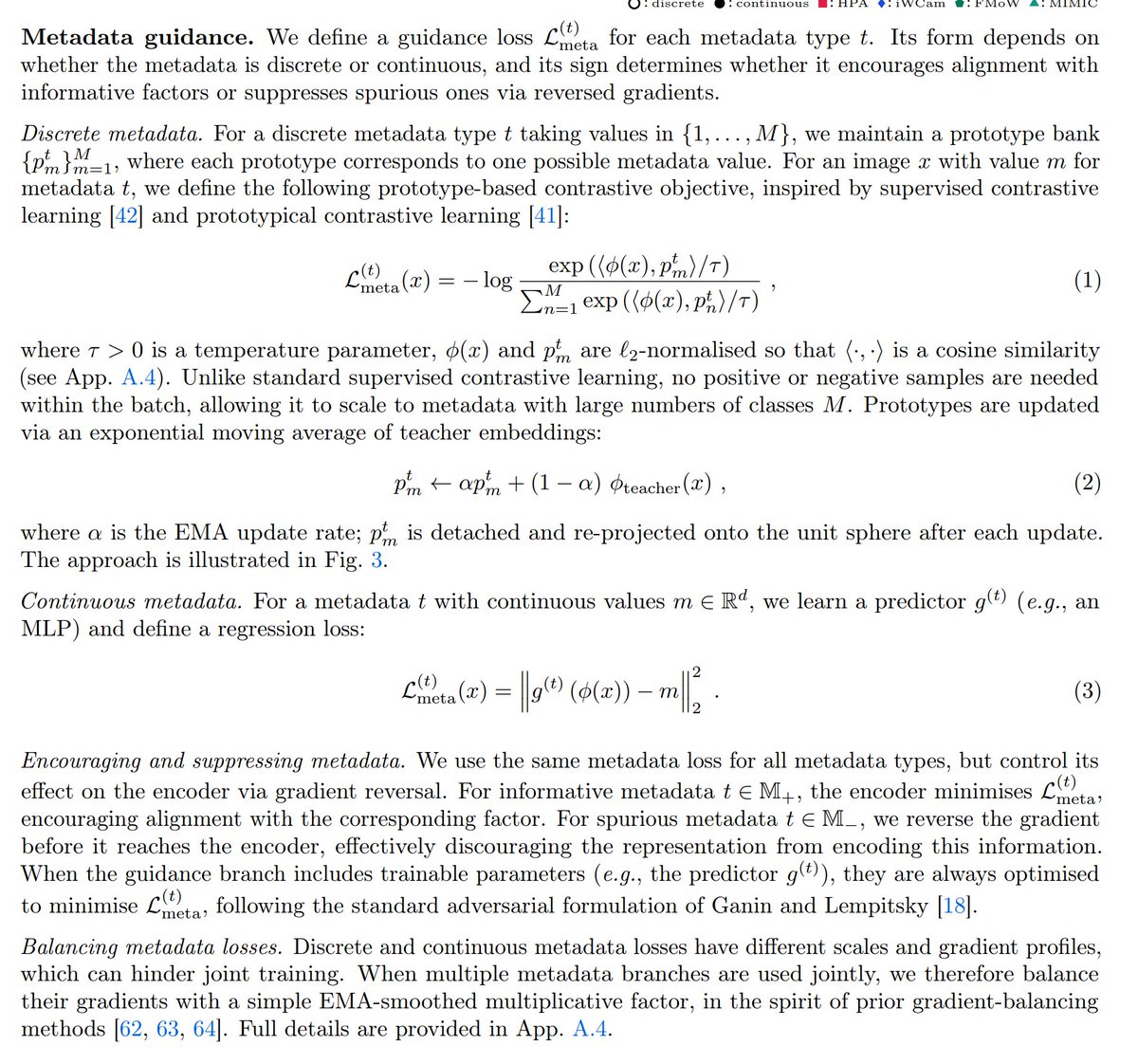
To handle discrete metadata with high cardinality (lots of categories), FINO uses a momentum-updated prototype bank for discrete factors. The loss used is a contrastive loss, inspired by supervised contrastive learning. For continuous metadata, the loss just regresses a small predictor head against the metadata target. Of course, no metadata is needed at inference, it is only used to guide learning.
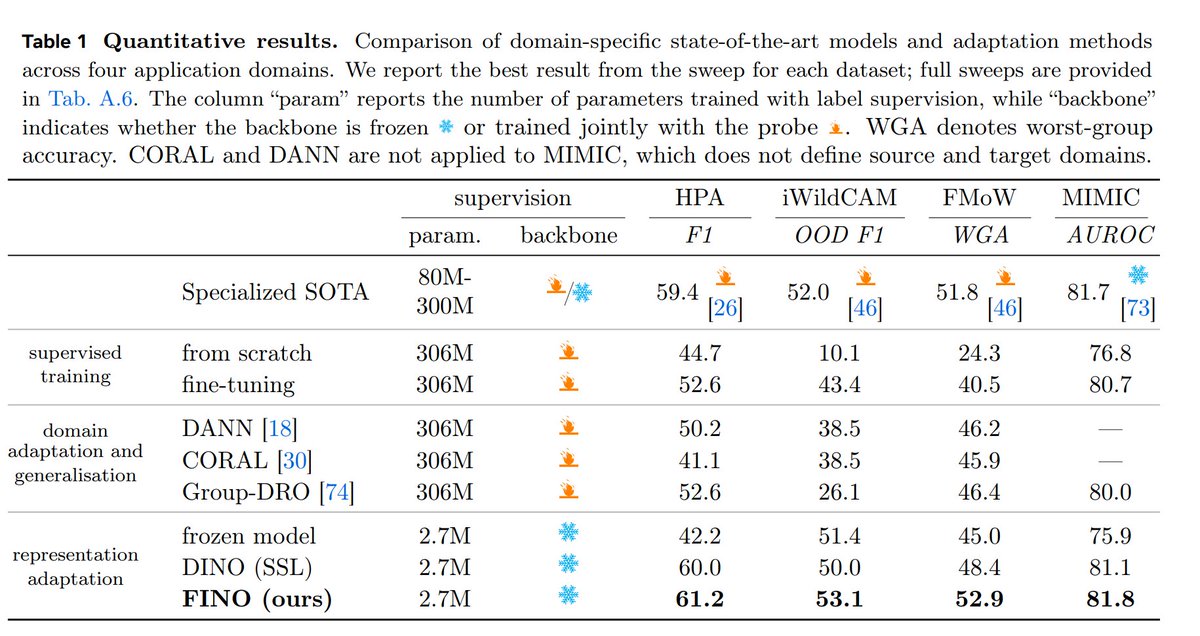
FINO was test across four different domains: protein-localization microscopy (HPA), Earth observation (FMoW), wildlife camera traps (iWildCam), and chest X-rays (MIMIC-CXR). In all cases, FINO beats both unsupervised domain adaptation and fully supervised fine-tuning, and even heavily engineered, domain-specific SOTA models. Just finetuning DINOv3 or even continually pretraining DINOv3 on the target dataset doesn't reliably give gains on performance but FINO does!
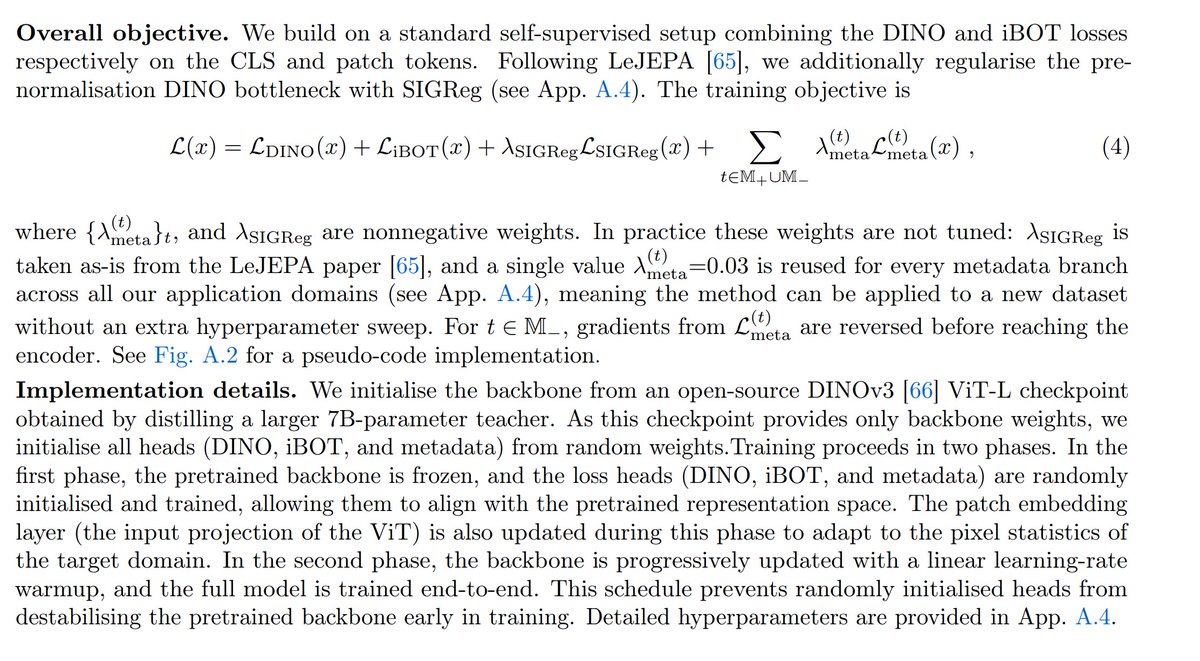
Another great aspect of the paper is a variety of practical DINOv3 domain adaptation tricks mentioned. For example, the use of SIGReg, or the use of a two-stage training pipeline. https://t.co/Tb2GVgy5M3
What's funny is this paper was released the day I tweeted this. I hope to continue to see more innovation in the SSL space! https://t.co/dkFOWlpbrE
I am genuinely frustrated by how poorly self-supervised learning for vision is researched and how underappreciated it is. Like how has DINOv2 been basically the best model for the past 3 years lol
This is one of the papers I'm quite excited about in the past few weeks. It's a very simple but practical modification to the DINOv3 training framework. Let me explain how it works. https://t.co/DERb8FjmbV
i started: https://t.co/LbB0srCALr
This is one of the papers I'm quite excited about in the past few weeks. It's a very simple but practical modification to the DINOv3 training framework. Let me explain how it works. https://t.co/DERb8FjmbV
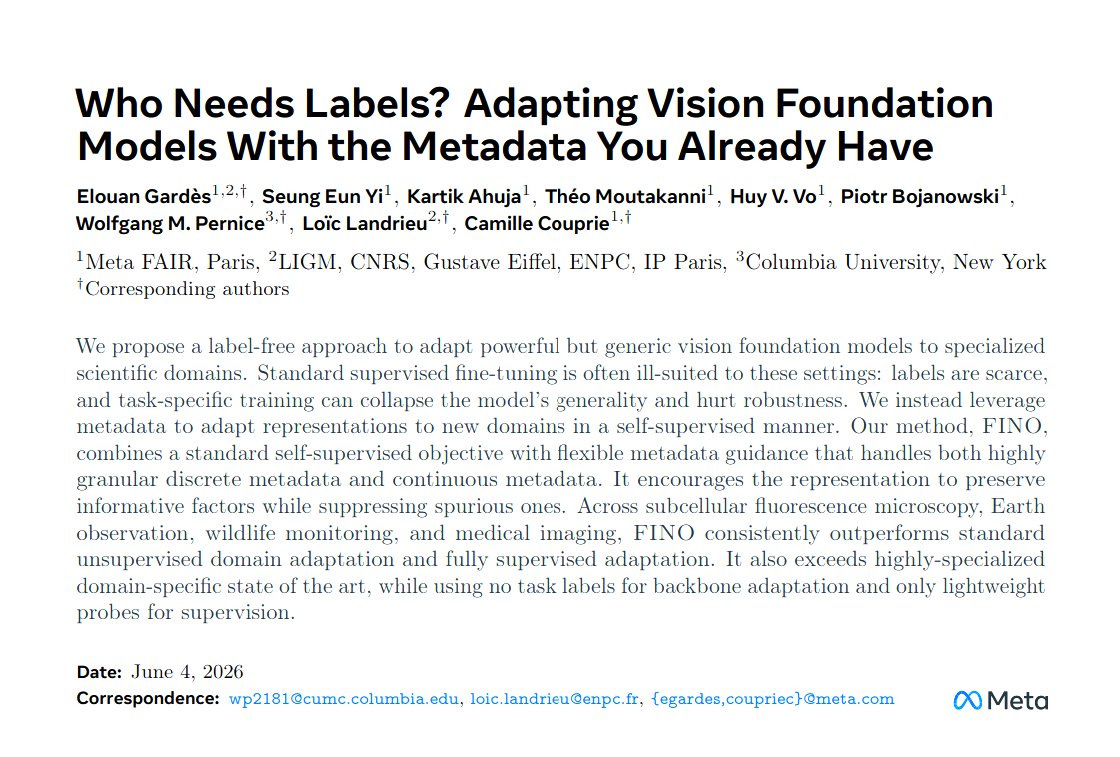
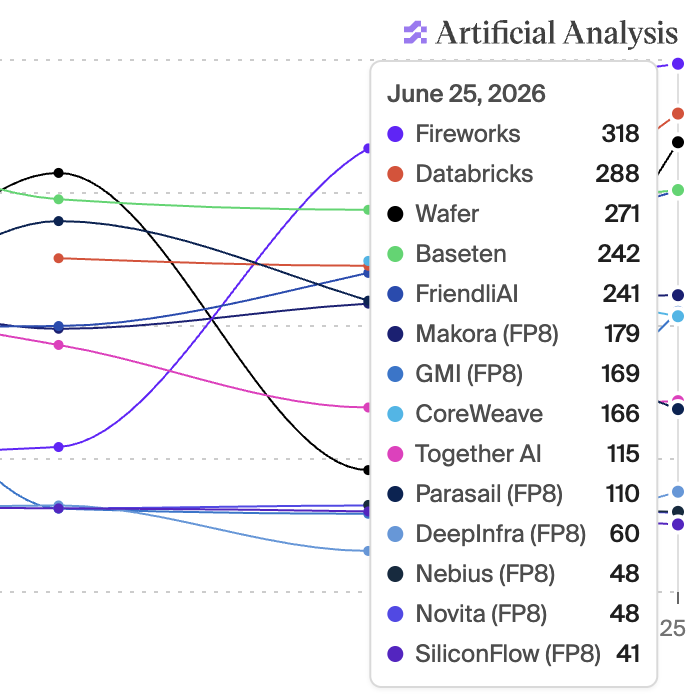
you may have heard that glm-5.2 at 280 token/s is cool, how about 318 and we still have room to go https://t.co/4g0dI6CEzd
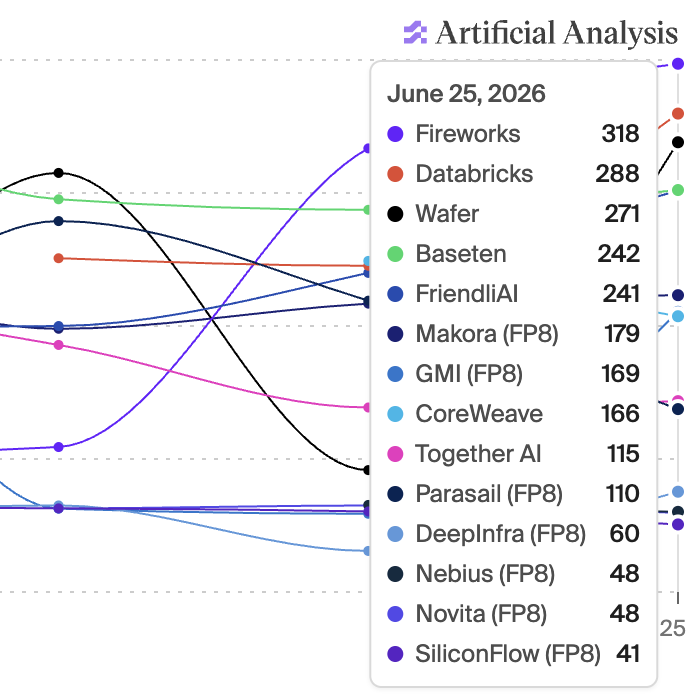
you may have heard that glm-5.2 at 280 token/s is cool, how about 318 and we still have room to go https://t.co/4g0dI6CEzd
@chrisalbon Nope mine is totes different :p https://t.co/DsSQH8DV45

We were on the ground with Europe’s most ambitious founders at VivaTech 2026. As a Founding Partner, AWS was proud to be at the heart of it. Founders got the full experience. Cloud sovereignty. AI security. Scaling and shipping agents. https://t.co/IfLjIDXnN5
.@SnorkelAI helps organizations leverage their own data and expertise to build high-quality, specialized AI systems orders of magnitude faster than fully manual approaches. The company drives value in partnership with AWS and @nvidia to help their customers. Available in AWS Marketplace, Snorkel’s AI Data Development platform enables enterprises to turn their proprietary data and domain knowledge into expert evaluation and training data, with options for in house data development or white glove dataset delivery.
Empowering businesses to seamlessly transition from AI pilots to production, @h2oai deploys models securely on their own infrastructure. With a single click, customers can connect to LLMs on Amazon Bedrock and leverage H2O's Enterprise LLM Studio for fine-tuning models (large and small) on proprietary data. Synthetic data generators from @nvidia, combined with TAL and NIMS frameworks, allow organizations to move rapidly from demos to production environments.
there's something so beautiful about a world-class chess player casually mentioning things like hermes, agentic engineering, gstack etc. thanks for carrying us through the pandemic VD, so happy to see you tinkering with tech and exploring different things @viditchess https://t.co/JZoTt6nQd2
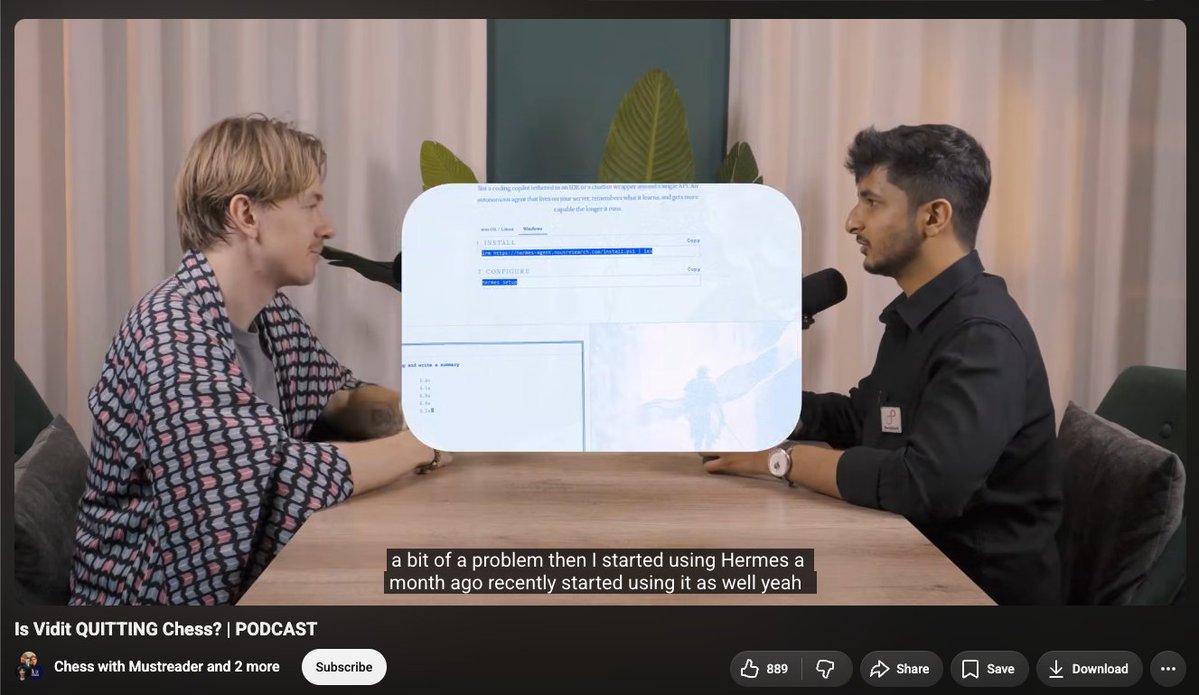
@jkneifoff @UltraLinx @Anti_PC_Man Yes (mac was first we just added windows and linux as well): https://t.co/Z1oynoX2wZ
Hermes Agent now supports computer use via @trycua on Windows and Linux in addition to existing macOS support https://t.co/62BdC5QdhL

@sousaopaulino https://t.co/b4NzXI7Iwm
Me every time AI is down or tokens run out.💀 https://t.co/uDJ9OoMnjU

@Lc_Queirozz https://t.co/b4NzXI7Iwm
Me every time AI is down or tokens run out.💀 https://t.co/uDJ9OoMnjU

@McConaughey https://t.co/b4NzXI7Iwm
Me every time AI is down or tokens run out.💀 https://t.co/uDJ9OoMnjU