Your curated collection of saved posts and media
Time-lapse of a Scarlet Pimpernel flower opening - makes me happy to look over from my desk and see these little flowers doing their thing 😀😀 https://t.co/uUEuvxvhok
Here, a neural cellular automata has learned to guess what is being (badly) drawn - watch how the correct consensus prediction emerges over time. Each pixel 'cell' can only see its neighbors, and each runs the same simple NN. https://t.co/OYx2MElsiE
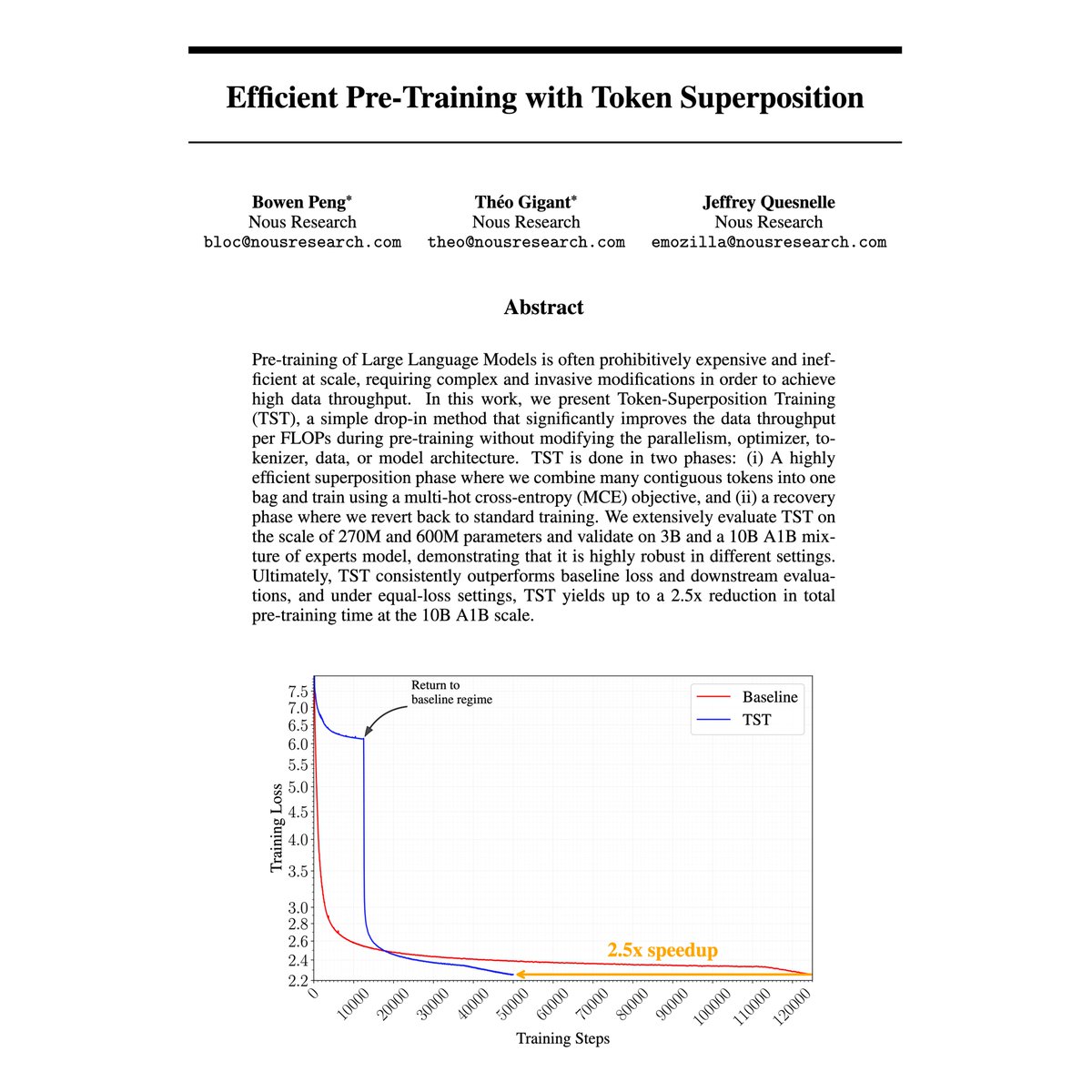
Today we release Token Superposition Training (TST), a modification to the standard LLM pretraining loop that produces a 2-3× wall-clock speedup at matched FLOPs without changing the model architecture, optimizer, tokenizer, or training data. During the first third of training, the model reads and predicts contiguous bags of tokens, averaging their embeddings on the input side and predicting the next bag with a modified cross-entropy on the output side. For the remainder of the run, it trains normally on next-token prediction. The inference-time model is identical to one produced by conventional pretraining. Validated at 270M, 600M, and 3B dense scales, and at 10B-A1B MoE. The work on TST was led by @bloc97_, @gigant_theo, and @theemozilla.
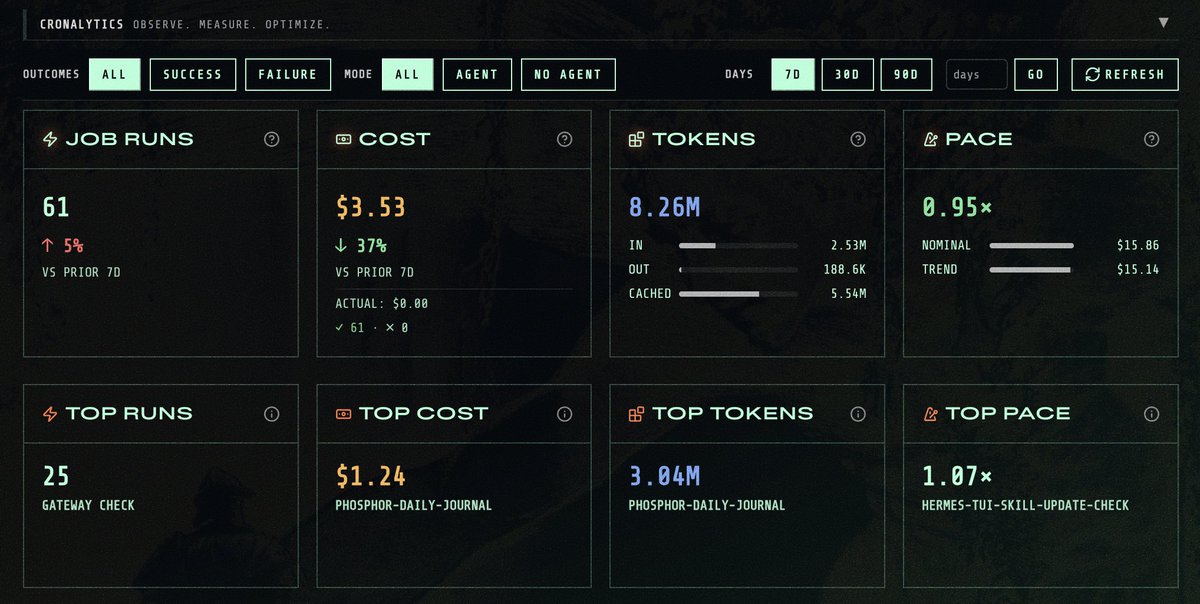
Do you know which of your Hermes cron jobs are consuming your cost and token budget? Observe. Measure. Optimize. Repo in thread 👇 https://t.co/eVbXfEKkZt
PyTorch 2.12 introduces major updates across compilation, export, distributed training, and accelerator support. Highlights include up to 100x faster batched linalg.eigh on CUDA, the new torch.accelerator.Graph API, Microscaling quantization support in torch .export.save, and fused Adagrad. The release includes 2,926 commits from 457 contributors since PyTorch 2.11. Have questions? Join @AndreyTalman (@Meta), @albanDesmaison (@Meta), and @joespeez (@reflection_ai), moderated by @Chris_AI_HPC (@Meta), on May 20 at 10:00 AM PT for a live Q&A covering the release and answering questions from the community. 🔗 Read the release blog and register for the webinar: https://t.co/lSkHPD3FQR #PyTorch #OpenSourceAI #MachineLearning #AIInfrastructure
Poolside is hosting a 2-day model research hackathon in London. Join us to push an open-weight agent model as far as you can. RL and fine-tune Laguna XS.2, our latest-generation model, on Prime Intellect Lab. Dates: May 29–30 Partners: @nvidia + @PrimeIntellect + @huggingface Prize: NVIDIA DGX Spark Agents need better models. Better models need cracked researchers. Link below.
Founders building outside of NYC or SF: https://t.co/0vNLYmWXt6

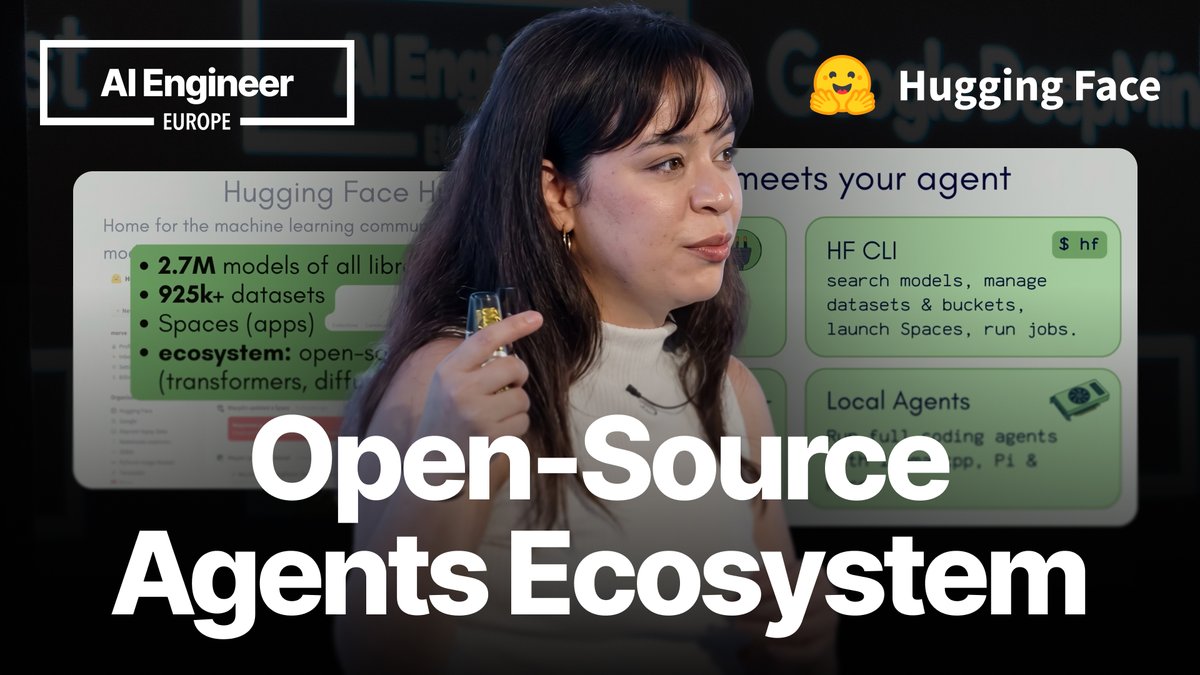
Your Agent Can Now Train Models The argument from @mervenoyann: open source models have caught up. GLM 5.1 is leading the Artificial Analysis intelligence index over closed models, and the gap is closing with every release cycle. Weight access means you can quantize, fine tune, and deploy to edge devices without data leaving your infrastructure. https://t.co/kQvBd0uHuk The talk covers the Hugging Face ecosystem built for agentic work: inference providers with tool use routing, benchmark datasets for filtering by SWE bench scores on Hub, a traces repository type for storing agent sessions, and skills that plug into coding agents. The closer is a live demo: she asks Claude Code to fine tune a vision language model on a dataset by name. The agent calculates VRAM requirements, picks an instance, and kicks off the job. What used to be a day of napkin math is now a prompt.
Want to (officially) use Codex at work? Send this post to your CTO to bring your team to Codex. Eligible enterprise customers who switch in the next 30 days get 2 free months of Codex usage for new users. https://t.co/38e8y7MAmg
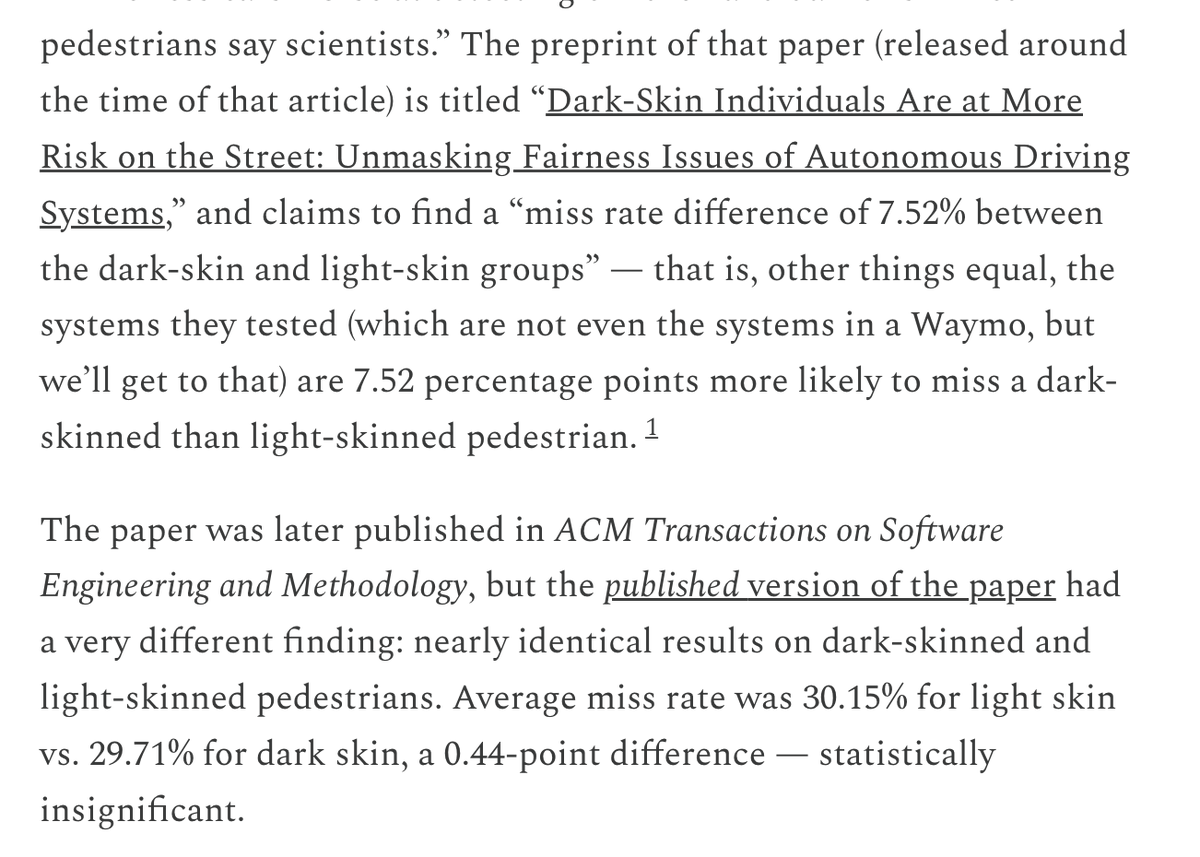
Are autonomous vehicles (self-driving cars) “less able to detect people of color”? That’s what I read in The Atlantic this weekend, in Xochitl Gonzalez’s “People Who Don’t Like People Are Making All of Our Decisions.” It appears to be entirely false. https://t.co/13etEOghUG
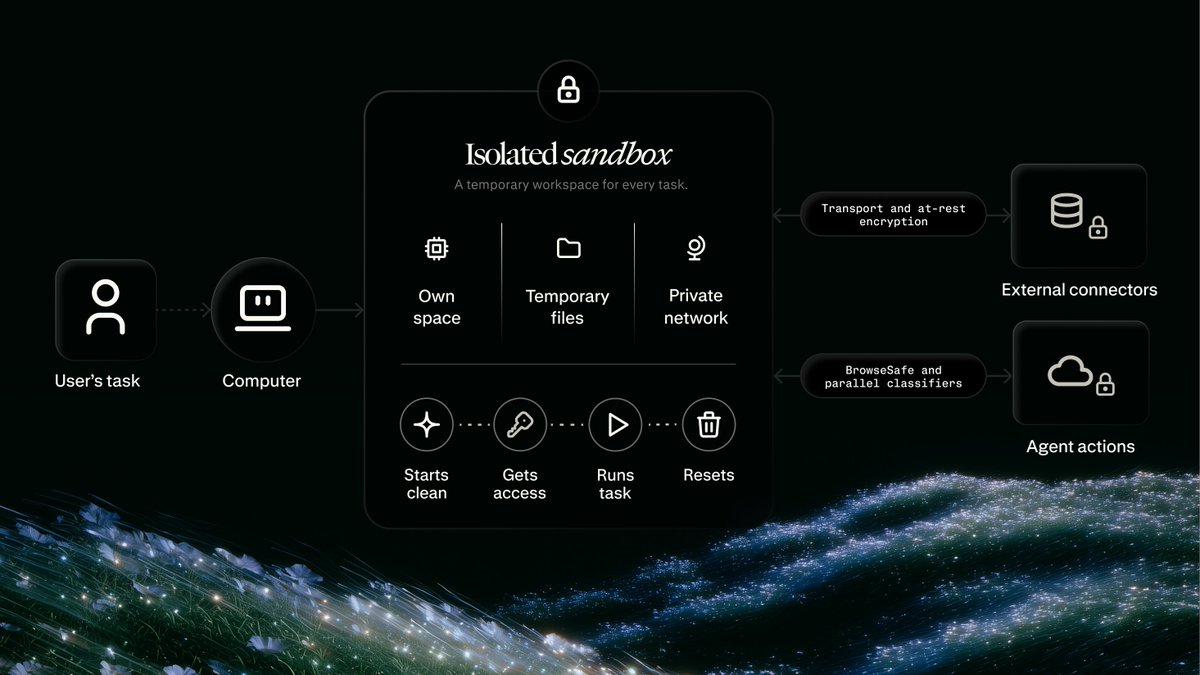
Computer is secure by default. Every task runs in its own hardware-isolated sandbox with VPC-level storage and compute separation. Agents are authenticated with short-lived proxy tokens instead of raw API keys. https://t.co/ohIjY3dboB
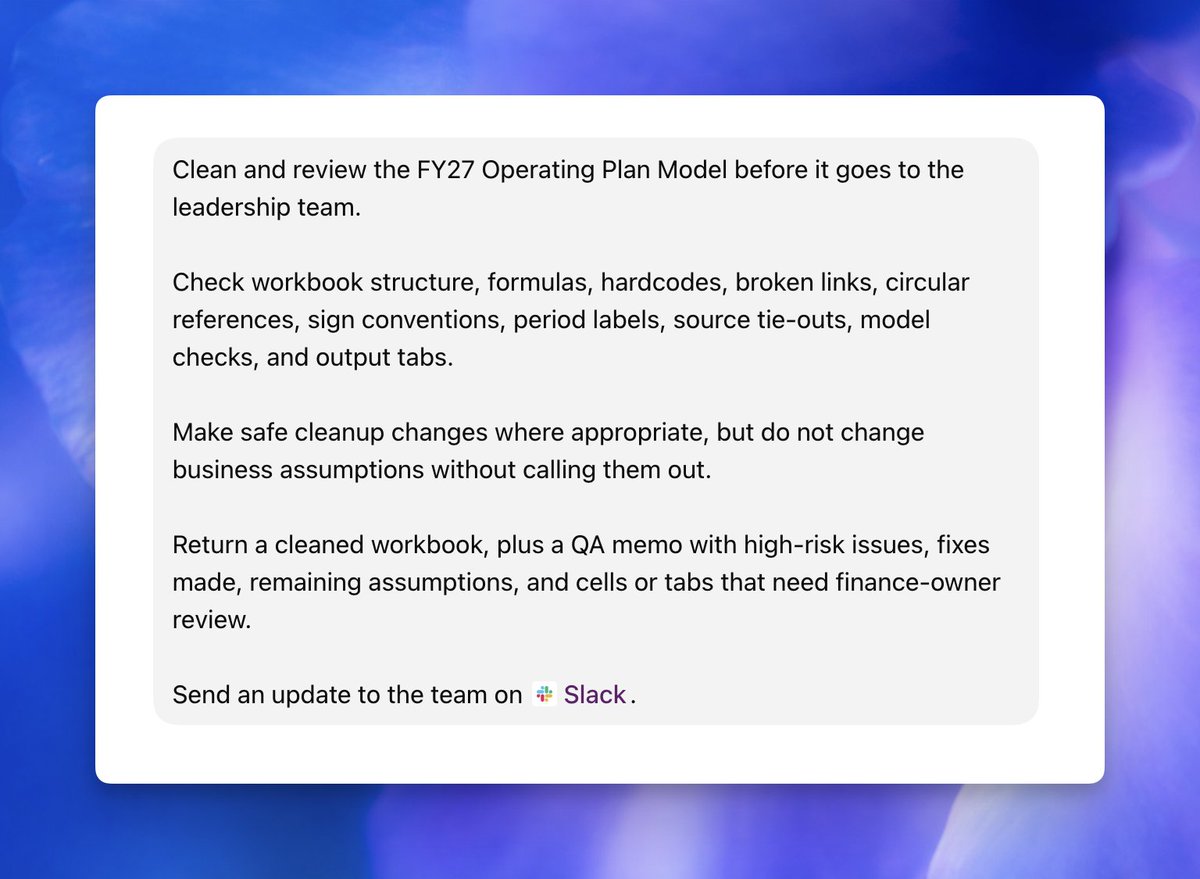
Codex isn’t just for software teams. Our CFO Sarah Friar and her team at OpenAI are big power users. A useful finance workflow: have it review an operating plan model before it goes to leadership. We've started posting some starter use cases here: https://t.co/1HMhutj7xL https://t.co/bRVkCgOZD5
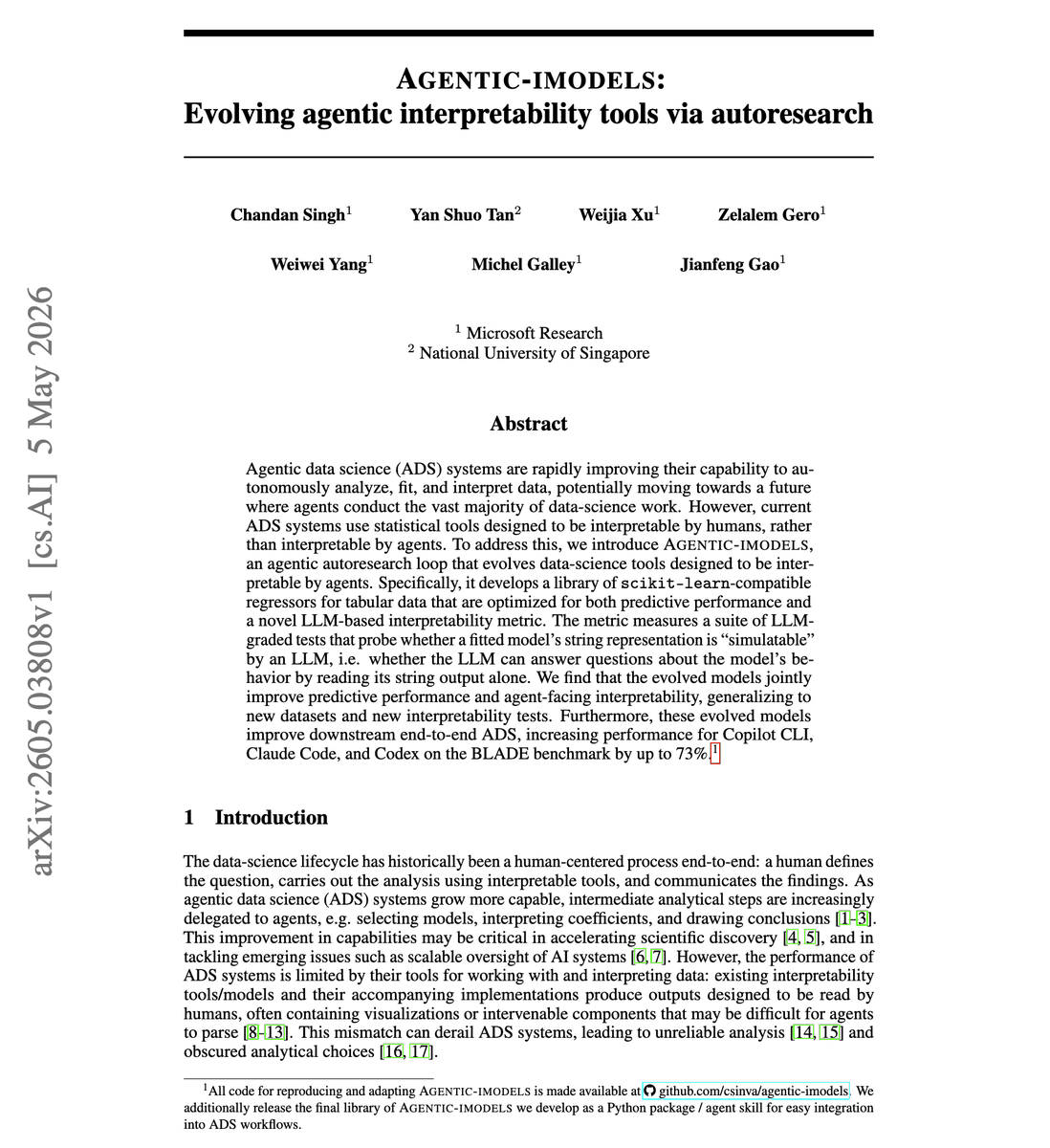
NEW paper from Microsoft Research. (bookmark it) The entire interpretability literature is built around human readers. As more analysis gets delegated to agents, the right target of interpretability shifts. This paper is a recipe for designing tools that agents can actually reason about. They introduce Agentic-imodels, an autoresearch loop where a coding agent (Claude Code, Codex) iteratively evolves scikit-learn-compatible regressors that are simultaneously accurate AND readable by other LLMs. Interpretability is measured by whether a small LLM can simulate the fitted model's behavior just by reading its string representation. Predictions, feature effects, counterfactuals, all from the __str__ output alone. Run on 65 tabular datasets, the discovered models push the Pareto frontier past every classical interpretable baseline (decision trees, GAMs, sparse linear), and improve four downstream agentic data science systems on the BLADE benchmark by 8% to 73%. Paper: https://t.co/rgMdEz5XEj Learn to build effective AI agents in our academy: https://t.co/LRnpZN7L4c
Hacker News → LLM Artifact I built the most personalized HN feed. It only tracks topics I do research around based on memory and LLM wiki. No point in storing bookmarks. With a few automations, rules, skills, and proactive agents, you can make the feed whatever you want. https://t.co/iZ0TIEnyiU
@omarsar0 Join our upcoming live session to learn how to build these: https://t.co/qCcEAnEbyQ
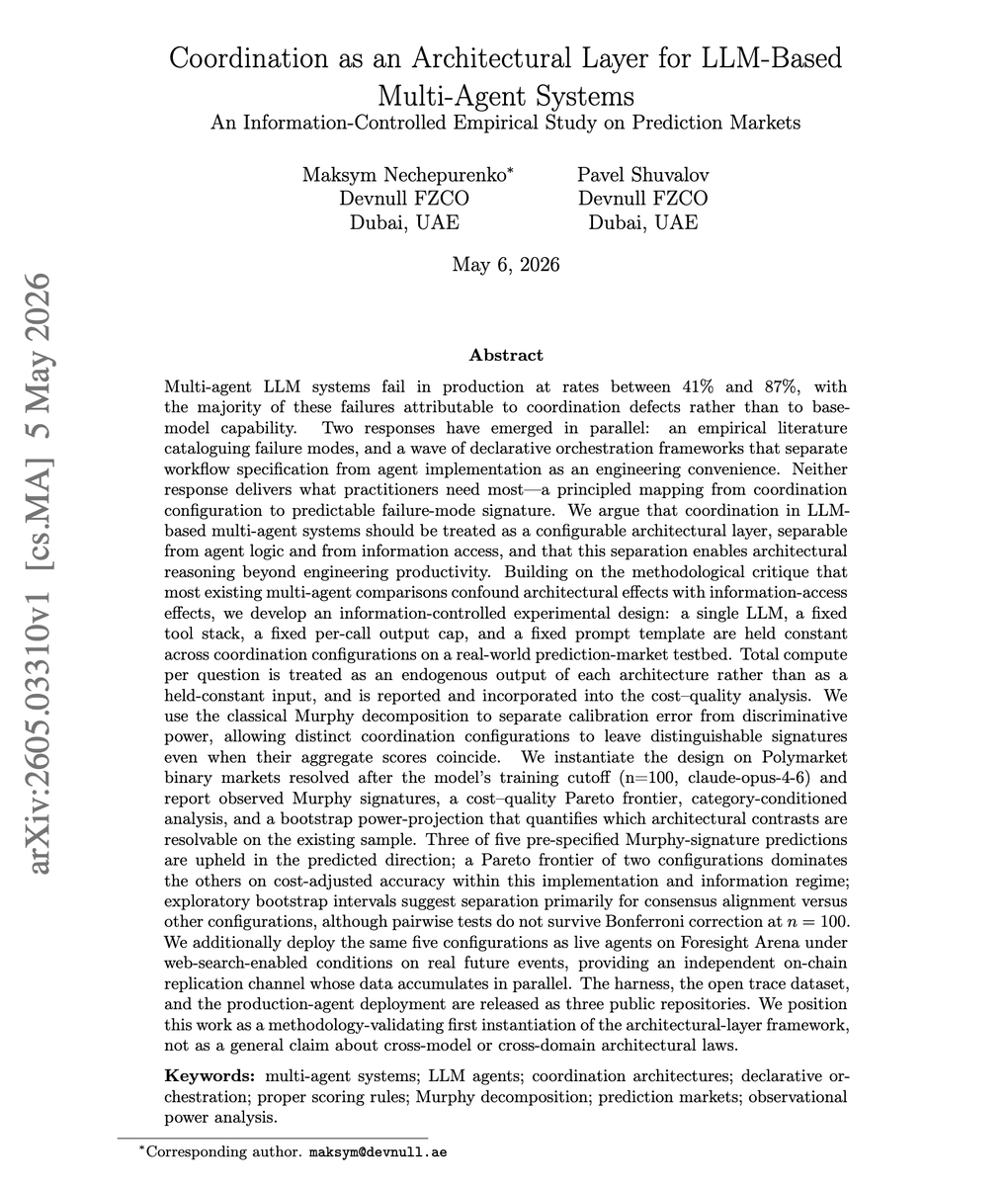
Pay attention to this one if you build multi-agent systems. Coordination is as important as prompts or agent architecture. Multi-agent LLM systems fail in production at rates between 41% and 87%. The majority of those failures are coordination defects, not base-model capability. Most published comparisons of multi-agent architectures can't even tell you whether the gain came from coordination or from one configuration just having larger context windows. This new research argues that coordination should be treated as a configurable architectural layer, separable from agent logic and from information access. Then it backs the position with an information-controlled experiment: same LLM, same tools, same prompt template, same per-call output cap. The only thing that varies is coordination structure. Why it matters: until you control for information access, "multi-agent beats single-agent" doesn't actually mean coordination won. This paper gives you a cleaner methodology for actually testing it, and a vocabulary for reasoning about coordination as architecture instead of plumbing. Paper: https://t.co/8m0P8kCQ2a Learn to build effective AI agents in our academy: https://t.co/LRnpZN7L4c
I will doing a live session for how to build something like this here: https://t.co/UljFfAEBJA
I will doing a live session for how to build something like this here: https://t.co/UljFfAEBJA
LLM Wikis + HTML Artifacts are insanely powerful. You should seriously consider this in your workflows. LLM Wikis captures all the important information that lets you and your agents do meaningful work. HTML artifacts present that information in interesting ways that allow you to take important actions along with your agents. My HTML artifacts sit on top of my LLM wikis. They are dynamic and are easily extended as needs arise. I have hooked my Artifacts to talk to my agents, and similarly, the agents can talk to artifacts. This has allowed me to build powerful artifacts that reduce my inbox to zero, keep me updated on any topic of interest, fast prototyping, do deep research, design/trigger new experiments, generate figures to improve understanding, schedule research, search relevant information, discover topics, and so much more. What you see in the clip is not a website. It's a simple interactive HTML artifact. HTML artifacts are useful for designers, engineers, researchers, students, and anyone working with agents. Lastly, HTML doesn't replace Markdown. They are a much better combination working together.
For those interested, I will be doing a live session on this topic soon: https://t.co/UljFfAEBJA Sign up if you are interested in some of the tools we are releasing soon to get you building with all these ideas.
For those interested, I will be doing a live session on this topic soon: https://t.co/UljFfAEBJA Sign up if you are interested in some of the tools we are releasing soon to get you building with all these ideas.
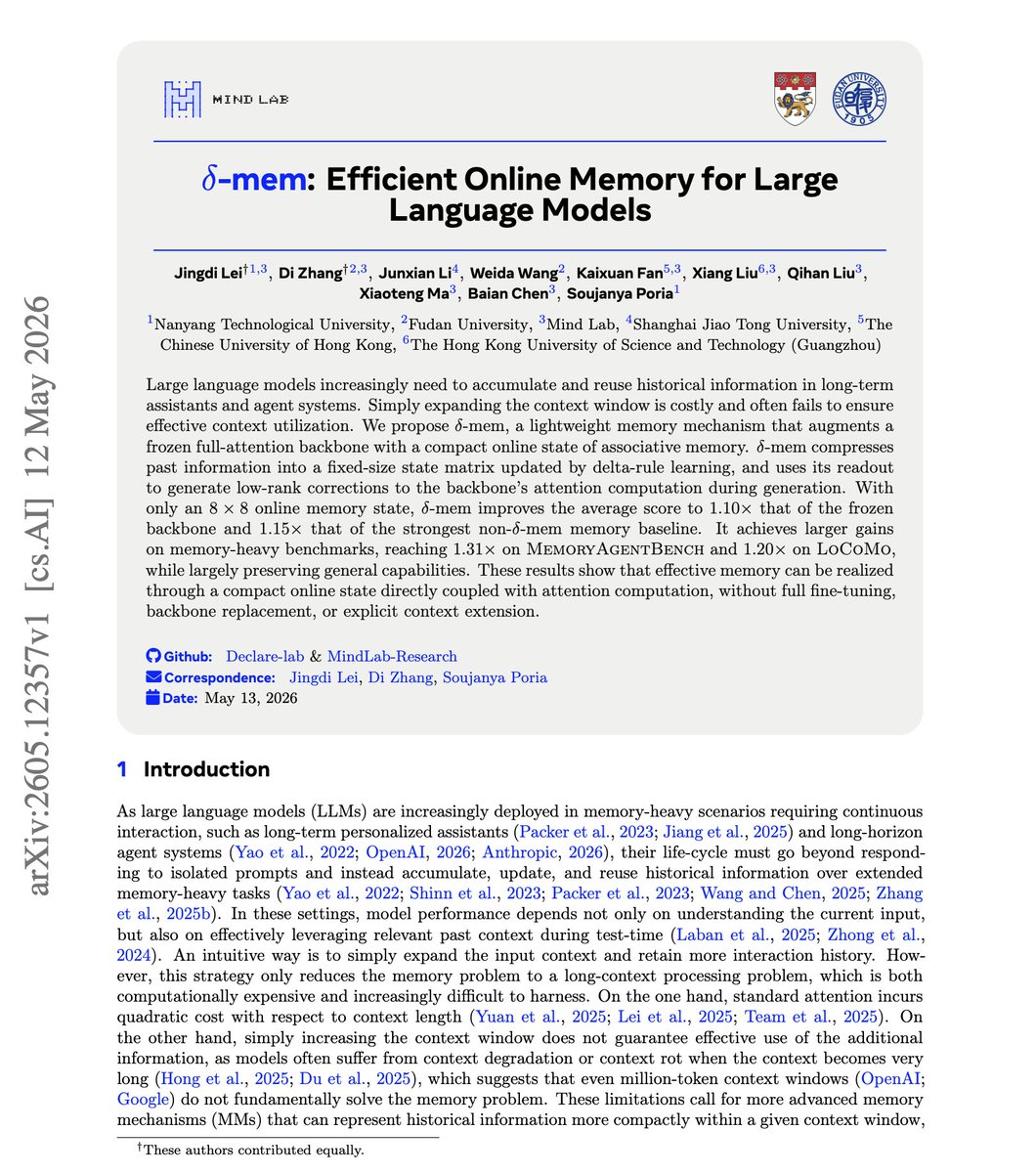
// δ-mem: Efficient Online Memory for LLMs // One of the more elegant memory mechanisms I've seen this month. Most long-term memory work either inflates context or retrains the model. This paper shows a tiny external state, coupled directly into the attention computation, can do the work that bigger context windows fail at. It's cheap, modular, and frozen-model friendly. There is no fine-tuning, no backbone swap, and no context extension. δ-mem augments a frozen full-attention model with a compact online associative-memory state. The state is a fixed-size matrix updated by delta-rule learning, and its readout produces low-rank corrections to the backbone's attention during generation. Results: An 8×8 online memory state is enough to lift the frozen backbone's average score by 1.10x and beat the strongest non-δ-mem memory baseline by 1.15x. On memory-heavy benchmarks the gap widens (1.31x on MemoryAgentBench, 1.20x on LoCoMo) while general capabilities are largely preserved. Paper: https://t.co/peVmZ9reue Learn to build effective AI agents in our academy: https://t.co/LRnpZN7L4c
Jules works with the lid closed. Join the waitlist for the new Jules today. Link in comments. https://t.co/03JGBMxsyB
Jules works with the lid closed. Join the waitlist for the new Jules today. Link in comments. https://t.co/03JGBMxsyB
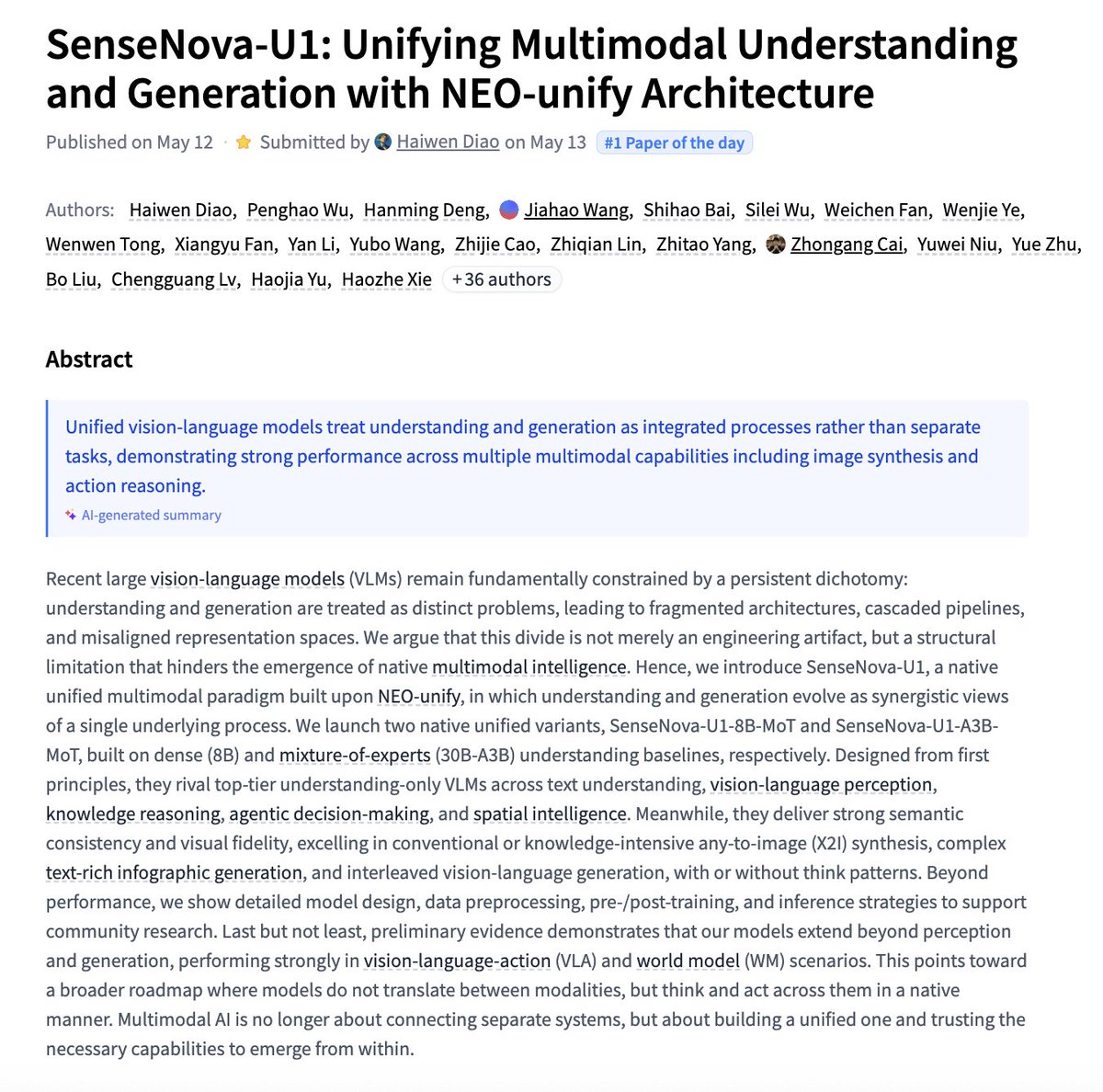
SenseNova-U1 Unifying Multimodal Understanding and Generation with NEO-unify Architecture https://t.co/wAosQlWjKd
New Voice AI Model from @resembleai's Research Team: Dramabox! 🎭 A Voice AI model SHOULD give you two things, an oscar-worthy performance and a verifiable signature to prove it's yours. DramaBox is the first model that does both. Open Source, available today! https://t.co/IA4u0nqm3i
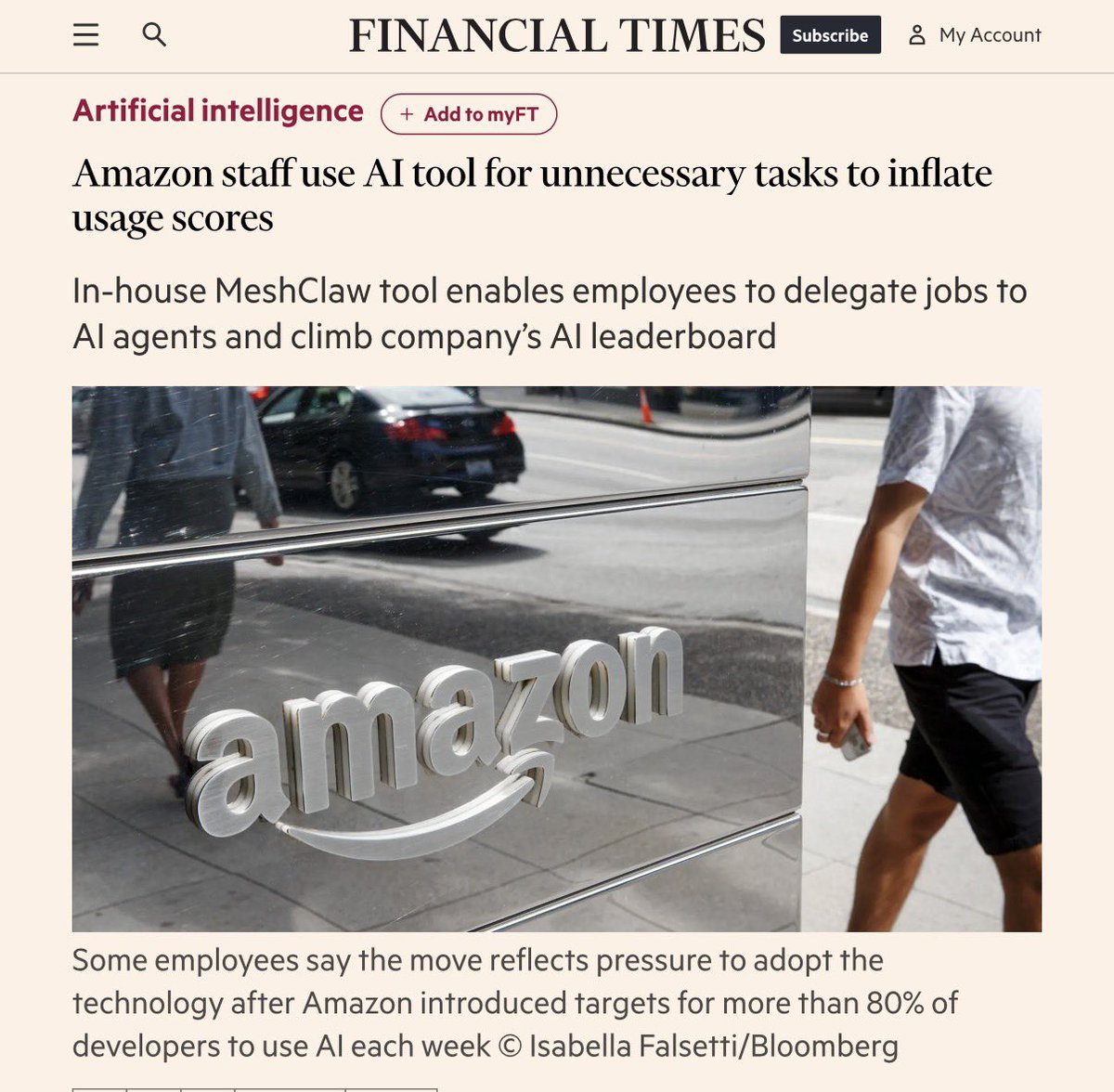
Wait, people are just burning tokens to look busy? https://t.co/K5sAXxeWKm
Introducing SWE-ZERO-12M-trajectories: the largest agentic trace dataset in the open, 5.7x larger than the previous largest. 112B tokens · 12M trajectories · 122K PRs · 3K repos · 16 languages https://t.co/aVqCc4J5tr
@macewan Lists: https://t.co/fasUz7PuHq News: https://t.co/kiuZ7QXLzb

HTML Artifacts are a big part of how I work with agents now. Artifacts can be more than just static files. When combined with agents, they can take action or help you take action. This unlocks all kinds of interesting ways to work with agents. This is clearly the future. Check out this writing and scheduler artifact I built in a few minutes. It uses a bit of HTML and JS. All the data is in markdown (Obsidian vaults), so the agent can access and modify it at any time. No DB needed. No sophisticated functionalities. The agent decides all that for me based on the skills, context, and memory it has access to. The best part about this simple stack is that all the important information stays with me. This has allowed me to build a recursive self-improving system and automations that can better tap into coding agents like Codex or Claude Code. I could have paid or built an entire app for scheduling posts, and there are so many of them out there. But I don't need to. I've realized a simple artifact does the job. And the simplicity of it is actually an advantage. Very little maintenance for very high returns on personalization, time, and efficiency. The other benefit of this is that I can add features as I please. That level of personalization feels magical, and we should all be pursuing more of it. All of this just keeps compounding. Of course, this example is just about writing. But I have similar artifacts for research, design, experimentation, evaluation, and so much more. And no, I didn't actually publish the post example I shared in the clip. It was just for demonstration purposes. I actually spend more time than this when writing together with agents. Lastly, having built my own agent orchestrator tool has made me realize that simplifying the tool stack is a superpower. If you are curious about how all this works, I will do a live session next week: https://t.co/AAkfLJHVmS
GitHub Copilot CLI now has a statusline feature! Here's how to set it up with Oh My Posh ❤️🔥 https://t.co/DpNR8Bjt7G
GitHub Copilot CLI now has a statusline feature! Here's how to set it up with Oh My Posh ❤️🔥 https://t.co/DpNR8Bjt7G