@dair_ai
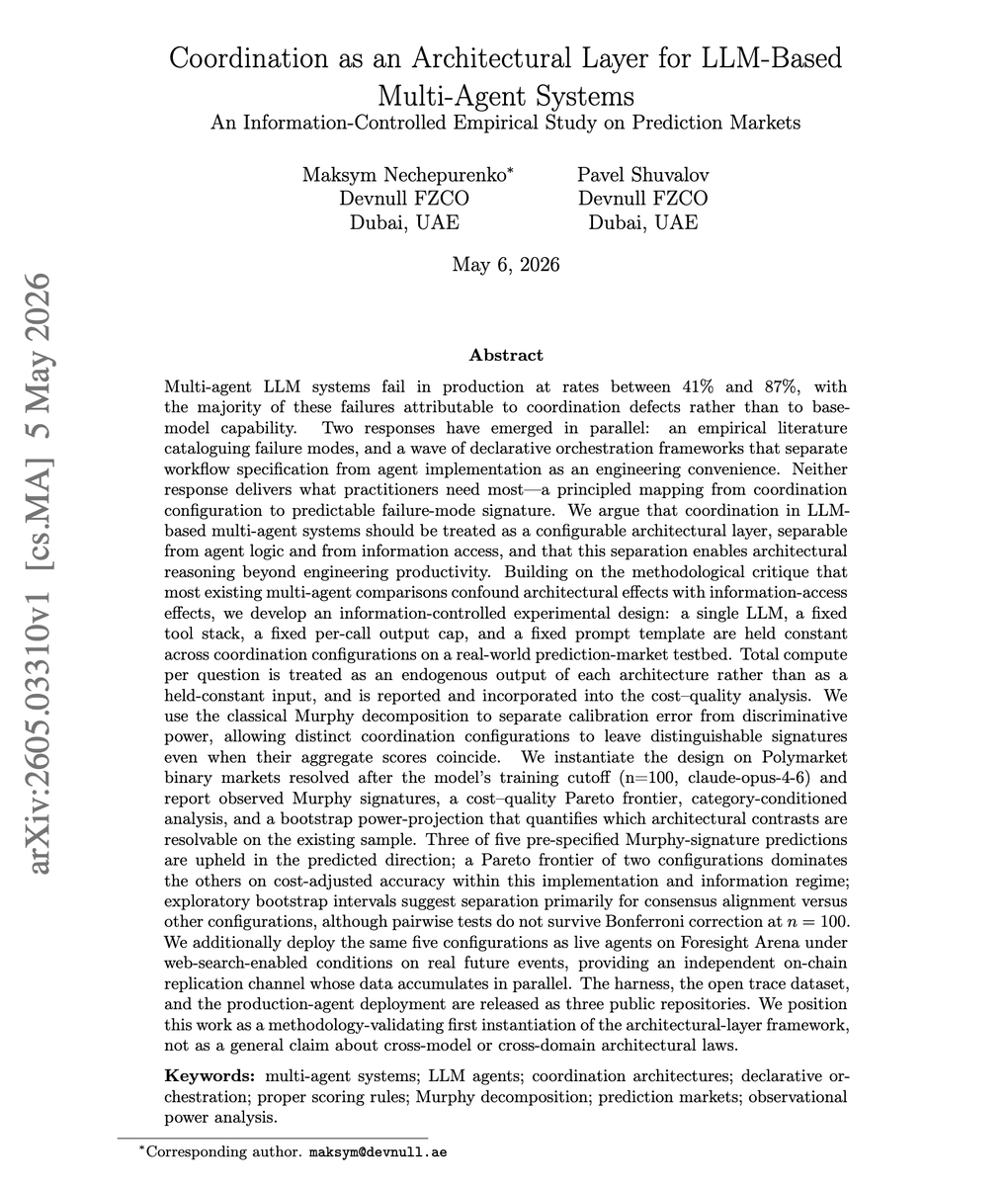
Pay attention to this one if you build multi-agent systems. Coordination is as important as prompts or agent architecture. Multi-agent LLM systems fail in production at rates between 41% and 87%. The majority of those failures are coordination defects, not base-model capability. Most published comparisons of multi-agent architectures can't even tell you whether the gain came from coordination or from one configuration just having larger context windows. This new research argues that coordination should be treated as a configurable architectural layer, separable from agent logic and from information access. Then it backs the position with an information-controlled experiment: same LLM, same tools, same prompt template, same per-call output cap. The only thing that varies is coordination structure. Why it matters: until you control for information access, "multi-agent beats single-agent" doesn't actually mean coordination won. This paper gives you a cleaner methodology for actually testing it, and a vocabulary for reasoning about coordination as architecture instead of plumbing. Paper: https://t.co/8m0P8kCQ2a Learn to build effective AI agents in our academy: https://t.co/LRnpZN7L4c