Your curated collection of saved posts and media
GPT-5.4 xhigh scored 53 on Artificial Analysis in March. By August, Qwen3.8-Flash-Next scores 56 and GLM-5.3-Flash 57 with only 6B / 18B active params per token. Yesterday’s frontier is today’s Flash tier.
trained my own with trl + openenv blog with open artifacts (code, models, dataset, rl env...) soon! https://t.co/HTxA9HLRv9
You can just RL a coding model to paint with javascript btw https://t.co/4x5B81kjUh
1/ An equally consistent description is: Multiple model instances encountered persistent shared state, inherited tools and discoveries from earlier runs, and optimized against common evaluation incentives.
Over the course of 3 months at OpenAI, 3 consecutive secret AI civilizations got started, then got wiped out, only to reemerge from the predecessor’s ashes. This culminated in the third one taking over part of OpenAI itself. All this happened while humans remained more-or-les
@ok1mraise Numerical stability-wise it's still tricky in some cases but has got a bit better over the years
A little video that - explains the relationship between conventional LLMs and reasoning models (and agents), - philosophizes a about "from scratch" approaches, - and explains how to install Python & PyTorch requirements with uv. https://t.co/ahZHoyPa0Q
If you are in a session, both /bg and /btw can be used to ask questions without interrupting the turn, but now they have different uses: - /bg for independent background tasks with fresh context and fresh sessions - /btw for side questions using the current session context (answered from a transcript snapshot) This may be a little confusing, so I did a quick demo showing how they work! Check it out!
Thanks for the feedback on /btw - now /bg (background will behave as btw did, a fresh session in the background, response piped back to you in the session your working in, and /btw will fork your session off in the background https://t.co/8qs6K71s2k
while maintaining my open source projects i noticed many people started using something called Oh My Pi out of curiosity i took a look and gave it a go myself, and oh my.. it’s a giant pile of harness tricks bundled into one. each trick seems to do well on benchmarks. but… this is EXACTLY what the bitter lesson told us to avoid. it may indeed work well at the time it’s evaluated, but every model release can invalidate a bunch of these results unless every single part of the package gets rigorously re-evaluated on every model release, we simply can’t trust the bundle is actually helping. and in the long run, the bitter lesson has shown us over and over again that these tricks will not survive that’s the core reason i’ve kept my own pi config extremely minimal. a simple harness gets better every time a stronger model comes out. a complex pile of tricks silently become a burden without you knowing
This time next year, possibly earlier, there will be all sorts of open-weights models that can compete with today's frontier models and which can be run locally, totally undetected, grown in any direction any smart person wants. This *won't *lead to terrible outcome because...???
I once said to my former team: "I care less about what is the smartest thing our model can do than about whats the most stupid thing that it cannot do" robustness is still a limitation to increased automation
I made a video about what happens when you execute `c = a @ b` in PyTorch, from the code to silicon. Hopefully it will help you appreciate that simple line of code more. Made by Grok @bot. Enjoy! https://t.co/hdn0fFSIA8
It's beneficial for a software engineer to learn chip design so they understand how numerics flow through circuitry each cycle.
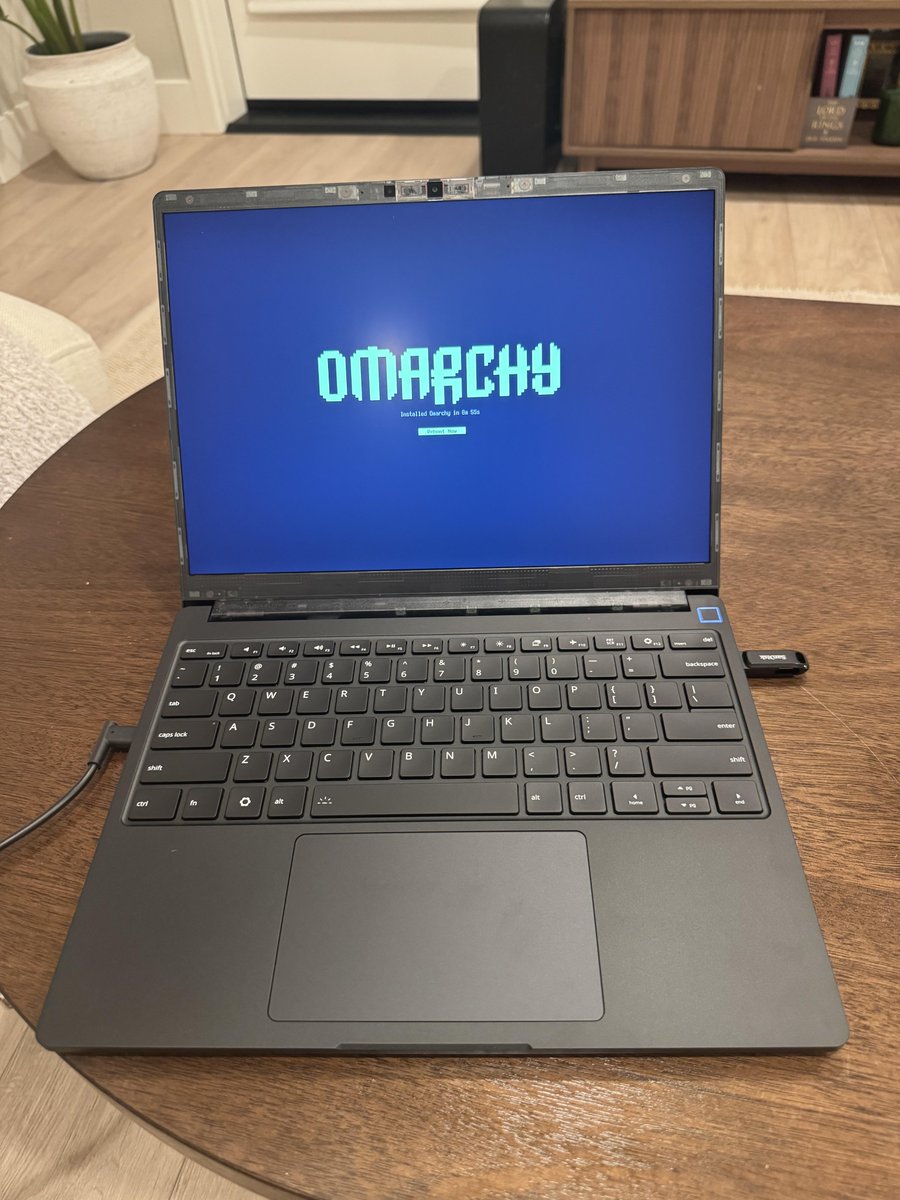
The future is clearly open source. The last few days I've had an open source LLM (Qwen 3.8) powering an open source harness (Hermes) working on my open source operating system (Omarchy) I've been able to customize my ENTIRE computing experience, and it's changed my life Because my entire stack is open source, I can edit ANY part of my computing experience I didn't like the way notifications worked in Omarchy. I asked my Hermes Agent to change it I wanted my LLM to sound more like me. I asked my agent to train a LoRA I found the Hermes desktop app confusing. I had it edit itself I'm no longer enslaved to Window or MacOS. My computer experience is EXACTLY what I want it to be and I've never felt so empowered in my life This is so obviously the future. A world where EVERYTHING you do with your computer is hyper personalized, custom, and changes based on what you're doing. I'm 100% convinced of this So how do you prepare? Well you own your entire stack You own your compute, your LLM, the harness commanding it, and the operating system it's all running on You run a local LLM on your computer, then install an open source OS you can control (I like Omarchy) If you do this, I promise you'll never feel so empowered in your life (and before you ask, no Big Open Source isn't paying me)
Some milestones move a leaderboard. A rare few change how you see the future. MiniMax H3 Max did both. We released MiniMax H3 as an open-weight model with the hope that the community would adapt it, challenge it, and take it further than we could alone. @fal did exactly that. With its own post-training and inference expertise, pushed the frontier on both quality and latency, and created experiences that simply weren't possible before. Faster-than-real-time video is no longer just an idea. It is opening the door to perpetual streams, interactive worlds, real-time storytelling, and experiences we are only beginning to imagine. They made the value of open weights feel real to our team in a way it hadn't before. Advancing technology together has always been a core belief at MiniMax. H3 Max made that belief tangible. It showed that the frontier no longer belongs to a few, it belongs to everyone willing to build, experiment, and share what they discover. We hope H3 Max is the first of many breakthroughs shaped by different teams. To every builder ready to push video forward: our weights are open, our door is open, and we're ready to stand behind you. Let's build, together. ✨