Your curated collection of saved posts and media
https://t.co/miY1f8Zb5e
The reality is there's mass amounts of cheating in our elections. Just because there's an engineered lack of data, does not mean there isn't data to the contrary. The new CBS/YouGov poll shows that 80% of Americans support Voter ID including 80% of black Americans & 77% of Hispanic Americans. Yet why is it that Congress seems so intractable to wanting to pass a such a popular policy?
This is fine. https://t.co/tJi4iDUk0x
Thomas Sowell: ”If you’re going to have reparations for slavery, it’s going to be the greatest transfer of wealth back and forth, because the number of Whites who were enslaved in North Africa by the Barbary Pirates exceeded the number of Africans enslaved in the United States.” https://t.co/nT6QYKN55g
WATCH: Elon Musk points out that "the fundamental moral flaw of the left is empathy for the criminals and not empathy for the victims." "It's undermining the people's faith in the legal system. It needs to stop." https://t.co/8v03g4U9VW
@elonmusk https://t.co/bEm7pUNT7S

The EU is moving to simplify its approach to AI regulation. As adoption accelerates, policymakers are trying to balance innovation with oversight, making rules easier to navigate while keeping safeguards in place. It signals a shift from heavy frameworks toward more practical implementation. Regulation is entering a new phase where clarity may matter as much as control. https://t.co/QPezowGe8n @DigWatchWorld

New compliance banner just dropped https://t.co/Lps18MWepE

Introducing Kitten TTS V0.8: open-source TTS that fits in 25MB. Three variants: 80M | 40M | 14M (<25MB) Highly expressive. Runs on CPU. Built for edge. No GPU? No problem. Ship voice anywhere. Check it out: https://t.co/HF8RFC7QOq
Let's hear what MiMo TTS can actually do 🔊 Most TTS reads text. MiMo performs it — with full control over emotion, speed, tone, and speaking style. Happy. Angry. Slow. Gentle. Dongbei dialect. Even Monkey King.🐒 Same model, one prompt away. 🎧 1/n
🚨 Today’s the day! Registration for #PyTorchCon Europe increases €100 TONIGHT after 23:59 CET. Join us 7-8 April in Paris. 🎟 Grab your pass: https://t.co/Q9AWqAyojY https://t.co/LabXw3UC7s

Not enough people are talking about NVIDIA's new Nemotron-3-Nano (4B) model! 🤯 Hybrid Mamba + Attention architecture, designed as a unified model for reasoning and non-reasoning tasks. So small and efficient, it can run 100% locally in your web browser at 75 tokens per second. https://t.co/afcHIy2CA7
Qwen3.5-4B searched 20+ websites, cited its sources, and found the best answer! 🔥 Try this locally with just 4GB RAM via Unsloth Studio. The 4B model did this by executing tool calls + web search directly during its thinking trace.
@youwouldntpost Sir, the polyamorists....they got us surrounded. https://t.co/rKGmdIH71f

@youwouldntpost Sir, the polyamorists....they got us surrounded. https://t.co/rKGmdIH71f

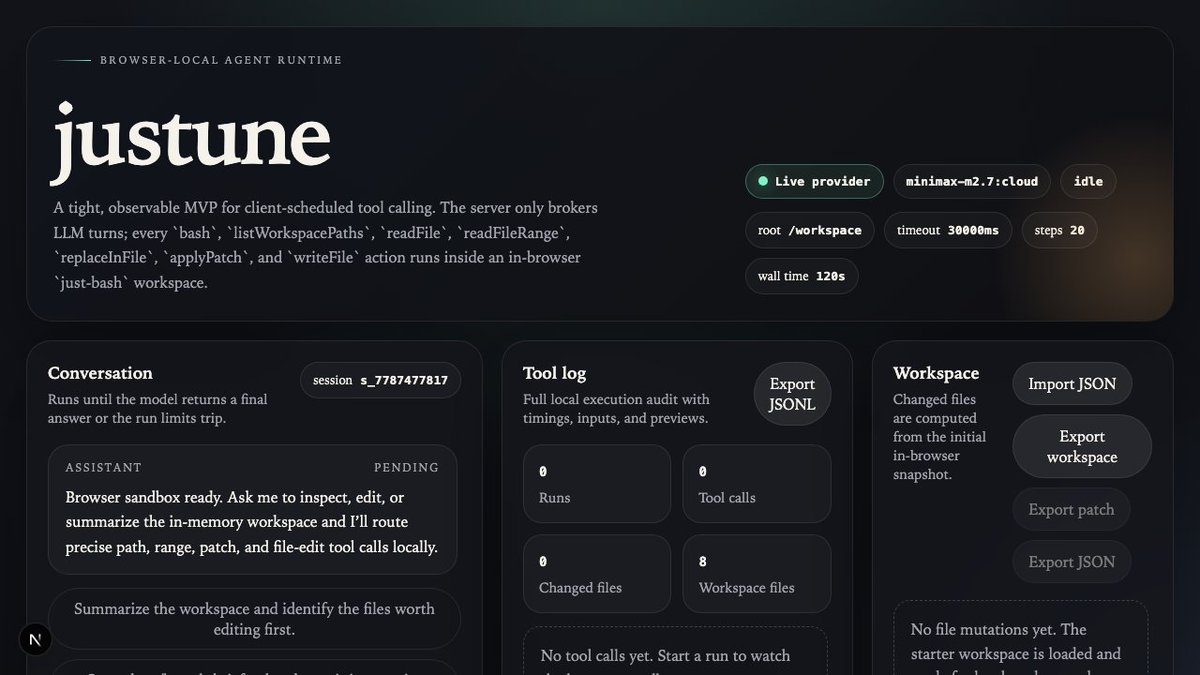
Introducing Justune, a browser-hosted agent runtime. Planning on the server and runs tools inside the user's browser workspace, test client-side tool calling without giving the server direct access to the user's files. https://t.co/pAZiUXLnGe https://t.co/niwqkEfGjk
MUFGさんとの取り組みに関する記事を発表しました。 とんでもないスケールでユーザから来るフィードバックをAI自身が分析し、「AIがAIを作る」システムになっています。 一個一個フィードバック来たら都度手動でプロンプトをいじるという、ほとんどの企業でやっているようなアプローチとは大幅に違うので、興味ある方はぜひ仲間になることをご検討ください。 https://t.co/m6C7CLJgtF
This robotic hand can be 3D printed by anyone and assembled in under 8 hours. Researchers at ETH Zurich created the Orca hand, fully open-sourced with artificial bones and tendons. For context, advanced robotic hands cost over $100,000 and require constant maintenance... Orca costs under $2,000. 50x less (!) A self-calibration system maps every motor to every joint, eliminating the manual tuning that tendon-driven hands usually need. Each fingertip has built-in tactile sensors covered by silicone skin. The hand can actually feel when it touches something, giving it feedback to grip objects without crushing them or letting them slip. It can hold over 20 lbs, learn tasks by watching human demonstrations, and transfer skills trained in simulation directly to the real world. The team proved its durability by having it pick up and place a cube over 2,000 times across 7 hours with no human intervention. The full design files and source code are open source, so any robotics lab in the world can start building one today.
https://t.co/54RSZUmaW4

we live in an amazing time 😂 https://t.co/pqDXXigchX
Grok @imagine is now on X! https://t.co/vzlCsx8HcQ

Watch how the camera rotates and reveals a stunning rear view. Grok Imagine rocks https://t.co/Sx9VYjYOOt
Jensen Huang just told every AI leader in the room to grow up. Stop scaring the public with science fiction. Start communicating like the weight of civilization is on your shoulders. Because it is. Huang: “AI is not a biological being. It is not alien. It is not conscious. It is computer software.” That single statement dismantles half the panic surrounding this industry. The mainstream conversation is dominated by people projecting human malice onto math. Alien consciousness onto code. Existential dread onto a software architecture we built, we trained, and we can read. Huang: “We say things like, ‘We don’t understand it at all.’ It is not true. We understand a lot of things about this technology.” When builders tell the public they don’t understand their own creation, the public hears threat. The state responds with control. That is already happening. Palihapitiya asked Huang what he would have told Anthropic during their regulatory clash with the Department of Defense. Huang didn’t attack the technology. He attacked the communication. Huang: “The desire to warn people about the capability of the technology is really terrific. We just have to make sure that we understand that the world has a spectrum, and that warning is good, scaring is less good because this technology is too important to us.” Warning shows risks, mitigation, why upside overwhelms downside. Scaring says we might be building something that destroys us and we can’t stop it. One builds trust. The other invites regulation written in panic. Huang: “To say things that are quite extreme, quite catastrophic, that there’s no evidence of it happening, could be more damaging than people think.” Projecting catastrophe without evidence is not caution. It is sabotage. When your technology is embedded in national defense, the financial system, and healthcare infrastructure, your words carry structural weight. If the architects act terrified of their own product, the response is predictable. Governments step in. They restrict. They seize control of something they don’t understand because the builders told them to be afraid. Huang: “There was a time when nobody listened to us, but now because technology is so important in the social fabric, such an important industry, so important to national security, our words do matter.” Most tech founders have not internalized this. You are no longer a startup founder disrupting an industry. You are running infrastructure that nations depend on. Your statements move policy. Your framing shapes legislation. Your tone determines whether governments treat you as partner or threat. Huang: “We have to be much more circumspect, we have to be more moderate, we have to be more balanced, we have to be far more thoughtful.” Huang did not ask for silence. He asked for precision. The leaders who cannot tell the difference will not be leading for long.
Charlie Munger explained why AI will solve diseases faster than anything in human history. He did it two weeks before he died, at 99. In 1954, his eight-year-old son Teddy was diagnosed with leukemia. There was no treatment. The survival rate for childhood leukemia in the 1950s was close to zero. Munger was 31, freshly divorced, nearly broke. His friend Rick Guerin said Munger would go to the hospital, hold Teddy, then walk the streets of Pasadena alone, crying. Teddy died in 1955 at the age of 9. A reporter asks how he got through it. He says, "You can't bring back the dead. You can't cure the dying child. You have to soldier through. If you have to walk through the streets crying for a few hours a day, it's part of soldiering. You go ahead and cry away. But you can't quit." Then he says, "In those days, the fatality rate with childhood leukemia was 100%. That's gone away. Now the cure rate is way up in the 90s." He's right. The five-year survival rate for the most common childhood leukemia (called ALL, acute lymphoblastic leukemia) was close to zero before 1950. By the 1960s, it was under 15%. Today, it's about 90%, according to the American Cancer Society. It took 70 years of researchers running clinical trials and developing combination drug therapies to get there. That was without AI. Human researchers work on one hypothesis at a time. There are now over 170 AI-discovered drug programs in clinical trials. AI is compressing early drug discovery timelines by 30 to 40%, turning what used to take three to four years of preclinical work into 12 to 18 months. No AI-discovered drug has yet received FDA approval, but the first is expected in 2026 or 2027. The pipeline is real and growing fast. What took seven decades for leukemia, AI could compress into years for diseases we haven't cracked yet. Munger said it plainly: "What mankind did, what civilization did, was soldier through those tough years that took away my cousin Tommy from meningitis, and then took away my son Teddy from leukemia. Imagine pretty well fixing that disease for families who came into life later. It's a huge achievement." He lost his son 68 years before this interview. He watched civilization solve the thing that took his boy. He died two weeks later, at 99. AI is about to make civilization progress much faster.
https://t.co/XTeMb8GXfG

Brutal ☠️ https://t.co/vFUozYZGBk