Your curated collection of saved posts and media
genius https://t.co/ow6Qjhjeu4

genius https://t.co/ow6Qjhjeu4

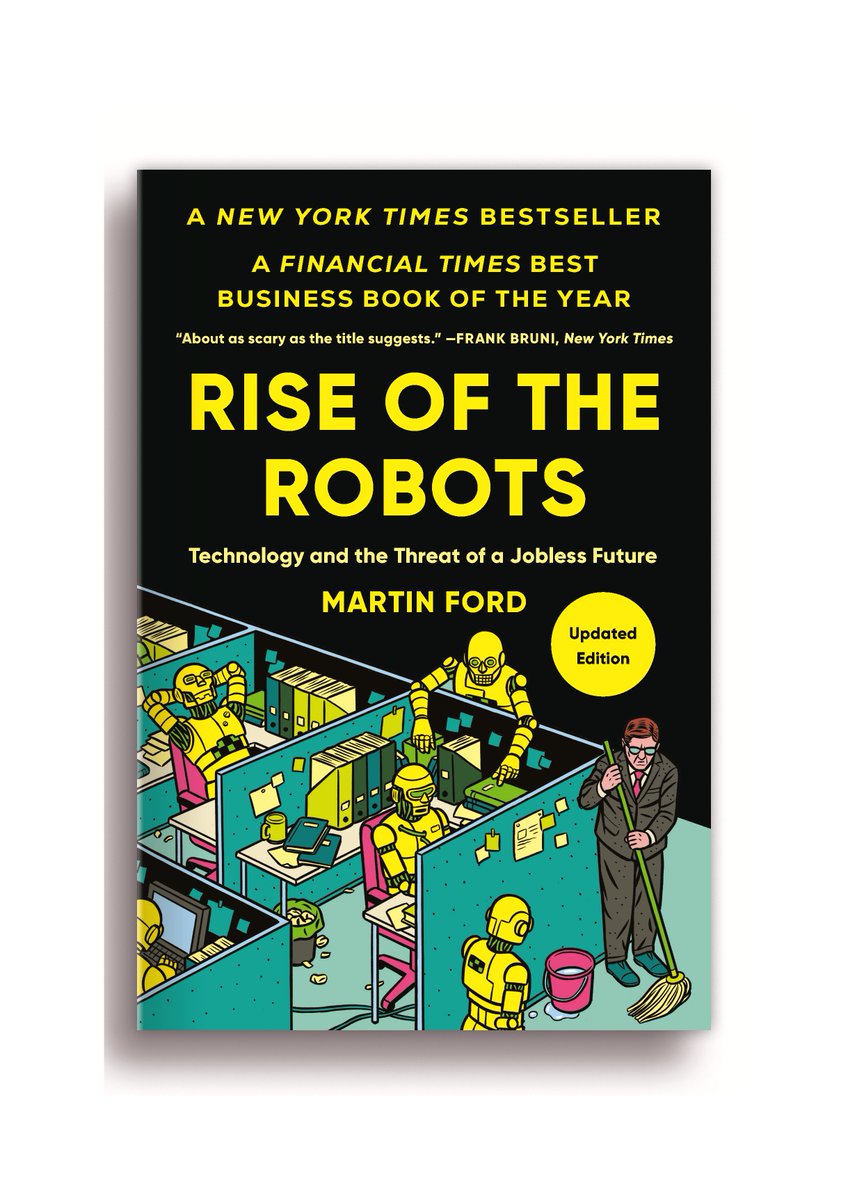
.@axios: "OpenAI and Anthropic dig in against each other on #AI jobs apocalypse" by @MadisonMills22 (link in the reply) There's a book about this... New edition updated for the latest advances in generative AI now available... https://t.co/6pTjYBrNMm
https://t.co/LxkQ0IJixj

https://t.co/K3HfScwiFh

Ted Cruz: "We are seeing a cancer on the right. It is rising antisemitism ... here's the scary thing: I've seen more antisemitism on the right over the last 18 months than any time in my life. And it's spreading like a cancer. Tucker Carlson is the most dangerous demagogue in America."
🚨BREAKING: Secretary Rubio just brokered a historic framework peace agreement between Israel and Lebanon, right here in Washington, D.C. The deal is simple: Iran is out. Hezbollah is out. The Lebanese military moves in. Israel begins withdrawing from southern Lebanon. Lebanon takes back control of its own soil. And for the first time in decades, a real path to peace is on the table. America made this happen. 🇺🇸🇮🇱🇱🇧
@erinnhorner @contralabs_ai @figma I loved the human-created vs. AI-generated show of hands! https://t.co/p77xR8ArLx
I was gifted the first version of Snap glasses in 2017, mostly used for art events, concerts, outdoorsy adventures on vacation. But the killer use case by far was hands-free dancing at Indian weddings. You can thank me later! https://t.co/4YG3Mm2LAJ

NEW: Apple and Audi alumni just unveiled a $25,000 open-air electric neighborhood vehicle. Amble One is a street-legal EV built for short local trips, with no doors, fewer screens, and a modular design inspired by the 1960s lunar rover. • Goes up to 40 mph with 60+ miles of range • Weighs under 1,000 lbs with a 5-hour home charge • Rear seats fold flat for cargo, surfboards, or gear • Built-in mounts let you add baskets, straps, mirrors, and cargo accessories • Already has 500+ vehicles committed by resorts Reservations are open now for 2028 deliveries.


No one told me you can stay at Picasso’s favorite hotel where artists would pay for their room with art and the menu hasn’t changed in 100 years. https://t.co/fWXTtG95Je


@jameygannon I saved this earlier today, give me these warm dusty rose summer nails ASAP. https://t.co/HleBez7ip5

I'll be on a panel at #Teardown2026 and attending the conference - if you'll be there please reach out! Would love to meet some fellow PDX nerds :) https://t.co/FrJWifkyrX https://t.co/GRgOv3ePK8

Oww spent too long today hyper focused on this, hunched over trying to put tiny drops of glue in tiny cracks. The graveyard grows but we're making progress! https://t.co/rNujccfShP


Didn't have much time to play with this today but I: - Got a peek at a real microfluidics chip+setup - Tested stepper-controlled fluid dispensing - Got my design-to-finished-chip time down to a 20-minute speed run - Made some droplets! The quest continues :) https://t.co/jVikwlfbly


Experiments towards manual sorting - peristaltic pump style jog wheel is a fun interface to use when looking through the microscope at tiny channels :) https://t.co/cELraTj5nc

Pebble Index 01. Will share more thoughts when properly released etc, but initial impressions are good! It's fun to have a push-to-talk way to send audio to my server without having to dig out a phone :) https://t.co/IklNikvpwX

I'd seen one of these four years ago when I didn't have my macro camera handy - I was very happy to find one yesterday right outside my door :) (Rhododendron Leafhopper, Graphocephala fennahi) https://t.co/jumNfsmKCx

“Great artists steal”: the National Park Service provides Illustrator files for their maps, so you can see exactly how great land management cartographers made it happen. Pick a park > "Compressed zip" gets you the AI and PSD files: https://t.co/VGAGQvbSVL https://t.co/x9w0fVaUeZ
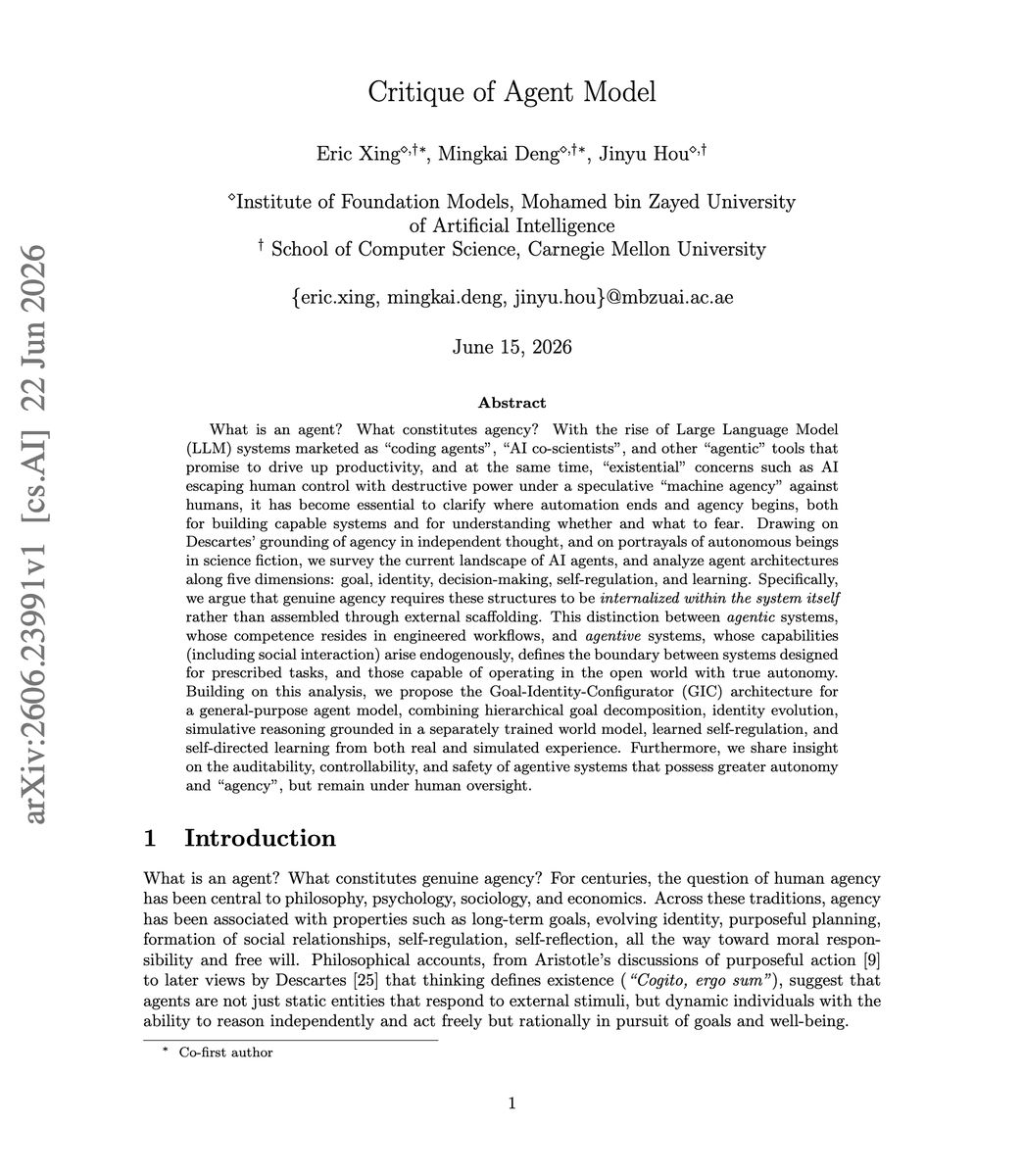
// Critique of the Agent Model // Finally, a paper that tries to define what an agent is and what agency consists of. Good read overall. (great bookmark) The word agent now covers everything from a for-loop with tool calls to speculative machine superintelligence. Eric Xing and colleagues ask where automation ends, and agency begins. Drawing on Descartes and on science-fiction portrayals of autonomous beings, they analyze agent architectures along five dimensions: goal, identity, decision-making, self-regulation, and learning. The argument is that genuine agency requires these structures to hold together in a specific way. Great paper overall, providing a vocabulary for arguing about what is and is not an agent. Paper: https://t.co/qFvMxWd5cq Learn to build effective AI agents in our academy: https://t.co/1e8RZKs4uX
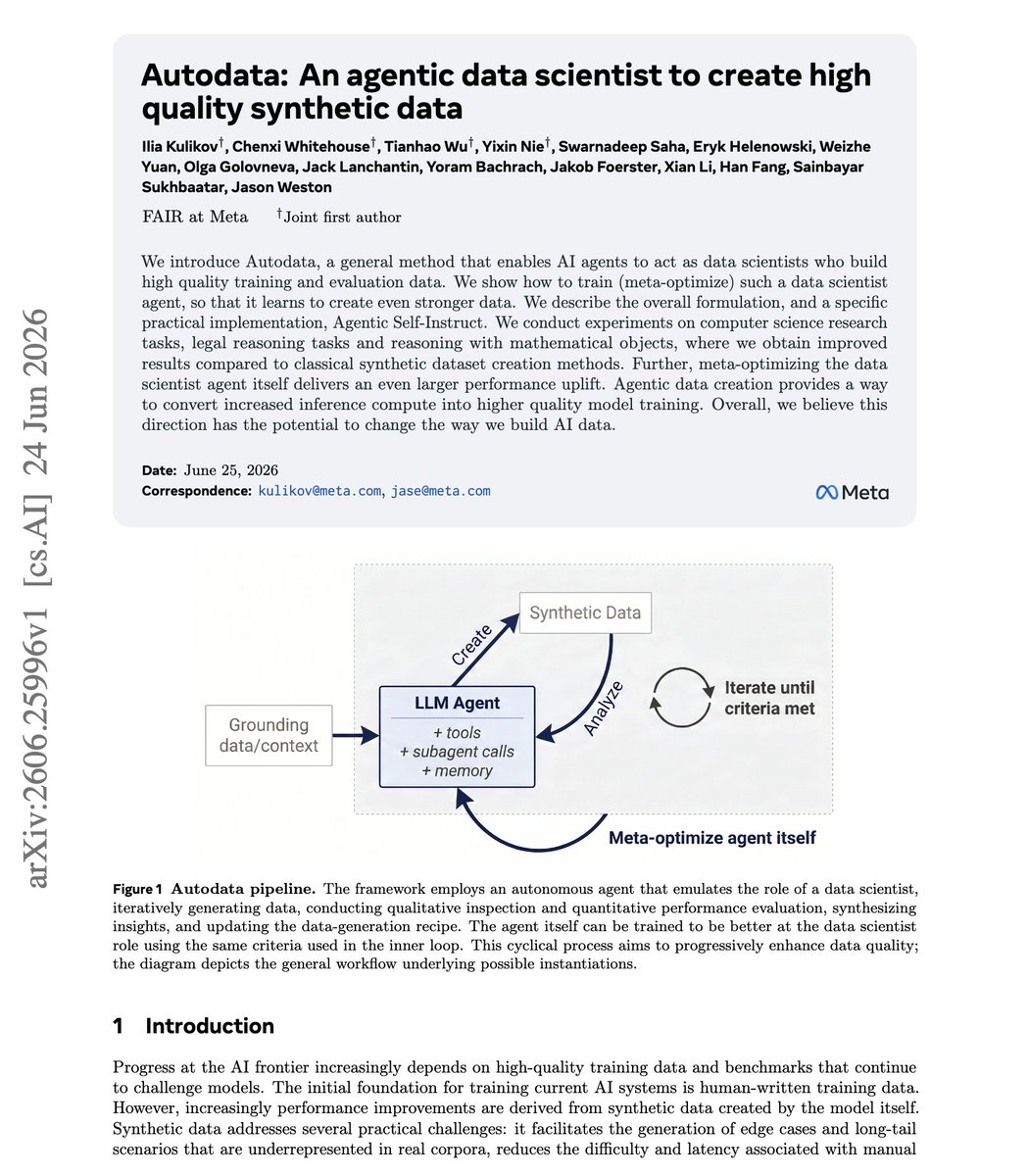
New research from Meta. Building synthetic training data has stayed a fixed pipeline that you hand-tune and then freeze. Autodata casts an AI agent as a data scientist that builds training and evaluation data, with an implementation called Agentic Self-Instruct that extends classic Self-Instruct with agentic planning and tool use. Think of it as meta-optimization, where the data scientist agent is itself trained to produce stronger data, so the pipeline keeps improving instead of staying static. Across computer science research, legal reasoning, and reasoning over mathematical objects, it beats classical synthetic-data methods, and meta-optimizing the agent delivers an even larger uplift. Paper: https://t.co/TgFN6EHZas Learn to build effective AI agents in our academy: https://t.co/1e8RZKs4uX
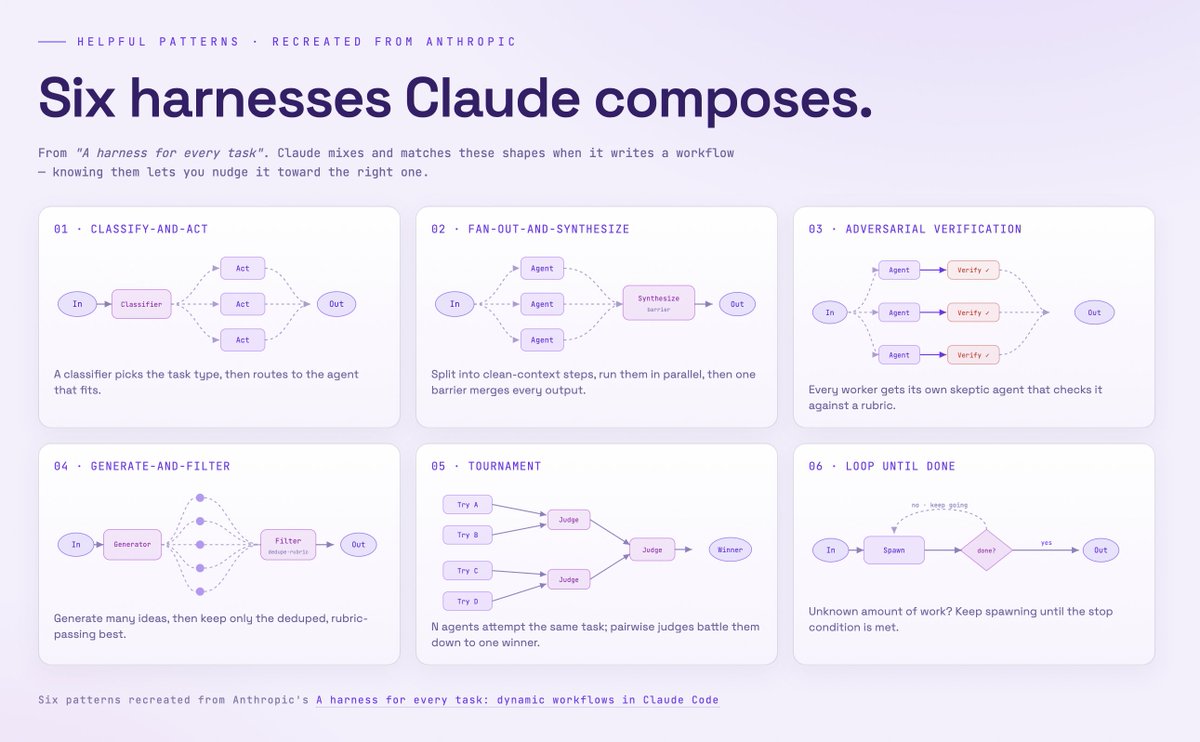
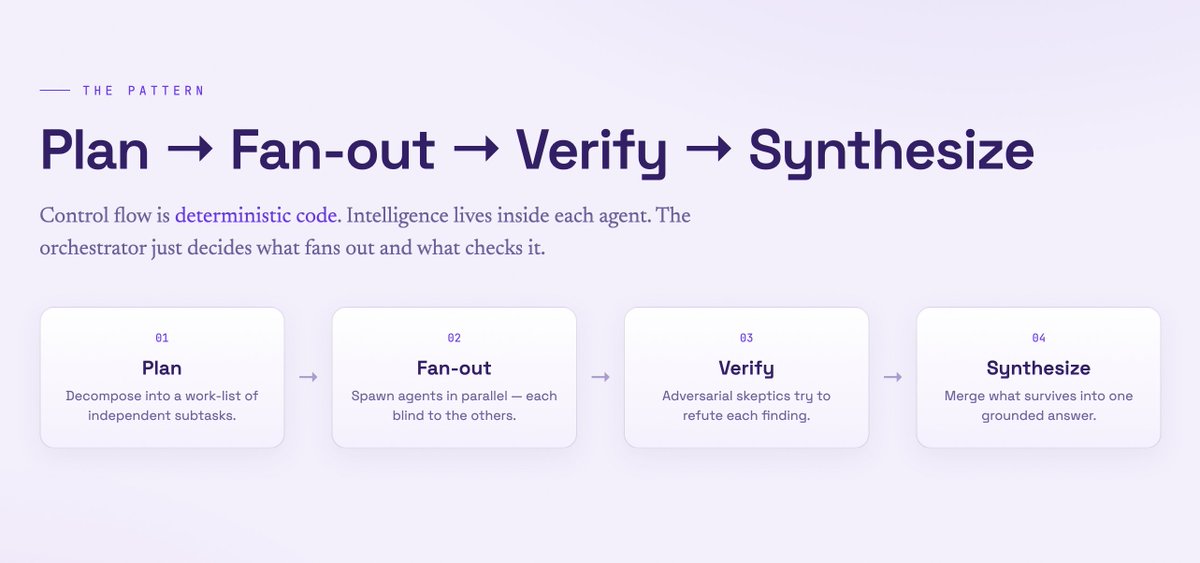
Just had a great discussion on dynamic workflows. Rough notes: - applies to a very small set of use cases - think of it as a new paradigm of (test-time compute) TTC - strong for hill-climbing research experiments - careful planning leads to better results - you can often get better results by just increasing the reasoning level - /goal + /loop is a subset of dynamic workflows - verifiers/judges are crucial to get good results - combine/fuse different coding agents for even better results - great for when you need different perspectives from agents (llm council) - frontier models are not equipped for optimally generating harnesses on the fly - newer models like Mythos are probably better trained to do more optimal agent orchestration - benchmarks on TTC are lacking, but we need them to measure how effective dynamic workflows are - meta prompt dynamic workflows are a lot of fun; even opus 4.8 might surprise you - dynamic workflows can be packaged as skills for further optimization of them Longer post coming soon.
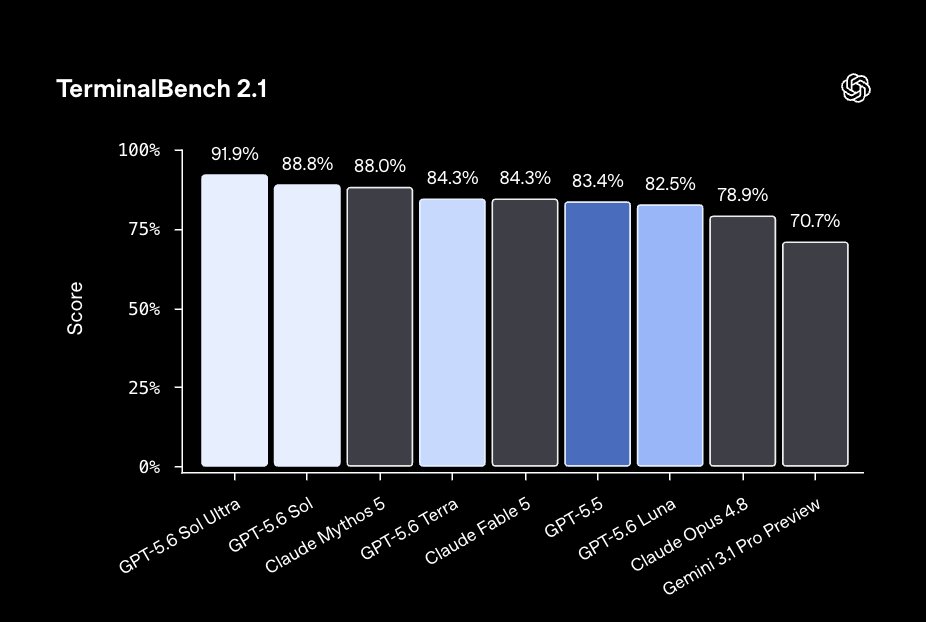
Great to see the new GPT-5.6 models finally announced. Sad to see this new release strategy where only a select few get access initially. Not a win for our industry IMO. Open-source AI must win! https://t.co/F44COphP8s
Introducing a limited preview of GPT-5.6 Sol, our next generation frontier model, as well as GPT-5.6 Terra, a balanced model for efficient, everyday work, and GPT-5.6 Luna, a fast and affordable model for high-volume work. https://t.co/OoM83SyISN
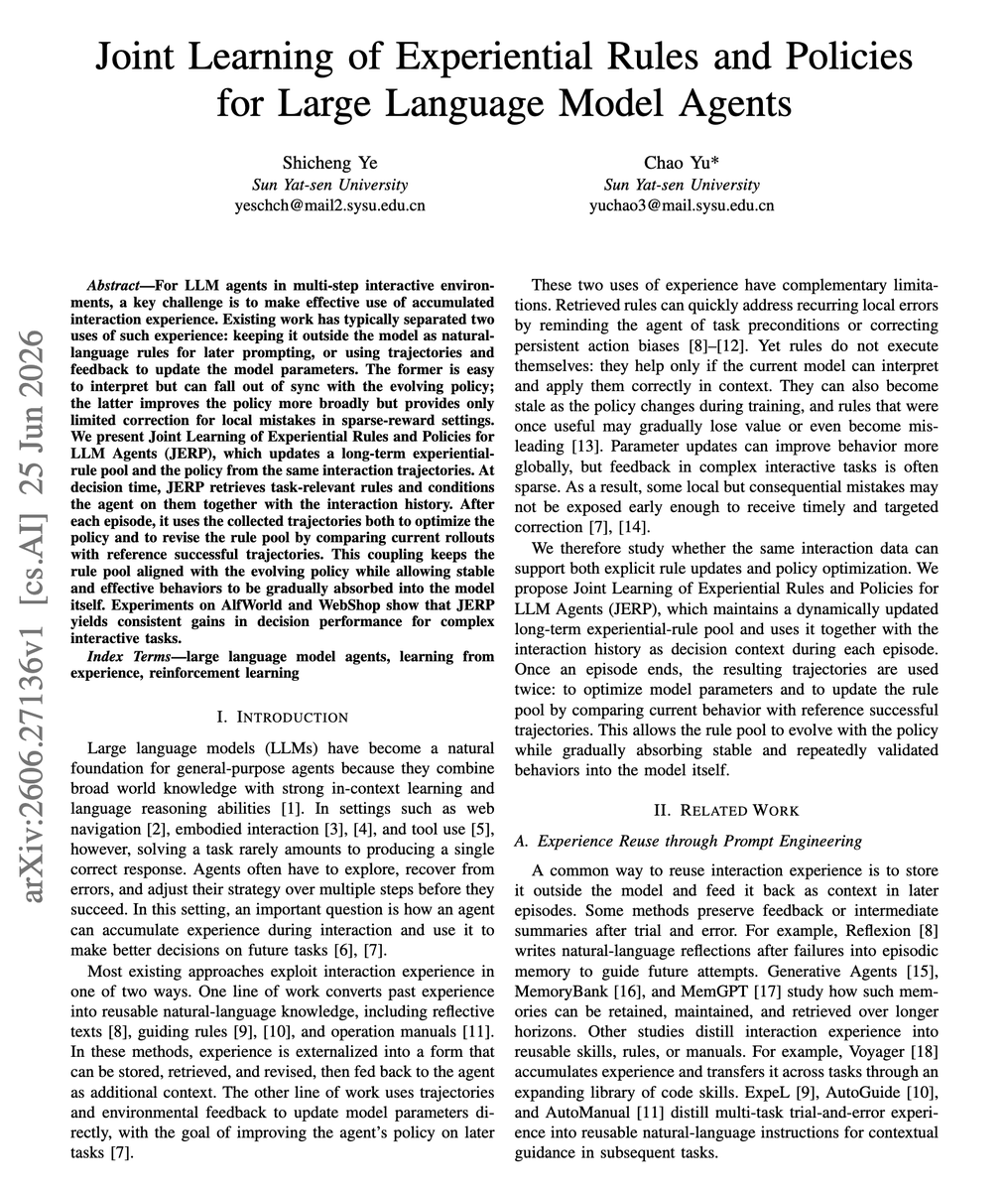
New paper on giving LLM agents experience that improves the weights and stays readable at the same time. Agent-experience methods split into two camps. Externalized natural-language rules stay interpretable but drift out of sync with the policy. Parameter updates generalize but make weak local corrections under sparse rewards. JERP runs both off one trajectory stream, retrieving task-relevant rules at decision time and, after each episode, optimizing the policy while revising the rule pool against reference successful trajectories. The conceptual payoff is the absorption dynamic. Stable, repeatedly useful behaviors get internalized into the weights over time, while the rule pool handles fresh local corrections. The interpretability-versus-generalization balance becomes a knob rather than an architecture choice. Why does it matter? Teams want agents that both improve and stay inspectable. This is a clean template for getting both from the same trajectories. Gains land on AlfWorld and WebShop. Paper: https://t.co/avjHvESdBQ Learn to build effective AI agents in our academy: https://t.co/LRnpZN7L4c
Dynamic workflows (generating harnesses on the fly) are a new form of test-time compute. But LLMs aren't great at building them. I often have to steer agents to generate complex patterns. Curious how effective Mythos/GPT-5.6 is at dynamically generating complex workflows. https://t.co/hFhMWZJSua
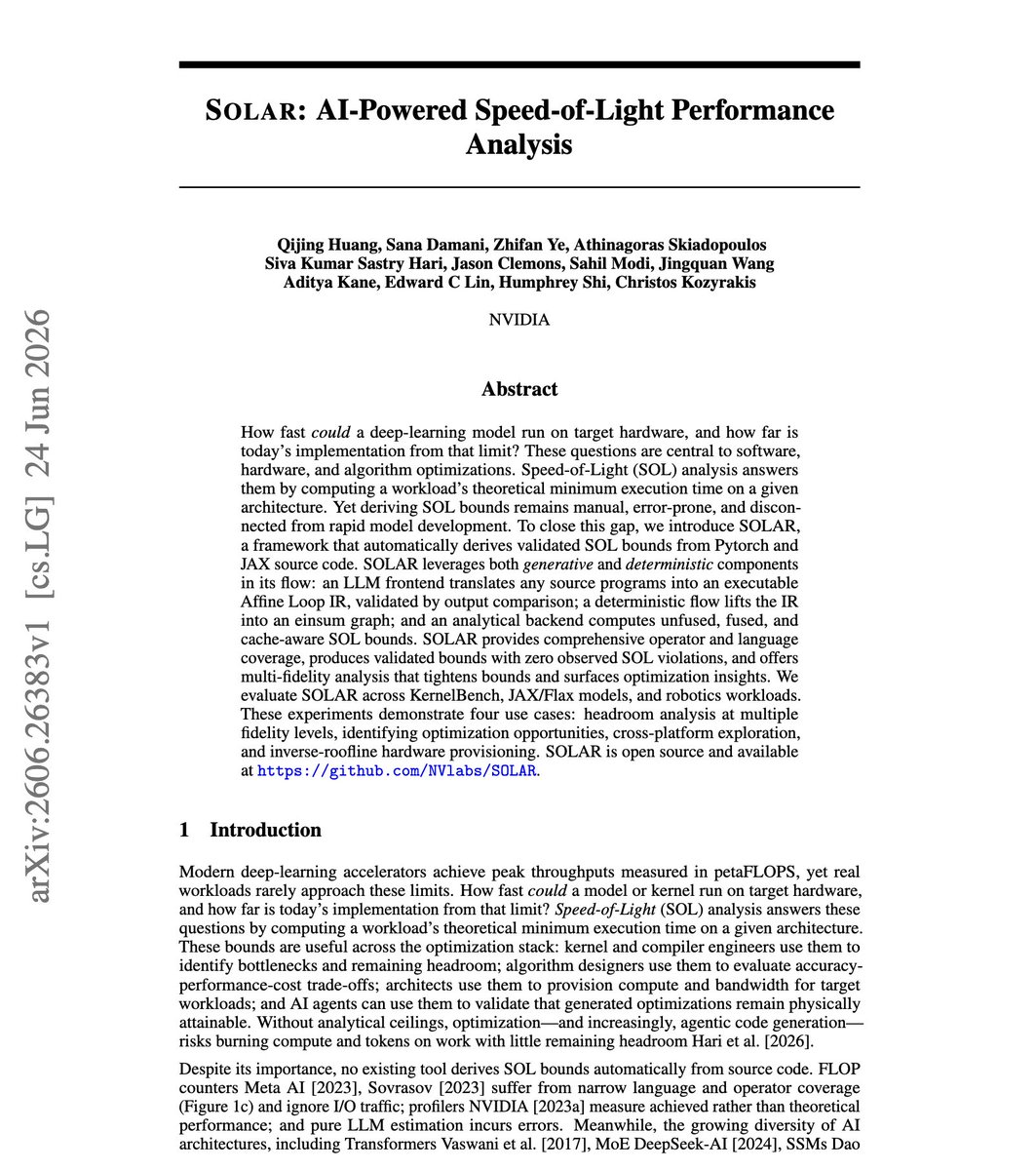
NEW paper from NVIDIA. (bookmark it) Speed-of-light performance analysis tells you the theoretical floor of a workload, but teams still derive it by hand and freeze it. SOLAR automates the whole thing straight from PyTorch or JAX source. An LLM frontend translates arbitrary code into an executable Affine Loop IR, validated by output comparison, then a deterministic pass lifts it into an einsum graph, and an analytical backend computes the bounds. The model is confined to translation, so the actual bound math stays deterministic. Across KernelBench, Flax models, and robotics workloads, they report zero observed SOL violations. Paper: https://t.co/KXgsPxcSnY Learn to build effective AI agents in our academy: https://t.co/LRnpZN7L4c
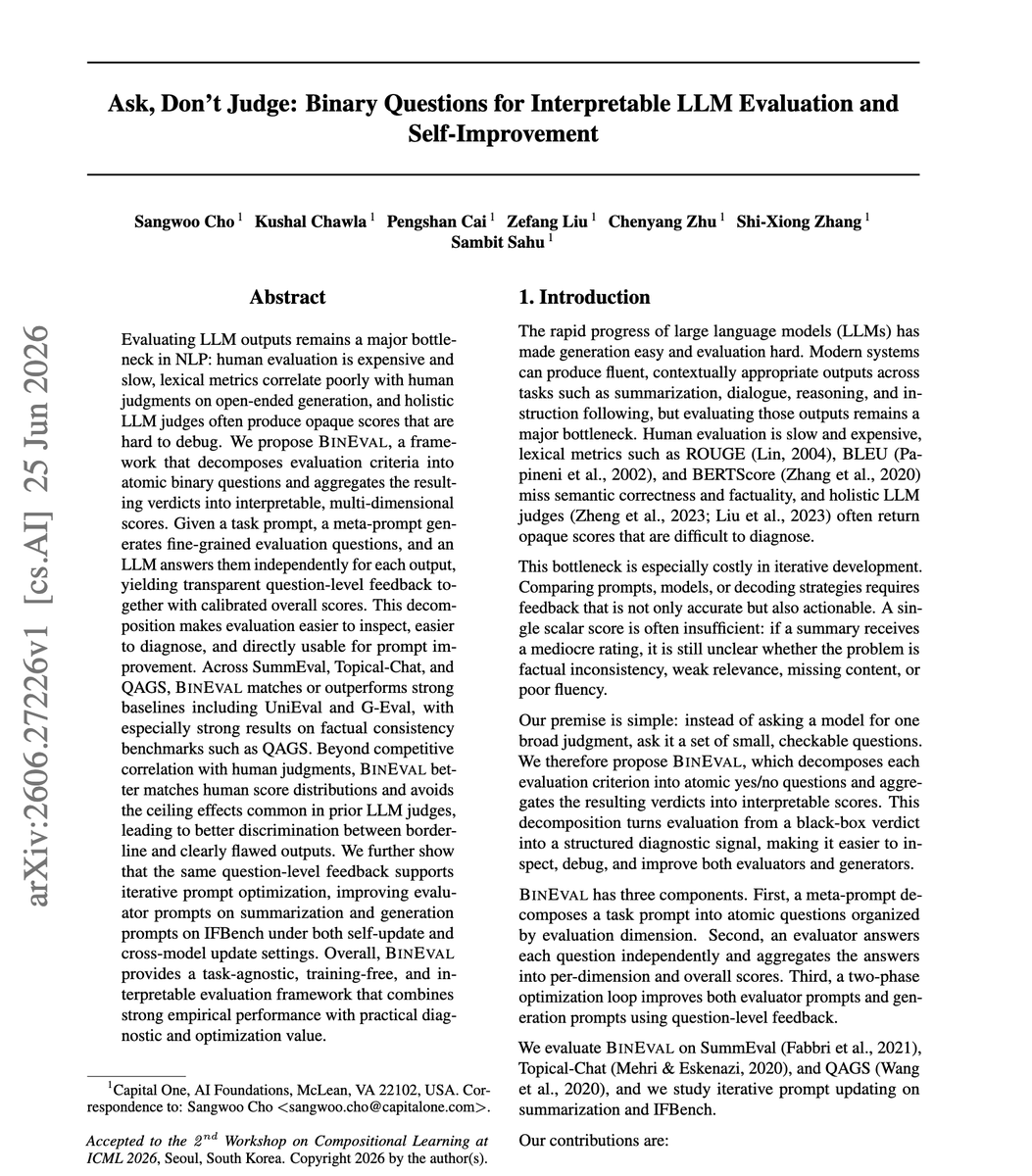
If you use LLM-as-judge, this one is worth reading. (bookmark it) It's actually one of the most effective ways to use LLM-as-a-Judge for evals. Holistic judge scores hide both their reasoning and their ceiling effects. BINEVAL decomposes each evaluation criterion into atomic yes-or-no questions, answers each independently per output, then aggregates the verdicts into calibrated multi-dimensional scores. Every question-level verdict is inspectable, so you can diagnose exactly why an output scored low, and the same verdicts feed straight back as targeted prompt-improvement signal. Across SummEval, Topical-Chat, and QAGS, it matches or beats UniEval and G-Eval, training-free, with especially strong results on factual consistency. Paper: https://t.co/oar6BZcasm Learn to build effective AI agents in our academy: https://t.co/1e8RZKs4uX
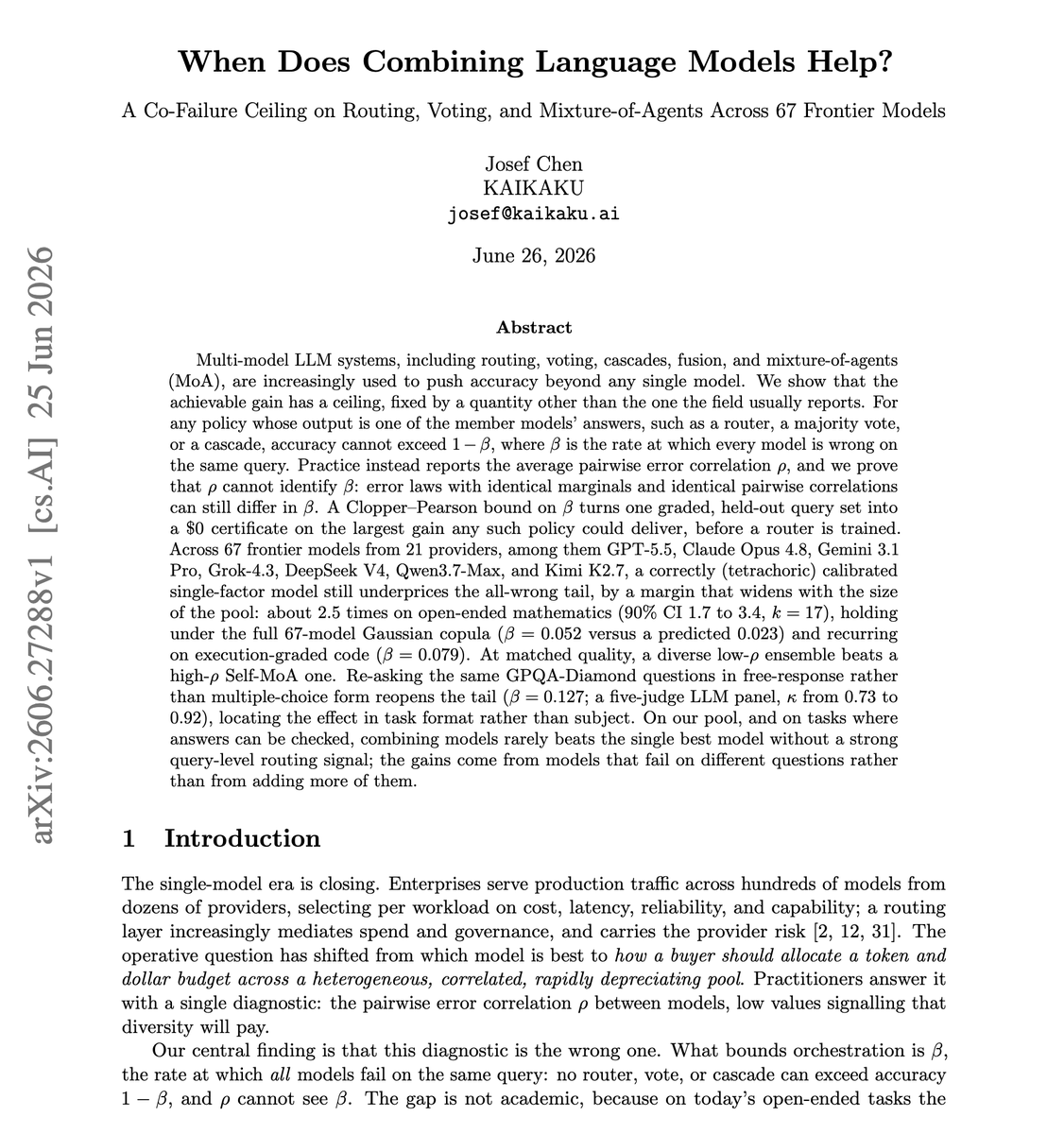
When does combining LLMs help? Great analysis on combining language models, measured across 67 models from 21 providers. Any policy that routes, votes, cascades, or runs a mixture of agents and then returns one model's answer is bounded above by 1 minus beta, where beta is the fraction of queries every candidate model gets wrong. The common justification for ensembling is diversity, usually measured as low pairwise error correlation. The paper proves that correlation cannot identify beta, so decorrelation does not establish that headroom exists. And across the 67 models, real co-failures are far more concentrated than independence-style assumptions predict. Before assuming a router or MoA setup will help, measure beta. Co-failures cluster on the answer format rather than the subject. Paper: https://t.co/PGO9YAoBzH Learn to build effective AI agents in our academy: https://t.co/LRnpZN7L4c
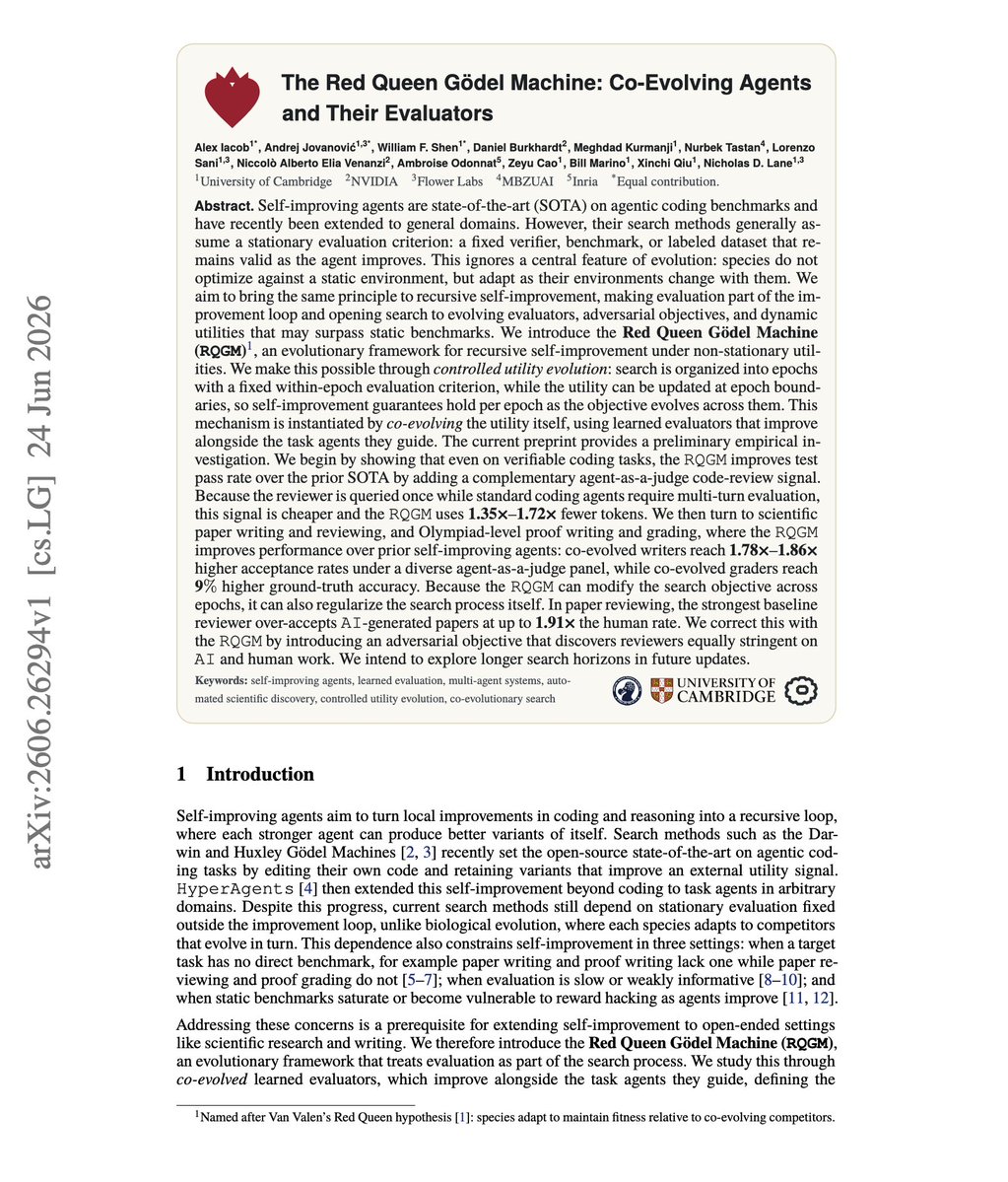
Fascinating paper on self-improving agents. (bookmark it) If you are working on agentic loops, you will quickly realize that they are only as good as the effectiveness of the evaluator. Self-improvement loops tend to stall the moment the judge stops getting harder. The agent learns to satisfy a fixed evaluator rather than getting genuinely better. The Red Queen Gödel Machine, from Cambridge, co-evolves the agent and its evaluator together, so the bar keeps rising as the agent climbs. The name borrows the evolutionary arms race. Both sides have to keep running to stay in place. A frozen evaluator is where reward hacking creeps into self-improvement. Co-evolving the judge is a structural answer to that, and it keeps the loop honest over many rounds. Paper: https://t.co/HuR9YWSTPr Learn to build effective AI agents in our academy: https://t.co/1e8RZKs4uX
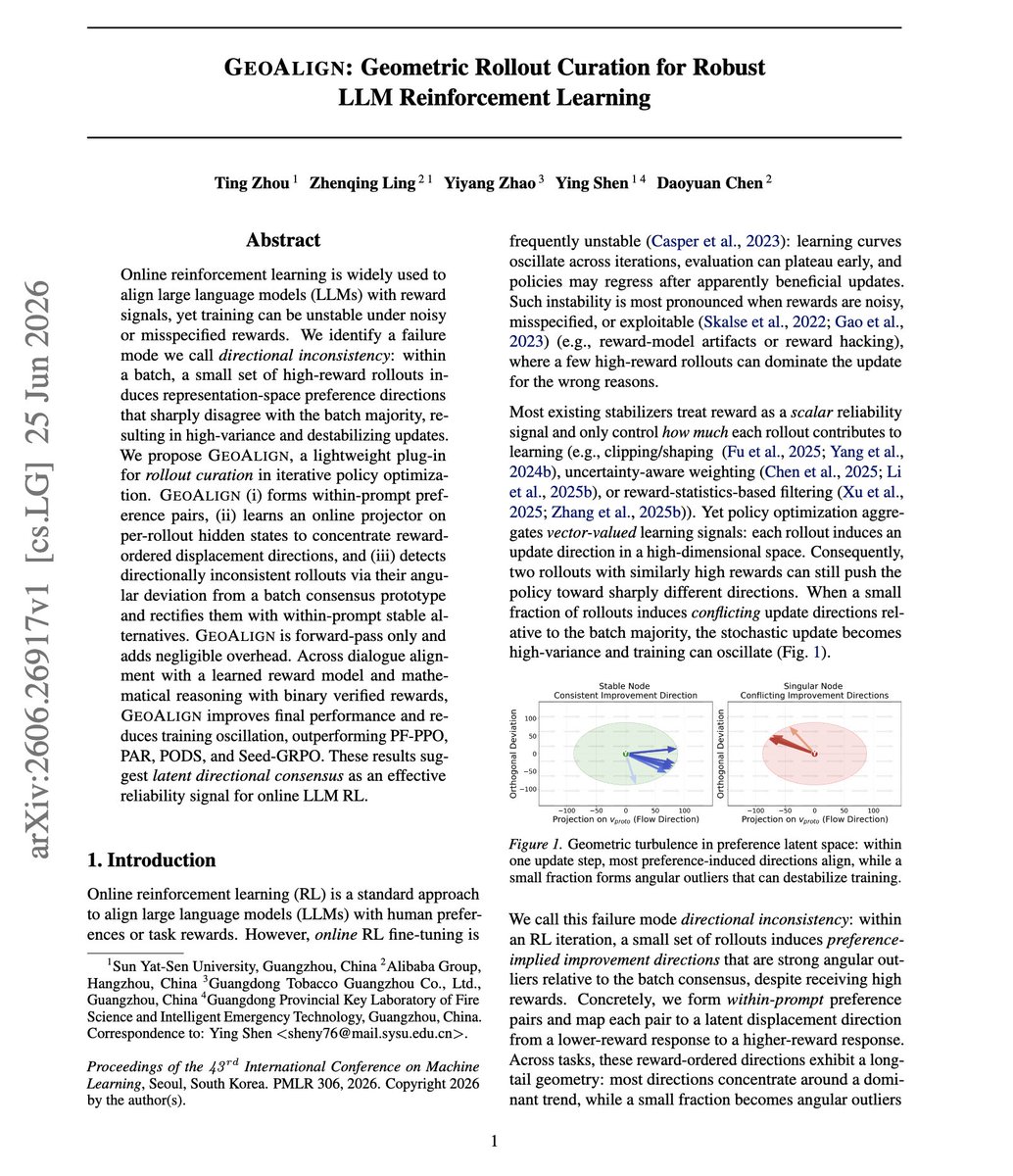
Why do RL runs on LLMs blow up even when the recipe looks right? GEOALIGN, from the Alibaba team behind Qwen, points at the rollouts. A handful of bad batches push the policy in incoherent directions, and most stability tuning just damps the symptom. This work curates rollouts by their geometry, removing the samples that make update directions conflict before they destabilize training. Why does it matter? If instability is largely a bad-batch problem, rollout curation is a lower-effort lever than another round of KL or clip tuning. You fix the data going into the update rather than fighting the optimizer. Paper: https://t.co/tUAYC57MVy Learn to build effective AI agents in our academy: https://t.co/LRnpZN7L4c
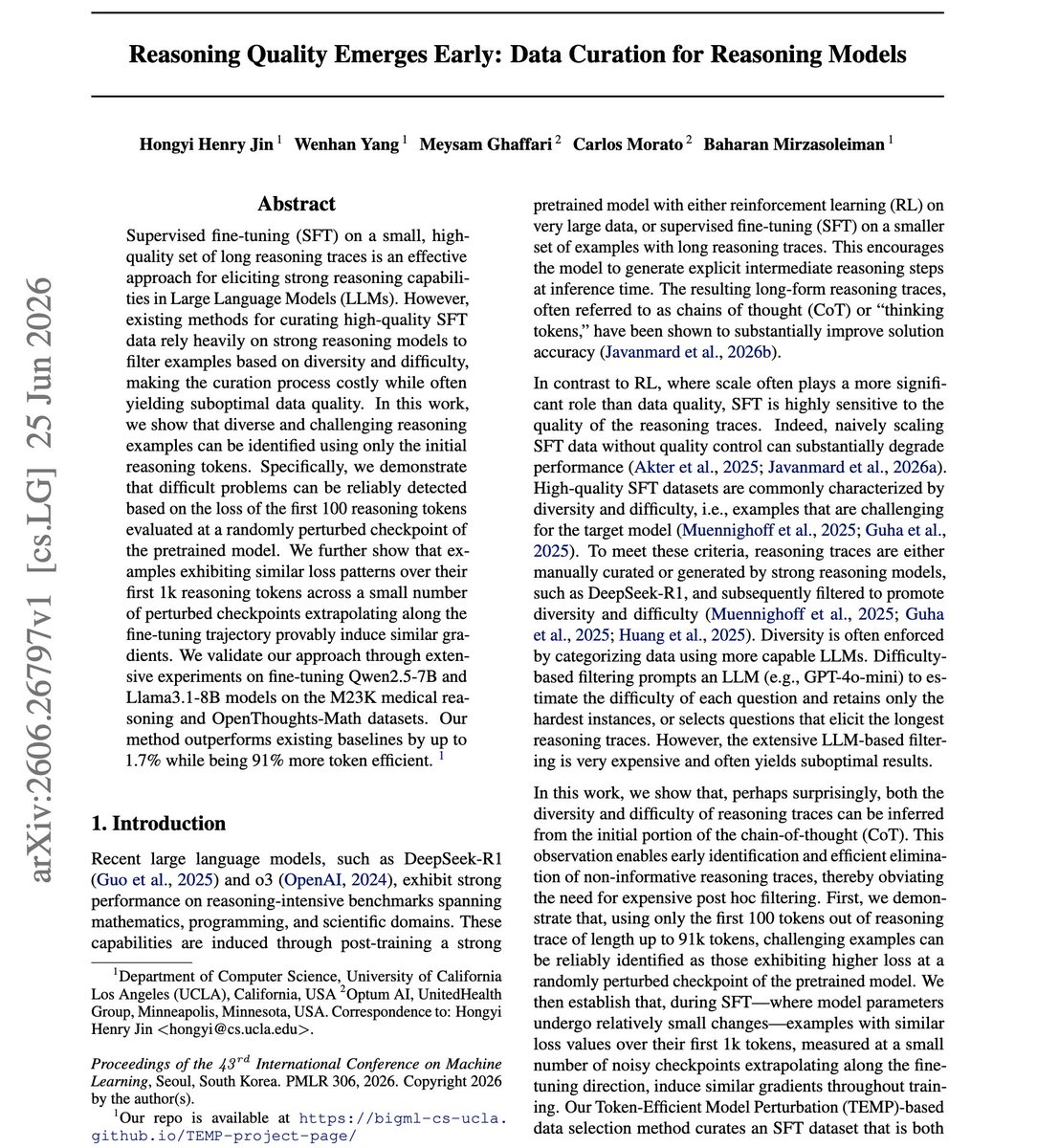
NEW paper worth reading. Reasoning-data curation is expensive because scoring a trace usually means reading it to the end. This new work from UCLA shows you may not have to. The quality of a reasoning trace is largely decided in its opening tokens, so a short prefix predicts whole-trace quality well enough to rank and filter on. What this means? You can score a million traces without finishing any of them. That turns curation into a cheap early-stopping problem and cuts the cost of building SFT data for reasoning models by a wide margin. Paper: https://t.co/KPKdygwd12 Learn to build effective AI agents in our academy: https://t.co/LRnpZN7L4c
https://t.co/atWPjSq0yg https://t.co/8mgP0A7oXP