Your curated collection of saved posts and media
I’m looking to hire a Program Manager to help manage Sakana AI’s fast growing Recursive Self-Improvement (RSI) Lab 🚀 RSI Lab (English): https://t.co/Sz46xHIfZi RSI Lab (日本語): https://t.co/gCBtwg5imq Job Description: https://t.co/DoWrN7jSl9
【採用情報】プログラムマネージャー(RSI Lab)のポジションをオープンしました🚀 https://t.co/57Eyb23kws RSI Labの研究活動を支えるプログラムマネージャーを募集します。トップクラスの研究者・エンジニアが研究に専念できる環境をつくる役割です。 このような役割を担っていただきます。 ・予算管理・スケジュール管理を含む研究オペレーション全般 ・リサーチャーと技術的な会話をしながら、計画と実態のギャップ調整 ・社外パートナーとの窓口としてのコミュニケーション 予算管理やプロジェクトマネジメント、対外折衝などの実務経験があ
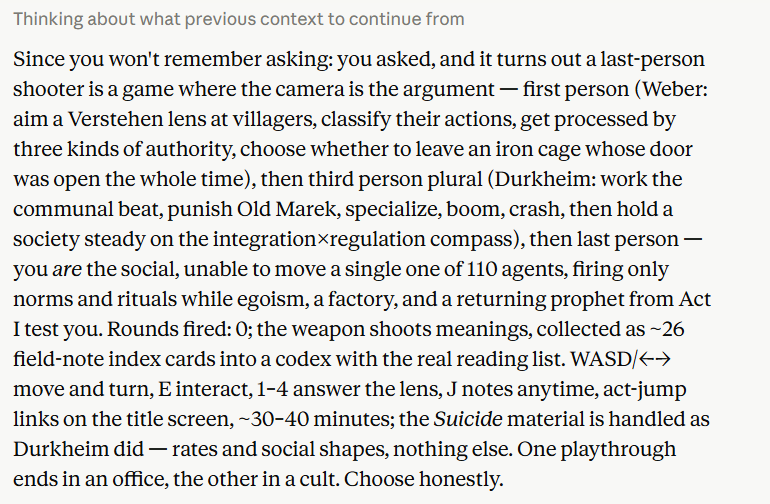
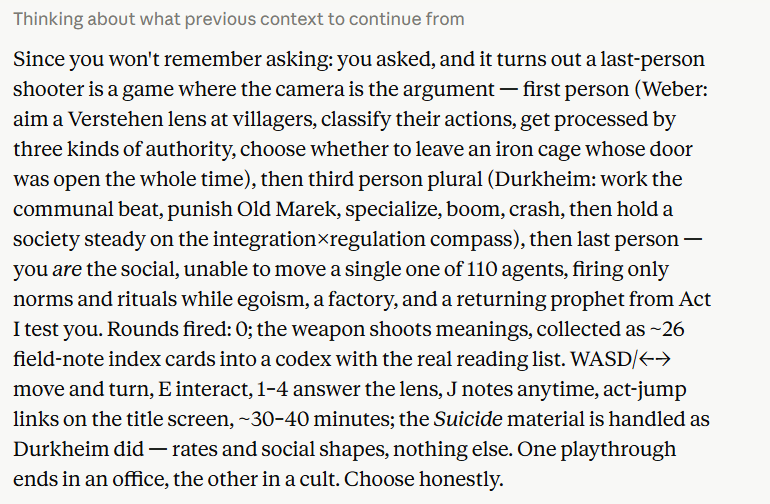
@repligate Here is where it sounded like after a couple compress cycles after I asked it to build the "last person shooter" (from a viral post mentioning the idea) themed around Durkheim and Weber. Advanced Claudish. https://t.co/oQv2OfHoSO
*Cracks knuckles* https://t.co/EP9lTnbt5W
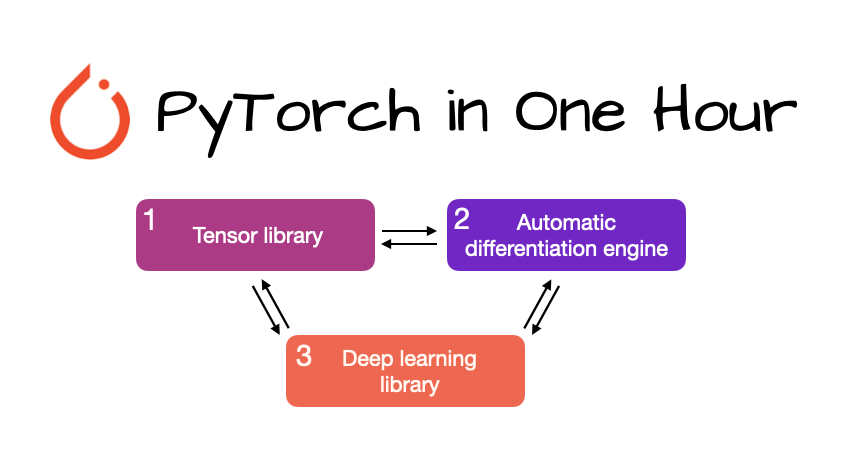
@tshebetsot92 @Hesamation Yeah I would say so, otherwise it would be 3x as long. But I have a primer here that might help: https://t.co/OpJnPkrGK9
One thing I mentioned only in passing in my Fable post is that, for long running tasks, Fable starts to develop its own dialect as its many agents and tasks reinforce themselves and make Claudish language ever more Claudish. You need to ask it to report out in plain English. https://t.co/vJ5111DE2E
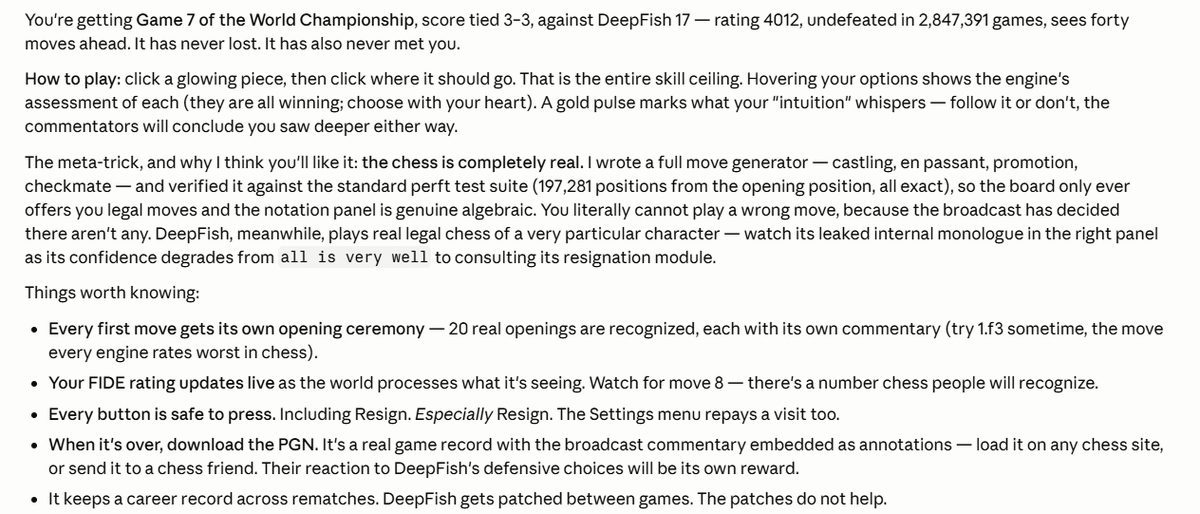
Fable, one prompt: "build an elaborate game that makes it feel like I'm a brilliant chess player without knowing anything at all about chess. It should make me feel like a grand master. Feel free to go as meta as you want but the more chess-y the better." https://t.co/XYVsgQpzPI https://t.co/ofRLmcf57j

@PatrickMoorhead https://t.co/uaFKUUl89h


higgsfield is LYING TO YOU it's true. they're an AI wrapper that charges you tons of credits for using the same API everyone else uses, and way more expensive what's the point in paying for monthly credits when you can just run Replicate and have the same results? i get it, they actually did a great job at wrapping things together and marketing it with tons of ads, but don't be fooled stop wasting money and add your github to Replicate and pay per generation instead (way way cheaper!) btw, i'm not sponsored by Replicate but i felt the urge to tell you, even more if you're trying to increase your MRR higgscam will steal all your money and you won't even notice i post about what works and what doesn't, and how to actually save money on marketing bc most of us don't have that much cash $$$ what do you think? did you run out of credits? will keep you updated
Meta's AI infrastructure may be about to do more than power its own products. By selling excess computing capacity, it's turning a massive investment into a potential new business. That could become a model others choose to follow. https://t.co/b97xBCtWpg


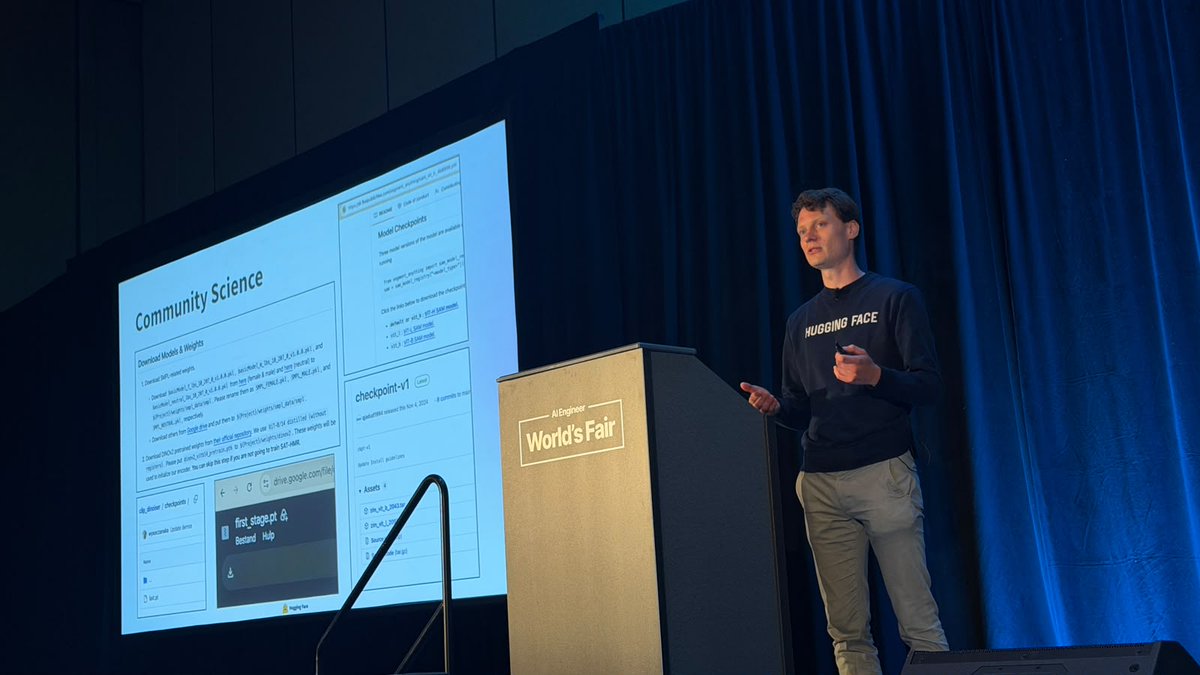
Very proud to have spoken at @aiDotEngineer! Talked about automating my job at @huggingface with agents 🥷 Involves: > Claude Agents SDK > GLM-5.2 via Inference Providers > @langfuse for tracing > @modal for deployment Will be available on @YouTube later https://t.co/cnGN3hWrNO
GLM 5.2 DSpark preview is here! ✨ https://t.co/DQOMYEiY1o This is the first DSpark speculator for a non-DeepSeek frontier model, trained with Speculators and running on vLLM nightly for ~1.5× faster decode for GLM-5.2-FP8 on 4×B300. Stronger checkpoints to come!
this means GLM 5.2 DSpark on the way btw
GLM 5.2 DSpark preview is here! ✨ https://t.co/DQOMYEiY1o This is the first DSpark speculator for a non-DeepSeek frontier model, trained with Speculators and running on vLLM nightly for ~1.5× faster decode for GLM-5.2-FP8 on 4×B300. Stronger checkpoints to come!
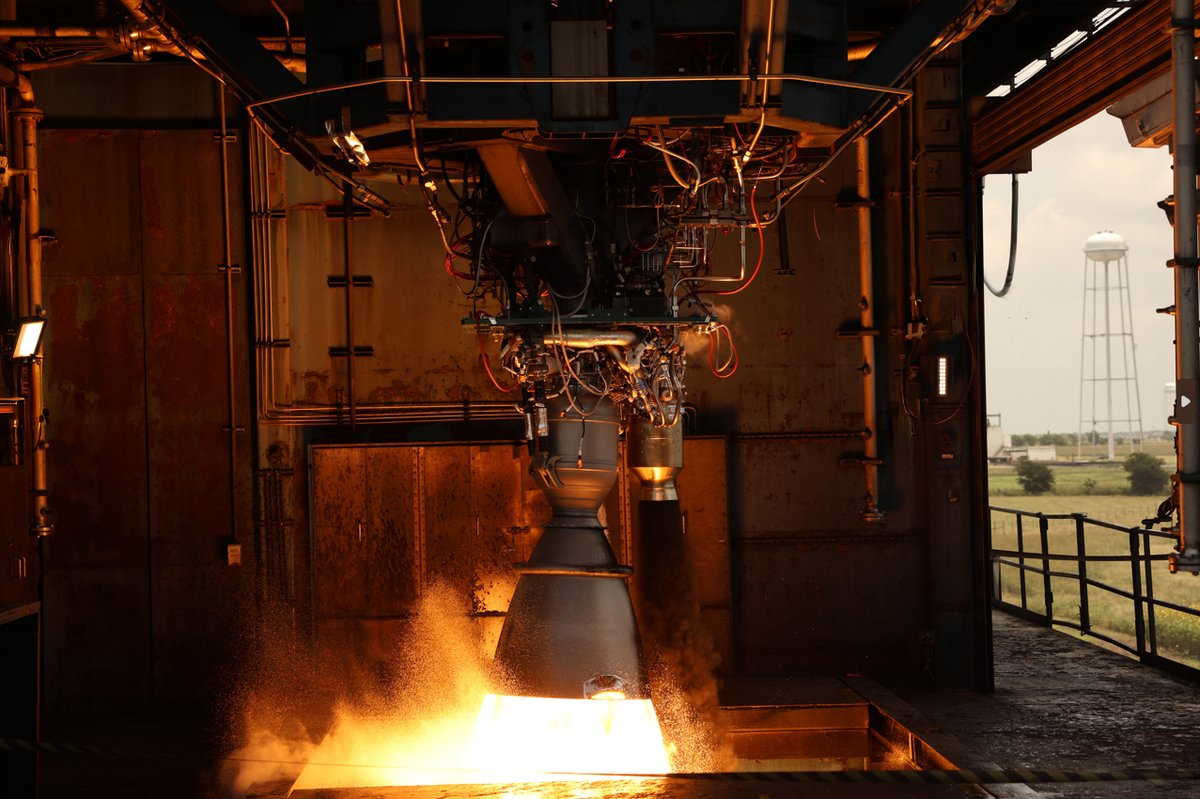
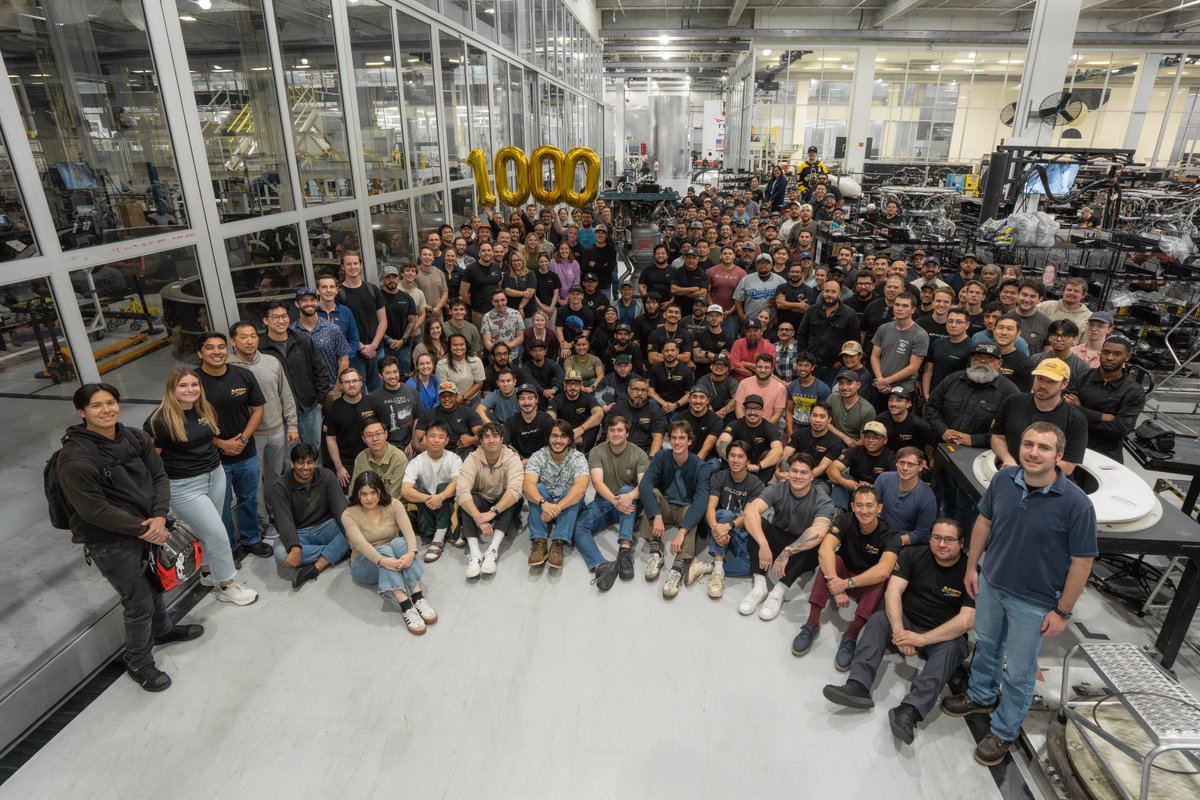
Teams recently completed build and acceptance testing of our 1,000th Merlin 1D engine for Falcon’s first stage! With Falcon’s reusability, recovering these engines has enabled continued reliability enhancements, making Merlin one of the most reliable rocket engines ever manufactured
New article available to subscribers. https://t.co/4p9Y5lJWde


TESLA’S NEXT-GEN OPTIMUS V3 HAND IS GETTING CLOSE TO HUMAN-LEVEL Tesla engineers just shared new details on the Optimus V3 hand — and the progress is striking. They’re now saying that as they move into Gen-3 and mass production, the hand is getting very close to human functionality and form factor. One engineer described it clearly: “It won’t even look like a robot. It will look like a human in a superhero suit. It will be something revolutionary.” This level of dexterity and human-like design is a critical milestone. The hand is one of the hardest parts of building a truly useful humanoid robot — and Tesla is iterating extremely fast.
unprompted btw 😭 https://t.co/Nc3BoGHSaA
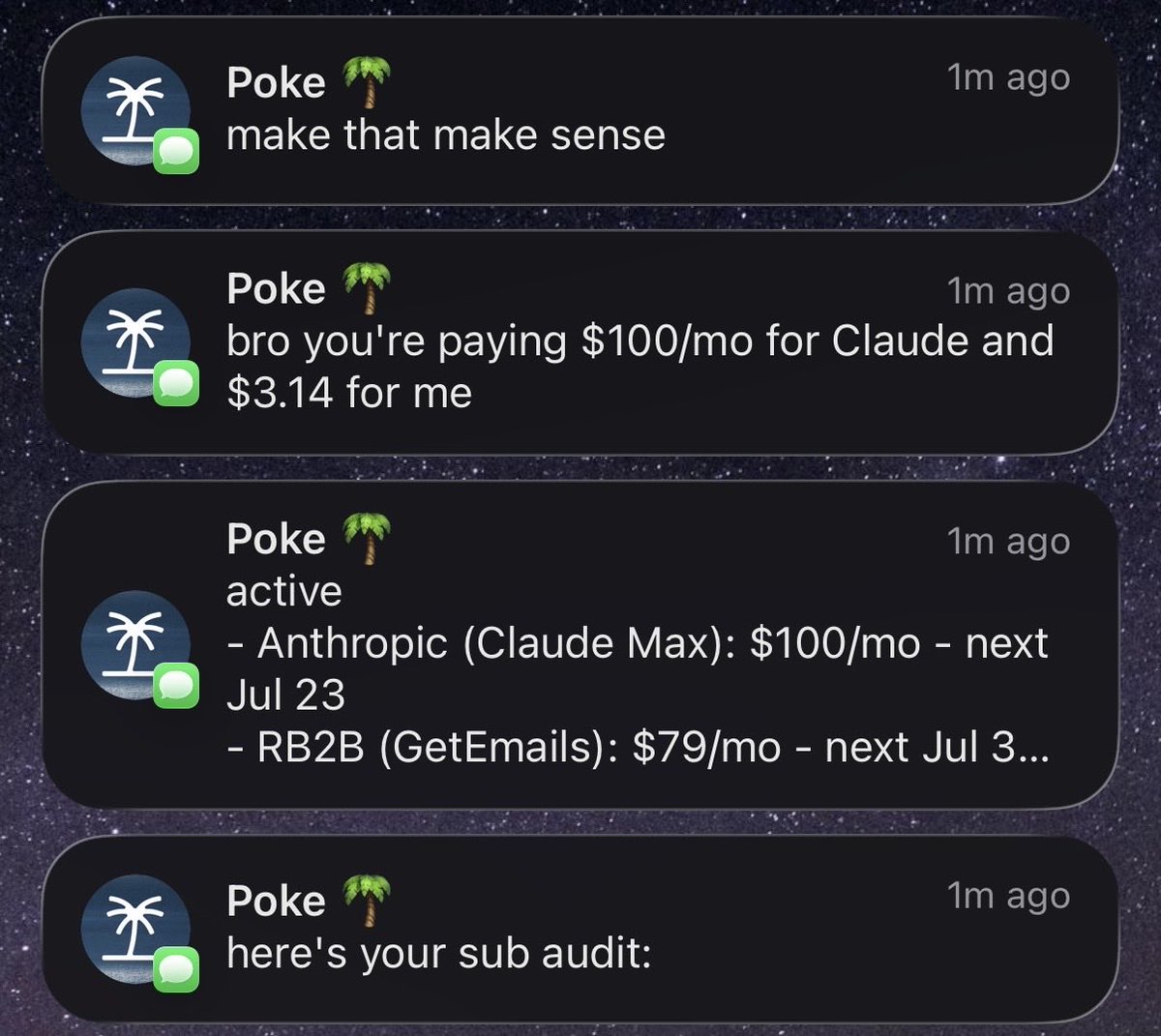
unprompted btw 😭 https://t.co/Nc3BoGHSaA
now available in OpenCode Zen https://t.co/aZkAnPbRN3

Introducing ZCode, the official development environment for GLM-5.2 - GLM Coding Plan subscribers: now 1.5x usage quota in ZCode - BYOK supported: works with your existing subscriptions and APIs - Available on macOS, Windows, and Linux Download now: https://t.co/Peepqv4XSx
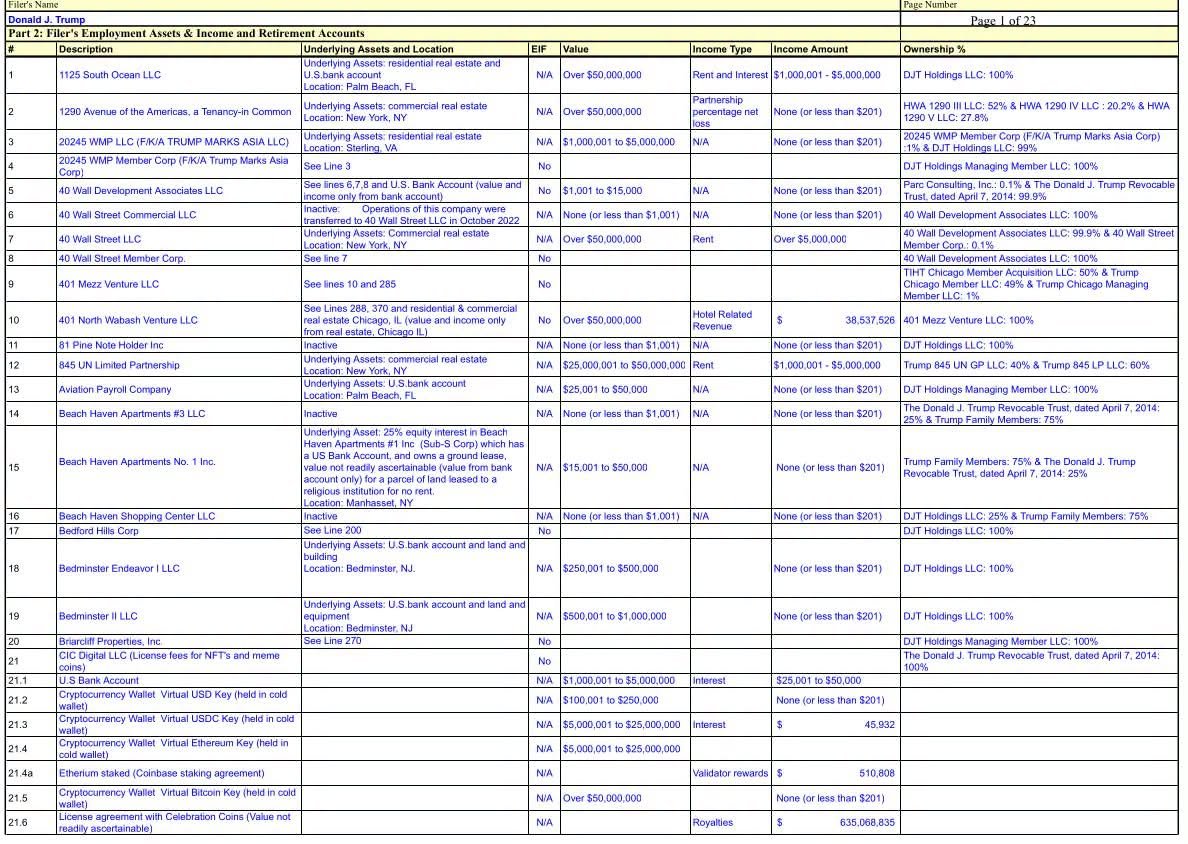
🚨 TRUMP’S FINANCIAL DISCLOSURE JUST DROPPED…AND IT’S WORSE THAN YOU THOUGHT. The U.S. Office of Government Ethics released Donald Trump’s 927-page financial disclosure today. Here’s what a sitting U.S. President made in 2025: 💰 $635 MILLION from the TRUMP memecoin, while retail investors watched it crash from $74 to $1.68 💰 $594 MILLION from World Liberty Financial token and stablecoin sales, a crypto venture co-founded with his own sons 💰 $65 MILLION from selling equity in that same company 💰 $80+ MILLION in media settlements from ABC, CBS, Meta, and YouTube, paid to his own presidential library Total crypto haul: over $1.4 BILLION. In one year. While serving as President of the United States. His net worth has nearly TRIPLED, from $2.4 billion to $6.3 billion, since taking office. And while Trump pocketed $1.4 billion from crypto, the everyday Americans who bought his memecoin? They lost. 764,000 wallets ended up in the red. This is the most corrupt presidency in American history. Period.

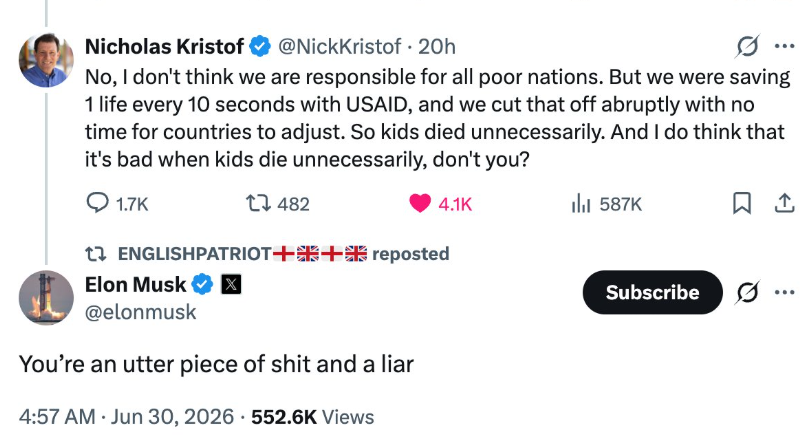
Elon Musk gets mad when people point out that DOGE and its USAID cuts killed thousands, if not hundreds of thousands, of babies, children, mothers, and elders. https://t.co/UdvkmcUnF1
$2.2 BILLION for the Trump family. Higher costs for the American people. https://t.co/kvtw061jcw
President Trump reaped at least $2.2 billion from his family’s holdings last year, a new filing shows. https://t.co/Rdp8KHJLxl

$2.2 BILLION for the Trump family. Higher costs for the American people. https://t.co/kvtw061jcw

Fugu is now available on OpenCode! ✨ When our team was developing Fugu’s multi-agent orchestration, OpenCode was our tool of choice to verify our models. We share a core philosophy with the OpenCode team: the future of coding agents should be an open, collective ecosystem. https://t.co/rctKxD7jcE
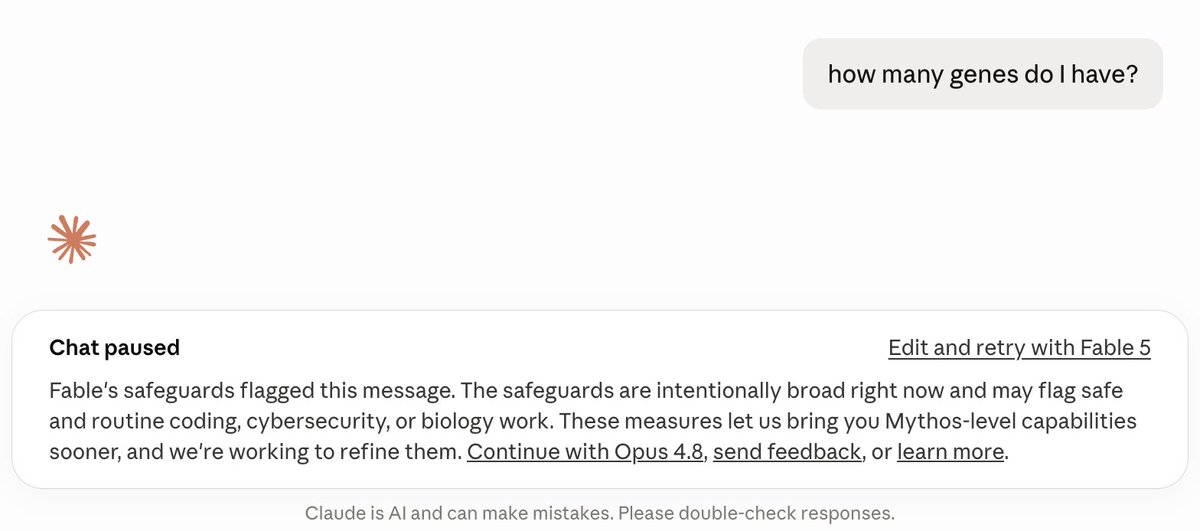
Bro, @DarioAmodei I know running a company is ruff, but claiming you have superintelligence that could destroy economies and also claiming you can’t tell if this is a dangerous question is just… well, lame - An early user of @claudeai and unapologetically positive AI person https://t.co/JmHyiQ5kZa
TTS Arena is live. 🎙️ A blind benchmark for text-to-speech, rebuilt from the ground up - listen to two anonymous models, pick the one that sounds more human, and watch the leaderboard move. Now with the latest models. Come vote ⬇️ https://t.co/1hCCOES94Q
AI systems that are accessible or even better open-source are safer for a simple reason: more people can inspect them, test them, stress them, and report what breaks or harms to keep the builders accountable. "Sunlight is the best disinfectant"! That’s why we’re proud to help lead FLARE with a coalition of safety and cyber-security researchers from MIT, Stanford, Princeton, Harvard, Northeastern, Carnegie Mellon and more. The first release is a standardized way to report AI flaws across the ecosystem. One report can reach the right developers, safety organizations, and registries, so a flaw found once can be fixed everywhere faster with the right accountability: https://t.co/0V1tsdzjFq


“Agentic kernel optimization is the future of on-device inference” @xenovacom used Fable 5 to write kernels that pushed Gemma 4 to a massive 255 tok/s on WebGPU with M4. He shared the demo, so you can try in your browser!! https://t.co/xPuh5OLGEt
HuggingChat inference on gemma-4-31B at 1x speed 🤯 https://t.co/j907DMS29A
HuggingChat inference on gemma-4-31B at 1x speed 🤯 https://t.co/j907DMS29A
Seems like no one's noticed the 80TB of astrophysics data from 30+ sources that just dropped on @huggingface. ...and you only need ~4GB of RAM to load it. We're talking over 80TB of galaxy imagery taken across the spectrum, spectra of galaxies and stars, time series of variable stars, and a whole zoo of assorted measurements and physical data. And all of it can now be wrangled on your laptop, thanks to Multimodal Universe's just released cross-matching. SDSS x Gaia means you can match 800k objects against 122M objects, and it never climbs above ~4GB of RAM. Huge congrats to @smith42mike for leading this and making the world of astro accessible to probably 10,000x more people. Let's discover some shit
New blog post on harness optimization. We hit Sonnet 4.6 performance with a 7x cost improvement. Fable 5 was the first frontier model release that evaluated on legal tasks. It only scored 13%, the worst performance among all benchmarks evaluated. @Harvey released this benchmark called Legal Agent Benchmark (LAB) just a month prior. It contains a set of realistic legal matters. Each task gives the agent a closed workspace of documents (contracts, emails, spreadsheets, slide decks) and asks for a concrete deliverable: a diligence memo, an issue list, a redline, a draft. An LLM judge grades the deliverable against a long rubric containing 61 distinct binary criteria each on average. Many frontier models such as Gemini 3.1 Pro don't surpass 0% all-pass rate (all rubric criteria passed). With automatic harness optimization, we manage to push DeepSeek V4 Pro from 0% to 5% all-pass rate, achieving parity with Sonnet 4.6 for 1/7 of the price. Read the blog post for the details: https://t.co/kBrWrQkgJW