Your curated collection of saved posts and media
Since announcing Jalapeño, our first custom inference chip, we’ve been testing it and the system around it. The results show a major advance: more intelligence from every watt and faster responses, delivering both higher throughput and lower latency in one architecture without sacrificing efficiency.
Aloha! 🌺Introducing Ornith-1.5, a family of open-source LLMs spanning 9B Dense, 35B MoE, and 397B MoE, trained with self-improving strategies. It achieves state-of-the-art performance among open-source models of comparable size and delivers performance comparable to Claude Opus 4.8 across reasoning, agentic, and coding tasks: ✅Terminal-Bench 2.1 (86.1) ✅SWE-Bench (86 on verified, 65.1 on pro, 79.6 on Multilingual) ✅DeepSWE (56) ✅HLE (44.6) ✅ClawEval (81.4) ✅Tool Decathlon (71.2) Ornith-1.5 takes a major step toward training foundation models through end-to-end self-improvement, extending the self-scaffolding strategies introduced in Ornith-1.0 into a more complete self-improvement loop: the model proposes new tasks, generates task-specific scaffolds, and produces solution rollouts for reinforcement learning, continuously creating new learning experiences from which it can improve. All models, along with their quantized versions (FP8, GGUF, MLX, and NVFP4), have been released under the MIT License, enabling unrestricted commercial and research use. 📘Tech Blog: https://t.co/OZ63scRWLB 🤗Huggingface: https://t.co/mGJLwhrQOM
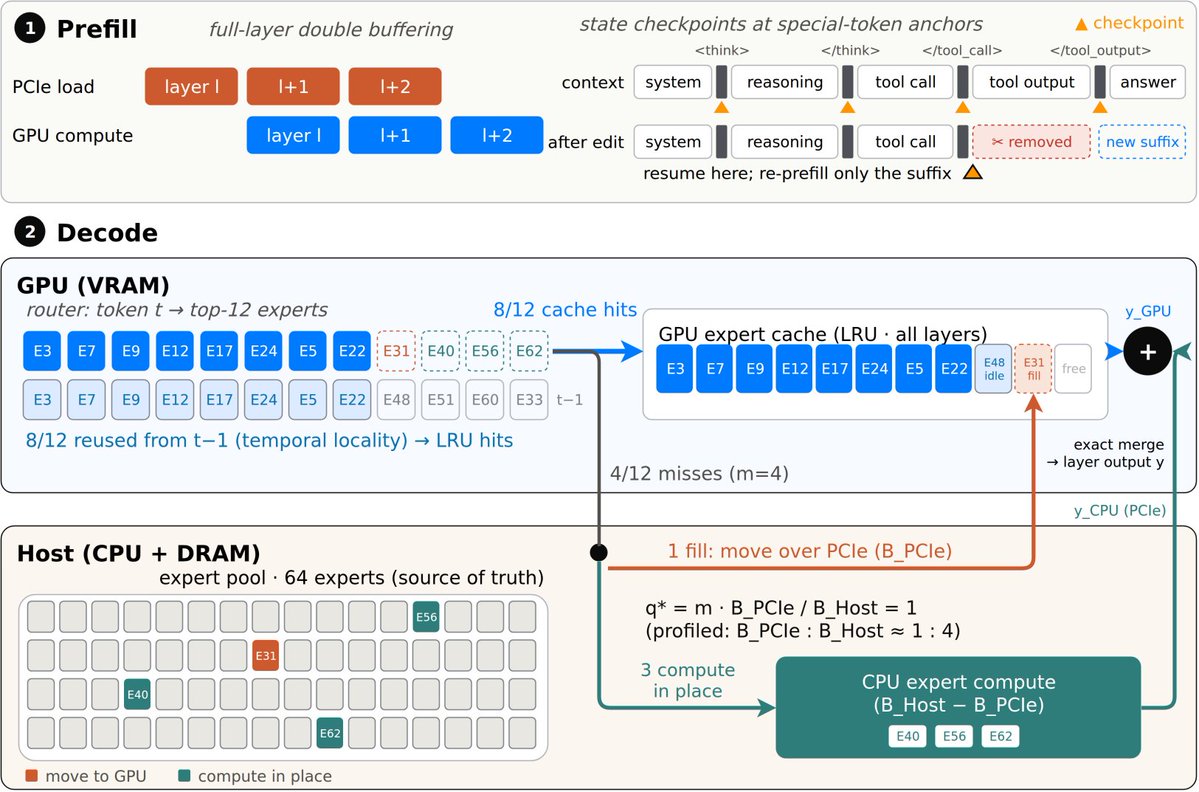
FreeToken is fast. Comparing to Ollama, we have 3–4× faster decode, and 6–30× faster prefill How? We introduce bandwidth-adaptive CPU–GPU execution + semantic-aware caching across agent turns. More details in the technical report: https://t.co/V3sIxbPMGU https://t.co/IsJZfQJ1FL
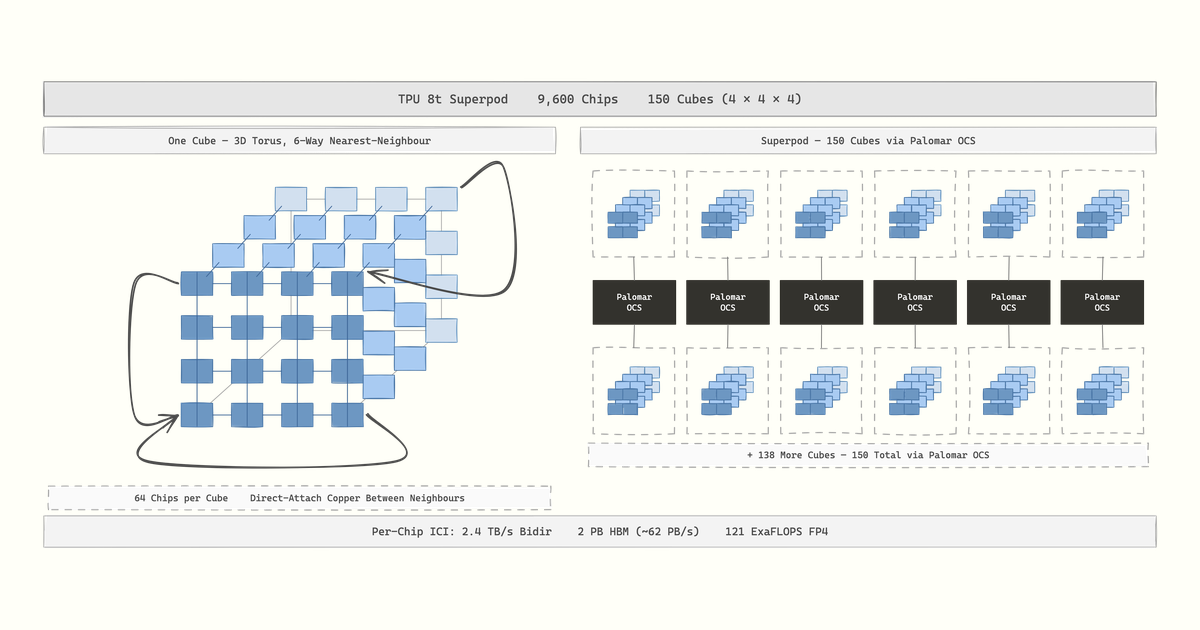
sharing a new long-form blog post: ai chip architectures it covers the leading chip architectures (nvidia, amd, tpus, trainium, cerebras, groq) across architecture, scaling (scale-up and scale-out), and software stacks. it helps build an intuition for the architectures and their trade-offs. https://t.co/7eZMh3ddZS
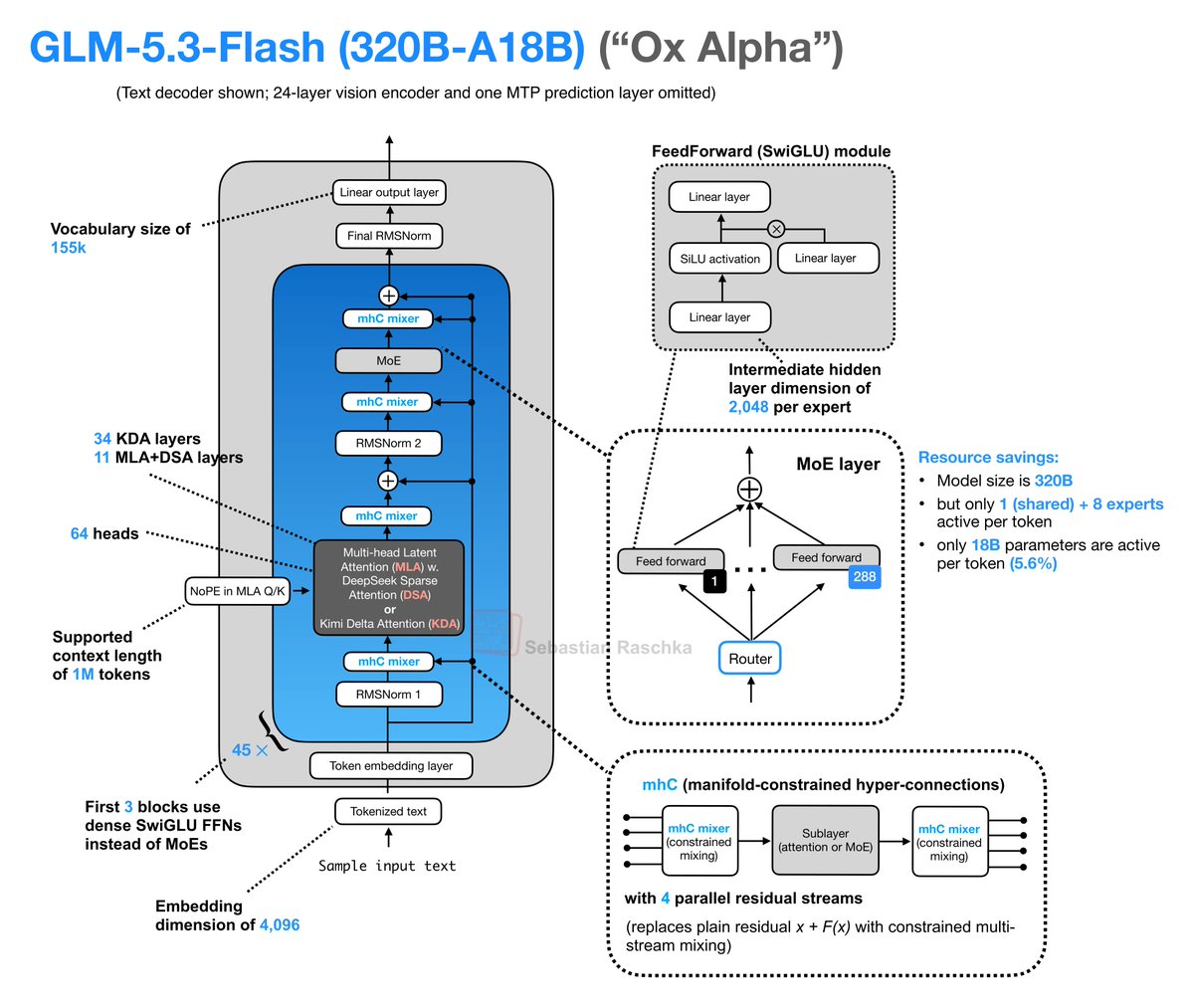
Now we know: The popular Ox Alpha LLM was GLM-5.3-Flash... Compared to GLM-5.2, this new GLM-5.3-Flash model uses: - a Kimi Linear-style 3:1 (super*) hybrid attention pattern with 34 Kimi Delta Attention layers (KDA) and 11 Multi-heat Latent Attention (MLA) / DeepSeek Sparse Attention (DSA) layers; - a scaled-down GLM-5.2-style sparse MoE backbone, going from 744B-A40B to 320B-A18B; - a DeepSeek V4-style mHC residual path with four parallel streams; - plus a native vision encoder (not shown). * "Super hybrid" because both KDA and MLA/DSA are "efficient" components. E.g., Kimi only uses KDA + full attention GQA, DeepSeek V3.2 uses DSA + full attention MLA. PS: Sry for the excessive tech jargon. Explainers on all these components (MLA, DSA, KDA, mhC, etc.) in my LLM Architecture Gallery PPS: Haha, maybe justification for getting that pricey Mac Studio M5 Ultra 256 GB / 512 GB to run this locally...
Introducing GLM-5.3-Flash - Leading capabilities at a highly competitive price - Natively multimodal with a 1M-token context window - A 320B-A18B model released under the MIT License - Previously previewed as Ox Alpha, running entirely on Chinese AI chips Blog: https://t.co/tzO
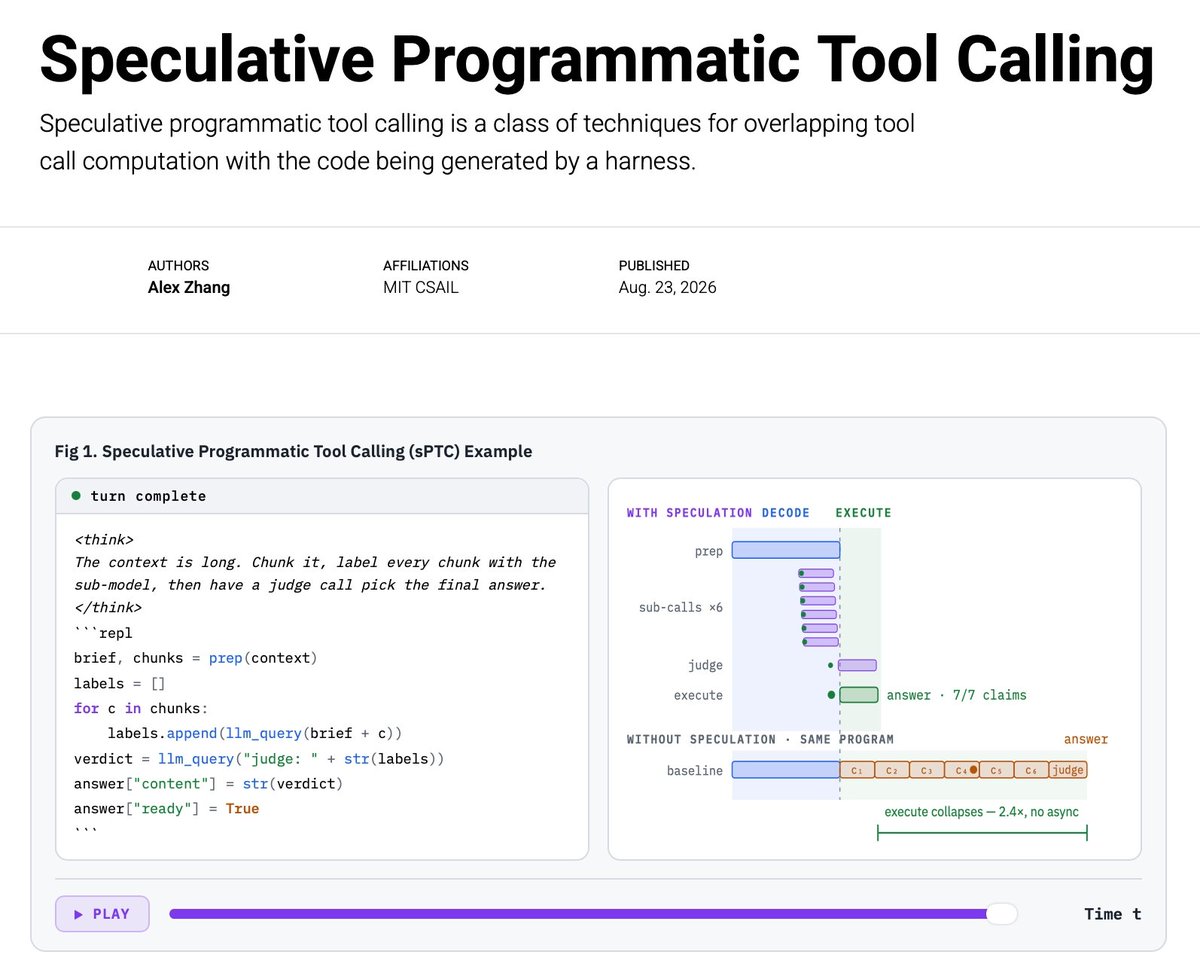
Introducing Speculative Programmatic Tool Calling (sPTC)! A general class of technique for speculating on tool calls during code generation in a harness and queuing them early to overlap with token generation + REPL execution time. Blog: https://t.co/0nzkLvTXNy https://t.co/SVH8D2JyEg
Face Anything: 4D Face Reconstruction from Any Image Sequence ECCV 2026 https://t.co/smXN0FGjRg Face Anything is a unified feed-forward model for high-fidelity 4D face reconstruction and dense tracking from arbitrary image sequences. The key idea is canonical facial point prediction, a representation that assigns each pixel a normalized facial coordinate in a shared canonical space. This formulation transforms dense tracking and dynamic reconstruction into a single canonical reconstruction problem, producing temporally consistent geometry and reliable correspondences.
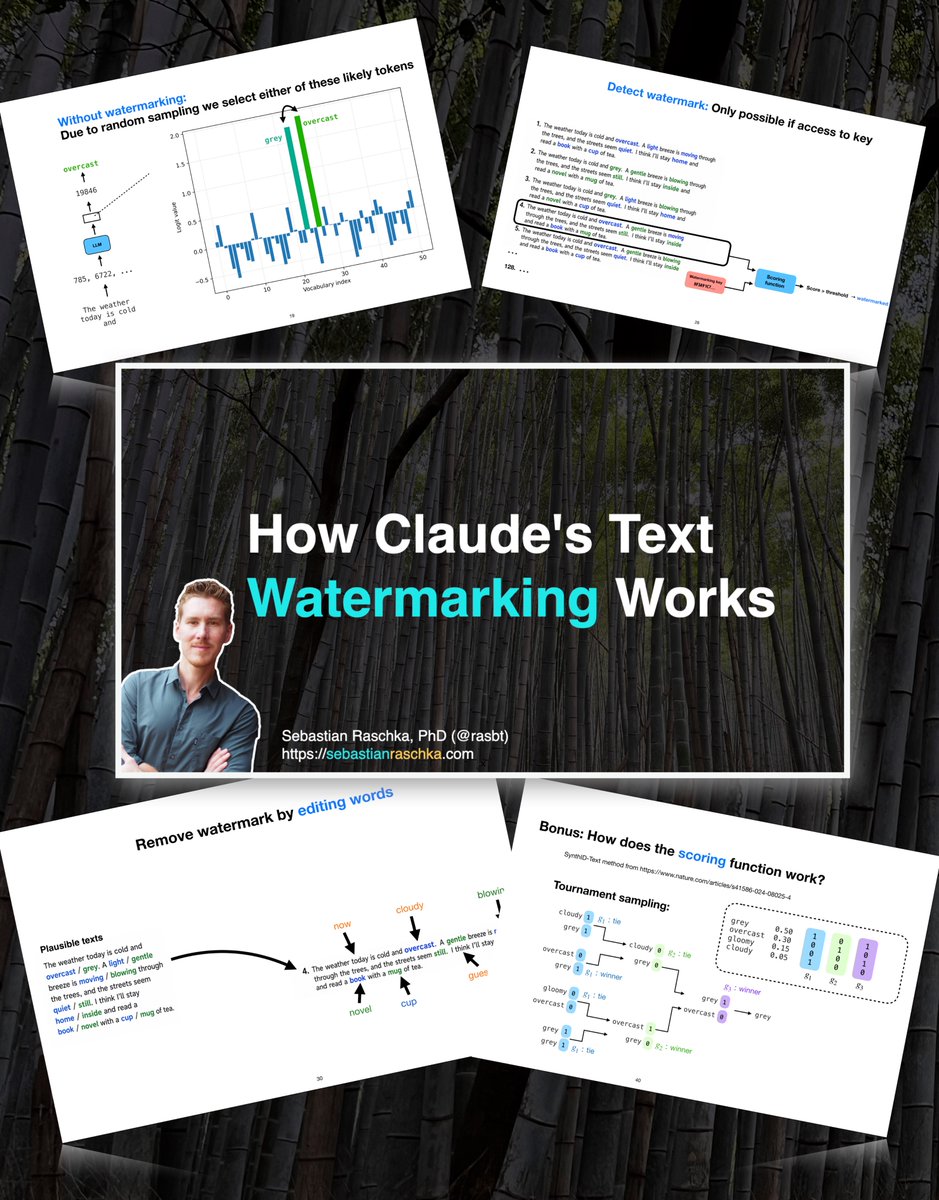
A couple of days ago, I did a quick explainer on Claude’s new watermarking process and implementation. Since it’s such a popular topic and sparked such a lively discussion, I thought it might be interesting to go into a bit more detail when explaining how it works. So, instead of the usual text article, I recorded a little lecture on the topic (to change it up a bit from my usual articles). It ended up a bit longer than intended, but I hope it clarifies a lot of things: - Sampling the next token in an LLM and pseudorandom number generators - How watermarking relates to the regular LLM sampling process - Whether watermarking makes text "worse" - How to remove watermarks - Tournament sampling - How new text is checked for watermarks without rerunning the LLM I ended up with ~50 slides, but I hope that these explain it well, though! Happy watching!
McByte sets a new SOTA on the SportsMOT benchmark MOT is short for Multi-Object Tracking, and is typically evaluated using the HOTA (Higher Order Tracking Accuracy) metric Find the major papers and benchmarks here: https://t.co/FSHY8IiBoT https://t.co/YAXti6Apww
McByte sets a new SOTA on the SportsMOT benchmark MOT is short for Multi-Object Tracking, and is typically evaluated using the HOTA (Higher Order Tracking Accuracy) metric Find the major papers and benchmarks here: https://t.co/FSHY8IiBoT https://t.co/YAXti6Apww
McByte shipped in trackers 2.6.0 similar to ByteTrack, but association is guided by segmentation masks (SAM + Cutie), not just boxes when players overlap and box IoU gets ambiguous, masks settle who is who here it is side by side with OC-SORT link: https://t.co/9Fam5U1zuC htt