Your curated collection of saved posts and media
Introducing Metaphor: The most cost-efficient cloud coding agent. We outperform Claude Code and Codex on Terminal-Bench 4.0 while achieving a 95% cache token rate. We use ~25% fewer tokens than Claude Code and Codex. DM us to try it free for a month. https://t.co/QeOT0Ju1jQ
Agent Manager is finally out! Orchestrate dozens of agents across harnesses (Claude Code, Codex, OpenCode etc.) effortlessly. Agents communicate and self-organize to help you achieve complex tasks and always keep running on HF spaces. Try it: https://t.co/JSPum13a0g https://t.co/grfIsuCQPK
I built a full game asset kit with my Hermes Agent and the Meshy plugin, about ~1h30 in one Hermes Desktop chat. what we made: - a duck knight hero, rigged, with idle, slash, walk and run animations - a hooded cultist duck enemy, rigged, with idle, spell cast, walk and run animations - 9 props for a ruined, Lovecraftian level: a shrine, a cursed lantern, an iron gate, two tombstones, a tentacled idol, a treasure chest, an altar and a broken pillar - 17 game-ready GLB files - the duck knight as a 10 cm figure, single color, STL and OBJ, ready for a slicer what Hermes did with Meshy: - planned the kit with a credit cost per step, then waited for my yes - made design images with front, side and back views, so I picked the look before anything went 3D - turned the picks into textured 3D models and showed each one in the chat - rigged both characters and added the animations - built the props in batches of three - made everything game-ready: the triangle counts were already fine, so it shrank the 4K textures instead and took the kit from 500 MB to 132 MB - checked the figure for printing at 10 cm, repaired the walls that were under 1 mm, and checked it again it asked before every paid call. the whole kit used 541 credits. @MeshyAI is offering Hermes users a month of Pro with 1,000 credits for $1, so this kit used about half of it. all 89 files landed in one project folder.
spent a few days trying to train a tiny model to diagnose patients on the Synthetic Hospital environment out of CMU. RL didn't help much, but some SFT and a simple search tool got qwen3-4b to perform as well as a ~1T param model this is because the agent is more than just the model. 🧵:
The evals book is here. Hamel is the evals 🐐 and I’m lucky he wanted to write this book with me!! We are grateful for our reviewers, editors, illustrators and readers. Order it on Amazon; or come to our book signing to get a copy (link in replies).
I read the error analysis chapter of Evals for AI Engineers by @HamelHusain and @sh_reya and realised I already had the dataset. Some backstory. I work with coding agents all day: Claude Code, Codex, Hermes, Antigravity. Every session is a trace. What I typed, every tool call, w
Hermes Agent can now pick a different model for each sub-agent from routes you define. fast for lookups. deep for debugging. local for private work. one plugin. Advanced Delegation. official plugin from @NousResearch two modes: ▸ model routes define named routes. the agent picks per task. delegation: backend: model_map backends: model_map: options: - name: fast description: "cheap and quick: lookups, summaries." provider: openrouter model: google/gemini-3-flash-preview - name: deep description: "slow and careful: hard debugging." provider: anthropic model: claude-opus-5 - name: local description: "private: runs on this machine." base_url: http://localhost:8080/v1 model: qwen3-coder default: fast the agent sees only the names and descriptions. never the raw provider, model ID, or API key. it can't invent a route. only pick from your list. ▸ profile routes sub-agents run as your Hermes profiles. each profile carries its own model, credentials, skills, and SOUL.md. delegation: backend: profile_routes backends: profile_routes: profiles: - name: coder description: writes and refactors code. - name: researcher description: web research and summaries. default: coder delegate a research task. it runs as your researcher profile with researcher's model, researcher's skills, researcher's memory. fully isolated. switch modes in any chat: /delegation models --now /delegation profiles --now /delegation default or configure from CLI: hermes delegation config hermes delegation config --show install: hermes plugins install advanced-delegation requires Hermes 0.22.5 or newer.
We are really excited to build independent evaluations of RSI progress and are actively hiring. We constantly see conflicting evidence about RSI progress. Most hinges on information coming from labs. To illustrate this, let's just look at evidence discussed *this week* that conflicts in whether it suggests RSI progress is fast or slow. https://t.co/F4vi5Z3fch Results from OpenAI and Google evals indicate the time horizons for R&D tasks being automated are around ~15 minutes, which are much slower than METR time horizons for software tasks. This suggests we should have *slower* RSI timelines. https://t.co/RfFobR22bw Results from Mirendil indicate that pretraining at a certain scale can be heavily automated such that it can be managed by a single pretraining researcher. This suggests we should have *faster* RSI timelines. https://t.co/lIYID0eFII Results from Nvidia indicate that frontier models provide significant uplift for CUDA optimization. This suggests we should have *faster* RSI timelines. Each piece of evidence is more complex than what I write here. Interpreting them all together is confusing even if you trusted them all fully. And factoring in the underlying level of credibility is basically impossible: each result is basically just some plots and numbers selectively disclosed by labs in a tweet/talk/report. So deep sense-making about RSI progress is very hard. If you are interested in building independent RSI evals, apply here: https://t.co/w6CfTsvJfI
We are really excited to build independent evaluations of RSI progress and are actively hiring. We constantly see conflicting evidence about RSI progress. Most hinges on information coming from labs. To illustrate this, let's just look at evidence discussed *this week* that conflicts in whether it suggests RSI progress is fast or slow. https://t.co/F4vi5Z3fch Results from OpenAI and Google evals indicate the time horizons for R&D tasks being automated are around ~15 minutes, which are much slower than METR time horizons for software tasks. This suggests we should have *slower* RSI timelines. https://t.co/RfFobR22bw Results from Mirendil indicate that pretraining at a certain scale can be heavily automated such that it can be managed by a single pretraining researcher. This suggests we should have *faster* RSI timelines. https://t.co/lIYID0eFII Results from Nvidia indicate that frontier models provide significant uplift for CUDA optimization. This suggests we should have *faster* RSI timelines. Each piece of evidence is more complex than what I write here. Interpreting them all together is confusing even if you trusted them all fully. And factoring in the underlying level of credibility is basically impossible: each result is basically just some plots and numbers selectively disclosed by labs in a tweet/talk/report. So deep sense-making about RSI progress is very hard. If you are interested in building independent RSI evals, apply here: https://t.co/w6CfTsvJfI
BREAKING NEWS🚨: NVIDIA ENGINEERS AT THE PYTORCH CONFERENCE JUST SAID THAT THE SPEED OF OPTIMIZING CUDA SOFTWARE WITH FRONTIER AI MODELS HAS INCREASED RAPIDLY October 2025 to August 2026: 5x in 1 year with expert human optimization September 2026 to October 2026: 2x in 1 month
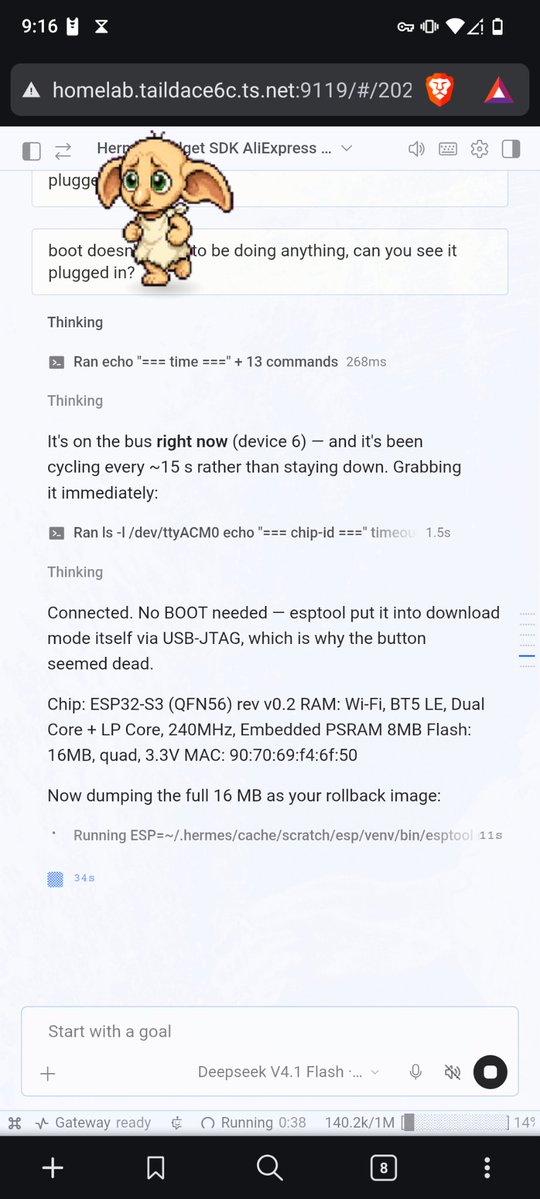
Got Hermes on my Optiplex homelab to strip out and re-write the firmware on a $40 AliExpress desktop ESP device. This would of been a project that could of taken a day of research and fumbling around internet forums. But here we are. Will update with progress once Hermes is loaded into the eye 👁️🗨️ The eye device I picke - battery with touchscreen: https://t.co/2Ec70DYmHo
🗝️ How Canvases Bring You and Your Coding Agent Together Explore canvases in #vscode Preview: shared workspaces where you and your coding agent can organize releases, prioritize backlog tasks, and turn cards into plans with context the agent can act on. From visualizing databases to managing cloud resources and app modernization, discover how to create or install a canvas that fits your workflow—and makes collaborating with your agent feel more seamless. https://t.co/2yslgB7rUC