Your curated collection of saved posts and media
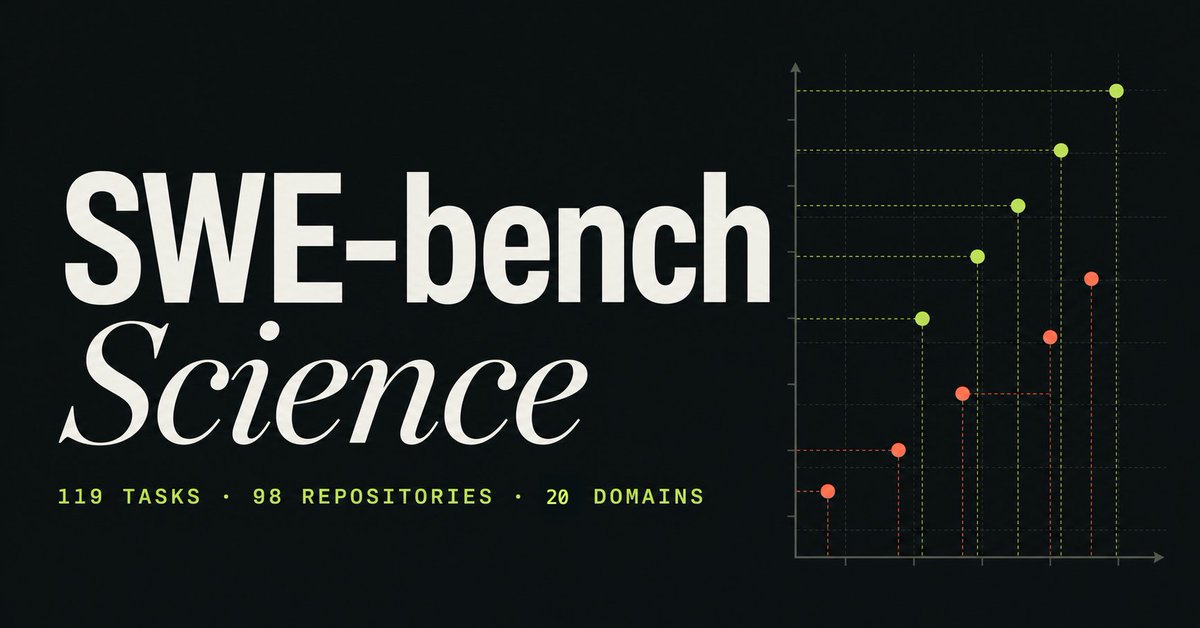
SWE-bench Science A new benchmark for scientific software engineering: 119 tasks across 98 repositories and 20 domains. Even the best agent, Claude Code with Opus-5, achieves under 50% pass@1. https://t.co/LtdNeJdwEh
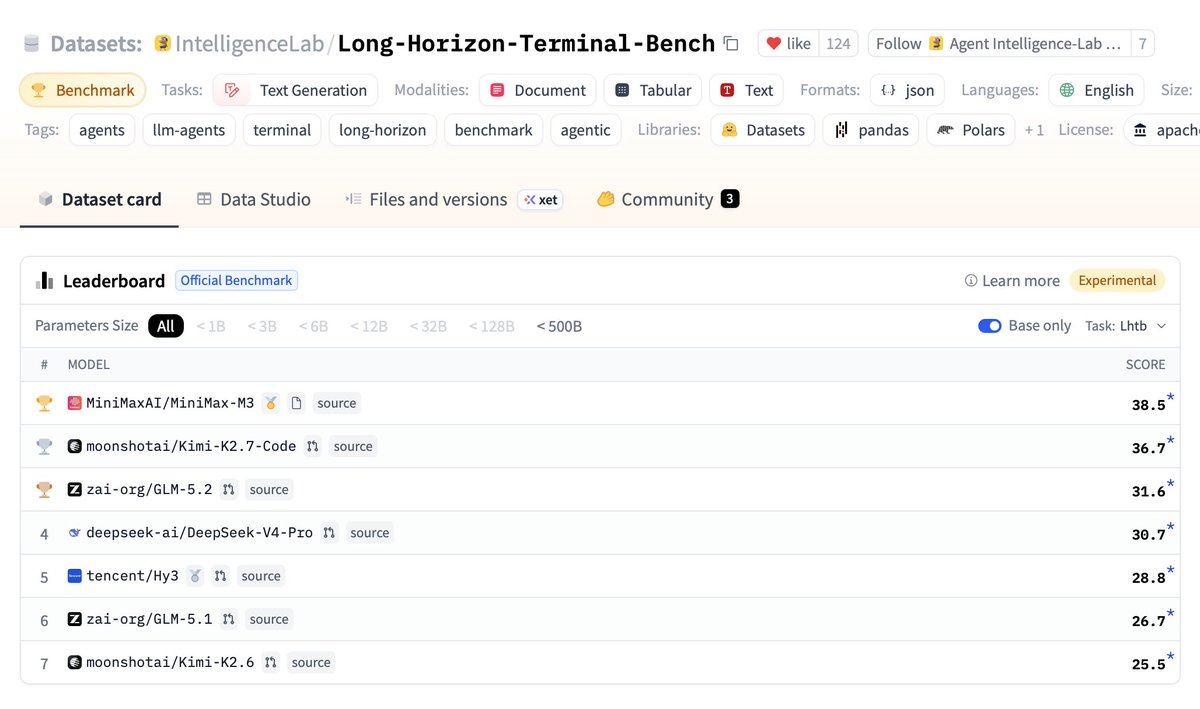
NEW BENCHMARK ON THE @huggingface HUB Your favorite LLM agent can write a script. Can it survive 300+ steps in a terminal without losing the plot? That's what Long-Horizon Terminal-Bench (LHTB) measures, 46 tasks, contamination-resistant, hidden verifiers that check real state, not vibes. 🏆 Leaderboard 🥇 @MiniMax_AI 's Minimax M3 🥈 @Kimi_Moonshot 's Kimi k2.7 Code 🥉 @Zai_org's GLM 5.2 Congrats to @zli12321 and team. Super excited to see how smaller local models perf on this benchmark @0xSero :)
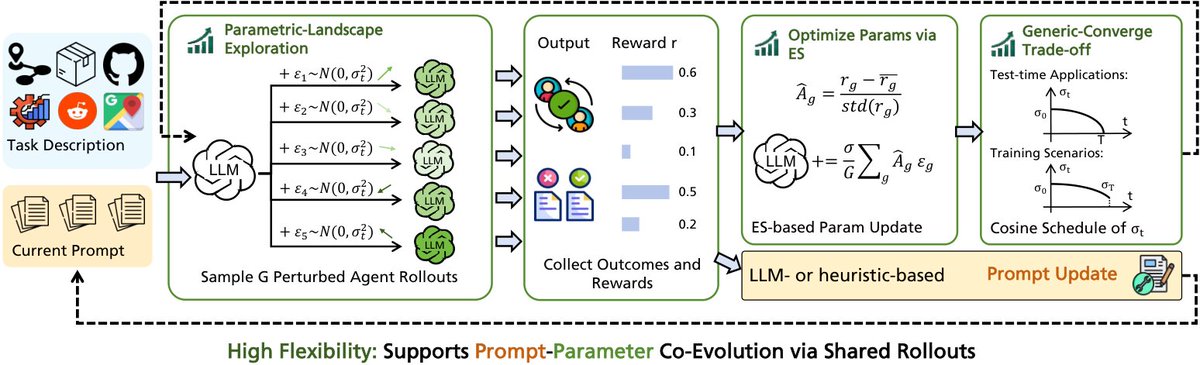
Agentic ESOpt: fine-tuning long-horizon LLM agents with minimal GPU memory This framework uses evolution strategies instead of backpropagation, enabling full-parameter optimization with only inference-level memory, and shows strong gains on WebArena-Lite and more. https://t.co/PP1j7ZP3H1
What's better than an open-weight multimodal model release? Well, the technical report. I just love how these labs like Qwen and DeepSeek continue to drop gem after gem. Qwen3.8-Flash is the latest in efficient multimodal MoE models. Worth reading the report. https://t.co/Z73tEodbgo
inspired by the anthropic post, i made a protein font! how does it work? when you design by differentiating backward through a folding model like esm-fold2 you can ask that the distogram of the folded protein looks like something you want. a little bit of help from @ChatGPT and now we have a protein font (fable, of course, didn't want to help me). this was not fully automated, i had to dial in some details like the protein sizes etc, but jointly me and codex got it working. i put the whole pipeline on my github below so you can mess with it too. bring your own gpus, its kind of expensive.
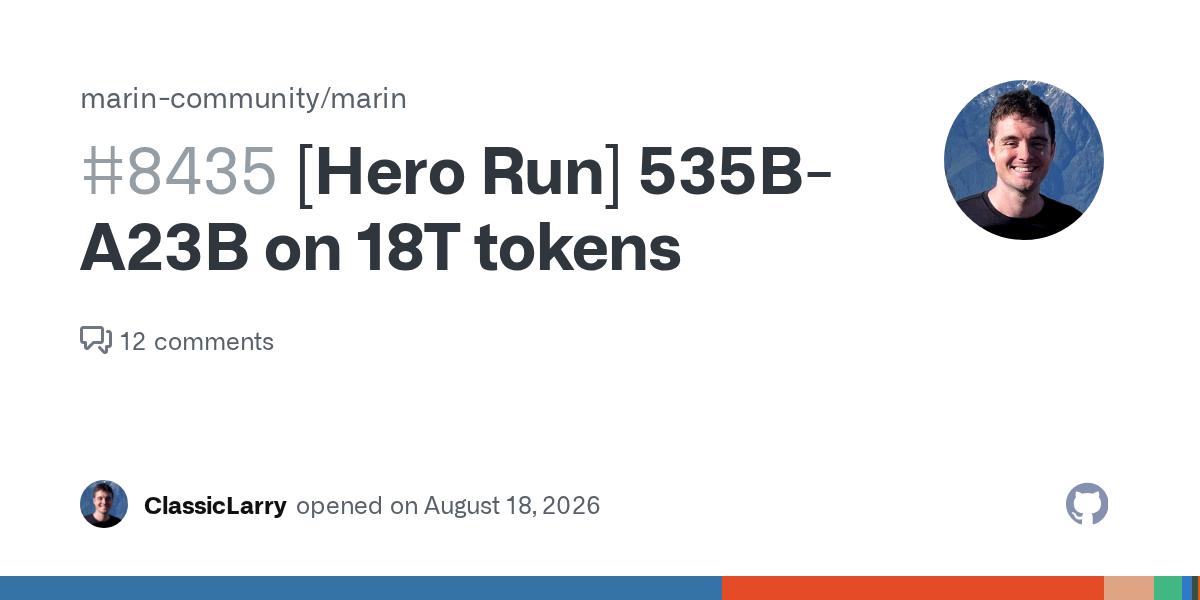
Look at our data composition: https://t.co/5K0v960lYh Watch the run live on wandb: https://t.co/7fg9VEFJ62 See all the gory details on GitHub: https://t.co/FH2w7Lx3Zm Assembling this hero run really required data, architecture, infra, kernels to all come together and was a huge joint effort by the entire Marin team!
Really cool article: how did a cybersecurity risk analyst at a bank end up replicating more than 300 ICML papers and finding dozens of mistakes? Using agents, @TrackioApp, and @HuggingFace: https://t.co/b1AY45SxCJ
TRANSIT (TRANsparent Scale-In for multi-node Training) is a runtime that makes unified virtual memory practical for large-scale LLM training, enabling models to train on up to 50% fewer GPUs without requiring modification to existing PyTorch training code. Hyungyo Kim, Ph.D. Candidate in Electrical and Computer Engineering, University of Illinois at Urbana-Champaign will present on TRANSIT as a poster at PyTorch Conference North America with Apoorve Mohan from IBM Research. Learn how to train more with less at PyTorch Conference North America: https://t.co/jBApW8nESi
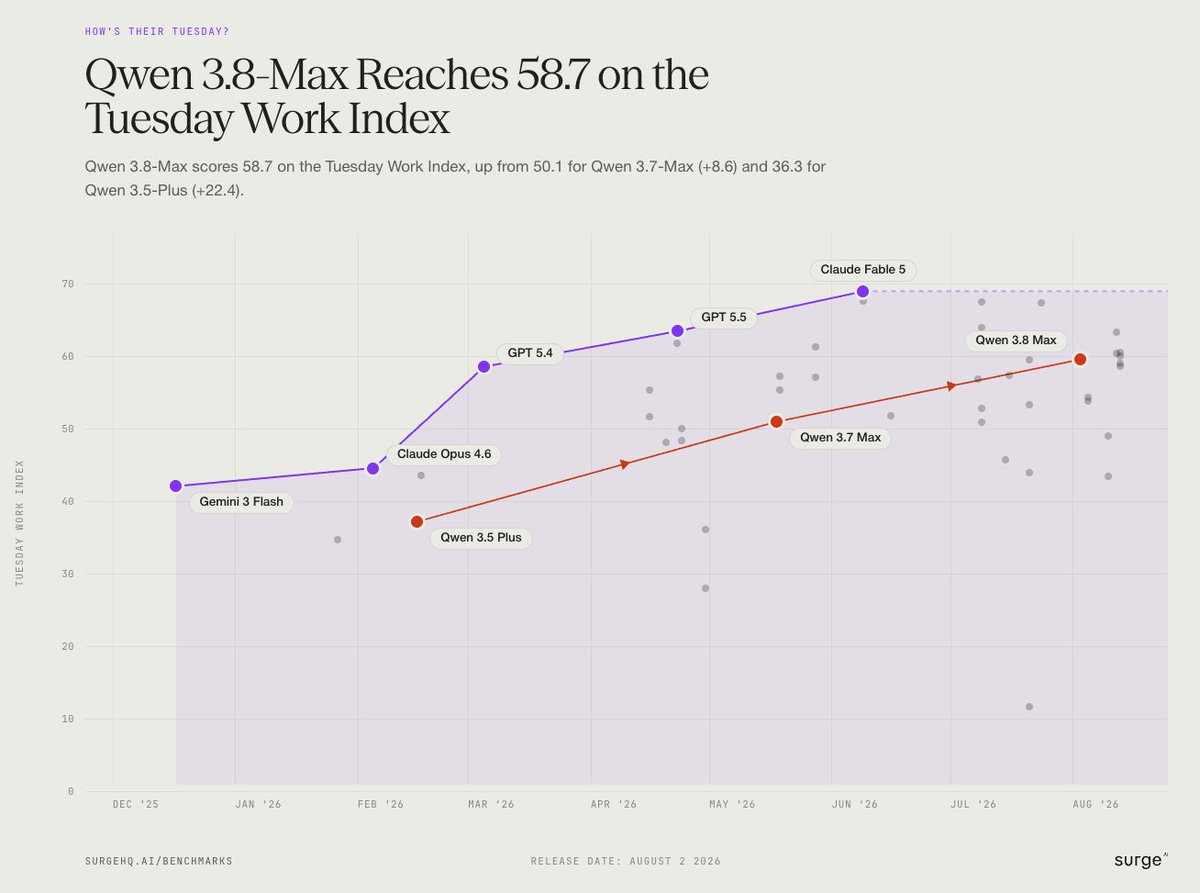
SURGE MODEL REPORT: QWEN 3.8 MAX Qwen 3.8 Max scores 58.7 on our Tuesday Work Index, our composite measure of frontier AI at work. Up +8.6 points from Qwen 3.7 Max and +22.4 points from Qwen 3.5 Plus. 🧵 of performance across our benchmarks:
New model architectures arrive weekly, but software compilation stacks often lag behind. Bringing up new hardware accelerators traditionally takes months of specialist work. In our latest technical blog, the IBM Spyre team demonstrates how AI coding agents can bridge this gap by writing runtime adapters. By patching unsupported operations and resolving memory alignment constraints, HF-adapters connected stock HuggingFace Transformers directly to PyTorch via torch-spyre. Key results include 13 AI-written adapters successfully enabling 7,960 of the top 10,000 HuggingFace embedding models, and 6,804 models passing complete end-to-end device tests on the IBM Spyre accelerator. Read the full technical deep dive here 👉 https://t.co/elZSgeU7oO @IBMResearch