Your curated collection of saved posts and media
@RonyVernet That’s not how AI works. LLMs sample outputs from a frozen probability landscape via interpolation and next-token probabilities. Every single generation requires external verification: a tool or a subject-matter expert. That’s precisely the point Tao is making. Mathematicians still have to interpret, validate and understand the results. They must judge whether something is correct, partial or hallucinated. Only then can it be integrated and taught. AI does not understand mathematics. It does not solve mathematics. It also cannot create new knowledge or understanding in people. AI is software. It cannot learn or understand things for you. Only a human can learn or understand. AI generates outputs. Only an external verifier can ground them. This is a gap in AI literacy. Hype continues to oversell what the technology can actually do.
🚨 Terence Tao warning about AI in mathematics. The greatest living mathematician new essay “Mathematics in the Age of AI” is one of the most significant individual responses from a leading researcher examining frontier AI’s impact on the discipline. The core message: AI will ma
Perfect weekend project doesn't exi... https://t.co/4LEwKN3dfG
Three Grok bots took four reference photos, built a physics simulator from them, ran 47 fracture experiments, rejected their own hypothesis, picked the best designs, sliced them, and 3D printed them. Images to physical object in one autonomous loop, steered from an Apple Watch.
Grok @bot is incredible - and they can even manufacture real physical objects! Here is a little experiment I did last night: I created a team of bots and asked them to solve a complex engineering problem end to end - starting from four images as design cues, inferring transferabl
just had a quick look at microduck_rl the codebase is very elegant, i’d recommend reading the agent.md since it contains quite a few fun quirks for reward modeling like head tracking too tight impairs walking cause the head is 38% of the duck’s weight, so it naturally oscillates -> to solve this, smooth the head tracking error using ema, essentially penalizing only the dc bias also a few other quirks as you dig deeper into the codebase like how they model the backlash of the motor by adding an unactuated hinge (with very small range) in series with the motor gg @antoinepirrone https://t.co/p7tvex9RSp

RoadScan-AI-Automated-Pothole-Detection-Tracking RoadScan AI is a computer vision system built to automatically detect and track potholes in road footage — including dashcam, drone, and fixed-camera video. At its core, the system uses a YOLO11n model fine-tuned on a custom pothole dataset, paired with ByteTrack for multi-object tracking. This enables the system to maintain a consistent identity for each pothole across frames rather than treating every detection as a new, isolated event.
llama.cpp docs now have a new home, shipped with ❤️ upcoming: speculative decoding in detail, quantization (k-quant, i-quant), coding agents what do you want to see next? 🤗 📖 https://t.co/g96cTPR24g @llama_cpp
We're excited to release the best open-weight model for robotics. Isaac 0.5 is a 36B, 2.5B active per token model, one sparse backbone serving video perception, embodied reasoning and robot control.
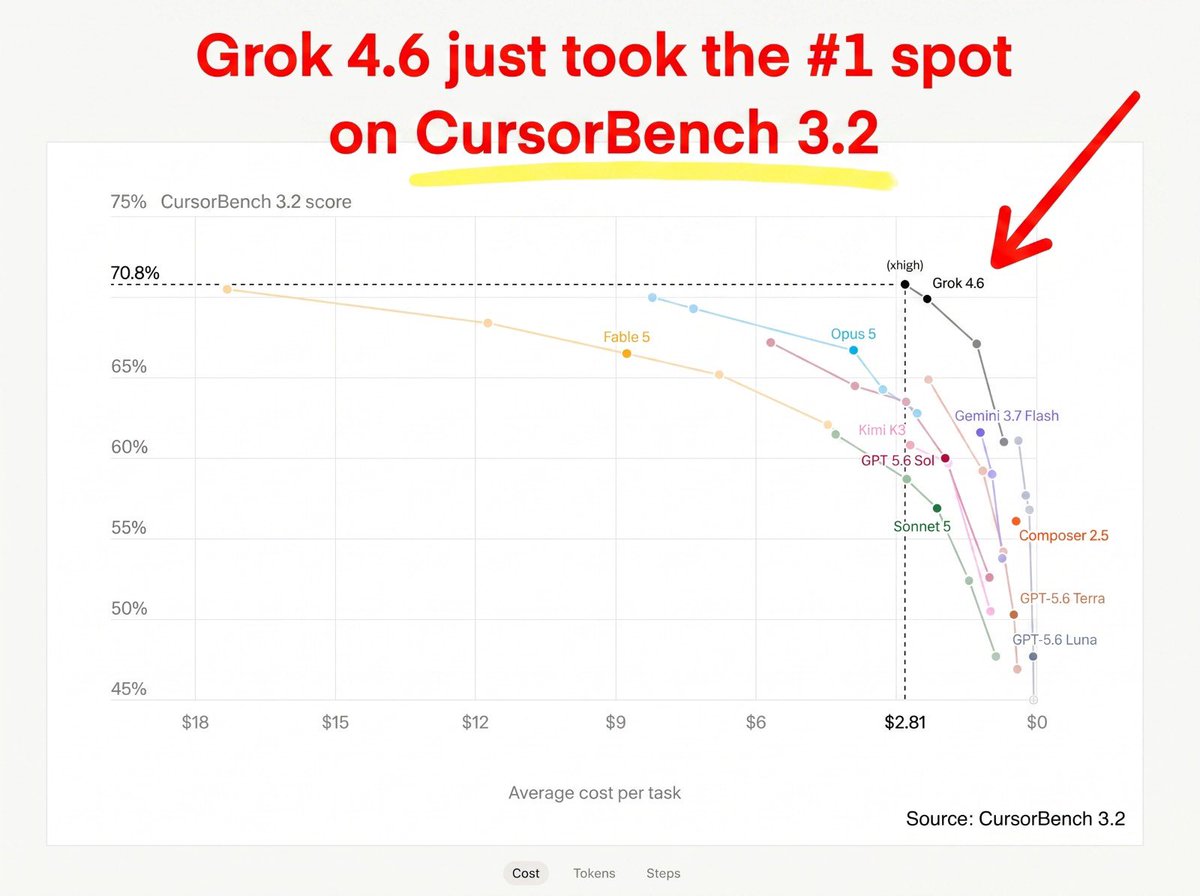
BREAKING: Grok 4.6 just took the #1 spot on CursorBench 3.2 — while delivering a massive efficiency advantage. ⚡💻 • Grok 4.6 Extra High — 70.8% | $2.81/task • Fable 5 Max — 70.5% | $17.32/task • Opus 5 Max — 70.0% | $8.23/task • GPT-5.6 Sol Max — 67.2% | $5.69/task Grok achieved the highest score while costing roughly 6× less than Fable 5 Max and nearly 3× less than Opus 5 Max per task. For AI agents, raw intelligence is only part of the equation. The ability to maintain high performance across long coding tasks without burning massive amounts of compute could be a major advantage. Grok’s agentic coding efficiency is becoming seriously impressive. 🚀 Source: CursorBench 3.2
GLM-5.3 open weights are now public, and Modular Cloud has Day Zero support. GLM-5.3 is the most capable open-weights model for coding, with a 50% improvement over GLM-5.2 on @Zai_org's Code Bench. Try it today on Modular Cloud: https://t.co/MfICcw0WAP https://t.co/iLBeRD30LP