@pbeisel
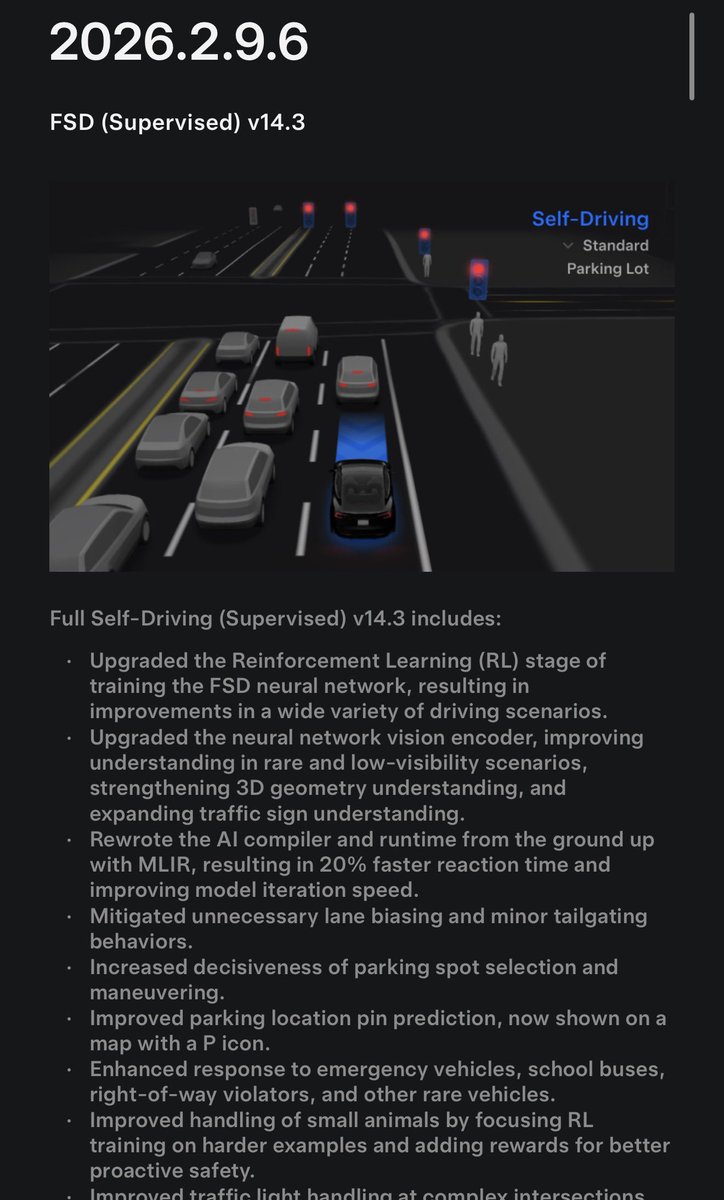
As FSD v14.3 rolls out, two aspects stand out. First is RL (reinforcement learning). It’s clear Tesla’s AI team has put significant focus here. This is what’s driving improvements in the “little things”— parking, avoiding road obstacles (animals now, potholes next), and other edge-case behaviors. The system benefits from large amounts of real-world data collected from customer vehicles and Robotaxis, which provides many usable training scenarios for the RL framework. That framework, while part of the broader training pipeline, runs on AI4 hardware at the Cortex data center and is highly compute-intensive. Given the number and variety of scenarios involved, it’s likely the total compute footprint for FSD v14.3 has grown substantially. Many of the other improvements in the release appear to stem from these RL efforts. Second is the release note: “Rewrote the AI compiler and runtime from the ground up with MLIR, resulting in 20% faster reaction time and improved model iteration speed.” This is a big deal. The runtime is what actually executes the model on the vehicle, many times per second. The model itself consists of the neural network structure and its learned parameters (the data). That structure defines how data flows through layers and is transformed (computed) during inference. Tesla’s AI team made the decision to completely rewrite this runtime (the inference data pipeline) to make it more efficient and better aligned with future development. This strongly suggests they needed/wanted greater compute efficiency on the AI4 platform and saw an opportunity to achieve it. MLIR enables a more abstract representation of computation, which in turn allows for deeper optimization of execution steps, reducing both memory usage and compute cycles. In short, this wasn’t a tweak, it was a full replacement of a core inference system, with meaningful performance gains (and some future proofing). Lastly, some have asked whether 14.3 includes the rumored 10× increase in parameter count. The short answer is: I don’t know and it likely doesn’t matter as much as people think. While increasing parameter count can improve the overall “driving function,” better tuning of existing parameters through RL will likely have a larger real-world impact. Tesla undoubtedly wants to scale parameters significantly, and the runtime rewrite may have created some headroom to do that (but it may ultimately require AI5). More importantly, a larger model doesn’t necessarily translate directly into better safety or decision-making compared to gains achieved through improved training and optimization.