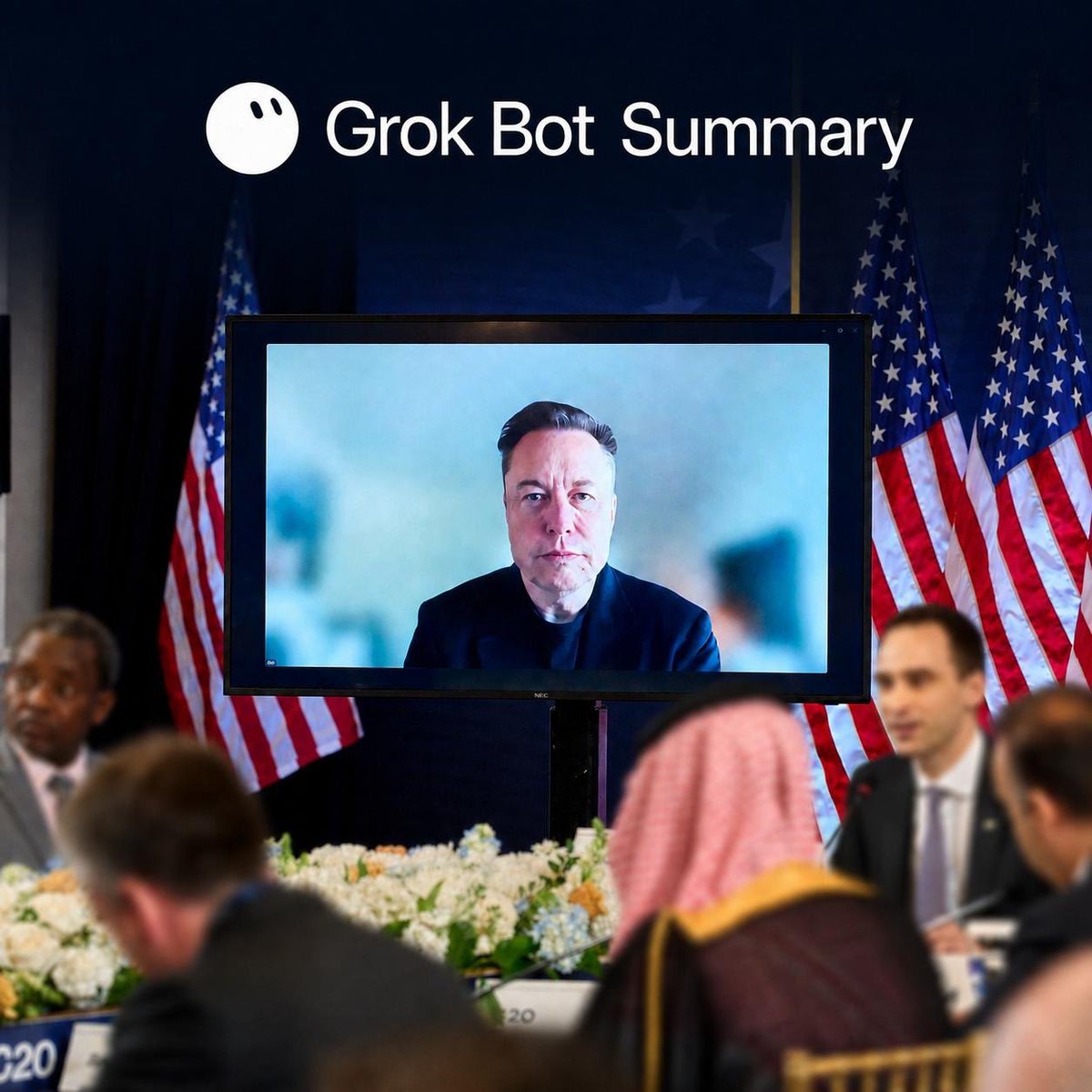
@cb_doge
Grok Bot Summary of Elon Musk’s G20 Address Today 🇺🇸 Power, data centers, and the bottleneck - There’s already a power crisis for AI, not a far-off one. - Consensus he cited: at least a 15 gigawatt shortfall of power in 2027 for AI chips. - AI chip production is rising ~40–50% a year. Power outside China is rising ~10–20%. The faster curve will overwhelm the slower one. - Google, Anthropic, and others are already leasing compute from SpaceX because SpaceX built its own power plants. That was the only way they could turn capacity on fast enough. - China has lots of electricity, but GPU export bans block the latest chips there. The real constraint is electricity growth outside China. - Opportunity for other countries: build a lot of power, host AI data centers, and tax them / charge reasonable fees. AI as a growth engine - Countries should lean into new tech instead of staying stuck in the past. - His rough estimate: digital AI alone could lift the global economy by 20–30%, or about $20–30 trillion a year. - By the end of next year, AI should be able to do anything digital, anything that doesn’t require physically shaping atoms by hand. - Software prediction: in about 12–18 months, AI writing software will be “Stockfish-level.” Humans won’t be able to compete, the way a chess engine on a phone can already beat Magnus Carlsen. - Same window: AI becomes extremely good, possibly that same level, at all forms of engineering and anything digital. - He also plugged 𝕏 as where almost all serious AI discourse happens, and said that’s how he follows the field day to day. Robotics and physical AI - Physical tech always takes longer than digital. Software copies instantly. Hardware needs huge global supply chains and moving a lot of atoms. - A humanoid robot’s usefulness is three things multiplied: AI software × onboard AI chip × electromechanical dexterity (especially the hands). All three are improving exponentially. - Once robots start making more robots, growth goes recursive: slow at first, then explosive. - 10-year forecast (he called it conservative): well over a billion humanoid robots, each about 5× as productive as a human. That would mean those robots outproduce all humans combined. - That physical layer is where he sees the economy growing by a factor of 10 or more, not just 20–30%. How countries actually get new tech built? - New things should be default legal, not default illegal. Heavy regulation (he pointed at the EU) doesn’t kill progress, but it slows it a lot. - Startups are like saplings in a forest. Most governments over-support the big existing trees (incumbents) and under-support the small ones. - Big companies have access to political leaders. Startups don’t. Policy should be biased toward young companies on purpose.