@omarsar0
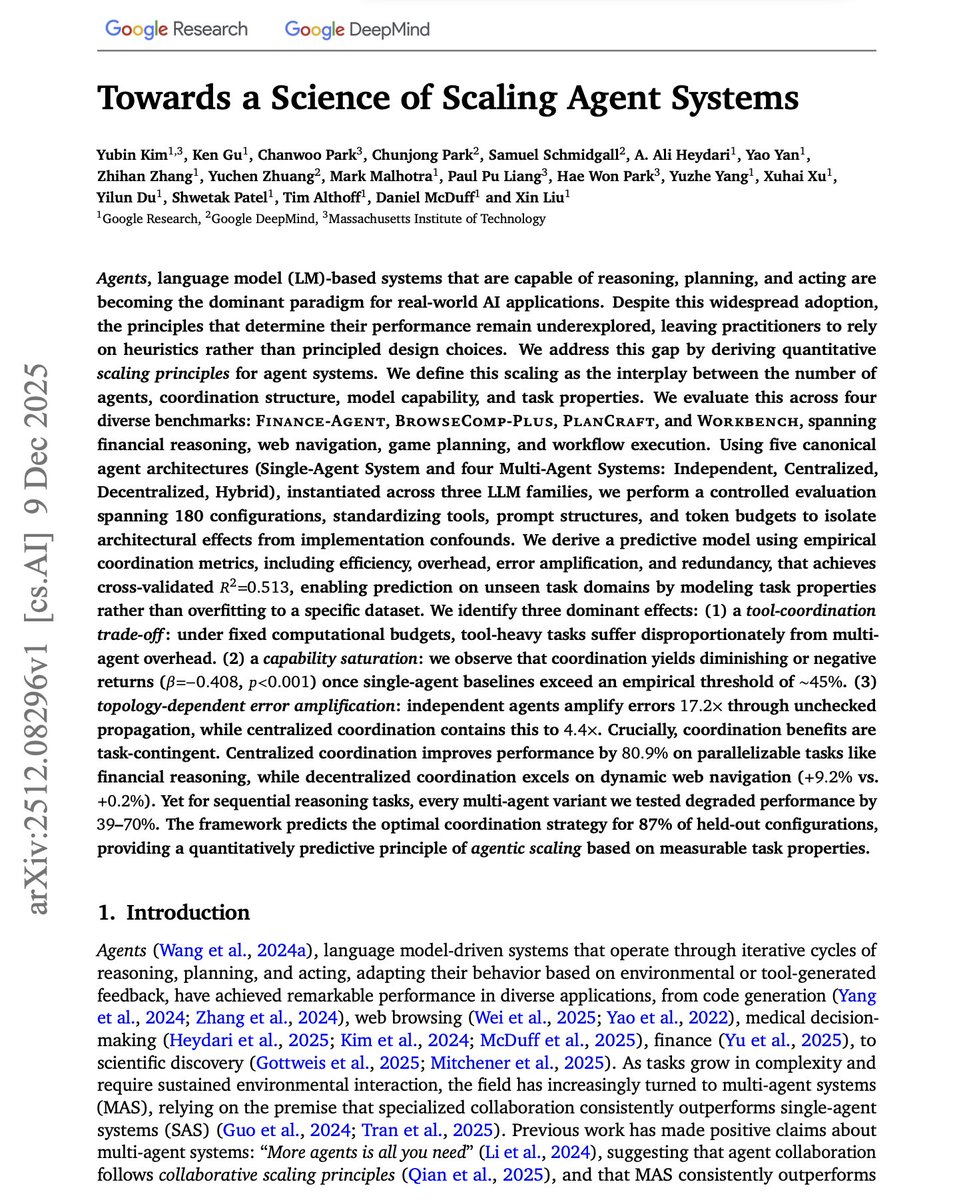
Major new research from Google and MIT. "More agents is all you need" has become a mantra for AI developers. We know multi-agent systems can be effective, but we do this mostly based on heuristics. The default approach to building complex AI systems today remains adding more agents, more coordination, more communication. It would be helpful to have a more principled way to scale agentic systems. This new research introduces the first quantitative scaling principles for agent systems, testing 180 configurations across three LLM families (OpenAI, Google, Anthropic) and four agentic benchmarks spanning financial reasoning, web navigation, game planning, and workflow execution. The findings: Multi-agent systems show an overall mean MAS improvement of -3.5% across all benchmarks, with massive variance ranging from +81% improvement to -70% degradation depending on task structure and architecture. Three dominant effects emerge from the data: The tool-coordination trade-off: tool-heavy tasks suffer disproportionately from multi-agent overhead. The efficiency penalty compounds as environmental complexity increases. A task with 16 tools makes even the most efficient multi-agent architecture paradoxically less effective than a single agent. The capability ceiling: once single-agent baselines exceed approximately 45% accuracy, coordination yields diminishing or negative returns. This is quantified as a statistically significant effect. Additional agents simply cannot overcome the coordination tax when baseline performance is already reasonable. Architecture-dependent error amplification: independent multi-agent systems amplify errors 17.2x through unchecked propagation. Centralized coordination contains this to 4.4x via validation bottlenecks (these catch errors before propagation). The presence or absence of inter-agent verification determines whether collaboration corrects or catastrophically compounds mistakes. The performance heterogeneity is also interesting to look at: - On parallelizable financial reasoning tasks, centralized multi-agent coordination achieves +80.9% improvement. - On sequential planning tasks requiring constraint satisfaction, every multi-agent variant tested degraded performance by 39-70%. - Decentralized coordination excels on dynamic web navigation (+9.2%) but provides essentially no benefit elsewhere. The researchers derive a predictive model achieving cross-validated 𝑅^2=0.513 that correctly predicts the optimal architecture for 87% of held-out configurations. This model contains no dataset-specific parameters, enabling generalization to unseen task domains. Overall, architecture-task alignment, not the number of agents, determines collaborative success. The research replaces heuristic guidance with quantitative principles: measure task decomposability, tool complexity, and baseline difficulty, then select a coordination structure accordingly. Paper: https://t.co/6QY8rT15Pd Learn to build effective AI agents in my academy: https://t.co/JBU5beIoD0