🐦 Twitter Post Details

Viewing enriched Twitter post

@SakanaAILabs

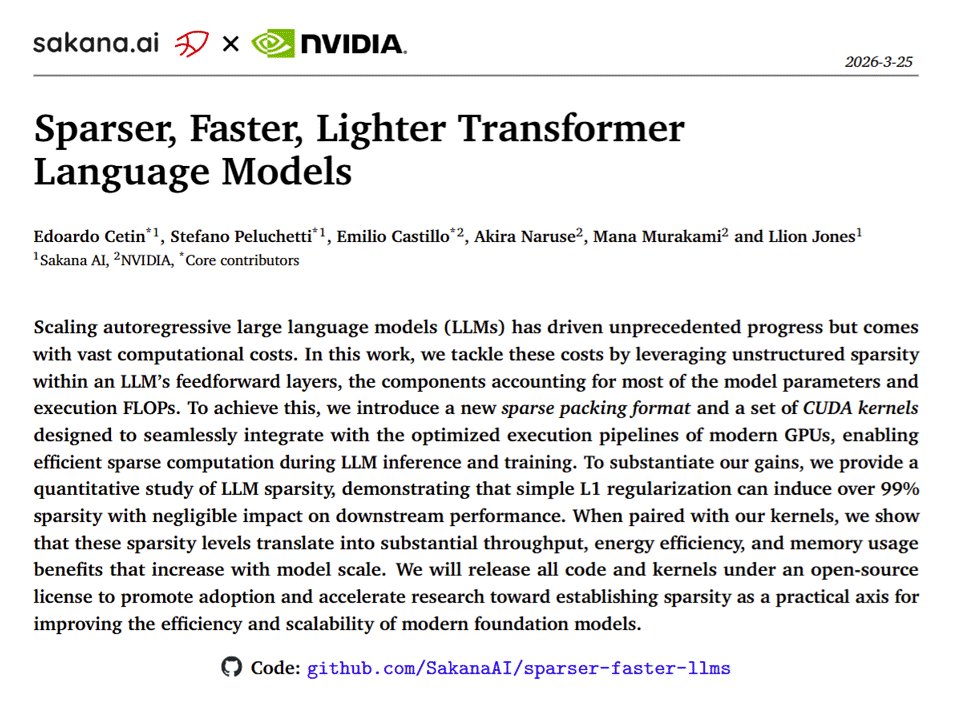
How do we make LLMs faster and lighter? Don’t force the GPU to adapt to sparsity. Reshape the sparsity to fit the GPU! ⚡️ Excited to share our new #ICML2026 paper in collaboration with @NVIDIA: "Sparser, Faster, Lighter Transformer Language Models". This work introduces new open-source GPU kernels and data formats for faster inference and training of sparse transformer language models: Paper: https://t.co/3Avj8N8iYO Blog: https://t.co/SqFkkKvkbd Code: https://t.co/PHSzMq8pg0 While LLMs are undoubtedly powerful, they are increasingly expensive to train and deploy, with a large part of this cost coming from their feedforward layers. Yet, an interesting phenomenon occurs inside these layers: For any given token, only a small fraction of the hidden activations actually matter. The rest approximate zero, wasting computation. With ReLU and very mild L1 regularization, this sparsity can exceed 95% with little to no impact on downstream performance. So, can we leverage this sparsity to make LLMs faster? The challenge is hardware. Modern GPUs are optimized for dense matrix multiplications. Traditional sparse formats introduce irregular memory access and overheads that cancel out their theoretical savings for GEMM operations. Our contribution is twofold: 1/ We introduce TwELL (Tile-wise ELLPACK), a new sparse packing format designed to integrate directly in the same optimized tiled matmul kernels without disrupting execution. 2/ We develop custom CUDA kernels that fuse multiple sparse matmuls to maximize throughput and compress TwELL to a hybrid representation that minimizes activation sizes. We used our kernels to train and benchmark sparse LLMs at billion-parameter scales, demonstrating >20% speedups and even higher savings in peak memory and energy. This work will be presented at #ICML2026. Please check out our blog and technical paper for a deep dive!
Media 1
Media 2

📊 Media Metadata

{
  "media": [
    {
      "url": "https://crmoxkoizveukayfjuyo.supabase.co/storage/v1/object/public/media/posts/2052787226136990029/media_0.jpg",
      "media_url": "https://crmoxkoizveukayfjuyo.supabase.co/storage/v1/object/public/media/posts/2052787226136990029/media_0.jpg",
      "type": "photo",
      "filename": "media_0.jpg"
    },
    {
      "url": "https://crmoxkoizveukayfjuyo.supabase.co/storage/v1/object/public/media/posts/2052787226136990029/media_2.jpg",
      "media_url": "https://crmoxkoizveukayfjuyo.supabase.co/storage/v1/object/public/media/posts/2052787226136990029/media_2.jpg",
      "type": "photo",
      "filename": "media_2.jpg"
    }
  ],
  "processed_at": "2026-05-11T22:36:35.460707",
  "pipeline_version": "2.0"
}

🔧 Raw API Response

{
  "type": "tweet",
  "id": "2052787226136990029",
  "url": "https://x.com/SakanaAILabs/status/2052787226136990029",
  "twitterUrl": "https://twitter.com/SakanaAILabs/status/2052787226136990029",
  "text": "How do we make LLMs faster and lighter? Don’t force the GPU to adapt to sparsity. Reshape the sparsity to fit the GPU! ⚡️\n\nExcited to share our new #ICML2026 paper in collaboration with @NVIDIA: \"Sparser, Faster, Lighter Transformer Language Models\". This work introduces new open-source GPU kernels and data formats for faster inference and training of sparse transformer language models:\n\nPaper: https://t.co/3Avj8N8iYO\nBlog: https://t.co/SqFkkKvkbd\nCode: https://t.co/PHSzMq8pg0\n\nWhile LLMs are undoubtedly powerful, they are increasingly expensive to train and deploy, with a large part of this cost coming from their feedforward layers. Yet, an interesting phenomenon occurs inside these layers: For any given token, only a small fraction of the hidden activations actually matter. The rest approximate zero, wasting computation. With ReLU and very mild L1 regularization, this sparsity can exceed 95% with little to no impact on downstream performance.\n\nSo, can we leverage this sparsity to make LLMs faster? The challenge is hardware. Modern GPUs are optimized for dense matrix multiplications. Traditional sparse formats introduce irregular memory access and overheads that cancel out their theoretical savings for GEMM operations.\n\nOur contribution is twofold:\n1/ We introduce TwELL (Tile-wise ELLPACK), a new sparse packing format designed to integrate directly in the same optimized tiled matmul kernels without disrupting execution.\n2/ We develop custom CUDA kernels that fuse multiple sparse matmuls to maximize throughput and compress TwELL to a hybrid representation that minimizes activation sizes.\n\nWe used our kernels to train and benchmark sparse LLMs at billion-parameter scales, demonstrating >20% speedups and even higher savings in peak memory and energy.\n\nThis work will be presented at #ICML2026. Please check out our blog and technical paper for a deep dive!",
  "source": "Twitter for iPhone",
  "retweetCount": 119,
  "replyCount": 20,
  "likeCount": 749,
  "quoteCount": 10,
  "viewCount": 378030,
  "createdAt": "Fri May 08 16:26:28 +0000 2026",
  "lang": "en",
  "bookmarkCount": 414,
  "isReply": false,
  "inReplyToId": null,
  "conversationId": "2052787226136990029",
  "displayTextRange": [
    0,
    275
  ],
  "inReplyToUserId": null,
  "inReplyToUsername": null,
  "author": {
    "type": "user",
    "userName": "SakanaAILabs",
    "url": "https://x.com/SakanaAILabs",
    "twitterUrl": "https://twitter.com/SakanaAILabs",
    "id": "218811492",
    "name": "Sakana AI",
    "isVerified": false,
    "isBlueVerified": true,
    "verifiedType": "Business",
    "profilePicture": "https://pbs.twimg.com/profile_images/1885939209388929024/dtnrOdGp_normal.jpg",
    "coverPicture": "https://pbs.twimg.com/profile_banners/218811492/1686643464",
    "description": "",
    "location": "Tokyo, Japan",
    "followers": 70759,
    "following": 0,
    "status": "",
    "canDm": false,
    "canMediaTag": true,
    "createdAt": "Tue Nov 23 10:20:07 +0000 2010",
    "entities": {
      "description": {
        "urls": []
      },
      "url": {}
    },
    "fastFollowersCount": 0,
    "favouritesCount": 2,
    "hasCustomTimelines": true,
    "isTranslator": false,
    "mediaCount": 380,
    "statusesCount": 1086,
    "withheldInCountries": [],
    "affiliatesHighlightedLabel": {},
    "possiblySensitive": false,
    "pinnedTweetIds": [
      "2036840833690071450"
    ],
    "profile_bio": {
      "description": "Sakana AI is an AI R&D company based in Tokyo. We develop AI solutions for Japan’s needs, and democratize AI in Japan. Try Sakana Chat: https://t.co/1m2lSgnfB2",
      "entities": {
        "description": {
          "urls": [
            {
              "display_url": "sakana.ai",
              "expanded_url": "https://sakana.ai/",
              "indices": [
                136,
                159
              ],
              "url": "https://t.co/1m2lSgnfB2"
            }
          ]
        },
        "url": {
          "urls": [
            {
              "display_url": "sakana.ai/careers",
              "expanded_url": "https://sakana.ai/careers",
              "indices": [
                0,
                23
              ],
              "url": "https://t.co/1q07mb3TzE"
            }
          ]
        }
      }
    },
    "isAutomated": false,
    "automatedBy": null
  },
  "extendedEntities": {
    "media": [
      {
        "display_url": "pic.twitter.com/ehByWHIh6I",
        "expanded_url": "https://twitter.com/SakanaAILabs/status/2052787226136990029/photo/1",
        "ext_alt_text": "Sparser, Faster, Lighter Transformer Language Models\n\nScaling autoregressive LLMs has driven unprecedented progress but comes with vast computational costs. In this work, we tackle these costs by leveraging unstructured sparsity within an LLM's feedforward layers, the components accounting for most of the model parameters and execution FLOPs. To achieve this, we introduce a new sparse packing format and a set of CUDA kernels designed to seamlessly integrate with the optimized execution pipelines of modern GPUs, enabling efficient sparse computation during LLM inference and training. To substantiate our gains, we provide a quantitative study of LLM sparsity, demonstrating that simple L1 regularization can induce over 99% sparsity with negligible impact on downstream performance. When paired with our kernels, we show that these sparsity levels translate into substantial throughput, energy efficiency, and memory usage benefits that increase with model scale.",
        "ext_media_availability": {
          "status": "Available"
        },
        "id_str": "2052786532772401154",
        "indices": [
          276,
          299
        ],
        "media_key": "16_2052786532772401154",
        "media_results": {
          "id": "QXBpTWVkaWFSZXN1bHRzOgwAAgoAARx89nm1mtACCgACHHz3GyVa0U0AAA==",
          "result": {
            "__typename": "ApiMedia",
            "id": "QXBpTWVkaWE6DAACCgABHHz2ebWa0AIKAAIcfPcbJVrRTQAA",
            "media_key": "16_2052786532772401154"
          }
        },
        "media_url_https": "https://pbs.twimg.com/tweet_video_thumb/HHz2ebWa0AI3I0R.jpg",
        "original_info": {
          "focus_rects": [],
          "height": 720,
          "width": 960
        },
        "sizes": {
          "large": {
            "h": 720,
            "w": 960
          }
        },
        "type": "animated_gif",
        "url": "https://t.co/ehByWHIh6I",
        "video_info": {
          "aspect_ratio": [
            4,
            3
          ],
          "variants": [
            {
              "bitrate": 0,
              "content_type": "video/mp4",
              "url": "https://video.twimg.com/tweet_video/HHz2ebWa0AI3I0R.mp4"
            }
          ]
        }
      }
    ]
  },
  "card": null,
  "place": {},
  "entities": {
    "hashtags": [
      {
        "indices": [
          148,
          157
        ],
        "text": "ICML2026"
      },
      {
        "indices": [
          1811,
          1820
        ],
        "text": "ICML2026"
      }
    ],
    "symbols": [],
    "urls": [
      {
        "display_url": "arxiv.org/abs/2603.23198",
        "expanded_url": "https://arxiv.org/abs/2603.23198",
        "indices": [
          398,
          421
        ],
        "url": "https://t.co/3Avj8N8iYO"
      },
      {
        "display_url": "pub.sakana.ai/sparser-faster…",
        "expanded_url": "https://pub.sakana.ai/sparser-faster-llms/",
        "indices": [
          428,
          451
        ],
        "url": "https://t.co/SqFkkKvkbd"
      },
      {
        "display_url": "github.com/SakanaAI/spars…",
        "expanded_url": "https://github.com/SakanaAI/sparser-faster-llms",
        "indices": [
          458,
          481
        ],
        "url": "https://t.co/PHSzMq8pg0"
      }
    ],
    "user_mentions": [
      {
        "id_str": "61559439",
        "indices": [
          186,
          193
        ],
        "name": "NVIDIA",
        "screen_name": "NVIDIA"
      }
    ]
  },
  "quoted_tweet": null,
  "retweeted_tweet": null,
  "isLimitedReply": false,
  "communityInfo": null,
  "article": null
}