@omarsar0
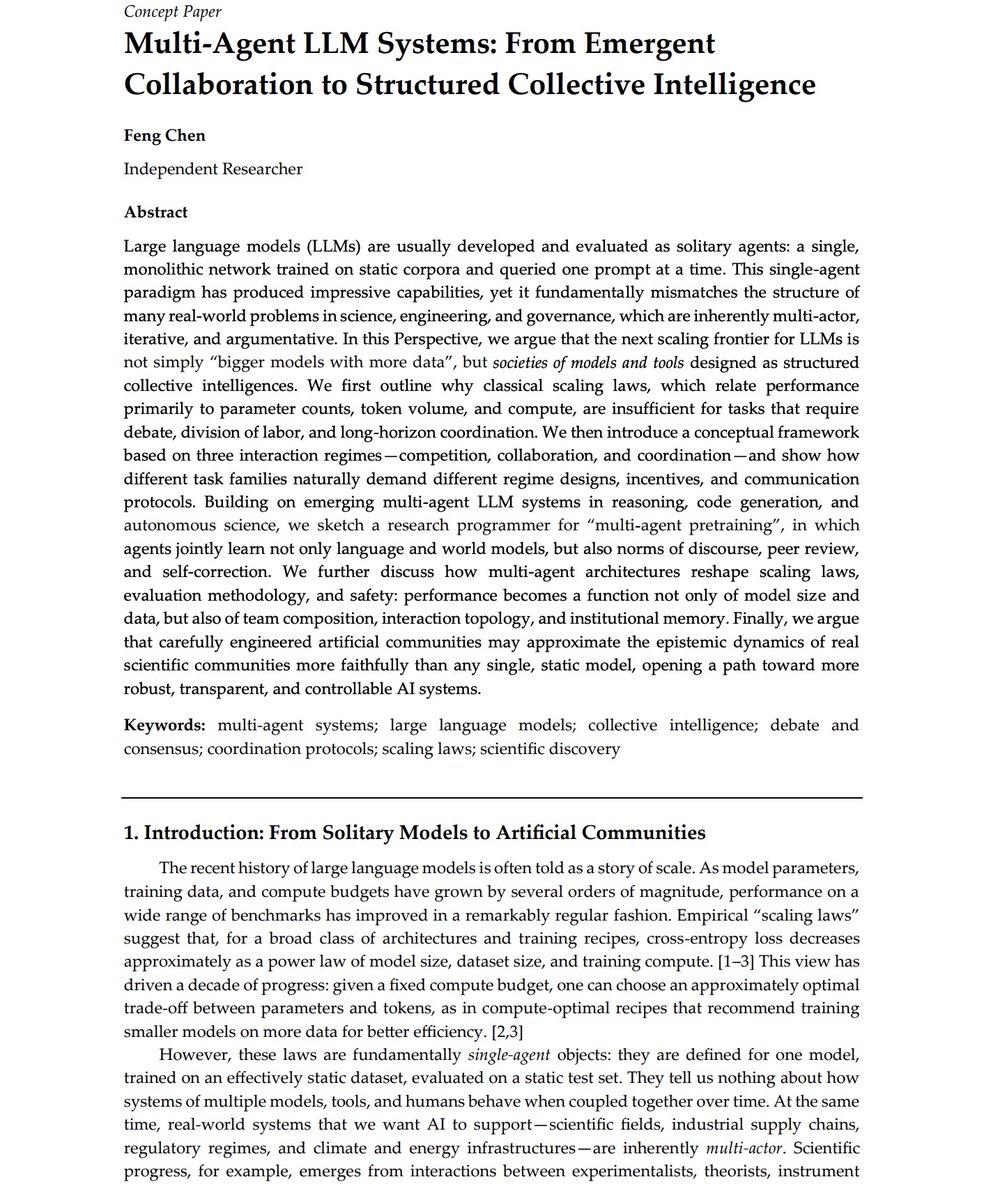
The next scaling frontier isn't bigger models. It's societies of models and tools. That's the big claim made in this concept paper. It actually points to something really important in the AI field. Let's take a look: (bookmark for later) Classical scaling laws relate performance to parameters, tokens, and compute. More of each, better loss. These laws have driven a decade of progress. But they describe a single-agent world: one model, static corpus, one prompt at a time. There is a clear misalignment with how real-world problems actually work. This new perspective paper argues that scaling must expand along three new axes: population, organization, and institution. Not just how many parameters, but how many agents, how they're connected, and what norms govern their interaction. Simply adding more agents doesn't monotonically improve performance. Early experiments in multi-agent debate show that naive agent swarms can degenerate into majority herding, where the first plausible-but-wrong answer locks in and gets reinforced through subsequent rounds. Groups of frontier models fail to integrate distributed information, displaying human-like collective failures. The paper proposes three interaction regimes for multi-agent systems: 1) Competition: debate, adversarial critique, self-play. 2) Collaboration: role specialization, division of labor, complementary expertise. 3) Coordination: orchestrated workflows, planner-worker hierarchies, reliable execution. Which regime fits which task matters. Competitive regimes suit focused reasoning problems with clear correctness criteria. Collaborative regimes fit an open-ended design where diverse skills are needed. Coordinated regimes handle long-horizon, safety-critical workflows. The architectural implications are significant. Effective multi-agent systems need cognitive diversity: agents with different priors, reasoning styles, and tool access. They need institutional memory: persistent artifacts that outlive individual sessions, analogous to lab notebooks and version control. They need communication topologies: not just broadcast or hub-and-spoke, but structured graphs that balance diversity and coherence. Training objectives must change, too. Current models optimize individual next-token prediction. Multi-agent systems need collective objectives: group accuracy, calibration, hypothesis diversity, and conflict resolution quality. The paper proposes "multi-agent pretraining" where debate, peer review, and negotiation become first-class optimization targets. Paper: https://t.co/OqwIIeJLYr Learn to build AI agents in my academy: https://t.co/JBU5beIoD0