@dair_ai
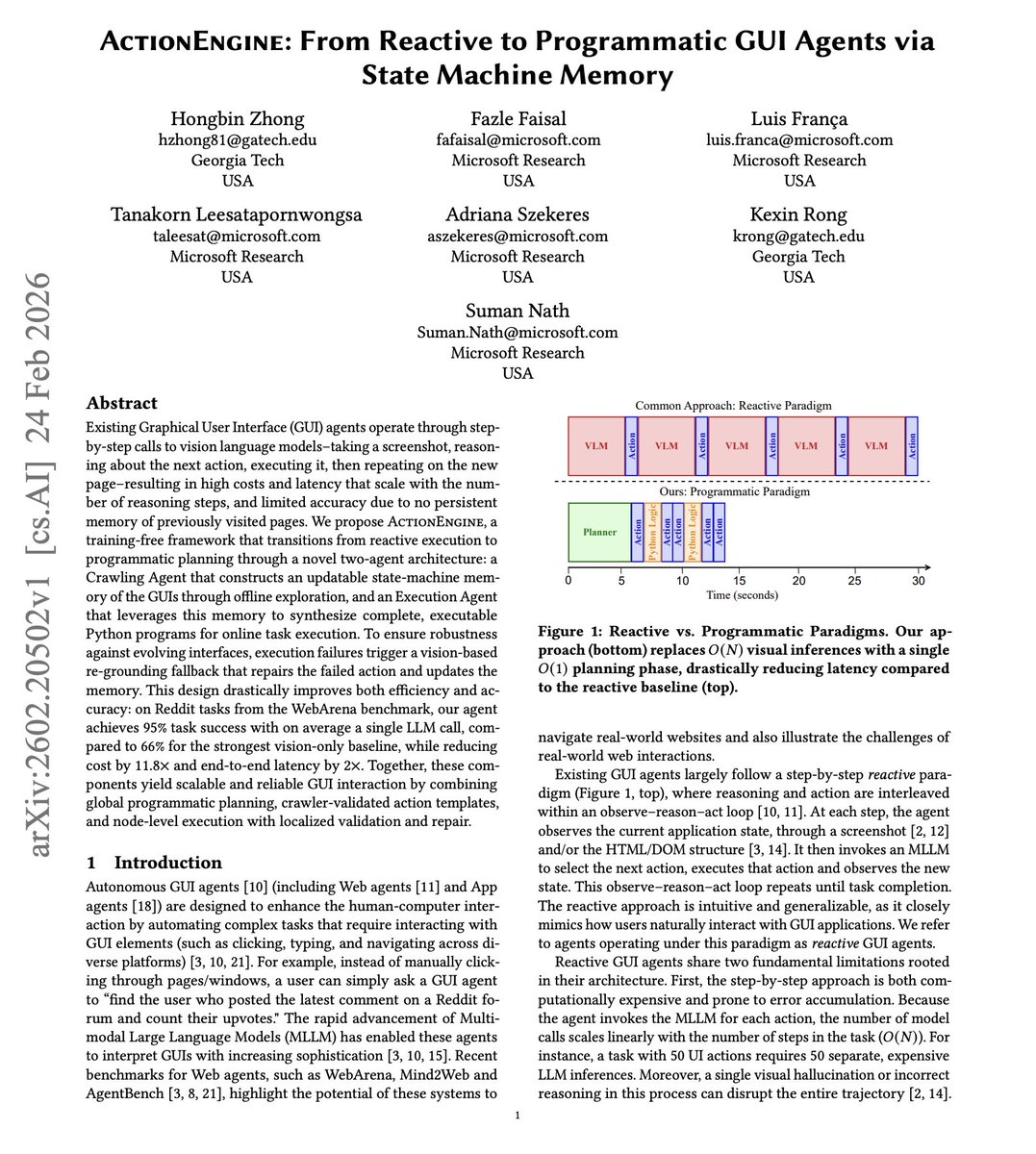
New research from Georgia Tech and Microsoft Research. GUI agents today are reactive. Every step costs an LLM call, which is why a lot of GUI agents are expensive, slow, and fragile. This new research introduces ActionEngine, a framework that shifts GUI agents from reactive execution to programmatic planning. A Crawling Agent explores the application offline and builds a state-machine graph of the interface. Nodes are page states, edges are actions. Then at runtime, an Execution Agent uses this graph to synthesize a complete Python program in a single LLM call. Instead of O(N) vision model calls per task, you get O(1) planning cost. On Reddit tasks from WebArena, ActionEngine achieves 95% task success with, on average, a single LLM call, compared to 66% for the strongest vision-only baseline. Cost drops by 11.8x. Latency drops by 2x. If the pre-planned script fails at runtime, a vision-based fallback repairs the action and updates the memory graph for future runs. Why does it matter? Treating GUI interaction as graph traversal rather than step-by-step probabilistic reasoning is a compelling direction for making agents both faster and more reliable. Paper: https://t.co/UR0PjvFf0c Learn to build effective AI agents in our academy: https://t.co/LRnpZN7L4c