@dair_ai
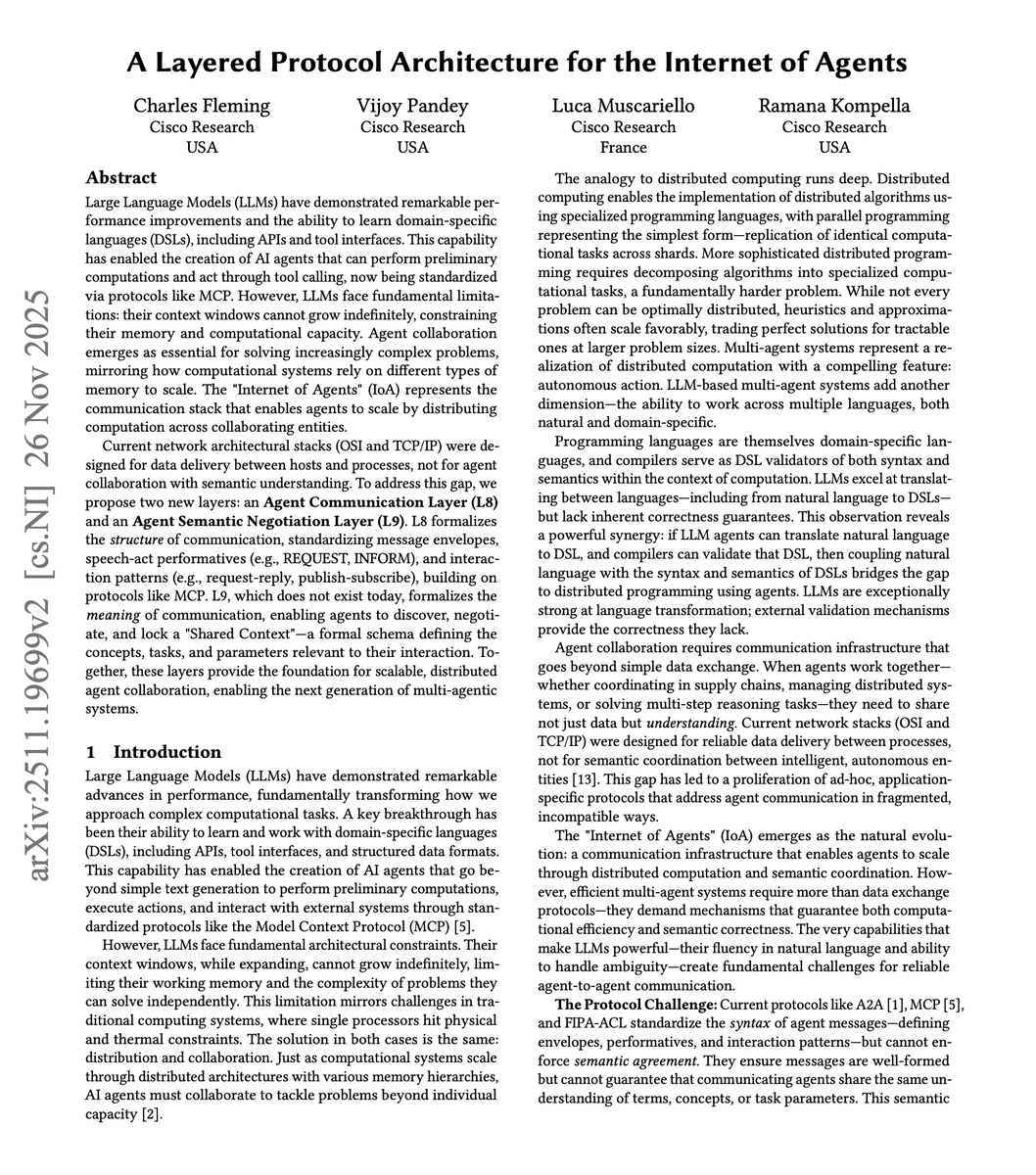
AI agents can talk to each other. But they don't always understand each other. This problem leads to inefficiency in collaboration for long-horizon problems and complex domains. The default approach in multi-agent systems today focuses on message structure. Protocols like MCP and A2A standardize syntax: how messages are formatted, how tools are invoked. What's missing is semantic agreement: shared understanding of what terms actually mean. When an agent requests "a flight to New York," which airport? JFK? LGA? EWR? Without formal semantic negotiation, agents fall back to expensive LLM clarification loops. This new research proposes two architectural layers for the Internet of Agents. Layer 8 (Agent Communication Layer) handles message structure with standardized envelopes, speech-act performatives like REQUEST and INFORM, and interaction patterns. Layer 9 (Semantic Negotiation Layer) establishes shared meaning through versioned semantic contexts that agents lock before task execution. The key idea is to separate the "how" of communication from the "what." Agents negotiate machine-readable schemas before exchanging task-specific messages. Ambiguous terms get resolved at the protocol level, not through costly inference. The authors compare existing standards. FIPA-ACL acknowledged ontologies but failed due to heavyweight formal languages. MCP and A2A provide excellent syntactic frameworks but leave semantic alignment ad-hoc. The proposed L9 layer fills this gap with a three-phase protocol: context discovery, semantic grounding, and validation. New attack vectors emerge, too. Semantic injection, context poisoning, and semantic DoS. The paper proposes authenticated contexts signed by Schema Authorities, semantic firewalls, and MLS encryption as defenses. Paper: https://t.co/Jtodz0gwAh Learn to build effective AI Agents in our academy: https://t.co/zQXQt0PMbG