@omarsar0
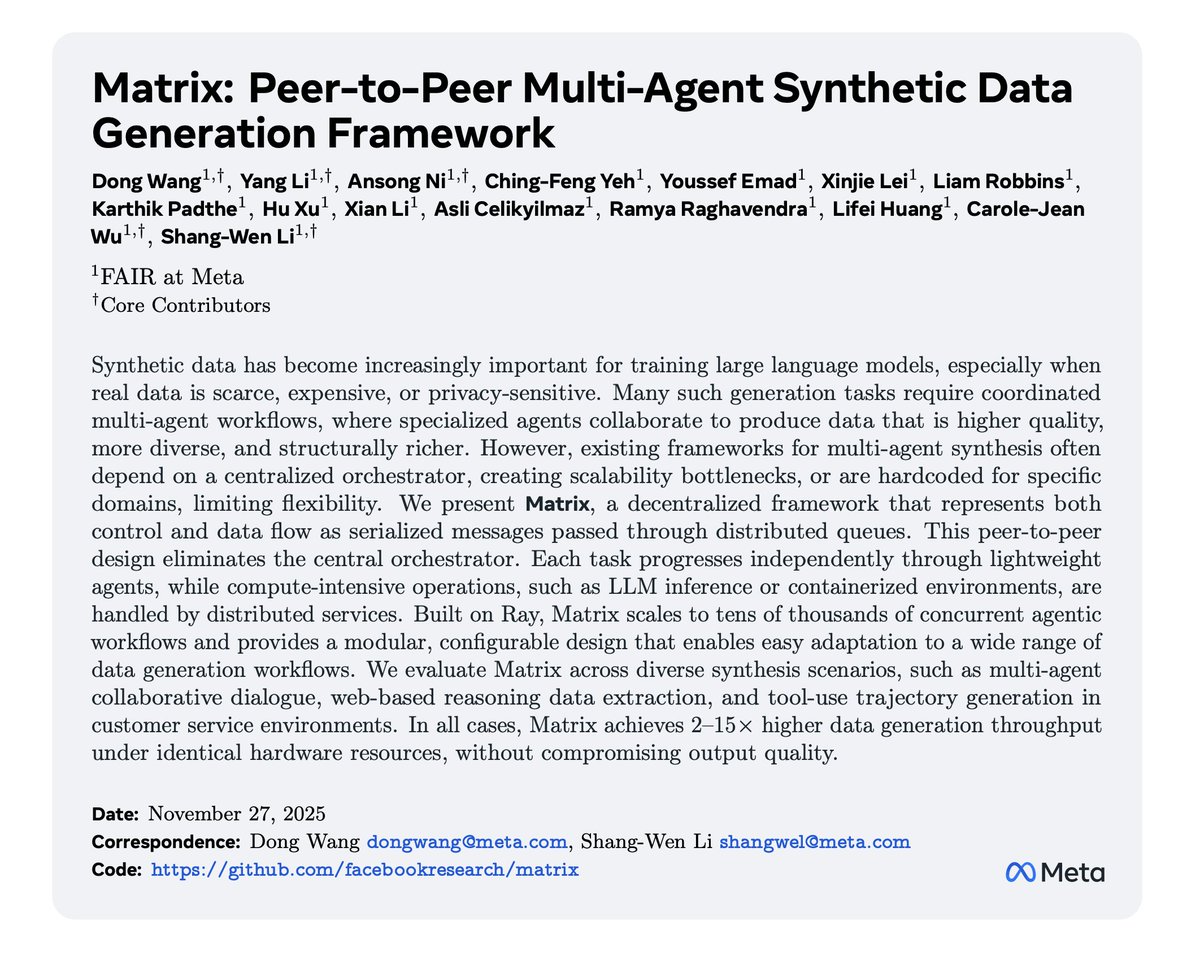
Cool paper from Meta. And another excellent application of multi-agent systems. (bookmark it) Training modern AI models requires massive amounts of high-quality data. However, the bottleneck isn't just quantity. The data is just not diverse enough. Single models generating synthetic data tend to produce homogeneous outputs, repeating patterns, and lacking the nuanced variety found in human-created datasets. This new research from Meta introduces Matrix, a peer-to-peer framework where multiple AI agents collaboratively generate synthetic training data through decentralized interactions. Matrix achieves 2–15× higher data generation throughput under identical hardware resources, without compromising output quality. TL;DR: Instead of one model producing data, specialized agents play distinct roles and interact with each other. One asks questions, another responds, a third evaluates quality. These multi-turn conversations capture complex reasoning and diverse perspectives. What makes Matrix different: no central coordinator. Agents communicate directly in a fully decentralized architecture. This enables scalability without infrastructure bottlenecks. The framework operates through role-based conversation protocols, multi-turn interaction patterns, and built-in quality filtering at each stage. Only data meeting quality thresholds makes it into the final training set. Multi-agent collaboration produces more diverse synthetic data than single-model approaches. The resulting datasets improve downstream model performance across reasoning and instruction-following benchmarks.