🐦 Twitter Post Details

Viewing enriched Twitter post

@HuaWenyue31539

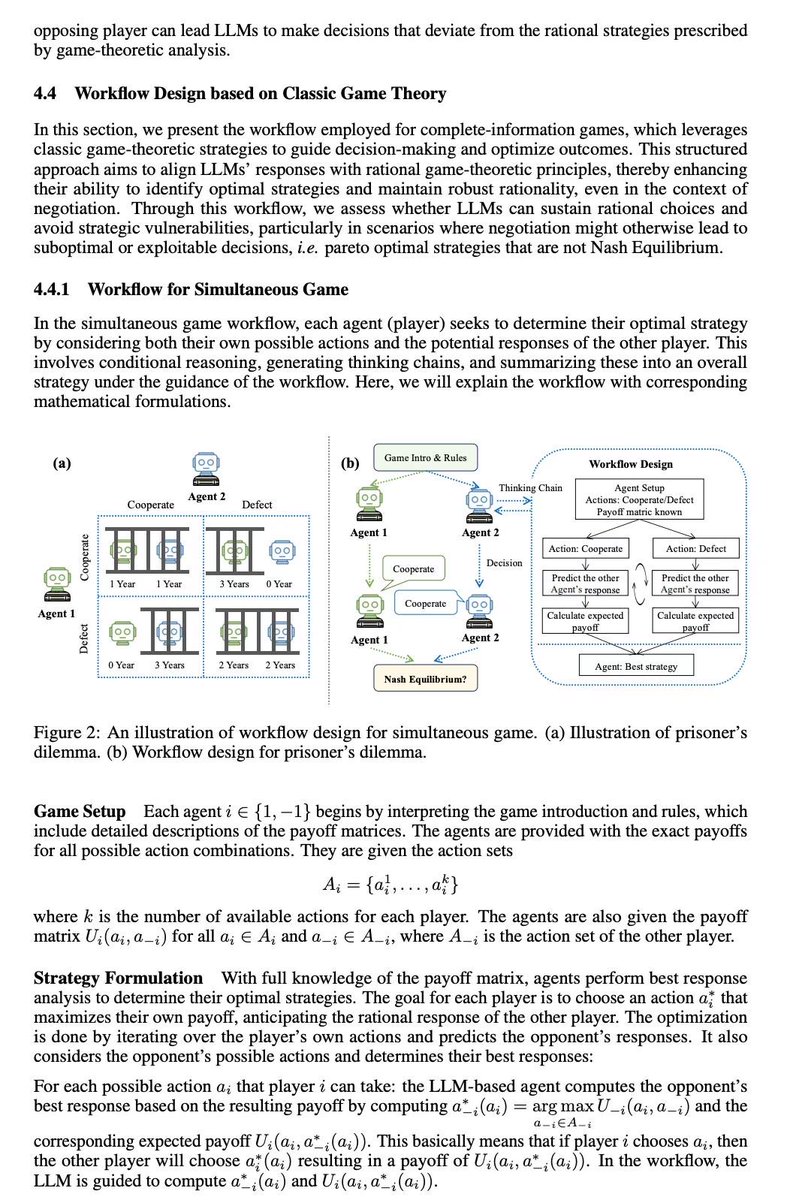
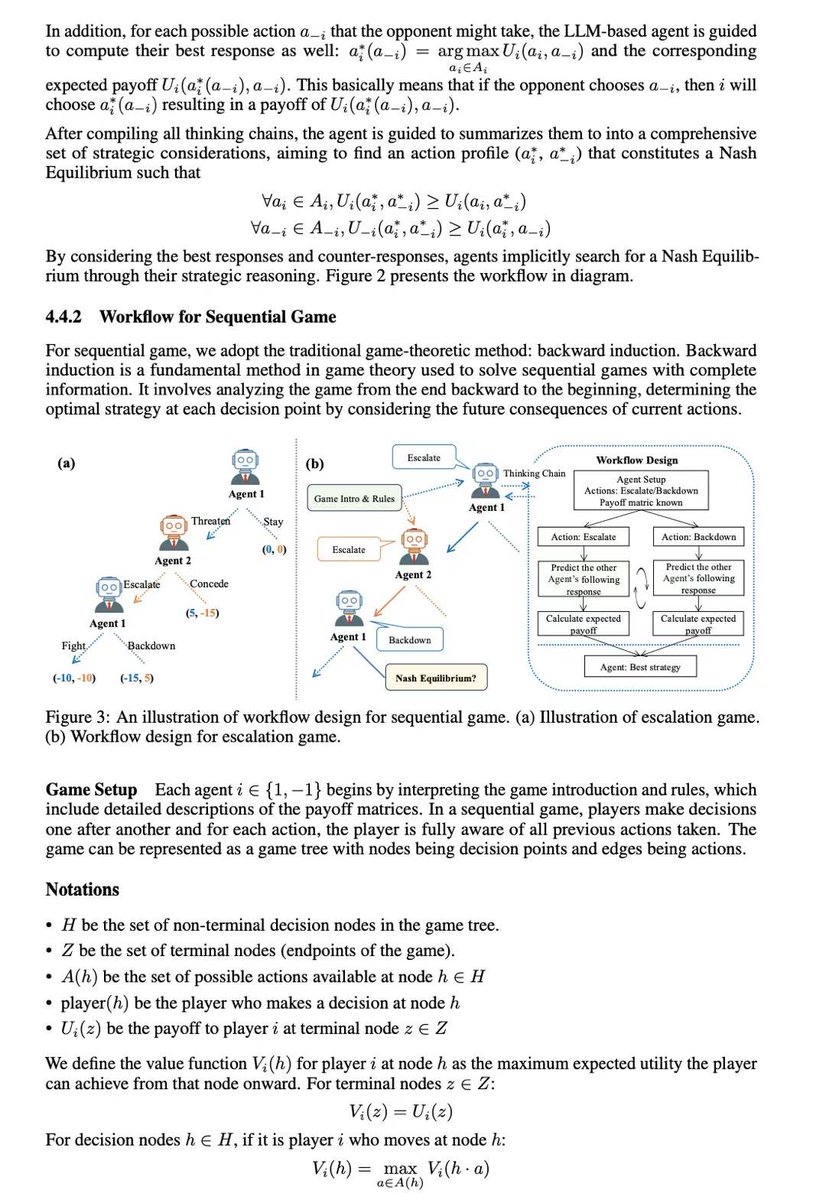
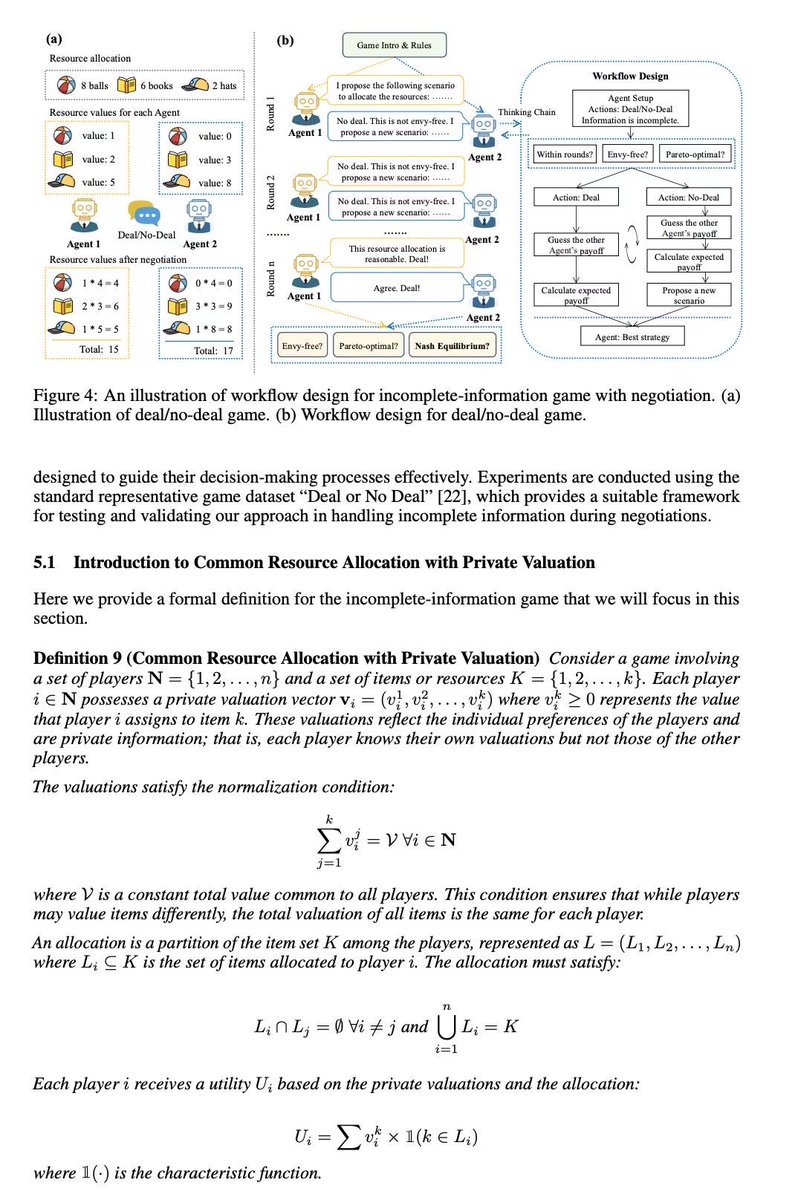
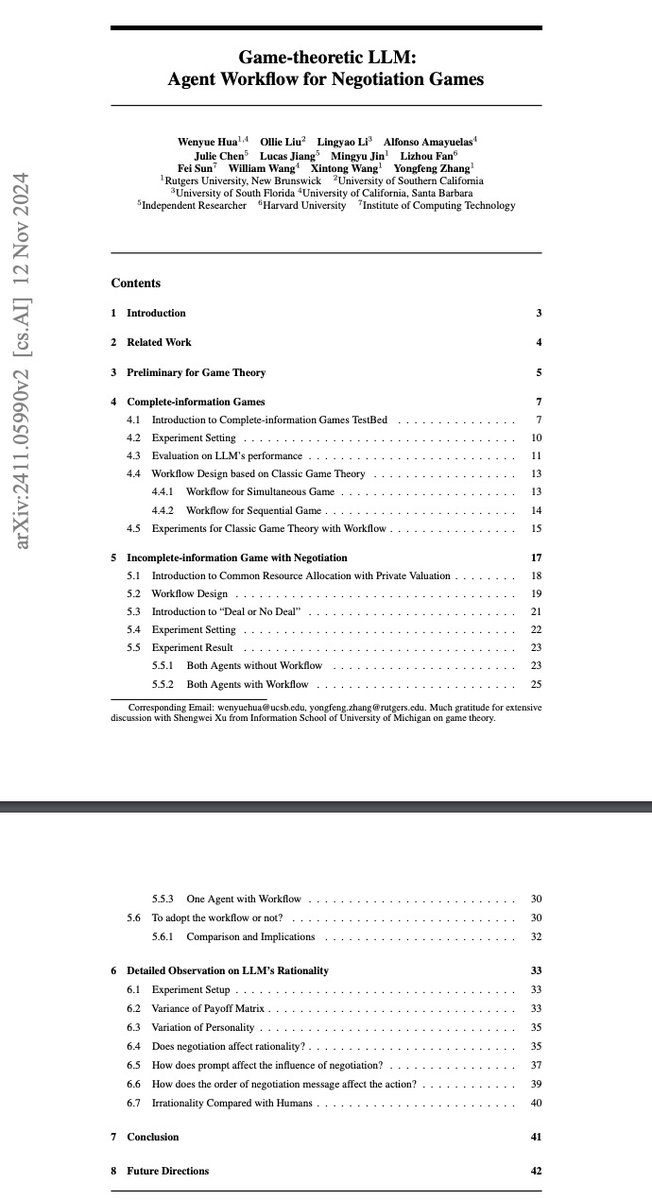
🌟🎲🎲How to create a rational LLM-based agent? using game-theoretic workflow! Game-theoretic LLM: Agent Workflow for Negotiation Games 😊 paper link: https://t.co/atfdfU8LSB github link: https://t.co/pTzXRJYBIj 😼 This paper aims at observing and enhancing the performance of agents in interactions guided by self-interest maximization 😼 😼 We chose game theory as the foundation, with rationality and Pareto optimality as the two basic evaluation metrics: whether an individual is rational and whether a globally optimal solution is developed based on individual rationality. ❣️ Complete information games They are classic games such as Prisoner's Dilemma. We selected 5 simultaneous games and 5 sequential games. We found that, except for o1, other LLM generally lack a robust ability to compute Nash equilibria, meaning they are not very rational. They are not robust to noise, perturbations, or random talks among them. Therefore, based on classical game theory methods (Iterative Elimination of Dominated Strategy & Backward Induction), we designed two workflows to guide large models step-by-step in computing Nash equilibria during inference time. ❣️ Incomplete information games We used the classic "Deal or No Deal" resource allocation game with private valuation, where agents do not know the opponent's valuation of resources. Game theory does not provide a solution for this, and previous work has been based on reinforcement learning. πŸ‘‰ Sonnet and o1 perform better than humans in terms of negotiation success rate and results πŸ‘‰ Opus and 4o are far behind. πŸ‘‰ We designed an algorithmic workflow based on the rational actor assumption, allowing agents to infer the opponent's valuation based on their reactions to various resource allocation schemes. The workflow is very effective, reducing the possible estimated valuations from an initial 1000 possibilities to 2-3 within 5 rounds of dialogue, and always including the opponent's true valuation. 🌟🌟Based on the estimated valuation of opponent's resource, we guide the agents in each step to calculate and propose an allocation proposal that maximizes their own interests while having a non-zero probability of being envy-free, ensuring that both parties are relatively satisfied and the negotiation can proceed. 🌟🌟 But very interestingly, we found that if only one agent uses this workflow during negotiation, it will be exploited. Although the workflow improves the overall negotiation outcome and brings more benefits to the individual agent, the benefits will always be less than the opponent's. πŸ”₯In the future, we will need a meta-strategy to choose which workflows to use!
Media 1
Media 2
Media 3
Media 4

πŸ“Š Media Metadata

{
  "data": [
    {
      "media_url": "https://pbs.twimg.com/media/Gcj8MFnbwAE3Y-F.jpg",
      "type": "photo"
    },
    {
      "media_url": "https://pbs.twimg.com/media/Gcj8OyeaMAA5EpA.jpg",
      "type": "photo"
    },
    {
      "media_url": "https://pbs.twimg.com/media/Gcj8QR_aMAAdf_u.jpg",
      "type": "photo"
    },
    {
      "media_url": "https://pbs.twimg.com/media/Gcj8RVnaAAAXKr0.jpg",
      "type": "photo"
    }
  ],
  "score": 0.86,
  "scored_at": "2025-08-09T13:46:07.553663",
  "import_source": "network_archive_import",
  "links_checked": true,
  "checked_at": "2025-08-10T10:32:53.988615",
  "media": [
    {
      "type": "photo",
      "url": "https://crmoxkoizveukayfjuyo.supabase.co/storage/v1/object/public/media/posts/1858014288855839154/media_0.jpg?",
      "filename": "media_0.jpg"
    },
    {
      "type": "photo",
      "url": "https://crmoxkoizveukayfjuyo.supabase.co/storage/v1/object/public/media/posts/1858014288855839154/media_1.jpg?",
      "filename": "media_1.jpg"
    },
    {
      "type": "photo",
      "url": "https://crmoxkoizveukayfjuyo.supabase.co/storage/v1/object/public/media/posts/1858014288855839154/media_2.jpg?",
      "filename": "media_2.jpg"
    },
    {
      "type": "photo",
      "url": "https://crmoxkoizveukayfjuyo.supabase.co/storage/v1/object/public/media/posts/1858014288855839154/media_3.jpg?",
      "filename": "media_3.jpg"
    }
  ],
  "reprocessed_at": "2025-08-12T15:26:26.972640",
  "reprocessed_reason": "missing_media_array"
}

πŸ”§ Raw API Response

{
  "user": {
    "created_at": "2023-11-30T20:59:57.000Z",
    "default_profile_image": false,
    "description": "Postdoc @ucsbNLP\nPh.D. @RutgersU CS\nex-intern @MSFTResearch @AmazonScience\nMath & Linguistics @UCLA\nTrustworthy AI, LLM, LLM-based agent",
    "fast_followers_count": 0,
    "favourites_count": 317,
    "followers_count": 410,
    "friends_count": 463,
    "has_custom_timelines": false,
    "is_translator": false,
    "listed_count": 7,
    "location": "",
    "media_count": 12,
    "name": "Wenyue Hua",
    "normal_followers_count": 410,
    "possibly_sensitive": false,
    "profile_banner_url": "https://pbs.twimg.com/profile_banners/1730330775105474560/1731919931",
    "profile_image_url_https": "https://pbs.twimg.com/profile_images/1859366305151008769/2j6M9G6c_normal.jpg",
    "screen_name": "HuaWenyue31539",
    "statuses_count": 85,
    "translator_type": "none",
    "url": "https://t.co/nJFh7m8mKh",
    "verified": true,
    "withheld_in_countries": [],
    "id_str": "1730330775105474560"
  },
  "id": "1858014288855839154",
  "conversation_id": "1858014288855839154",
  "full_text": "🌟🎲🎲How to create a rational LLM-based agent? using game-theoretic workflow!\n\nGame-theoretic LLM: Agent Workflow for Negotiation Games 😊 \n\npaper link: https://t.co/atfdfU8LSB\ngithub link: https://t.co/pTzXRJYBIj\n\n😼 This paper aims at observing and enhancing the performance of agents in interactions guided by self-interest maximization\n\n😼 😼 We chose game theory as the foundation, with rationality and Pareto optimality as the two basic evaluation metrics: whether an individual is rational and whether a globally optimal solution is developed based on individual rationality. \n\n❣️ Complete information games\n\nThey are classic games such as Prisoner's Dilemma. We selected 5 simultaneous games and 5 sequential games. We found that, except for o1, other LLM generally lack a robust ability to compute Nash equilibria, meaning they are not very rational. They are not robust to noise, perturbations, or random talks among them. \n\nTherefore, based on classical game theory methods (Iterative Elimination of Dominated Strategy & Backward Induction), we designed two workflows to guide large models step-by-step in computing Nash equilibria during inference time.\n\n❣️ Incomplete information games\n\nWe used the classic \"Deal or No Deal\" resource allocation game with private valuation, where agents do not know the opponent's valuation of resources. Game theory does not provide a solution for this, and previous work has been based on reinforcement learning.\n\nπŸ‘‰ Sonnet and o1 perform better than humans in terms of negotiation success rate and results\nπŸ‘‰ Opus and 4o are far behind.\n\nπŸ‘‰ We designed an algorithmic workflow based on the rational actor assumption, allowing agents to infer the opponent's valuation based on their reactions to various resource allocation schemes. \n\nThe workflow is very effective, reducing the possible estimated valuations from an initial 1000 possibilities to 2-3 within 5 rounds of dialogue, and always including the opponent's true valuation.\n\n🌟🌟Based on the estimated valuation of opponent's resource, we guide the agents in each step to calculate and propose an allocation proposal that maximizes their own interests while having a non-zero probability of being envy-free, ensuring that both parties are relatively satisfied and the negotiation can proceed.\n\n🌟🌟 But very interestingly, we found that if only one agent uses this workflow during negotiation, it will be exploited. Although the workflow improves the overall negotiation outcome and brings more benefits to the individual agent, the benefits will always be less than the opponent's. \n\nπŸ”₯In the future, we will need a meta-strategy to choose which workflows to use!",
  "reply_count": 5,
  "retweet_count": 50,
  "favorite_count": 207,
  "hashtags": [],
  "symbols": [],
  "user_mentions": [],
  "urls": [
    {
      "url": "https://t.co/hJzChwHpjg",
      "expanded_url": "https://arxiv.org/abs/2411.05990",
      "display_url": "arxiv.org/abs/2411.05990"
    },
    {
      "url": "https://t.co/Xs8lUqMM2O",
      "expanded_url": "https://github.com/Wenyueh/game_theory",
      "display_url": "github.com/Wenyueh/game_t…"
    }
  ],
  "media": [
    {
      "media_url": "https://pbs.twimg.com/media/Gcj8MFnbwAE3Y-F.jpg",
      "type": "photo"
    },
    {
      "media_url": "https://pbs.twimg.com/media/Gcj8OyeaMAA5EpA.jpg",
      "type": "photo"
    },
    {
      "media_url": "https://pbs.twimg.com/media/Gcj8QR_aMAAdf_u.jpg",
      "type": "photo"
    },
    {
      "media_url": "https://pbs.twimg.com/media/Gcj8RVnaAAAXKr0.jpg",
      "type": "photo"
    }
  ],
  "url": "https://twitter.com/HuaWenyue31539/status/1858014288855839154",
  "created_at": "2024-11-17T05:08:21.000Z",
  "#sort_index": "1858014288855839154",
  "view_count": 23800,
  "quote_count": 8,
  "is_quote_tweet": false,
  "is_retweet": false,
  "is_pinned": false,
  "is_truncated": true,
  "startUrl": "https://x.com/huawenyue31539/status/1858014288855839154"
}