@forallcurious
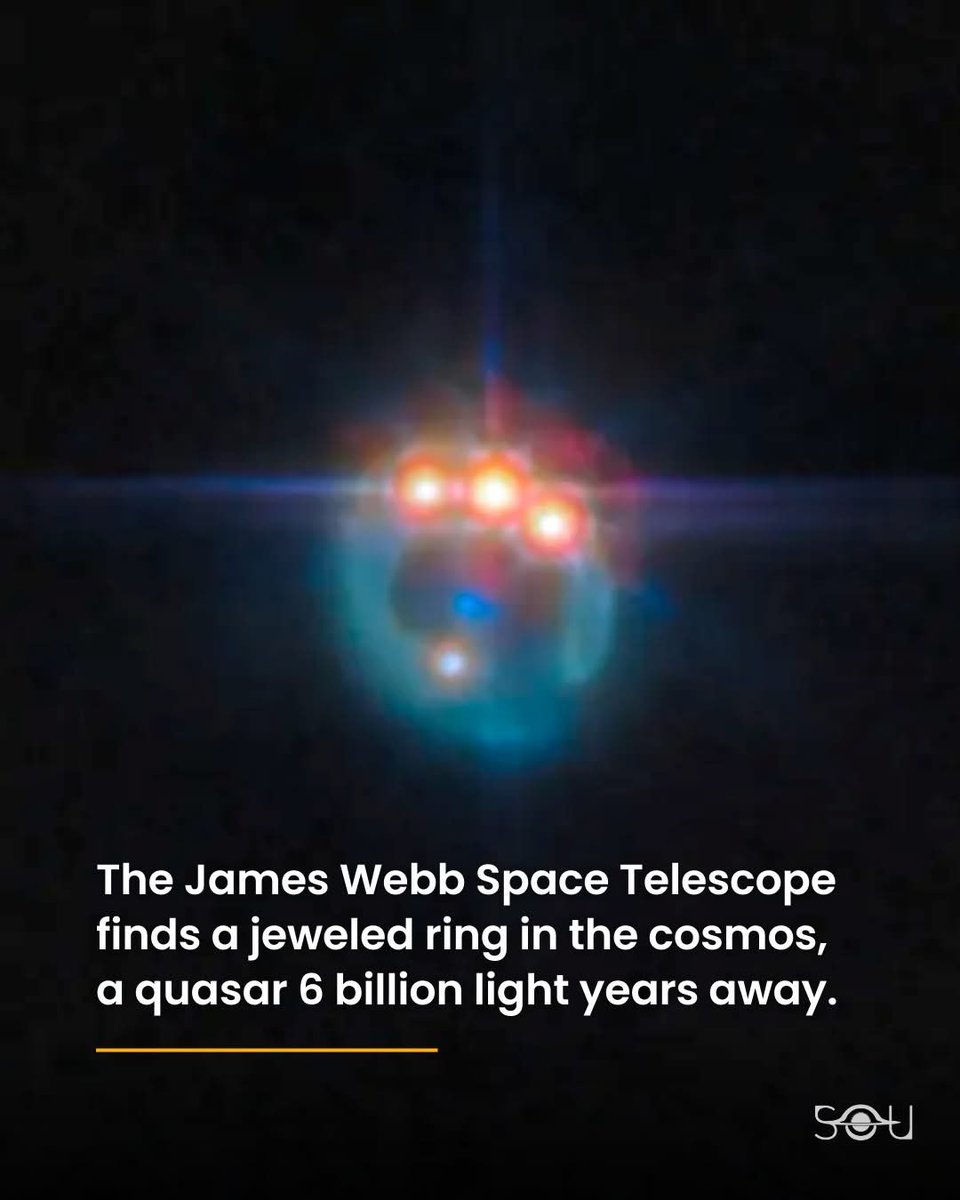
🚨: 💍 The James Webb Space Telescope (JWST) has captured a stunning image of a distant quasar, RX J1131-1231, showcasing a sparkling "jeweled ring" effect created by gravitational lensing. This quasar is located approximately 6 billion light-years from Earth and is an example of an active galactic nucleus (AGN), where a supermassive black hole consumes large amounts of gas and dust, emitting intense radiation. The bright arc and duplicate views of the quasar are the result of the gravitational field of a nearby elliptical galaxy, which warps the light from RX J1131-1231. This phenomenon allows astronomers to study regions close to the black hole that would otherwise be too distant to analyze. At the center of the ring, a small blue dot represents the elliptical galaxy acting as a natural telescope. Its gravitational influence magnifies the light from the quasar, enhancing our ability to observe it. The study of X-ray emissions from quasars can reveal information about the spin of their central black holes. For RX J1131-1231, observations indicate that its black hole is spinning at over half the speed of light. This suggests that it has grown primarily through mergers with other galaxies rather than through random accretion of material. This image is part of a broader study on dark matter and its distribution in the universe. RX J1131-1231 is considered one of the best-lensed quasars discovered to date, providing valuable insights into both gravitational lensing and black hole evolution.