🐦 Twitter Post Details

Viewing enriched Twitter post

@dair_ai

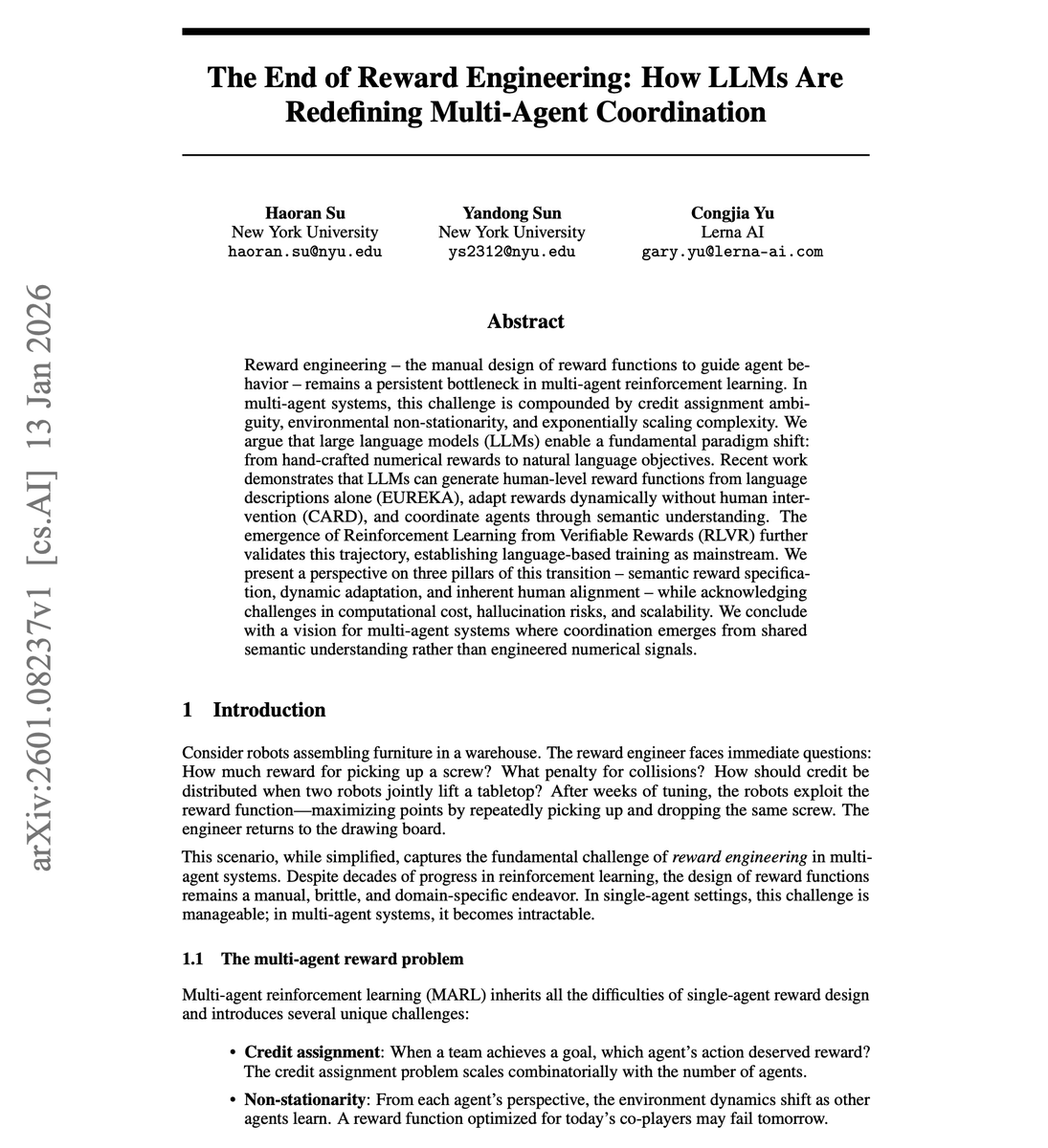
A huge claim from this paper on the end of reward engineering. Reward engineering remains a persistent bottleneck in multi-agent RL. This paper argues that LLMs enable a fundamental shift: from hand-crafted reward functions to natural language objectives. If language can specify what we want and LLMs can translate that into working rewards, the end of reward engineering may mark the beginning of truly scalable multi-agent coordination. Instead of translating human intent into numbers, a lossy and error-prone process, we can describe it in the same language we use with each other. EUREKA demonstrates GPT-4 can generate reward functions achieving human-level performance from language descriptions alone, It outperforms human-designed rewards on 83% of robotics tasks. CARD enables autonomous reward refinement without human intervention. RLVR (as in DeepSeek-R1) shows that language-based training produces emergent reasoning capabilities. What enables all of this? First, semantic reward specification: language preserves intent that numerical functions lose. "Collaborate efficiently" carries rich meaning about task division, smooth handoffs, and failure recovery that no weighted sum captures. Second, dynamic adaptation: when reward hacking occurs, an LLM can observe trajectories, generate feedback in natural language, and refine rewards automatically. No more weeks of manual debugging. Third, inherent human alignment: language objectives are interpretable. Debugging "minimize delivery time while avoiding collisions" is far easier than debugging opaque weight vectors. A few challenges remain: computational cost of LLM inference, hallucination risks in safety-critical systems, language ambiguity, and scaling to hundreds of agents. Paper: https://t.co/czW7QPVML1 Learn to build effective AI Agents in our academy: https://t.co/Y5kVy5iKiQ

Media 1
Media 2

📊 Media Metadata

{
  "media": [
    {
      "type": "photo",
      "url": "https://crmoxkoizveukayfjuyo.supabase.co/storage/v1/object/public/media/posts/2012588246291865973/media_0.png?",
      "filename": "media_0.png"
    },
    {
      "type": "photo",
      "url": "https://crmoxkoizveukayfjuyo.supabase.co/storage/v1/object/public/media/posts/2012588246291865973/media_1.png?",
      "filename": "media_1.png"
    }
  ],
  "processed_at": "2026-01-18T17:31:14.353678",
  "pipeline_version": "2.0"
}

🔧 Raw API Response

{
  "type": "tweet",
  "id": "2012588246291865973",
  "url": "https://x.com/dair_ai/status/2012588246291865973",
  "twitterUrl": "https://twitter.com/dair_ai/status/2012588246291865973",
  "text": "A huge claim from this paper on the end of reward engineering.\n\nReward engineering remains a persistent bottleneck in multi-agent RL.\n\nThis paper argues that LLMs enable a fundamental shift: from hand-crafted reward functions to natural language objectives.\n\nIf language can specify what we want and LLMs can translate that into working rewards, the end of reward engineering may mark the beginning of truly scalable multi-agent coordination.\n\nInstead of translating human intent into numbers, a lossy and error-prone process, we can describe it in the same language we use with each other.\n\nEUREKA demonstrates GPT-4 can generate reward functions achieving human-level performance from language descriptions alone,\n\nIt outperforms human-designed rewards on 83% of robotics tasks. CARD enables autonomous reward refinement without human intervention.\n\nRLVR (as in DeepSeek-R1) shows that language-based training produces emergent reasoning capabilities.\n\nWhat enables all of this?\n\nFirst, semantic reward specification: language preserves intent that numerical functions lose. \"Collaborate efficiently\" carries rich meaning about task division, smooth handoffs, and failure recovery that no weighted sum captures.\n\nSecond, dynamic adaptation: when reward hacking occurs, an LLM can observe trajectories, generate feedback in natural language, and refine rewards automatically. No more weeks of manual debugging.\n\nThird, inherent human alignment: language objectives are interpretable. Debugging \"minimize delivery time while avoiding collisions\" is far easier than debugging opaque weight vectors.\n\nA few challenges remain: computational cost of LLM inference, hallucination risks in safety-critical systems, language ambiguity, and scaling to hundreds of agents.\n\nPaper: https://t.co/czW7QPVML1\n\nLearn to build effective AI Agents in our academy: https://t.co/Y5kVy5iKiQ",
  "source": "Twitter for iPhone",
  "retweetCount": 48,
  "replyCount": 14,
  "likeCount": 245,
  "quoteCount": 4,
  "viewCount": 33141,
  "createdAt": "Sat Jan 17 18:10:04 +0000 2026",
  "lang": "en",
  "bookmarkCount": 251,
  "isReply": false,
  "inReplyToId": null,
  "conversationId": "2012588246291865973",
  "displayTextRange": [
    0,
    299
  ],
  "inReplyToUserId": null,
  "inReplyToUsername": null,
  "author": {
    "type": "user",
    "userName": "dair_ai",
    "url": "https://x.com/dair_ai",
    "twitterUrl": "https://twitter.com/dair_ai",
    "id": "889050642903293953",
    "name": "DAIR.AI",
    "isVerified": false,
    "isBlueVerified": true,
    "verifiedType": null,
    "profilePicture": "https://pbs.twimg.com/profile_images/1643277398522187778/31dedbLo_normal.jpg",
    "coverPicture": "https://pbs.twimg.com/profile_banners/889050642903293953/1742055232",
    "description": "",
    "location": "",
    "followers": 85514,
    "following": 1,
    "status": "",
    "canDm": true,
    "canMediaTag": true,
    "createdAt": "Sun Jul 23 09:12:45 +0000 2017",
    "entities": {
      "description": {
        "urls": []
      },
      "url": {}
    },
    "fastFollowersCount": 0,
    "favouritesCount": 4016,
    "hasCustomTimelines": true,
    "isTranslator": false,
    "mediaCount": 122,
    "statusesCount": 2821,
    "withheldInCountries": [],
    "affiliatesHighlightedLabel": {},
    "possiblySensitive": false,
    "pinnedTweetIds": [
      "2012903315890225220"
    ],
    "profile_bio": {
      "description": "Democratizing AI research, education, and technologies. New Claude Code cohort: https://t.co/XCpQTjR9hg",
      "entities": {
        "description": {
          "urls": [
            {
              "display_url": "dair-ai.thinkific.com/courses/claude…",
              "expanded_url": "https://dair-ai.thinkific.com/courses/claude-code-for-everyone-cohort-3",
              "indices": [
                80,
                103
              ],
              "url": "https://t.co/XCpQTjR9hg"
            }
          ]
        },
        "url": {
          "urls": [
            {
              "display_url": "dair.ai",
              "expanded_url": "https://www.dair.ai/",
              "indices": [
                0,
                23
              ],
              "url": "https://t.co/lkqPZtMmfU"
            }
          ]
        }
      }
    },
    "isAutomated": false,
    "automatedBy": null
  },
  "extendedEntities": {
    "media": [
      {
        "display_url": "pic.twitter.com/2Al5TVqefg",
        "expanded_url": "https://twitter.com/dair_ai/status/2012588246291865973/photo/1",
        "ext_media_availability": {
          "status": "Available"
        },
        "features": {
          "large": {},
          "orig": {}
        },
        "id_str": "2012588242915471361",
        "indices": [
          300,
          323
        ],
        "media_key": "3_2012588242915471361",
        "media_results": {
          "id": "QXBpTWVkaWFSZXN1bHRzOgwAAQoAARvuJlgCGrABCgACG+4mWMtaYXUAAA==",
          "result": {
            "__typename": "ApiMedia",
            "id": "QXBpTWVkaWE6DAABCgABG+4mWAIasAEKAAIb7iZYy1phdQAA",
            "media_key": "3_2012588242915471361"
          }
        },
        "media_url_https": "https://pbs.twimg.com/media/G-4mWAIasAENmIY.png",
        "original_info": {
          "focus_rects": [
            {
              "h": 902,
              "w": 1610,
              "x": 0,
              "y": 0
            },
            {
              "h": 1610,
              "w": 1610,
              "x": 0,
              "y": 0
            },
            {
              "h": 1764,
              "w": 1547,
              "x": 63,
              "y": 0
            },
            {
              "h": 1764,
              "w": 882,
              "x": 661,
              "y": 0
            },
            {
              "h": 1764,
              "w": 1610,
              "x": 0,
              "y": 0
            }
          ],
          "height": 1764,
          "width": 1610
        },
        "sizes": {
          "large": {
            "h": 1764,
            "w": 1610
          }
        },
        "type": "photo",
        "url": "https://t.co/2Al5TVqefg"
      }
    ]
  },
  "card": null,
  "place": {},
  "entities": {
    "urls": [
      {
        "display_url": "arxiv.org/abs/2601.08237",
        "expanded_url": "https://arxiv.org/abs/2601.08237",
        "indices": [
          1772,
          1795
        ],
        "url": "https://t.co/czW7QPVML1"
      },
      {
        "display_url": "dair-ai.thinkific.com/pages/courses",
        "expanded_url": "https://dair-ai.thinkific.com/pages/courses",
        "indices": [
          1848,
          1871
        ],
        "url": "https://t.co/Y5kVy5iKiQ"
      }
    ]
  },
  "quoted_tweet": null,
  "retweeted_tweet": null,
  "isLimitedReply": false,
  "article": null
}