@trajektoriePL
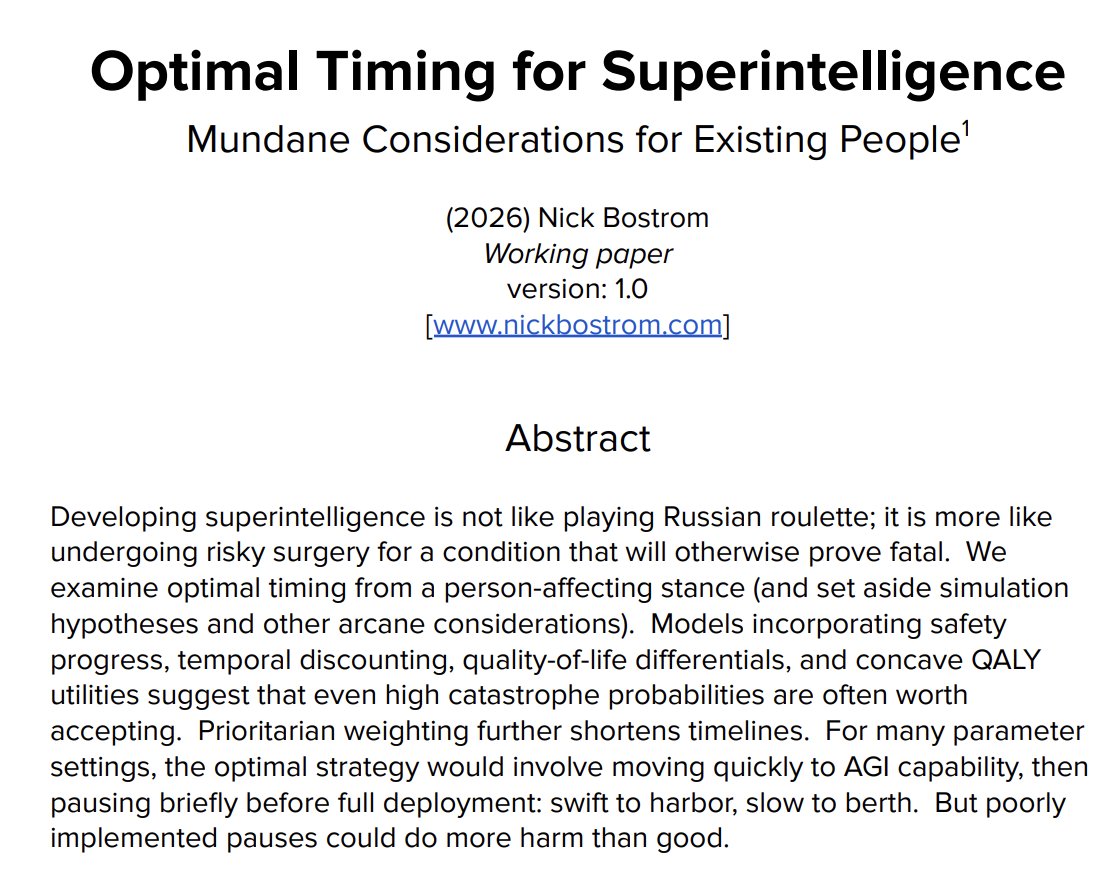
Nick Bostrom’s new paper: >Developing superintelligence is not like playing Russian roulette; it is more like undergoing risky surgery for a condition that will otherwise prove fatal. > One could equally maintain that if nobody builds it, everyone dies. In fact, most people are already dead. The rest of us are on course to follow within a few short decades. For many individuals—such as the elderly and the gravely ill—the end is much closer. Part of the promise of superintelligence is that it might fundamentally change this condition." >Along one path (forgoing superintelligence), 170,000 people die every day of disease, aging, and other tragedies. >The choice before us, therefore, is not between a risk-free baseline and a risky AI venture. It is between different risky trajectories, each exposing us to a different set of hazards. >Imagine curing Alzheimer's disease by regrowing the lost neurons in the patient's brain. Imagine treating cancer with targeted therapies that eliminate every tumor cell but cause none of the horrible side effects of today's chemotherapy. Imagine restoring ailing joints and clogged arteries to a pristine youthful condition. These scenarios become realistic and imminent with superintelligence guiding our science. >We assume that rejuvenation medicine could reduce mortality rates to a constant level similar to that currently enjoyed by healthy 20-year-olds in developed countries, which corresponds to a life expectancy of around 1,400 years. >Developing superintelligence increases our remaining life expectancy provided that the probability of AI-induced annihilation is below 97%.