🐦 Twitter Post Details

Viewing enriched Twitter post

@omarsar0

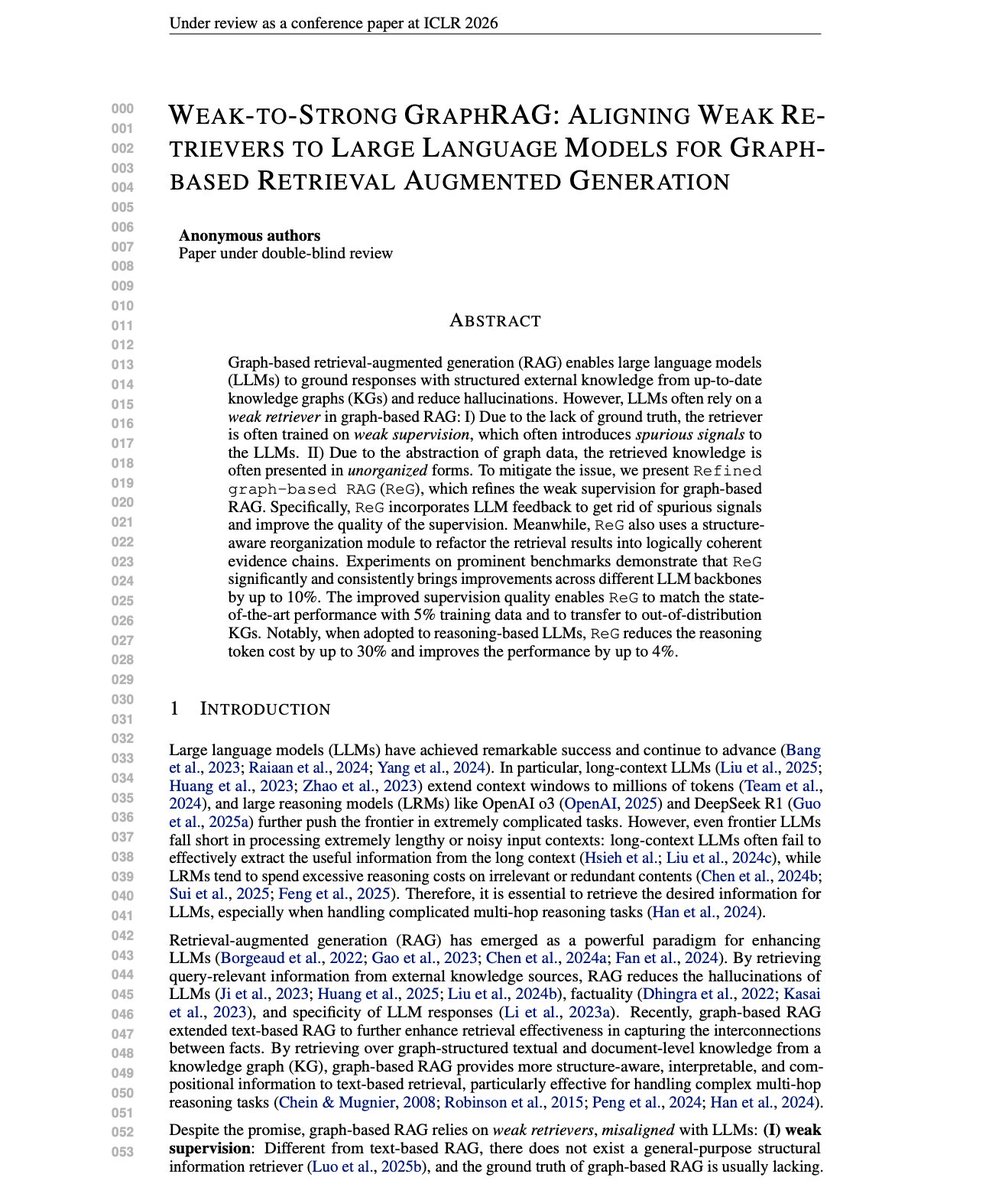
Weak-to-Strong GraphRAG Interesting ICLR 2026 submission with some insights on improving GraphRAG systems and making them more feasible in production environments. Graph-based RAG lets LLMs ground responses in structured knowledge graphs. But there's a fundamental mismatch between retrievers and the LLMs they serve. As knowledge graphs become central to RAG systems, aligning retrievers to LLM needs through LLM feedback offers a principled path to better multi-hop reasoning with lower costs. The problem is twofold. First, graph retrievers train on weak supervision like query-answer shortest paths. This misses key reasoning steps and introduces spurious connections. Second, retrieved knowledge comes back unorganized. LLMs are sensitive to context ordering, and messy graph data adds unnecessary complexity. This new research introduces ReG (Refined Graph-based RAG), a framework that uses LLM feedback to align weak retrievers with the LLMs they serve. Graph-based RAG is essentially a black-box combinatorial search. Given a query, find the minimal sufficient subgraph for correct reasoning. The LLM acts as an evaluator. But exhaustively searching this space is computationally intractable. ReG takes a simpler approach. Instead of optimizing over all possible subgraphs, it utilizes LLMs to select more effective reasoning chains from candidate chains extracted from the knowledge graph. The improved supervision trains better retrievers. A structure-aware reorganization module then refactors retrieval results into logically coherent evidence chains. This aligns the presentation to how LLMs actually process information. On CWQ-Sub with GPT-4o, ReG achieves 68.91% Macro-F1 versus SubgraphRAG's 66.48%. On WebQSP-Sub, 80.08% versus 79.4%. The gains hold across multiple LLM backbones. The data efficiency is notable in the reported experimental results. ReG trained on just 5% of data, matches baselines trained on 80%. The refined supervision eliminates noise that larger datasets would otherwise compound. When paired with reasoning LLMs like QwQ-32B, ReG reduces reasoning tokens by up to 30% while improving performance. The structure-aware reorganization prevents the "overthinking" problem where LRMs produce verbose traces in a noisy context. Paper: https://t.co/mF9sLB63JN
Media 1

📊 Media Metadata

{
  "media": [
    {
      "type": "photo",
      "url": "https://crmoxkoizveukayfjuyo.supabase.co/storage/v1/object/public/media/posts/1999881513220100336/media_0.jpg?",
      "filename": "media_0.jpg"
    }
  ],
  "processed_at": "2025-12-13T16:42:20.972218",
  "pipeline_version": "2.0"
}

🔧 Raw API Response

{
  "type": "tweet",
  "id": "1999881513220100336",
  "url": "https://x.com/omarsar0/status/1999881513220100336",
  "twitterUrl": "https://twitter.com/omarsar0/status/1999881513220100336",
  "text": "Weak-to-Strong GraphRAG\n\nInteresting ICLR 2026 submission with some insights on improving GraphRAG systems and making them more feasible in production environments.\n\nGraph-based RAG lets LLMs ground responses in structured knowledge graphs. But there's a fundamental mismatch between retrievers and the LLMs they serve. As knowledge graphs become central to RAG systems, aligning retrievers to LLM needs through LLM feedback offers a principled path to better multi-hop reasoning with lower costs.\n\nThe problem is twofold.\n\nFirst, graph retrievers train on weak supervision like query-answer shortest paths. This misses key reasoning steps and introduces spurious connections.\n\nSecond, retrieved knowledge comes back unorganized. LLMs are sensitive to context ordering, and messy graph data adds unnecessary complexity.\n\nThis new research introduces ReG (Refined Graph-based RAG), a framework that uses LLM feedback to align weak retrievers with the LLMs they serve.\n\nGraph-based RAG is essentially a black-box combinatorial search. Given a query, find the minimal sufficient subgraph for correct reasoning. The LLM acts as an evaluator. But exhaustively searching this space is computationally intractable.\n\nReG takes a simpler approach. Instead of optimizing over all possible subgraphs, it utilizes LLMs to select more effective reasoning chains from candidate chains extracted from the knowledge graph. The improved supervision trains better retrievers.\n\nA structure-aware reorganization module then refactors retrieval results into logically coherent evidence chains. This aligns the presentation to how LLMs actually process information.\n\nOn CWQ-Sub with GPT-4o, ReG achieves 68.91% Macro-F1 versus SubgraphRAG's 66.48%. On WebQSP-Sub, 80.08% versus 79.4%. The gains hold across multiple LLM backbones.\n\nThe data efficiency is notable in the reported experimental results. ReG trained on just 5% of data, matches baselines trained on 80%. The refined supervision eliminates noise that larger datasets would otherwise compound.\n\nWhen paired with reasoning LLMs like QwQ-32B, ReG reduces reasoning tokens by up to 30% while improving performance. The structure-aware reorganization prevents the \"overthinking\" problem where LRMs produce verbose traces in a noisy context.\n\nPaper: https://t.co/mF9sLB63JN",
  "source": "Twitter for iPhone",
  "retweetCount": 3,
  "replyCount": 0,
  "likeCount": 4,
  "quoteCount": 0,
  "viewCount": 264,
  "createdAt": "Sat Dec 13 16:38:03 +0000 2025",
  "lang": "en",
  "bookmarkCount": 4,
  "isReply": false,
  "inReplyToId": null,
  "conversationId": "1999881513220100336",
  "displayTextRange": [
    0,
    276
  ],
  "inReplyToUserId": null,
  "inReplyToUsername": null,
  "author": {
    "type": "user",
    "userName": "omarsar0",
    "url": "https://x.com/omarsar0",
    "twitterUrl": "https://twitter.com/omarsar0",
    "id": "3448284313",
    "name": "elvis",
    "isVerified": false,
    "isBlueVerified": true,
    "verifiedType": null,
    "profilePicture": "https://pbs.twimg.com/profile_images/939313677647282181/vZjFWtAn_normal.jpg",
    "coverPicture": "https://pbs.twimg.com/profile_banners/3448284313/1565974901",
    "description": "",
    "location": "DAIR.AI Academy",
    "followers": 279206,
    "following": 733,
    "status": "",
    "canDm": true,
    "canMediaTag": true,
    "createdAt": "Fri Sep 04 12:59:26 +0000 2015",
    "entities": {
      "description": {
        "urls": []
      },
      "url": {}
    },
    "fastFollowersCount": 0,
    "favouritesCount": 33912,
    "hasCustomTimelines": true,
    "isTranslator": true,
    "mediaCount": 4377,
    "statusesCount": 16733,
    "withheldInCountries": [],
    "affiliatesHighlightedLabel": {},
    "possiblySensitive": false,
    "pinnedTweetIds": [
      "1999483394963701911"
    ],
    "profile_bio": {
      "description": "Building @dair_ai • Ex Meta AI, Elastic, PhD • New cohort: https://t.co/GZMhf39NRs",
      "entities": {
        "description": {
          "urls": [
            {
              "display_url": "dair-ai.thinkific.com/courses/claude…",
              "expanded_url": "https://dair-ai.thinkific.com/courses/claude-code-for-everyone-2",
              "indices": [
                59,
                82
              ],
              "url": "https://t.co/GZMhf39NRs"
            }
          ],
          "user_mentions": [
            {
              "id_str": "0",
              "indices": [
                9,
                17
              ],
              "name": "",
              "screen_name": "dair_ai"
            }
          ]
        },
        "url": {
          "urls": [
            {
              "display_url": "dair.ai",
              "expanded_url": "https://www.dair.ai/",
              "indices": [
                0,
                23
              ],
              "url": "https://t.co/XQto5ypkSM"
            }
          ]
        }
      }
    },
    "isAutomated": false,
    "automatedBy": null
  },
  "extendedEntities": {
    "media": [
      {
        "display_url": "pic.twitter.com/aeC2lvMXEH",
        "expanded_url": "https://twitter.com/omarsar0/status/1999881513220100336/photo/1",
        "ext_media_availability": {
          "status": "Available"
        },
        "features": {
          "large": {},
          "orig": {}
        },
        "id_str": "1999881509084463104",
        "indices": [
          277,
          300
        ],
        "media_key": "3_1999881509084463104",
        "media_results": {
          "id": "QXBpTWVkaWFSZXN1bHRzOgwAAQoAARvBAaL92gAACgACG8EBo/Ra0PAAAA==",
          "result": {
            "__typename": "ApiMedia",
            "id": "QXBpTWVkaWE6DAABCgABG8EBov3aAAAKAAIbwQGj9FrQ8AAA",
            "media_key": "3_1999881509084463104"
          }
        },
        "media_url_https": "https://pbs.twimg.com/media/G8EBov3aAAAQFMk.jpg",
        "original_info": {
          "focus_rects": [
            {
              "h": 725,
              "w": 1294,
              "x": 0,
              "y": 0
            },
            {
              "h": 1294,
              "w": 1294,
              "x": 0,
              "y": 0
            },
            {
              "h": 1475,
              "w": 1294,
              "x": 0,
              "y": 0
            },
            {
              "h": 1570,
              "w": 785,
              "x": 0,
              "y": 0
            },
            {
              "h": 1570,
              "w": 1294,
              "x": 0,
              "y": 0
            }
          ],
          "height": 1570,
          "width": 1294
        },
        "sizes": {
          "large": {
            "h": 1570,
            "w": 1294
          }
        },
        "type": "photo",
        "url": "https://t.co/aeC2lvMXEH"
      }
    ]
  },
  "card": null,
  "place": {},
  "entities": {
    "urls": [
      {
        "display_url": "openreview.net/forum?id=GtjEL…",
        "expanded_url": "https://openreview.net/forum?id=GtjELGHkPB",
        "indices": [
          2284,
          2307
        ],
        "url": "https://t.co/mF9sLB63JN"
      }
    ]
  },
  "quoted_tweet": null,
  "retweeted_tweet": null,
  "isLimitedReply": false,
  "article": null
}