@michellelsun
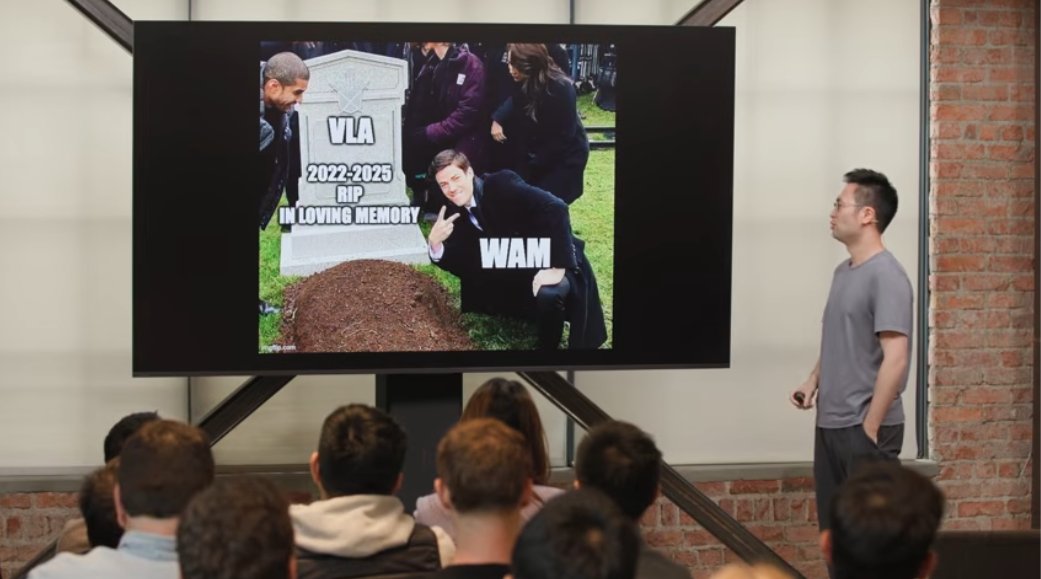
“Rest in Peace, VLAs”, NVIDIA’s robotics lead @DrJimFan said, at the Sequoia’s AI Ascent 2026 conference. So, what’s next? Here’s Jim Fan’s core argument: VLA (Vision Language Action Model) architectures are fundamentally brittle; they merely bolted robotic actions onto LLMs. Instead, the industry is converging on physics-grounded World Models. When it comes to robotics data, sample efficiency and data architecture are replacing brute-force token volume. Look at how the unit economics of data collection just shifted through two recent breakthroughs: - @1x_tech trained its NEO humanoid world model to execute out-of-distribution tasks using just 900 hours of egocentric human video and a mere 70 hours of real robot data (Jan 2026) - @nvidia shipped Cosmos 3, demonstrating that with a strong world foundation model, just 100 teleop seed samples are enough to post-train a complete, action-conditioned forward dynamics pipeline. (Jun 2026) By utilizing world models, robots learn not by memorizing millions of environments, but through an implicit, internalized understanding of physics. Pre-trained world models are now sophisticated enough to execute zero-shot tasks out-of-the-box. They then try them in the wild, and instantly convert those real-world interactions into clean, autonomous training tokens. Instead of racing to collect the most data, the winning recipe is now sample efficiency. And beneath that sits the model architecture that turns the fewest training examples into the most action.