@dair_ai
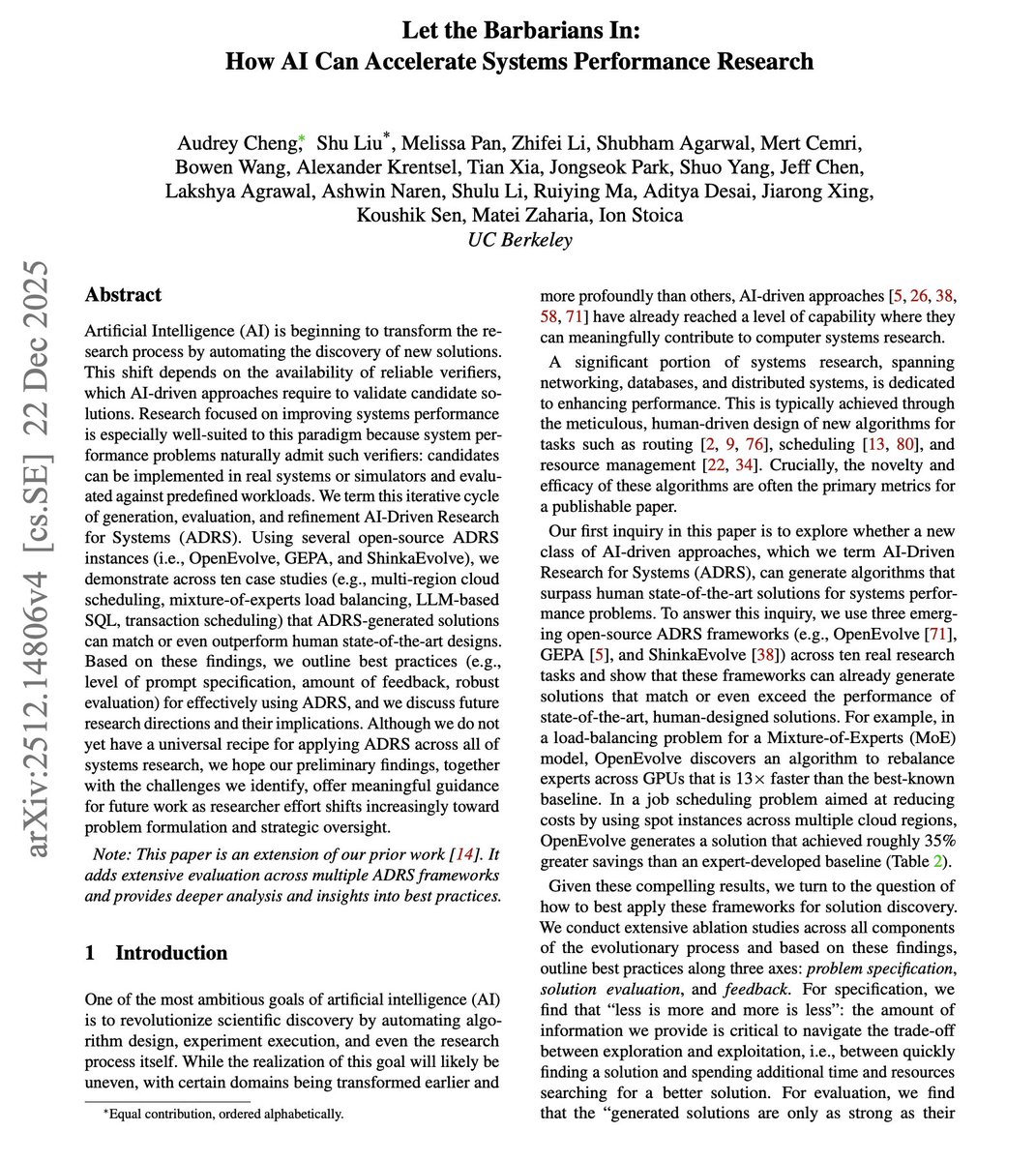
How AI Can Accelerate Systems Performance Research This new research introduces AI-Driven Research for Systems (ADRS), a framework where LLMs iteratively generate, evaluate, and refine algorithms for systems performance problems automatically. The researchers applied three open-source ADRS frameworks (OpenEvolve, GEPA, ShinkaEvolve) across ten real research tasks spanning networking, databases, and distributed systems. What did they find? In MoE load balancing, ADRS discovered an algorithm that's 13x faster than the best-known proprietary implementation. In multi-region cloud scheduling with spot instances, it achieved 35% greater cost savings than an expert-developed baseline. In transaction scheduling, it improved the makespan by 60% over state-of-the-art for the offline case. ADRS borrowed Hamilton's Apportionment method from political science to solve GPU load balancing. It applied Borda Count from voting theory to optimize transaction ordering. It used Kirchhoff's Current Law from electrical engineering to repair network telemetry. The cost? Most tasks completed in under 5 hours for less than $30. Systems problems are uniquely suited for AI-driven research because candidate solutions can be verified automatically. The LLM proposes, the system evaluates. There is no human judgment bottleneck. The researchers outline best practices across three axes: - For specifications: less is more, and more is less. Structured prompts with clear problem definitions, evaluation criteria, and context. - For evaluation: diverse test sets and precise scoring functions prevent reward hacking. - For feedback: calibrated granularity provides actionable guidance without overfitting. As AI takes on algorithm discovery, researcher effort shifts from solution design to problem formulation and strategic oversight. The 40% of research time spent on solution iteration can now be automated, fundamentally changing how systems research is done. Paper: https://t.co/YKcVKuku4P Learn to build effective AI agents in our academy: https://t.co/zQXQt0PMbG