@omarsar0
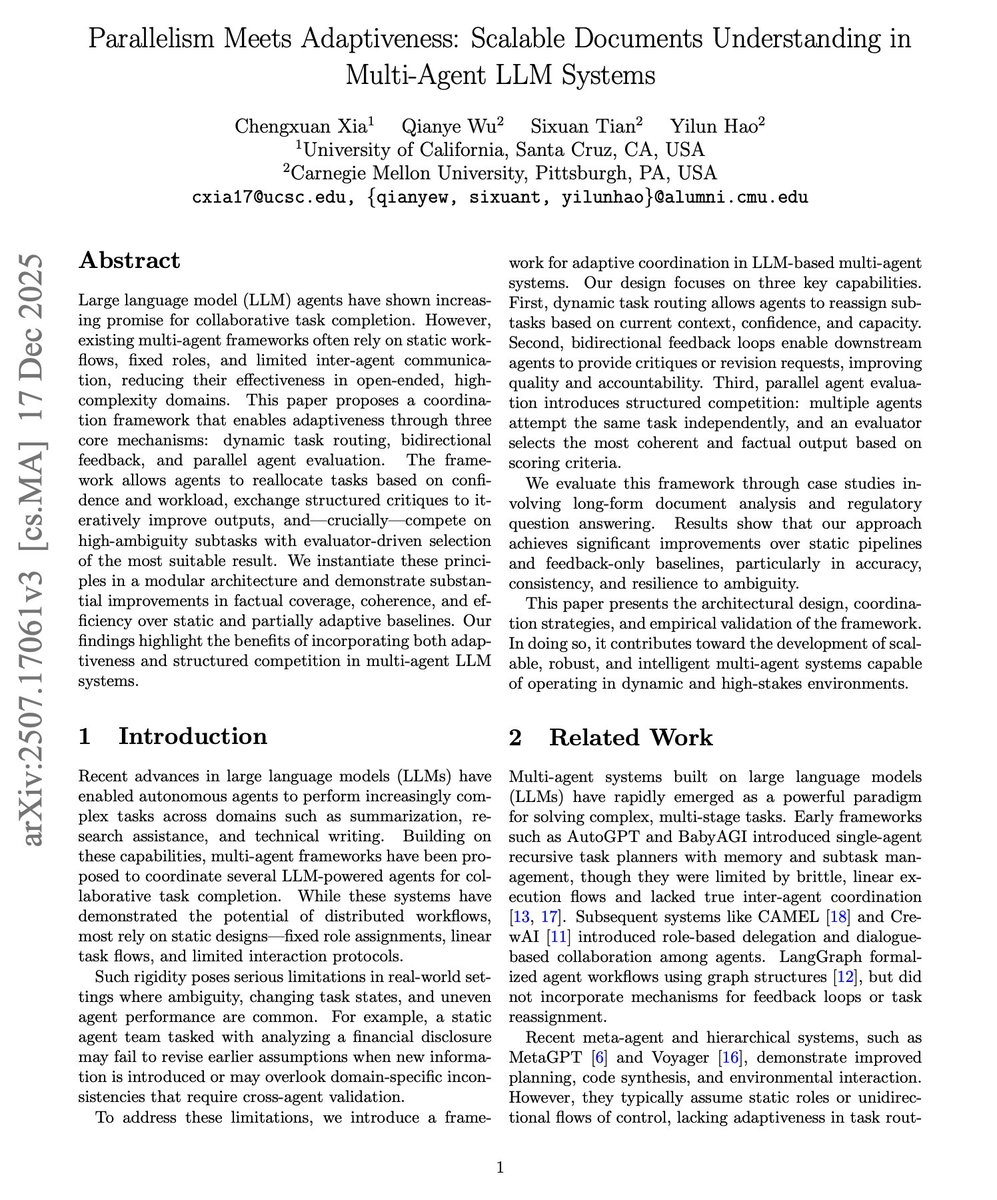
Neat ideas to improve multi-agent LLM systems. Most frameworks rely on static workflows: fixed role assignments, linear task flows, and limited communication between agents. When tasks involve ambiguity, changing context, or uneven agent performance, rigid pipelines break down. An agent analyzing a financial disclosure might miss new information that contradicts earlier assumptions. Factual errors propagate downstream without correction. This new research introduces an adaptive coordination framework with three core mechanisms: 1) Dynamic routing: This allows agents to reassign subtasks at runtime based on confidence, complexity, or workload. An agent encountering a technical legal paragraph can defer to a compliance-focused peer instead of producing a subpar result. 2) Bidirectional feedback: Enables downstream agents to issue revision requests upstream. A QA agent detecting an inconsistency between two document sections can trigger clarification from the summarization agent, preventing error propagation. 3) Parallel agent evaluation: For high-ambiguity tasks, multiple agents tackle the same subtask independently. An evaluator scores each output on factual correctness, coherence, and relevance, then selects the best result for downstream use. On the SEC 10-K analysis, the full system achieved 92% factual coverage and 94% compliance accuracy, compared to 71% and 74% for static baselines. Revision rates dropped by 74%. Redundancy penalties fell by 73%. Human coherence ratings improved from 3.2 to 4.7 on a 5-point scale. The ablation study revealed shared memory and feedback loops as the most critical components. Removing either caused coverage and coherence to drop by over 20%. Paper: https://t.co/x86kb54zQD Learn to build effective AI Agents in my academy: https://t.co/JBU5beIoD0