@omarsar0
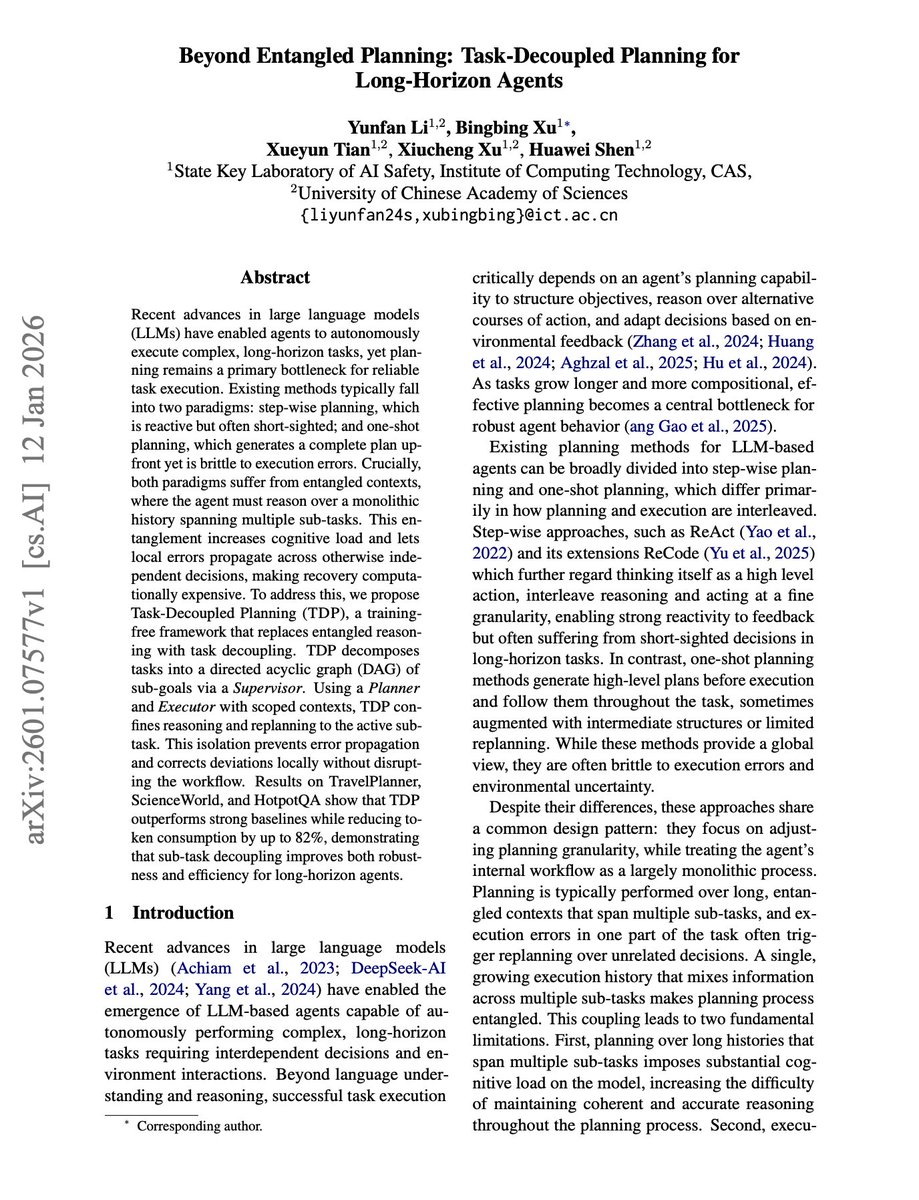
The better the plan, the better your agents perform. Long-horizon agents break not because they can't plan. They break because they plan over entangled contexts. The default approach to LLM agent planning falls into two camps. Step-wise planning (like ReAct) interleaves reasoning and acting but makes short-sighted decisions. One-shot planning generates complete plans upfront but becomes brittle when execution errors occur. But both share the same flaw: a single, growing execution history that mixes information across multiple sub-tasks. This new research introduces Task-Decoupled Planning (TDP), a training-free framework that replaces entangled reasoning with explicit task decoupling. How does it work? A Supervisor decomposes tasks into a directed acyclic graph (DAG) of sub-goals. A Planner and Executor then operate with scoped contexts, reasoning only over the active sub-task. This reminds me of the new blog published by Cursor, which uses a similar tactic where planning is decoupled. When something goes wrong, replanning stays local. Independent decisions remain untouched. Isolating context, decisions, and error correction at the sub-task level prevents local failures from cascading across the entire workflow. On TravelPlanner, TDP achieves the highest hard-constraint micro pass rate (32.5%) under DeepSeek-V3.2. On HotpotQA, it reaches 85.88% delivery accuracy. On ScienceWorld, it matches or exceeds strong baselines across both GPT-4o and DeepSeek models. TDP reduces token consumption by up to 82% compared to Plan-and-Act while improving task outcomes. On HotpotQA, it uses just 1,747 output tokens versus 9,929 for the baseline. Fewer tokens, better results. Sub-task decoupling offers a unified mechanism that works across heterogeneous demands like multi-hop reasoning, interactive environments, and constraint-heavy tool planning. You get all of this without sacrificing performance or efficiency. Paper: https://t.co/0hOsV3wFsZ Learn to build effective AI agents in our academy: https://t.co/JBU5beIoD0