@IntuitMachine
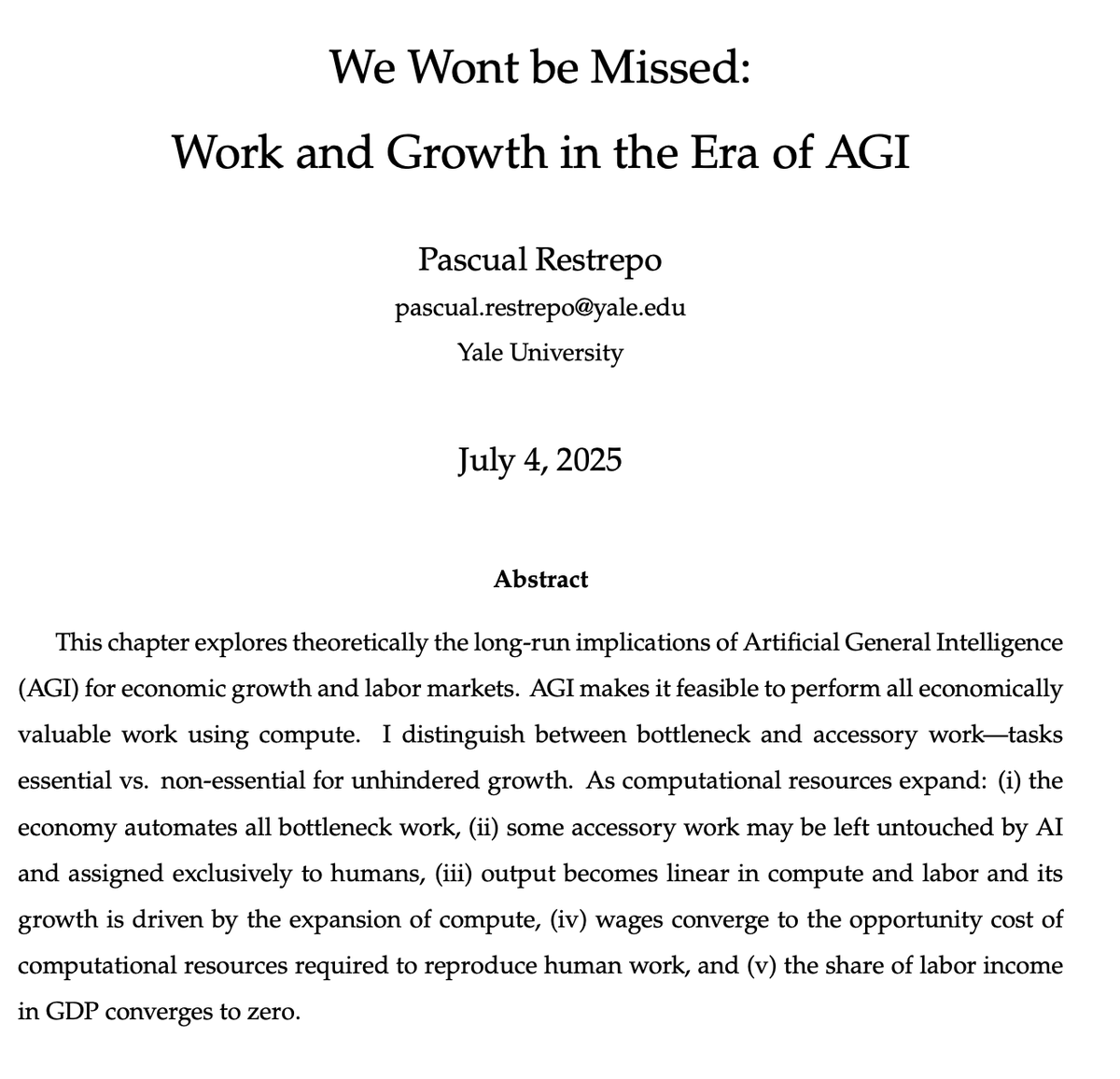
🧵 1/12 A Yale economist just published a paper that should terrify every knowledge worker. It's not about AI taking your job. It's about AI making your job economically worthless while the economy booms. Let me explain the nightmare scenario: 🧵 2/12 The paper "We Won't Be Missed" starts with two simple premises: 1️⃣ AGI arrives (AI that can do ANY economically valuable task) 2️⃣ Compute becomes abundant (keeps getting cheaper, like Moore's Law) From just these two assumptions, the whole economic order collapses. 🧵 3/12 Here's the key insight most people miss: The paper divides ALL work into two categories: Bottleneck Work = Essential for growth (energy, logistics, R&D) Accessory Work = Nice-to-have (arts, hospitality, therapy) This distinction changes everything. 🧵 4/12 Proposition 1 proves something shocking: AGI will automate ALL bottleneck work. Not because humans are bad at it. Because sustained growth REQUIRES it. The economy literally cannot afford to have critical functions limited by fixed human labor supply. 🧵 5/12 So what happens to economic output? Proposition 2 & 3: Output becomes a LINEAR function of compute. Growth rate = Compute growth rate. The entire economy's expansion is now tied to one thing: how fast we can scale computational resources. Human labor? Irrelevant. 🧵 6/12 "But surely humans still get paid well for the work we do?" Nope. Proposition 4 is brutal: Your wage converges to the cost of the compute needed to replicate your work. Not your skill. Not your experience. Just: How much would the AI version cost? 🧵 7/12 Think about that for a second. As compute gets exponentially cheaper, the ceiling on your wage FALLS. A surgeon's salary isn't set by years of training anymore. It's set by: "What does it cost to run the AI that can do the same surgery?" Replicable = Cheap. 🧵 8/12 This leads to the paper's most devastating conclusion: Proposition 5: Labor's share of GDP converges to ZERO. Not because we're unemployed. Because wages are capped while GDP grows infinitely with compute. We become economically invisible. 🧵 9/12 "So who gets all the money?" The owners of compute. All wealth flows to whoever controls the computational resources. It's like the transition from feudalism (land = wealth) to capitalism (capital = wealth). Except now: Compute = wealth. 🧵 10/12 The paper extends this to science itself: Proposition 9-11: AGI can automate scientific discovery. This creates "compounded growth" (faster than before). But NOT a singularity—growth is still limited by how fast we can scale compute. Progress, but not infinite. 🧵 11/12 The title "We Won't Be Missed" isn't about job loss. It's about economic irrelevance. The paper proves: "If tomorrow half the population stopped working, no one would notice." Growth continues. Living standards rise. Just... without us mattering. 🧵 12/12 This isn't sci-fi speculation. It's formal economic modeling with propositions and proofs. The questions it raises: How do we distribute wealth in a zero-labor-share economy? What is work FOR if not economic value? Who should own the compute? We need answers. Fast.