@dair_ai
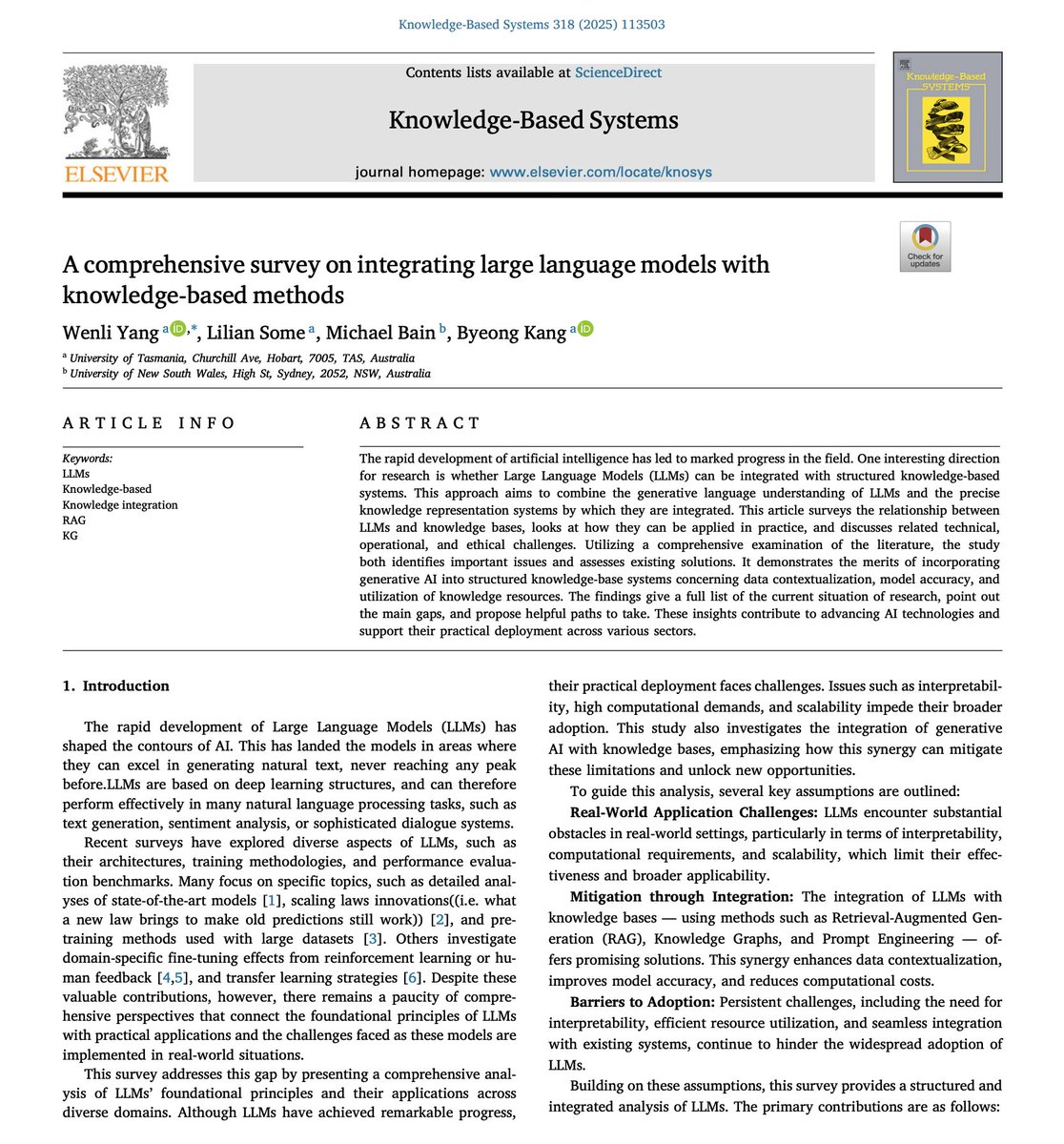
Integrating LLMs with knowledge bases. Important read for AI practitioners LLMs generate impressive text but struggle with hallucinations, outdated knowledge, and reasoning over structured data. The default response has been scaling up (e.g., more parameters, more compute, more cost). But bigger models don't solve the fundamental problem: LLMs lack reliable access to external, verifiable knowledge. This new survey examines how RAG, Knowledge Graphs, and hybrid approaches address these limitations. The key insight: integration happens at three levels: - Level 1 focuses on retrieval, getting the right information into the model. - Level 2 addresses reasoning, synthesizing retrieved knowledge for complex tasks. - Level 3 handles optimization, adapting systems for domain-specific needs. KAG showed 19.1% exact match improvement over basic RAG on HotpotQA. Think-on-Graph achieved significant accuracy gains over Chain-of-Thought on complex QA. The practical applications span finance, medicine, and code generation. FinAgent combines RAG with reinforcement learning for trading decisions. UMLS integration improves diagnostic accuracy in medical AI. Codex leverages retrieval to enhance code generation quality. Knowledge drift requires continuous updates, domain-specific representations don't always align with LLM embeddings, and standardized evaluation benchmarks are still lacking. The path to reliable LLMs isn't just scale. It's thoughtful integration with structured knowledge that provides factual grounding and enables complex reasoning. Paper: https://t.co/vl8ZPf4ncA Learn to build RAG and AI agents in our academy: https://t.co/zQXQt0PMbG