@rohanpaul_ai
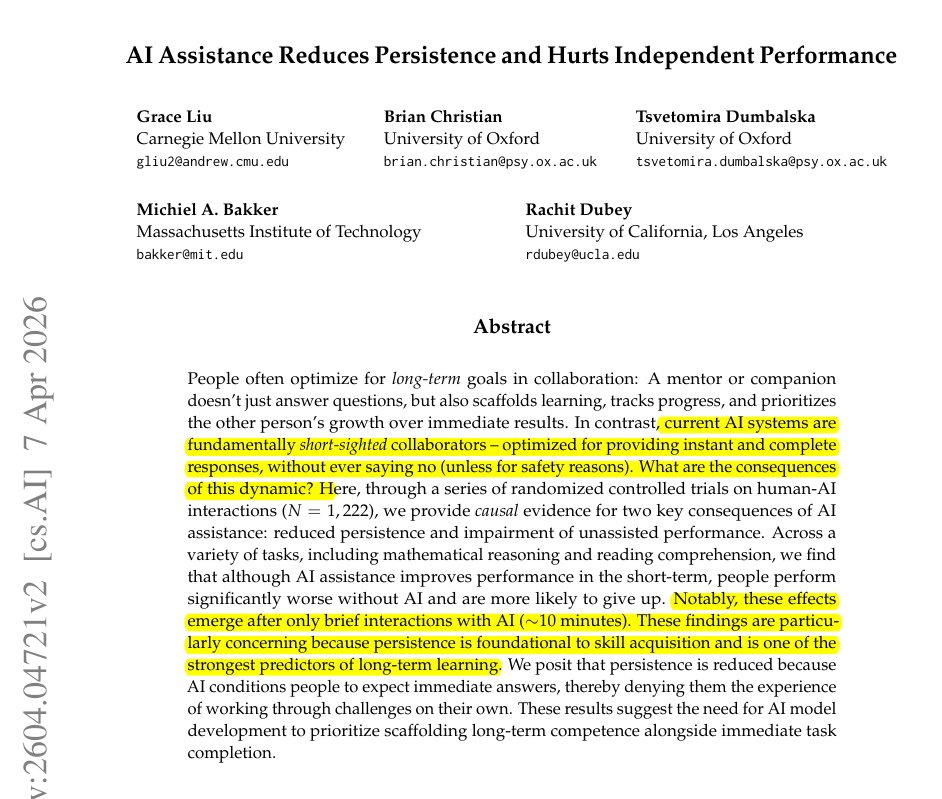
BIG claim from new MIT + Oxford + Carnegie Mellon and other top labs paper: AI can boost performance at first and then leave people less able to think through problems on their own. Just minutes of AI help can improve scores now while weakening independent problem-solving right after. The interesting part is that the damage is not just lower accuracy. It is lower persistence, which is usually the hidden engine of learning, because skill grows through repeated contact with difficulty, not just exposure to correct answers. That's why a good teacher sometimes withholds help to preserve struggle as part of the lesson, while today’s chatbots are tuned to erase friction on demand. Across 3 experiments in math and reading, about 1.2K people either worked alone or used a GPT-5-based assistant for part of the task. Assisted users finished early questions faster, but after roughly 10 minutes without AI, they solved less, stalled more, and quit sooner. That happens because hard thinking is not only about getting answers; it is also about building the habit of holding a problem in mind, testing steps, and pushing through confusion. The sharpest drop came from people who used the model for direct answers, not from those who used it more like a hint system, which suggests the real issue is not AI exposure itself but replacing effort with completion. The result is not that AI makes people less capable by default, but that answer outsourcing can shrink the mental effort that normally trains skill. ---- Paper Link – arxiv. org/abs/2604.04721 Paper Title: "AI Assistance Reduces Persistence and Hurts Independent Performance"