@victorialslocum
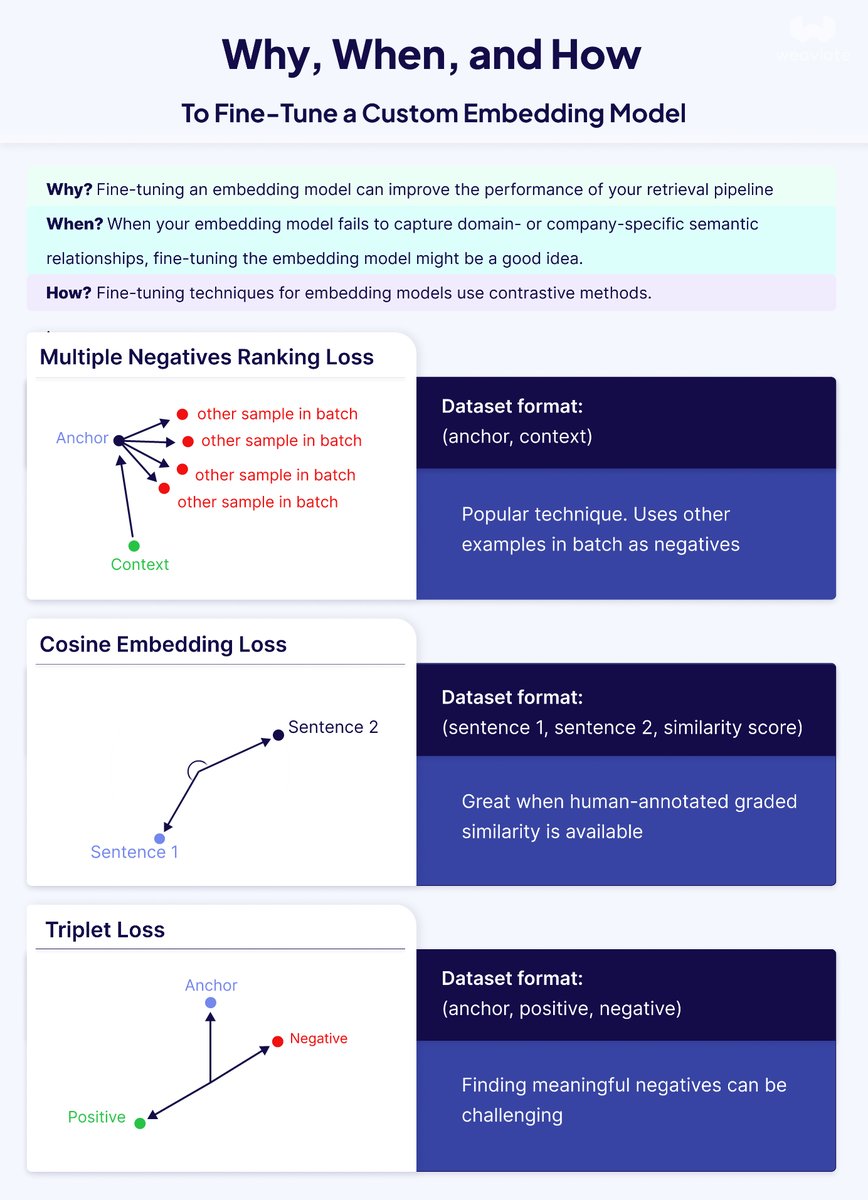
"Just fine-tune your embeddings" they said. "It'll fix your RAG system" they said. They were wrong. Here's what actually works: After working with countless retrieval systems, I've noticed a pattern: teams often jump straight to fine-tuning when their vector search underperforms. But that's like replacing your car engine when you might just need better tires. 𝗙𝗶𝗿𝘀𝘁, 𝗱𝗲𝗯𝘂𝗴 𝗯𝗲𝗳𝗼𝗿𝗲 𝘆𝗼𝘂 𝗳𝗶𝗻𝗲-𝘁𝘂𝗻𝗲: Before spending time and compute on fine-tuning, ask yourself: • Do many queries need exact keyword matches? → Try hybrid search first • Are your chunks oddly split or lacking context? → Experiment with different chunking techniques like late chunking • Is the model missing general semantic relationships? → Try a larger model or one with more dimensions • Is it only failing on your specific domain terminology? → NOW we're talking fine-tuning territory 𝗪𝗵𝗲𝗻 𝗳𝗶𝗻𝗲-𝘁𝘂𝗻𝗶𝗻𝗴 𝗺𝗮𝗸𝗲𝘀 𝘀𝗲𝗻𝘀𝗲: Fine-tuning shines when off-the-shelf models can't grasp your domain-specific language. Pre-trained models learn from Wikipedia and web crawls - they don't know your company's product names or industry jargon. The payoff can be substantial: • Better retrieval = better RAG performance • Smaller fine-tuned models can outperform larger general ones • Lower costs and latency for domain-specific tasks 𝗧𝗵𝗲 𝘁𝗲𝗰𝗵𝗻𝗶𝗰𝗮𝗹 𝗱𝗲𝗲𝗽-𝗱𝗶𝘃𝗲: Fine-tuning embedding models isn't like fine-tuning LLMs. It's all about adjusting distances in vector space using contrastive learning. Three main approaches: 1. 𝗠𝘂𝗹𝘁𝗶𝗽𝗹𝗲 𝗡𝗲𝗴𝗮𝘁𝗶𝘃𝗲𝘀 𝗥𝗮𝗻𝗸𝗶𝗻𝗴 𝗟𝗼𝘀𝘀: Just needs query-context pairs. Treats other examples in the batch as negatives - elegant and popular 2. 𝗧𝗿𝗶𝗽𝗹𝗲𝘁 𝗟𝗼𝘀𝘀: Requires (anchor, positive, negative) triplets. Great for precise control but finding good hard negatives is tricky 3. 𝗖𝗼𝘀𝗶𝗻𝗲 𝗘𝗺𝗯𝗲𝗱𝗱𝗶𝗻𝗴 𝗟𝗼𝘀𝘀: Uses similarity scores between sentence pairs. Perfect when you have gradients of similarity 𝗣𝗿𝗮𝗰𝘁𝗶𝗰𝗮𝗹 𝗰𝗼𝗻𝘀𝗶𝗱𝗲𝗿𝗮𝘁𝗶𝗼𝗻𝘀: • Start with 1,000-5,000 high-quality samples for narrow domains • Plan for 10,000+ for complex specialized terminology • Good news: fine-tuning can run on consumer GPUs or free Google Colab for smaller models • Always evaluate against a baseline - use metrics like MRR, Recall@k, or NDCG 𝗣𝗿𝗼 𝘁𝗶𝗽: The MTEB leaderboard is your friend for finding base models, but remember - leaderboard performance doesn't always translate to your specific use case. The bottom line? Fine-tuning is powerful but it's not a magic bullet. Sometimes your retrieval problems need a different solution entirely. Debug systematically, and when you do fine-tune, start small and iterate. Check out the full technical blog - it includes code examples for both Hugging Face and AWS SageMaker integrations: https://t.co/PH1djlDFDt