@Shaughnessy119
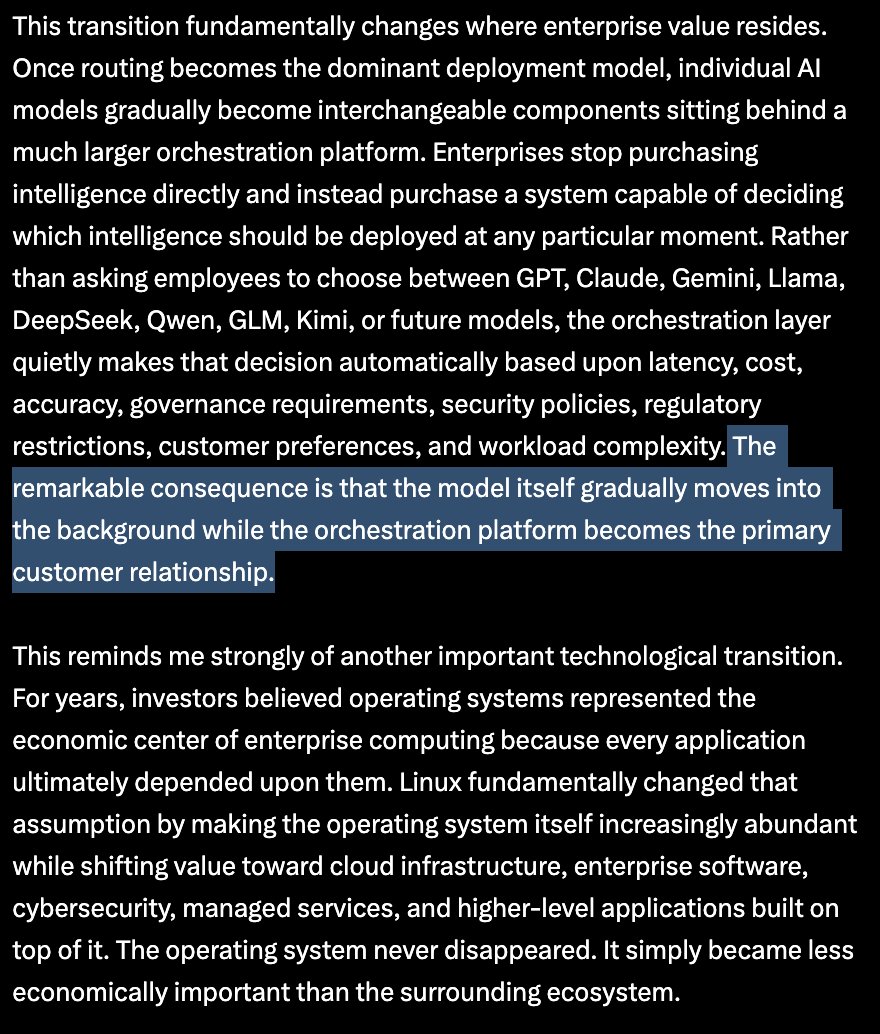
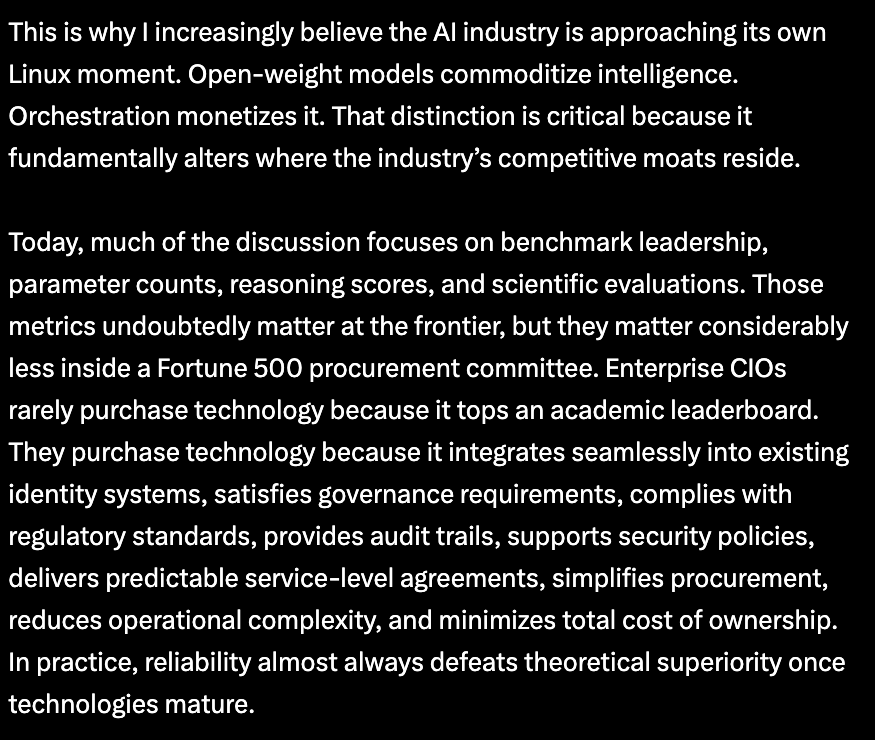
One of the best AI takes I’ve read in a long time I strongly agree with @rickyho_1989 that enterprises will optimize for the best intelligence per dollar, not loyalty to any one lab, and that durable value moves toward the orchestration layer To me this is bullish AWS, Google via Gemini and Vertex, and Microsoft on the AI infra side and bullish @NousResearch Hermes Agent on the orchestration side The AI switching cost is not just the model, it is the orchestration layer where the actual work compounds: memory, tools, credentials, evals, approvals, budgets, routing, observability, security, compliance, identity, audit trails and execution history. Models get swapped constantly based on quality, cost, latency and policy. The harness is what makes that possible without rebuilding the enterprise’s operating context every time. The second order unlock is that the harness captures traces, tool outcomes, eval failures and human approvals, which become the feedback loop for better agents, better routing and better company specific models. This is why I think Hermes Agent is attacking such an important layer. Enterprises do not want to be locked into one AI lab forever. They want GPT for one task, Claude for another, Qwen or DeepSeek for cheaper work, company specific models where they fit best, and self hosted/private deployment where control matters. The winning agent platform is not one model to rule them all. It is the open control plane where model choice, tools, workflows, governance and spend live in one place. Why use Nous vs other AI lab or hyperscaler harnesses? Because enterprises do not just want model choice inside another walled garden. They want model choice plus control over the agent state itself. They can mix/match models at will, literally type /model and switch, while controlling memory, tools, credentials, data, policies, evals, approvals and audit trails. If the entire stack becomes a moat for the business, they will want to own it and swap models at will to achieve the best cost/performance. This is where open source and the Red Hat and Linux analogy shines. Open models commoditize intelligence. The orchestration layer monetizes the work.