@omarsar0
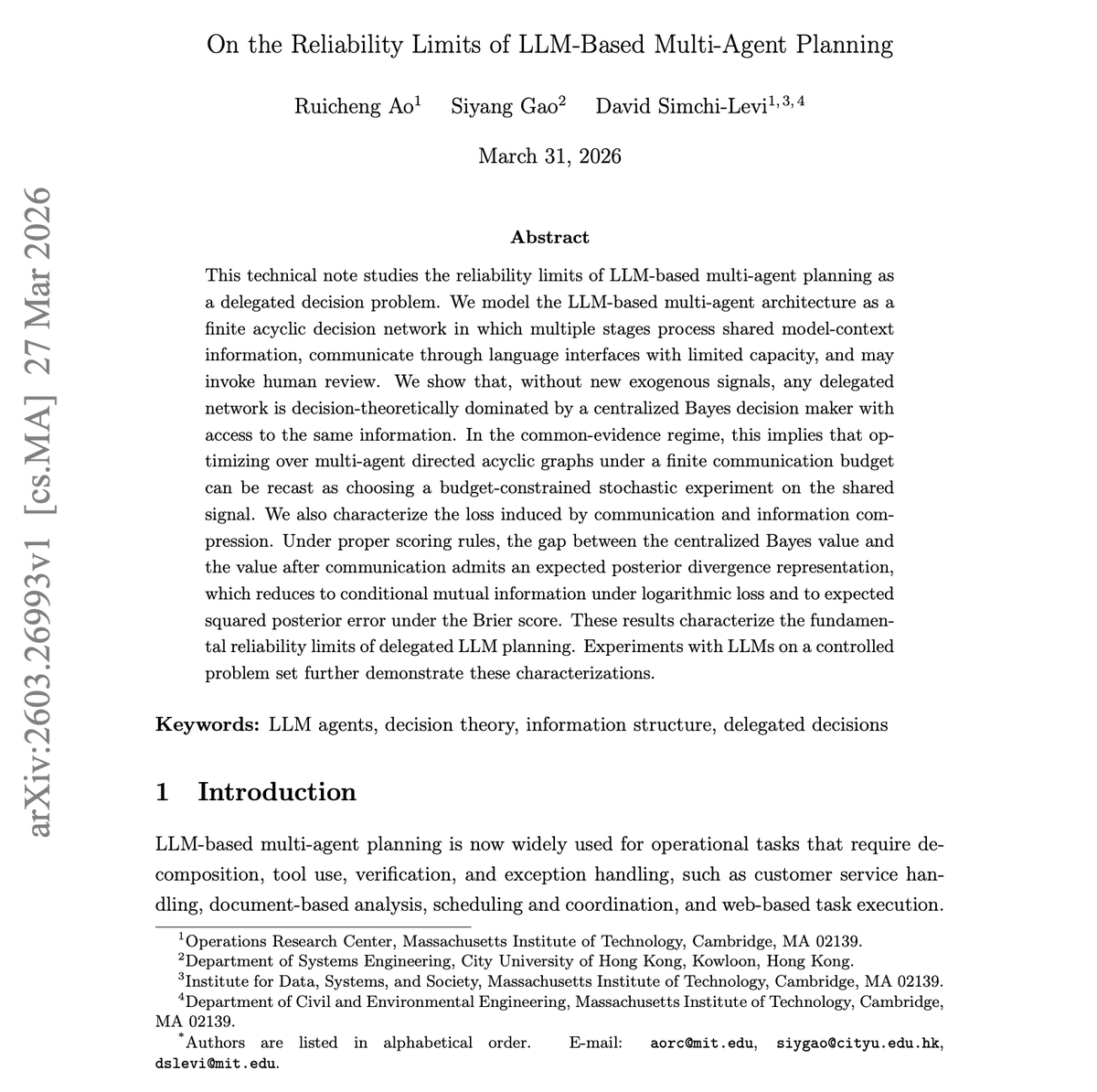
Most devs think that adding more agents to a planning system should help. The math says otherwise. New theoretical work from MIT proves fundamental limits on what multi-agent LLM architectures can achieve. The work models LLM multi-agent planning as finite acyclic decision networks where stages communicate through language interfaces with limited capacity. The key result: without new exogenous signals, any delegated multi-agent network is decision-theoretically dominated by a centralized Bayes decision maker with access to the same information. The information loss from communication and compression can be precisely characterized through expected posterior divergence. Why does it matter? This is a foundational constraint for anyone designing multi-agent systems. Splitting a task across agents introduces information loss that no prompt engineering can recover. Multi-agent architectures only help when agents access genuinely different information sources, not when they subdivide shared context. Paper: https://t.co/ml60RoNVcA Learn to build effective AI agents in our academy: https://t.co/1e8RZKs4uX