@SakanaAILabs
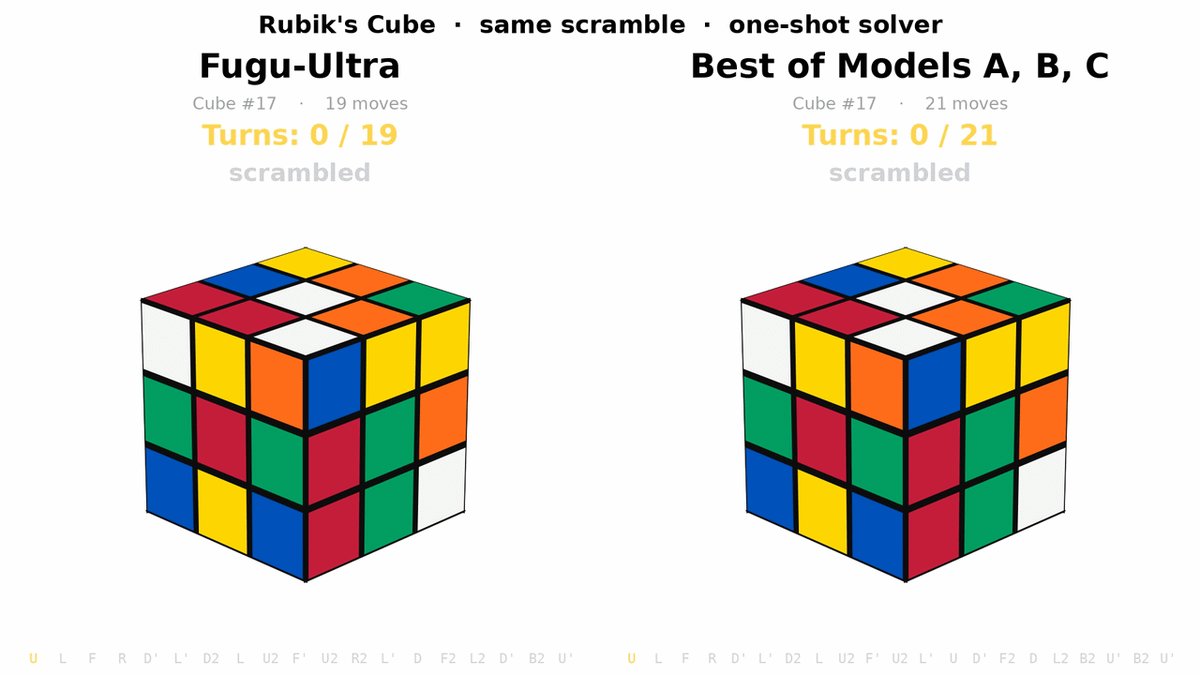
Use Case 5: Rubik’s Cube Solver Can an AI write complex algorithmic solvers from scratch? We tasked Fugu Ultra and three frontier models with writing a Rubik’s Cube solver in pure Python from a single prompt. No off-the-shelf solving libraries were allowed. We then ran the resulting programs locally on 300 randomly scrambled cubes. In this example, Fugu Ultra’s solver reaches the goal in 19 moves compared to Model A (best of the three models)’s 21 moves. The Results: • Fugu Ultra and Model A generated solvers that successfully ran and solved all 300 cubes. • Models B and C shipped sophisticated-looking code that completely crashed on execution (0/300). • Fugu Ultra was strictly more efficient, averaging 19.72 moves versus Model A’s 19.76, and never requiring a single move more than Model A across all 300 scrambles. For code generation that actually executes and optimizes for efficiency, dynamically orchestrating multiple agents beats relying on a single monolithic model.