@DavidSacks
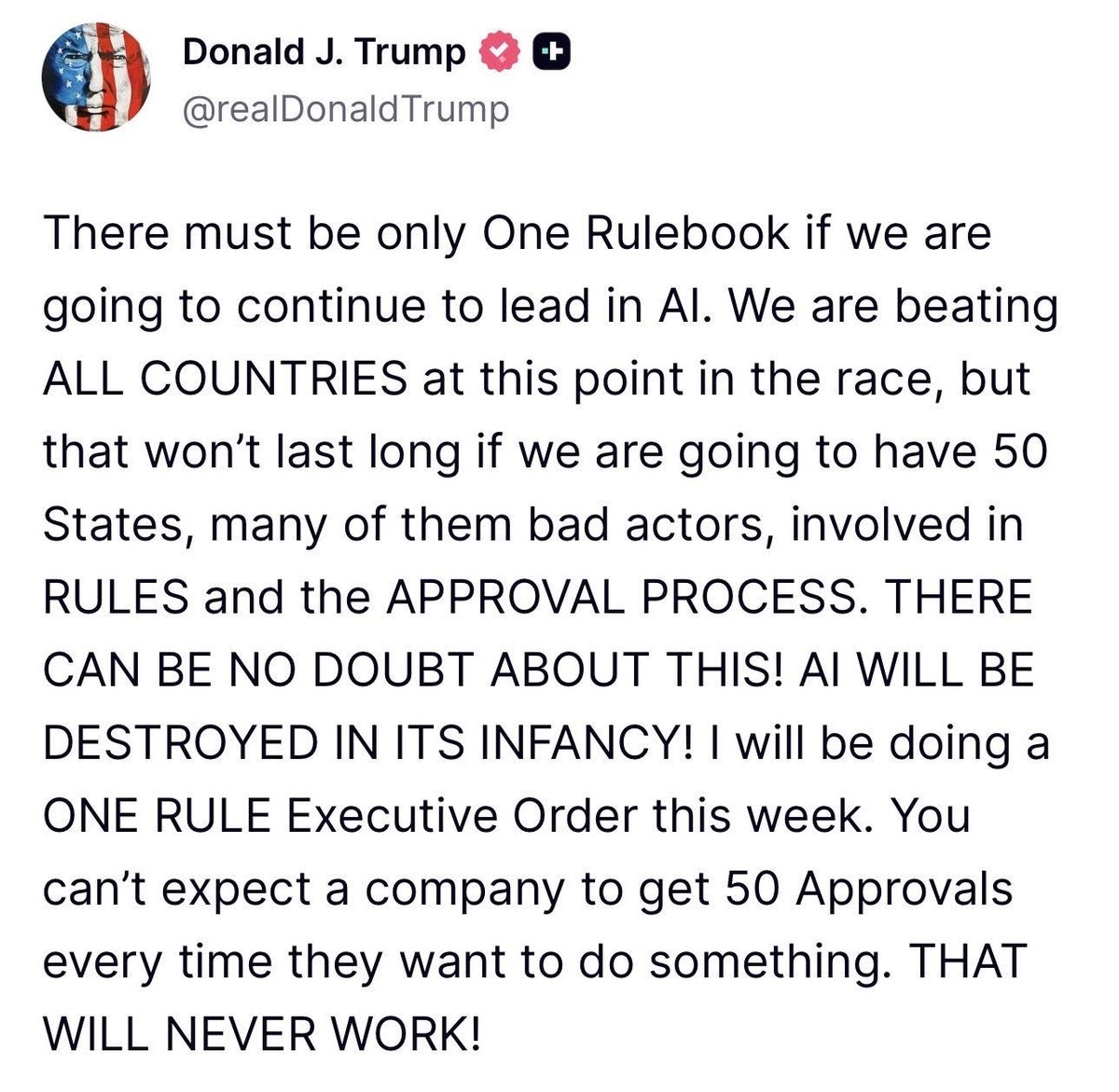
ONE RULEBOOK FOR AI I wanted to share a few thoughts on AI preemption and address some of the concerns. First, this is not an “AI amnesty” or “AI moratorium.” It is an attempt to settle a question of jurisdiction. When an AI model is developed in state A, trained in state B, inferenced in state C, and delivered over the internet through national telecommunications infrastructure, that is clearly interstate commerce, and exactly the type of economic activity that the Framers of the Constitution intended to reserve for the federal government to regulate. In the absence of preemption, 50 different states will assert their jurisdiction, creating a patchwork of 50 different regulatory regimes, often in contradiction with each other. Indeed this is already happening. Over 1,200 bills have been introduced in state legislatures, and over 100 measures have already passed. For example, states like Colorado, California and Illinois have made AI developers liable if their models contribute to “algorithmic discrimination,” which is defined as having a “disparate impact” on a protected group. Colorado's list of protected groups even includes English language proficiency, so presumably it’s against the law for an AI model to criticize illegal aliens. This type of ideological meddling is how we ended up with “black George Washington.” This can’t be allowed. AI models should strive for the truth and be ideologically unbiased. Only a federal framework can achieve this goal. The attempts of Red States to protect conservatives from bias and discrimination (a worthy goal) will have limited effectiveness when Blue States like California have the most market power and nexus to AI development. At best, we’ll end up with 50 different AI models for 50 different states – a regulatory morass worse than Europe. This will stymie innovation, especially by small startups who can’t afford the compliance burden. Meanwhile, China will race ahead. We can’t afford this. As President Trump truthed today, we need One Rulebook for AI. But what about the 4 C’s? Let me address those concerns: 1. Child safety - Preemption would not apply to generally applicable state laws. So state laws requiring online platforms to protect children from online predators or sexually explicit material (CSAM) would remain in effect. 2. Communities - AI preemption would not apply to local infrastructure. That’s a separate issue. In short, preemption would not force communities to host data centers they don’t want. 3. Creators - Copyright law is already federal, so there is no need for preemption here. Questions about how copyright law should be applied to AI are already playing out in the courts. That’s where this issue will be decided. 4. Censorship - As mentioned, the biggest threat of censorship is coming from certain Blue States. Red States can’t stop this – only President Trump’s leadership at the federal level can. In summary, we’ve heard the concerns about the 4 C’s, and the 4 C’s are protected. But there is a 5th C that we all need to care about: competitiveness. If we want America to win the AI race, a confusing patchwork of regulation will not work. As President Trump wrote today: “There must be only One Rulebook if we are going to continue to lead in Al. We are beating ALL COUNTRIES at this point in the race, but that won't last long if we are going to have 50 States, many of them bad actors, involved in RULES and the APPROVAL PROCESS.” To this end, President Trump has indicated that he will sign an Executive Order this week. This Order will provide the tools necessary for the federal government to push back against the most onerous and excessive state regulation. At the same time, the Administration will continue to work with Congress to define a federal framework that can be enacted through legislation. Thank you to President Trump for his extraordinary vision and leadership on AI and for looking out for the interests of the entire country, as the Framers of the Constitution intended and as only the President of the United States can do.